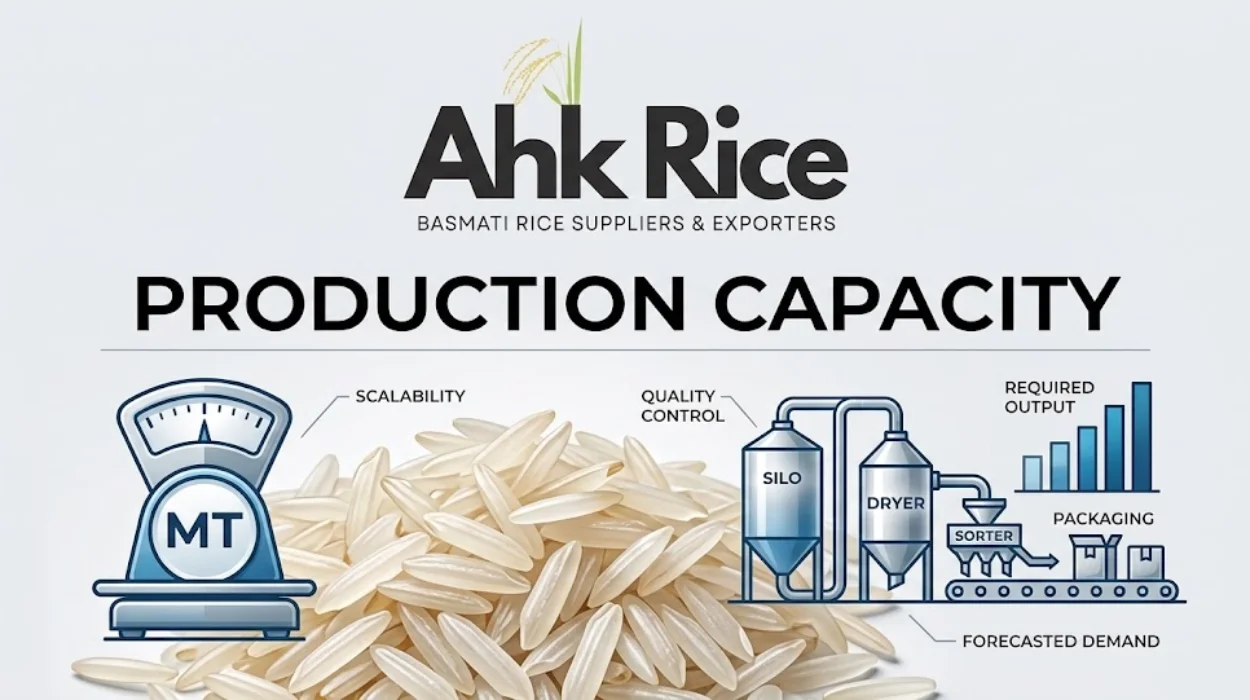
How Much Production Capacity Should Importers Require from Suppliers?
Importers should require supplier capacity that covers at least 1.5 times the planned peak shipment volume, while high-volume programs should target 2 times peak monthly demand to protect supply continuity, quality control, and shipment scheduling during seasonal procurement pressure.
Production capacity is not the same as available inventory. A rice supplier may operate a large mill but have limited capacity available for one buyer because other contracts already occupy processing, packing, or loading schedules.
For importers evaluating this difference, understanding:
Why production capacity is a key rice procurement metric is the foundation for comparing suppliers, production models, and contract structures.
In 2026, Pakistan remains an important origin for Basmati rice, with export pricing influenced by crop quality, variety, processing type, destination demand, and international competition. Pakistan Customs’ 2026 valuation framework lists reference values of $1,175/MT for 1121 White/Sella, $1,225/MT for 1121 Steam, $1,100/MT for 1509 White/Sella, and $1,150/MT for 1509 Steam.
For procurement planning, capacity therefore needs to be evaluated alongside product specification, processing throughput, packaging capability, storage, quality assurance, and export execution.
What production capacity should an importer require from a rice supplier?
Importers should require capacity based on peak monthly demand, not average annual demand; a supplier should normally demonstrate 1.5 times peak requirements, while large programs should target 2 times peak volume to accommodate seasonal demand, quality holds, packaging changes, and shipment delays.
The correct capacity depends on the buyer’s purchasing cycle.
A distributor importing 50 MT per month does not automatically need a supplier producing 50 MT per month. The supplier must have enough operational capacity to process the buyer’s order while continuing other production commitments.
A practical capacity model is:
Required supplier capacity = peak monthly requirement × capacity coverage factor
For example, an importer requiring 100 MT in a normal month and 180 MT during peak season should evaluate suppliers against the 180 MT peak rather than the 100 MT average.
At a 1.5× coverage level, the supplier should demonstrate approximately 270 MT of relevant capacity for that peak requirement.
At a 2× coverage level, the benchmark becomes 360 MT.
The word relevant is important. A supplier claiming 5,000 MT of annual rice production does not automatically have 5,000 MT of 1121 Steam Basmati available. Capacity must be connected to the exact variety, grade, processing method, packaging format, and shipment window.
A supplier’s daily mill capacity is also only one measurement. A facility operating at 150 MT per day, for example, could theoretically process 3,900 MT over 26 operating days. Actual buyer allocation depends on crop availability, processing yield, existing contracts, maintenance, laboratory release, packaging, and logistics.
Therefore, importers should request both installed capacity and available contract capacity.
What are the available solutions for different procurement volumes?
Importers can choose spot purchasing, scheduled container programs, annual volume contracts, dedicated production allocations, or multi-supplier sourcing; the best solution depends on monthly demand, peak requirements, inventory policy, product complexity, and the financial cost of supply interruption.
Spot purchasing
Spot purchasing suits buyers with irregular demand or limited market exposure.
An importer might purchase two or three 20-foot containers when inventory falls below a predetermined level. Current Pakistani export listings commonly show approximately 25–27 MT of rice in a 20-foot FCL, depending on packaging and loading configuration.
This approach minimizes contractual commitment but provides less protection against production congestion and market price movement.
Scheduled container programs
A scheduled program is stronger for distributors with predictable monthly demand.
A buyer requiring 120 MT per month could schedule approximately four to five containers depending on the agreed net weight per container. The supplier reserves processing and packing slots while the buyer receives shipments according to a defined calendar.
This model creates a balance between flexibility and supply continuity.
Annual volume contracts
Annual contracts work for established importers with predictable demand.
A buyer forecasting 1,200 MT annually could negotiate monthly or quarterly allocations instead of ordering the entire volume at once.
The supplier needs sufficient annual procurement, processing, storage, and export capacity to support the agreement.
Dedicated production allocation
Dedicated allocation is appropriate when the buyer requires strict specifications or high volume.
For example, a private-label distributor purchasing 300 MT of 1121 Steam Basmati every month needs more than general rice availability. It needs controlled specifications, packaging capacity, laboratory release, and shipment scheduling.
Multi-supplier sourcing
A two-supplier model reduces concentration risk.
An importer requiring 1,000 MT annually could allocate 700 MT to its primary supplier and 300 MT to a qualified secondary supplier.
This reduces dependence on one processing facility without abandoning volume efficiency.
How do different supplier capacity approaches compare?
Supplier capacity should be compared using available monthly output, peak allocation, processing type, packaging throughput, storage, lead time, and shipment history rather than advertised annual production alone; the strongest supplier is the one that can reserve relevant capacity against the buyer’s actual schedule.
| Attribute | Small / Flexible Supplier | Medium Capacity Supplier | High-Volume Supplier |
|---|---|---|---|
| Typical buyer requirement | 25–100 MT/month | 100–500 MT/month | 500+ MT/month |
| Capacity approach | Order-based | Scheduled production | Reserved allocation |
| Peak coverage | 1.0–1.5× | 1.5× | 1.5–2× |
| Container planning | Spot FCLs | Monthly FCL schedule | Multi-sailing program |
| Packaging flexibility | Moderate | High | High with dedicated lines |
| Inventory strategy | Buyer-led | Shared planning | Supplier + buyer allocation |
| Best use case | Trial or irregular demand | Distributor programs | National or multi-region distribution |
The table illustrates why capacity should not be judged from a single production figure.
A supplier with lower total capacity can outperform a larger supplier if it has more capacity available for the buyer’s required grade.
For example, Supplier A may advertise 20,000 MT annual production but allocate only 100 MT monthly to a new customer. Supplier B may operate at a smaller scale but reserve 250 MT monthly for the same customer.
Supplier B has the stronger procurement position for a 200 MT monthly contract.
Current market data also demonstrates why procurement volume matters to price. A July 2026 Pakistani export listing showed 1121 Basmati White at approximately $1,165–$1,205/MT FOB Karachi and Super Kernel Basmati in a similar range.
Larger orders can improve commercial efficiency, but price should never be evaluated separately from capacity allocation, specifications, inspection, packaging, and shipment reliability.
Which capacity strategy works best for Middle East and North American buyers?
Middle East buyers generally benefit from faster replenishment and flexible container scheduling, while North American distributors need stronger forward planning because longer logistics cycles increase inventory exposure; both markets require capacity matched to peak demand and destination-specific grade preferences.
Middle East: Saudi Arabia and UAE
Middle Eastern importers commonly operate through distributors, wholesalers, foodservice suppliers, and retail channels.
Saudi Arabia and the UAE create demand for long-grain Basmati products with strong cooking performance, aroma, grain appearance, and consistent processing.
For these buyers, 1121 Steam, 1121 Sella, Super Kernel, and 1509 processing formats can fit different commercial segments.
A distributor requiring 300 MT monthly should evaluate a supplier capable of supporting at least 450 MT during peak demand under the 1.5× model.
For highly seasonal programs, 600 MT of relevant monthly capacity provides a stronger 2× buffer.
North America: United States
U.S. buyers often require longer planning cycles because ocean transit, customs clearance, inland transportation, warehouse receiving, and distributor inventory all affect replenishment.
For a U.S. importer requiring 200 MT monthly, a supplier should demonstrate approximately 300–400 MT of relevant monthly capacity depending on the buyer’s inventory policy.
The U.S. market also supports multiple Basmati formats, including 1121, Super Kernel, and 1509, with specifications varying by ethnic retail, foodservice, wholesale, and private-label applications.
The commercial difference is therefore not simply the rice grade. It is the amount of working inventory required to maintain service levels.
Price and shelf-life comparison
| Market region | Typical capacity priority | Common grade preference | 2026 planning price benchmark* | Shelf-life planning |
| Middle East | 1.5× peak demand | 1121 Steam/Sella, Super Kernel, 1509 | ~$1,150–$1,225/MT FOB for comparable premium Basmati references | 12–24 months depending on product and packaging |
| North America | 1.5–2× peak demand | 1121, Super Kernel, 1509 for retail/foodservice | ~$1,150–$1,225/MT FOB for comparable premium Basmati references | 12–24 months depending on product and packaging |
*The price range is a procurement planning benchmark based on 2026 Pakistan export references, not a destination-specific landed quotation. Freight, insurance, duties, packaging, inspection, and destination charges change the final landed cost. Pakistan’s 2026 customs reference values place 1121 White/Sella at $1,175/MT and 1121 Steam at $1,225/MT.
Shelf life must be confirmed against the final product specification and packaging system. Capacity planning should therefore include warehouse rotation rather than treating shelf life as permission to hold unlimited stock.
What are the advantages and disadvantages of each capacity strategy?
Spot buying offers flexibility but exposes buyers to availability risk; scheduled programs improve continuity; annual contracts improve planning; dedicated allocations protect high-volume specifications; multi-supplier sourcing reduces concentration risk but requires additional quality and documentation controls.
Spot purchasing
Advantages: low commitment, flexible ordering, useful for testing new suppliers.
Disadvantages: weaker allocation priority, greater exposure to market changes, and less control during peak procurement periods.
Example: A new importer buying 50 MT every three months can use spot purchasing without locking itself into an annual contract.
Scheduled programs
Advantages: predictable production, clearer shipping calendars, better inventory planning.
Disadvantages: requires demand forecasting and coordination.
Example: A distributor ordering 150 MT every month benefits from a production calendar that reserves processing and packing capacity.
Annual contracts
Advantages: stronger supply planning, volume visibility, and improved commercial negotiation.
Disadvantages: inaccurate forecasts can create excess inventory or unused contractual capacity.
Example: A retailer forecasting 2,400 MT annually should establish quarterly volume reviews instead of assuming every month will consume exactly 200 MT.
Dedicated allocations
Advantages: strongest control for high-volume or specification-sensitive programs.
Disadvantages: requires greater commitment and detailed production planning.
Example: A private-label customer specifying exact grain length, broken percentage, moisture, packaging, and labeling benefits from reserved production.
Multi-supplier sourcing
Advantages: reduces single-supplier dependency and creates contingency capacity.
Disadvantages: quality variation becomes a greater management issue.
Example: A 1,000 MT annual importer can allocate 700 MT to the primary supplier and 300 MT to a qualified secondary supplier.
Which factors should importers use when deciding supplier capacity?
Importers should evaluate peak monthly demand, available capacity, product-specific throughput, processing and packaging capability, lead time, shipment history, storage, quality controls, and backup capacity before approving a supplier for a high-volume rice procurement program.
1. Peak monthly requirement
Start with the highest realistic monthly demand.
Average demand hides procurement pressure.
A supplier should be evaluated against the peak month because that is when capacity constraints become commercially visible.
2. Product-specific capacity
Ask how much capacity is available for the exact product.
A supplier may have substantial total rice production but limited capacity for 1121 Steam or a specific private-label configuration.
3. Processing throughput
Check milling, sorting, polishing, steaming, parboiling, drying, and grading capacity where relevant.
Processing bottlenecks can limit shipment volume even when paddy or finished rice is available.
4. Packaging capacity
Packaging can become the constraint.
A supplier may process 300 MT per day but have limited capacity for small retail bags, printed BOPP packaging, private-label cartons, or destination-specific labeling.
5. Quality-release capacity
Laboratory testing must scale with shipment volume.
The supplier should demonstrate sampling, moisture testing, grain-length verification, broken-grain analysis, foreign-matter control, and required food-safety testing before shipment release.
6. Storage and inventory
Storage capacity affects procurement timing.
A supplier with adequate warehouse space can hold processed stock while containers are scheduled, reducing the pressure to process every order immediately before vessel cut-off.
7. Export execution
Capacity must extend beyond the factory gate.
Importers should examine container loading, documentation, customs clearance, port coordination, and shipment history.
8. Backup capacity
Ask what happens when the primary line is unavailable.
A strong procurement program has defined contingency procedures for equipment maintenance, quality rejection, packaging shortages, or sudden demand increases.
What five-step decision framework should importers use?
A practical supplier decision framework should first calculate peak demand, then test capacity coverage, verify product-specific production, assess logistics and quality controls, and finally confirm contingency capacity before signing a recurring supply agreement.
| Decision factor | Buyer question | Minimum evidence |
| Demand | What is the peak monthly requirement? | 12-month forecast |
| Capacity | Can the supplier cover 1.5–2× peak demand? | Production and allocation data |
| Specification | Can the exact grade be produced consistently? | Product specification and samples |
| Execution | Can production become export-ready on schedule? | Shipment and loading history |
| Continuity | What happens if demand or production changes? | Backup capacity plan |
This framework prevents one common procurement mistake: selecting a supplier because its advertised production number appears large.
Capacity should be measurable.
If an importer forecasts 1,000 MT annually but expects 180 MT in its busiest month, the supplier should be evaluated against the 180 MT peak.
If the supplier can reliably allocate 360 MT during that period, the buyer has a 2× capacity buffer.
That buffer becomes particularly valuable when several customers require the same grade at the same time.
How should importers verify a supplier before signing a high-volume contract?
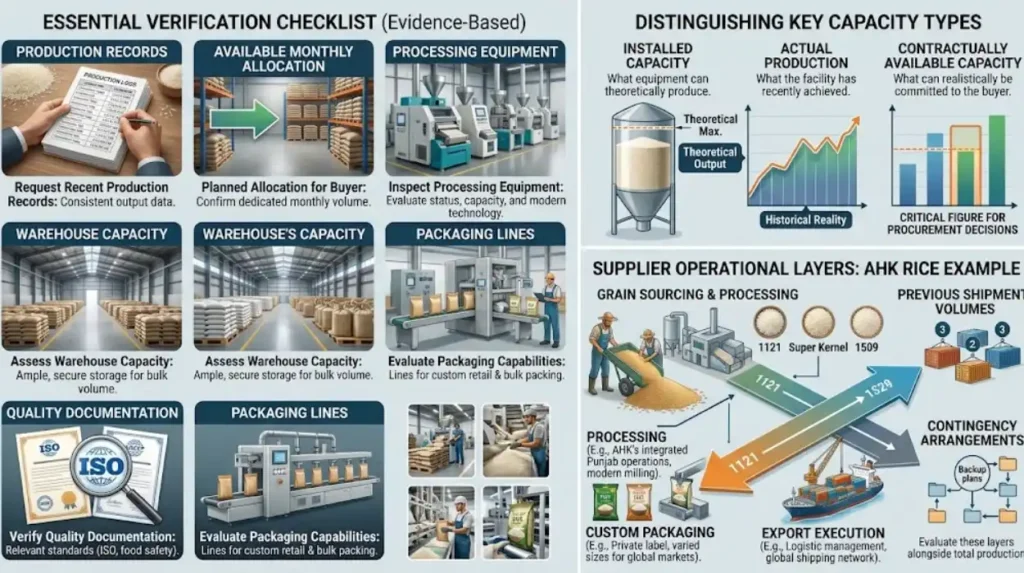
Importers should verify production records, available monthly allocation, processing equipment, warehouse capacity, quality documentation, packaging lines, previous shipment volumes, and contingency arrangements before committing to a high-volume Basmati rice supply agreement.
A supplier capacity claim should be supported by operational evidence.
Importers can request recent production records, shipment history, product specifications, factory audit documentation, packaging capabilities, and planned allocation for the buyer.
The buyer should also distinguish between installed capacity, actual production, and contractually available capacity.
Installed capacity represents what equipment can theoretically produce.
Actual production represents what the facility has recently achieved.
Available capacity represents what can realistically be committed to the buyer.
The third figure is the most important for procurement decisions.
AHK Rice operates from Punjab and supplies Pakistani Basmati varieties including 1121, Super Kernel, and 1509 to international markets. Its end-to-end model covers processing, custom packaging, and export execution, which are the operational layers importers should evaluate alongside production volume.
For an Arizona distributor evaluating high-volume Pakistani Basmati supply, the next decision stage is:
Source high-volume Basmati rice supply for Arizona through AHK Rice.
Frequently Asked Questions
How much production capacity should a rice importer require from a supplier?
Importers should generally require suppliers to have at least 1.5 times their peak monthly demand in relevant production and allocation capacity. High-volume buyers can target 2 times peak demand for additional supply protection.
Why is production capacity important when selecting a rice supplier?
Production capacity indicates whether a supplier can fulfill recurring orders without creating delays during peak demand. It should be evaluated alongside processing, packaging, storage, quality control, and export capacity.
What is the difference between installed capacity and available capacity?
Installed capacity is the maximum theoretical output of a facility. Available capacity is the volume a supplier can realistically allocate to a specific buyer after accounting for existing contracts, production schedules, maintenance, and other commitments.
How should importers calculate required supplier capacity?
Importers should calculate capacity using their peak monthly requirement, not average demand. A buyer requiring 200 MT during its peak month should evaluate suppliers against at least 300 MT of relevant capacity using a 1.5× coverage target.
Is 1.5 times capacity enough for large rice import programs?
A 1.5× capacity buffer works for many recurring programs. Buyers with seasonal demand, strict delivery schedules, or large distribution networks can target 2× peak monthly capacity to provide greater operational flexibility.
Which Pakistani Basmati rice grades require capacity planning?
Capacity planning can apply to 1121 Basmati, Super Kernel, and 1509 Basmati, including White, Steam, and Sella processing formats. The supplier’s capacity should match the exact grade and specification required.
How does peak-season demand affect rice supplier capacity?
Peak-season demand can reduce available production slots because multiple importers may require the same varieties and processing formats simultaneously. Buyers should reserve capacity before peak periods rather than relying on spot availability.
Should importers use one rice supplier or multiple suppliers?
A single supplier can simplify quality and logistics management when sufficient capacity is available. Multi-supplier sourcing can reduce concentration risk for large programs but requires tighter specification and quality controls.
How much supplier capacity does a buyer importing 100 MT per month need?
If 100 MT represents the buyer’s peak monthly requirement, a 1.5× capacity target would require approximately 150 MT of relevant monthly capacity. A 2× target would require approximately 200 MT.
How should importers verify a supplier’s production capacity?
Importers should review production records, processing equipment, shipment history, product-specific output, packaging lines, warehouse capacity, quality documentation, and the amount of capacity actually available for their contract.
Does higher production capacity always mean a better rice supplier?
No. A supplier with higher total production may have limited capacity available for the buyer’s required variety. Product-specific capacity, quality consistency, shipment performance, and confirmed allocation are more useful procurement indicators.