Vietnam’s Rice Import Shifts and Niche Demand Opportunities for Pakistani Exporters in 2026
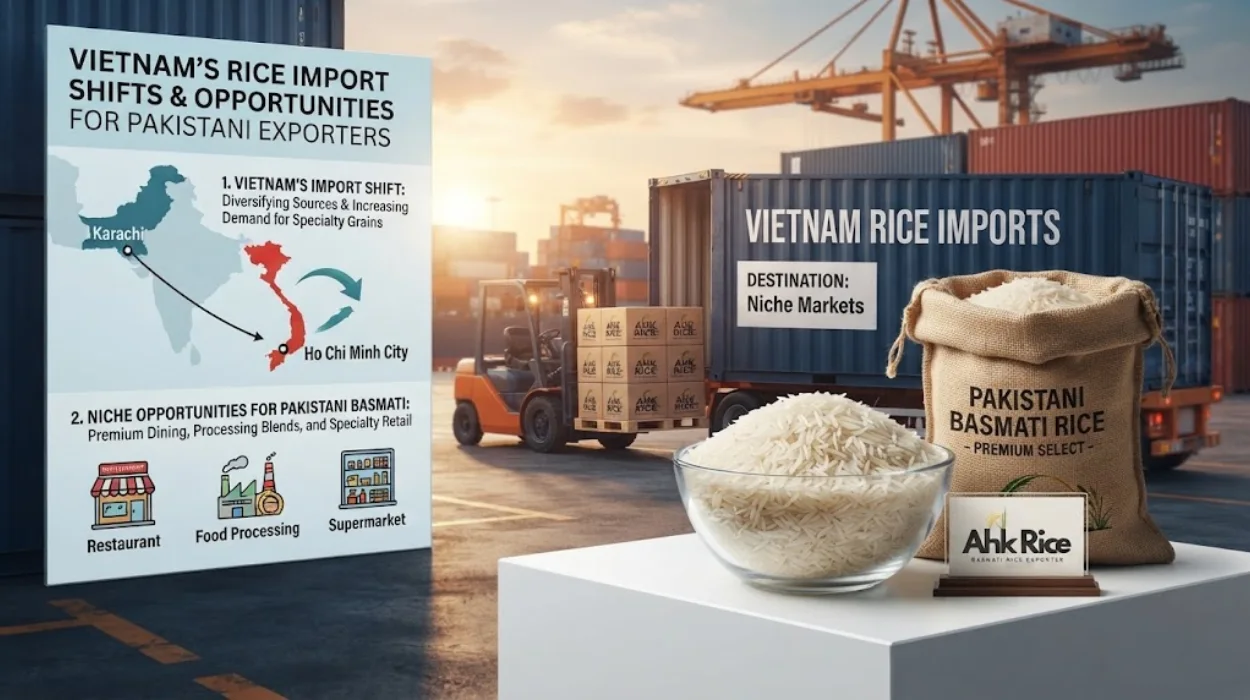
Vietnam’s 2026 rice import market is shifting from broad supply supplementation toward specific demand for food processing, premium aromatic rice, and supply-balancing requirements, creating niche opportunities for Pakistani Basmati varieties rather than a direct volume competition with Vietnamese rice. Vietnam imported about US$800 million of rice during the first seven months of 2026, while also exporting nearly 5.5 million tonnes. The imports therefore reflect commercial segmentation rather than a shortage of domestic rice.
Vietnam remains a major rice producer and exporter, but its import structure is changing. Importers source rice for food manufacturing, rice noodles, pho, rice paper, blending, export supply management, and premium consumption. For a broader explanation of the country’s rice trade structure, Vietnam rice trade and the role of Pakistani Basmati in the premium segment provides the market foundation before evaluating individual varieties.
What are the available solutions for Pakistani exporters entering Vietnam?
Pakistani exporters have four practical market approaches: premium Basmati for retail and restaurants, value-oriented 1509 for foodservice, aromatic Super Kernel for specialist buyers, and specification-led private-label supply for distributors seeking differentiated imported rice products. Each approach addresses a different demand condition.
The first approach is premium Basmati. Pakistan 1121 targets buyers that value extra-long grain presentation, aroma, cooking elongation, and premium packaging. This segment fits hotels, international restaurants, specialty retailers, and consumers seeking imported aromatic rice.
The second approach is 1509 Basmati. Its long grain, efficient production cycle, and multiple processing options make it suitable for buyers that need a balance between visual quality and procurement cost. White, Steam, and Sella processing allow the specification to match different foodservice and distribution requirements.
The third approach is Super Kernel Basmati. This traditional Pakistani Basmati provides strong aroma and a distinctive cooking profile. It fits specialist distributors, South Asian and Middle Eastern restaurants, and premium consumers who recognize traditional Basmati characteristics.
The fourth approach is private-label supply. Vietnamese importers can purchase an agreed specification and use customized retail packaging for their own distribution network. This approach shifts the commercial focus from variety name alone toward grain length, broken percentage, moisture, processing, packaging, documentation, and landed cost.
Vietnam’s import statistics support this segmentation. Imports reached approximately 2.785 million tonnes of rice and paddy during January-June 2026, worth about US$800 million, while import volume declined 14.53% year on year. This indicates that the opportunity is increasingly about matching the correct rice to a defined application.
How do Pakistani Basmati varieties compare for Vietnam?
1121 provides the strongest premium grain presentation, Super Kernel emphasizes traditional aroma, and 1509 provides a value-oriented long-grain option; the correct selection depends on retail positioning, foodservice requirements, processing format, price per MT, and inventory conditions.
| Specification | 1121 Basmati | Super Kernel Basmati | 1509 Basmati |
|---|---|---|---|
| Grain length | Approx. 8.3–8.5 mm | Approx. 7.0–7.5 mm | Approx. 8.2–8.4 mm |
| Aroma | Strong, premium Basmati | Strong traditional aroma | Moderate to strong |
| Processing | White, Steam, Sella, Golden Sella | White, Steam, selected Sella formats | White, Steam, Sella |
| Broken target | Premium contracts commonly 0–2% | Premium contracts commonly 0–2% | Common commercial target 0.5–2% |
| Moisture | About 12–13% | About 12–13% | About 12–13% |
| Cooking profile | Long, separate, visually expanded grains | Aromatic, soft, separate grains | Long grain with efficient cooking performance |
| Indicative FOB price | About US$1,135–1,205/MT | About US$965–1,205/MT | About US$950–1,450/MT depending on grade |
These figures are export-market references rather than fixed Vietnam landed prices. Current published Pakistani references place 1121 around US$1,135–1,205/MT and Super Kernel around US$1,165–1,205/MT for specified premium grades. 1509 has a wider published range because processing, quality, destination, and specification create larger price differences.
Vietnamese premium rice prices also establish an important competitive benchmark. On July 22, 2026, Vietnamese Jasmine rice was quoted at approximately US$513–517/MT, while 5% broken fragrant rice was around US$510–520/MT. Pakistani Basmati therefore cannot compete in Vietnam by attempting to replace mainstream domestic rice on price alone.
The commercial case depends on differentiation. A Pakistani exporter competes through grain characteristics, aroma, international cuisine applications, packaging, and consistent specifications.
How do Vietnam’s northern and southern markets differ?
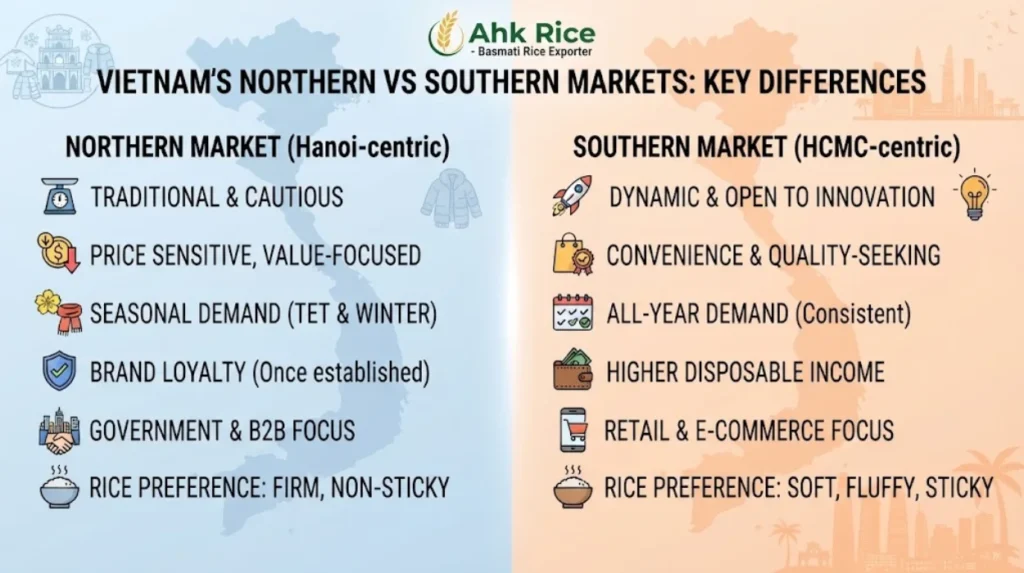
Northern and southern Vietnam share demand for imported rice, but urban distribution patterns create different opportunities: Hanoi and northern premium channels favor differentiated imported products, while Ho Chi Minh City and southern commercial networks provide stronger access to restaurants, distributors, foodservice, and processing-oriented buyers.
Northern Vietnam: Hanoi and premium distribution
Hanoi is a major urban consumption center with hotels, restaurants, specialty food retailers, and international cuisine operators. The opportunity for Pakistani Basmati is therefore specification-led premium demand rather than mass-market staple consumption.
1121 fits buyers requiring extra-long grains and premium presentation. Super Kernel fits restaurants and distributors that prioritize strong aroma and traditional Basmati characteristics.
1509 serves buyers that require long-grain performance while controlling procurement cost. Steam and Sella formats also provide processing options for foodservice and institutional use.
Southern Vietnam: Ho Chi Minh City and commercial foodservice
Ho Chi Minh City provides a broader commercial ecosystem. The city connects importers, wholesalers, hotels, restaurants, international food operators, supermarkets, and industrial food businesses.
Super Kernel can serve specialist restaurants and ethnic-food distribution. 1121 fits premium packaged retail and high-end hospitality. 1509 has stronger relevance where procurement efficiency and consistent cooking performance receive greater weight.
Vietnam’s broader import structure reinforces this distinction. Domestic food manufacturers require rice with particular starch and price characteristics for products such as rice noodles, pho, and rice paper, while other buyers require aromatic or premium rice.
What are the price per MT and shelf-life differences?
Price differences are driven mainly by variety, processing, broken percentage, grain specification, packaging, and contract quantity, while shelf life depends more on moisture control and warehouse conditions than on variety; properly processed export rice commonly supports approximately 18–24 months of planning.
For commercial comparison, 1121 occupies a premium price position because of its extra-long grain characteristics and strong visual presentation. Super Kernel occupies another premium position based on aroma and traditional Basmati identity. 1509 provides broader pricing flexibility because it is available across different grades and processing specifications.
A useful planning comparison is:
| Variety | Indicative FOB position | Planning shelf life* | Main commercial use |
|---|---|---|---|
| 1121 | US$1,135–1,205/MT | 18–24 months | Premium retail, hotels, restaurants |
| Super Kernel | US$965–1,205/MT | 18–24 months | Specialist retail, restaurants, premium wholesale |
| 1509 | US$950–1,450/MT by specification | 18–24 months | Value-premium retail, foodservice, distribution |
*Shelf-life planning assumes appropriate moisture, packaging, pest control, and warehouse conditions. The storage environment has greater impact on stability than the variety name itself.
Vietnam’s humid climate makes moisture control particularly important. Export specifications around 12–13% moisture reduce storage risk and support more consistent distribution. The importer should therefore compare the complete specification rather than accepting a generic “Basmati” description.
Which method works best for different Vietnamese buyers?
Premium retail buyers should prioritize 1121, specialist restaurants should evaluate Super Kernel, cost-conscious foodservice distributors should examine 1509, and private-label importers should select the variety only after defining grain, processing, packaging, price, and shelf-life requirements.
For premium supermarkets, 1121 provides the clearest visual differentiation. Its longer grain supports premium packaging and cooked-rice presentation. The buyer should specify grain length, broken percentage, moisture, purity, packing format, and processing method.
For international restaurants and specialist distributors, Super Kernel provides a different proposition. Its traditional aroma supports dishes such as biryani, pilaf, and other South Asian or Middle Eastern preparations. This creates a niche based on culinary identity rather than mainstream Vietnamese rice consumption.
For foodservice distributors, 1509 offers a more flexible cost structure. Steam and Sella formats support commercial kitchens where cooking consistency, holding performance, and procurement economics matter.
For private-label importers, the variety should follow the product brief. A 5 kg premium retail bag requires a different specification from a 25 kg restaurant sack. Packaging, label design, palletization, moisture protection, and container loading must therefore form part of the initial purchasing specification.
What are the pros and cons of each approach?
Premium Basmati creates stronger differentiation but requires higher price acceptance; value-oriented 1509 improves procurement flexibility but faces stronger competition; Super Kernel creates aroma-led differentiation but requires buyers to understand its traditional Basmati positioning.
1121 Basmati
The main advantage is premium visual presentation. The long grain is easy to communicate on packaging and restaurant menus. It also supports high-end international cuisine.
The limitation is price. A buyer comparing it with Vietnamese Jasmine at roughly US$513–517/MT sees a substantial cost difference. The product therefore requires a premium sales proposition rather than a commodity strategy.
Super Kernel Basmati
The main advantage is aroma. Super Kernel provides a traditional Basmati identity that distinguishes it from ordinary long-grain rice.
The limitation is market education. Vietnamese mainstream consumers do not automatically assign the same value to Pakistani Basmati characteristics as established Basmati-consuming markets. Importers therefore need targeted distribution through restaurants, specialty retail, and international-food channels.
1509 Basmati
The advantage is flexibility. It provides long-grain performance with multiple processing options and a wider commercial price structure.
The limitation is competition. Buyers focused mainly on price can compare 1509 with numerous Asian long-grain rice options. The specification must therefore demonstrate measurable value through grain uniformity, cooking performance, broken percentage, packaging, and consistency.
What decision factors should Vietnamese importers use?
Vietnamese importers should compare destination demand, grain specification, processing type, landed cost, storage requirements, and documentation before selecting a Pakistani variety; price per MT alone does not identify the most commercially suitable product.
| Decision factor | What the buyer should evaluate |
|---|---|
| Target customer | Premium retail, restaurant, foodservice, wholesale, or processing |
| Grain specification | Length, uniformity, broken percentage, purity |
| Processing | White, Steam, Sella, or Golden Sella where applicable |
| Landed economics | FOB price, freight, insurance, duties, clearance, inland logistics |
| Inventory stability | Moisture, packaging, warehouse conditions, shelf-life planning |
The first decision is market positioning. If the importer sells premium packaged rice, 1121 has a clear visual advantage. If the buyer serves restaurants requiring aromatic rice, Super Kernel deserves evaluation. If the business depends on procurement efficiency, 1509 becomes more relevant.
The second decision is landed cost. A low FOB price does not automatically create the lowest final cost. Freight, port handling, customs charges, packaging, inspection, and inland distribution affect the delivered price.
The third decision is compliance. Vietnam’s 2026 tariff schedule separately identifies Basmati rice under HS 1006.30.50. The standard MFN rate shown for Basmati is 40%, while preferential treatment varies by applicable trade agreement and origin. Importers must therefore confirm the exact tariff treatment before contracting.
The fourth decision is product consistency. A buyer should approve a physical sample and specification before ordering a container. Grain length, moisture, broken percentage, cooking performance, packaging, and certificate requirements should appear in the commercial specification.
The fifth decision is channel fit. Pakistani exporters should not treat Vietnam as a single homogeneous market. Hanoi premium retail, Ho Chi Minh City foodservice, specialty restaurants, international supermarkets, and industrial processors have different purchasing requirements.
What does Vietnam’s changing import structure mean for Pakistani exporters?
Vietnam’s import shift creates a niche opportunity for Pakistani exporters when they target differentiated aromatic rice rather than mainstream commodity volume; success depends on matching Basmati specifications with premium retail, hospitality, specialist distribution, and selected foodservice applications.
Vietnam imported roughly US$800 million of rice in the first seven months of 2026, down 25.2% from the same period of 2025, while the country continued exporting large volumes. This combination shows why broad-volume competition is difficult for foreign suppliers.
The opportunity is narrower but more defined. Imported rice is entering the country because businesses require specific raw materials, supply balancing, processing characteristics, or differentiated products.
Pakistan can address the differentiated segment through 1121, Super Kernel, and 1509. The commercial model should begin with a defined application rather than a generic variety list.
A 1121 proposal should emphasize grain length, presentation, aroma, and premium packaging. A Super Kernel proposal should emphasize traditional aroma and culinary identity. A 1509 proposal should emphasize long-grain performance, processing flexibility, and procurement efficiency.
AHK Rice operates within this specification-led model, supplying Pakistani Basmati varieties from Punjab with processing, grading, packaging, and export coordination. The relevant comparison is not simply Pakistan versus Vietnam. It is specification versus application.
For buyers moving from market research to product selection, the next stage should compare the Pakistani varieties against the exact requirements of Vietnamese retail, wholesale, foodservice, and hospitality channels. That comparison should be based on measurable product attributes and landed commercial value rather than variety names alone.
Frequently Asked Questions
Why is Vietnam importing rice despite being a major rice exporter?
Vietnam imports rice because domestic businesses need specific varieties and raw materials for food processing, rice noodles, pho, rice paper, blending, supply balancing, and export-related operations. Imports therefore reflect segmentation and supply management rather than a simple domestic shortage.
Which Pakistani rice varieties have opportunities in Vietnam?
The main Pakistani Basmati opportunities are 1121, Super Kernel, and 1509 Basmati rice. 1121 suits premium retail and hospitality, Super Kernel suits aroma-focused specialist channels, and 1509 suits buyers seeking long-grain performance with procurement flexibility.
Is 1121 suitable for Vietnamese premium retail?
Yes. 1121 is suitable for premium retail where long grain, visual presentation, aroma, and international cuisine positioning justify a higher price. It should be sold through differentiated packaging and specialty channels rather than compared directly with mainstream Vietnamese rice on price.
Is Super Kernel suitable for Vietnamese restaurants?
Super Kernel suits restaurants serving South Asian, Middle Eastern, and international cuisines because its traditional aroma and cooking characteristics differentiate it from standard Vietnamese long-grain rice. Its strongest opportunity is specialist foodservice rather than mainstream commodity distribution.
Is 1509 cheaper than 1121?
1509 generally occupies a more flexible and value-oriented pricing position, but the exact price depends on processing, broken percentage, grain specification, packaging, order quantity, and destination. Published 2026 references show a broad 1509 range rather than one universal export price.
What is the shelf life of Pakistani Basmati rice?
Properly processed and packaged Pakistani Basmati can support approximately 18–24 months of planning under suitable storage conditions. Moisture, warehouse humidity, pest control, packaging integrity, and temperature have a greater effect on actual storage stability than the variety name alone.
What should Vietnamese importers check before buying Pakistani rice?
Importers should check grain length, broken percentage, moisture, purity, processing type, packaging, certificate requirements, inspection procedures, landed cost, and storage conditions. A physical sample and approved commercial specification should be established before container-scale purchasing.
What price benchmark should Pakistani exporters compare against in Vietnam?
Vietnamese Jasmine rice was quoted around US$513–517/MT in July 2026, while 5% broken fragrant rice was around US$510–520/MT. Pakistani Basmati sits at a much higher FOB origin price, so its commercial case depends on premium differentiation rather than commodity price competition.