What Import Duty Applies to Basmati Rice in Indonesia?
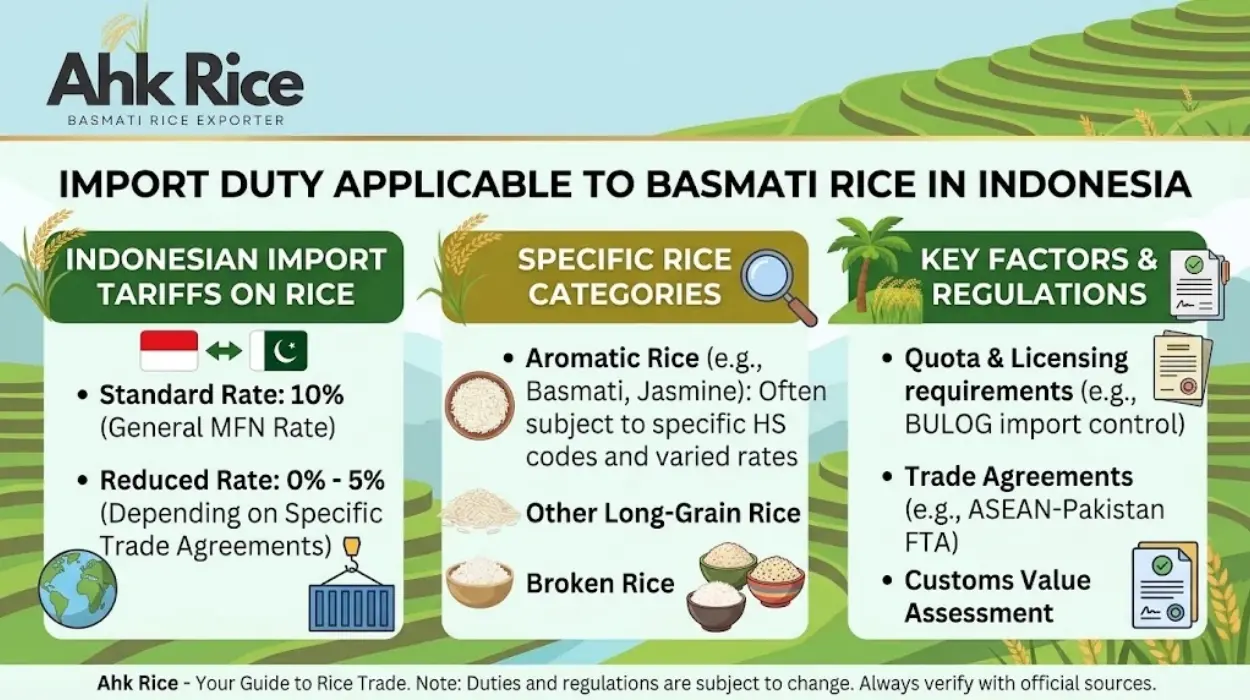
Indonesia generally applies a 5% import duty to Pakistani semi-milled or wholly milled rice under HS 1006.30, the tariff heading covering Basmati rice. The Indonesia-Pakistan Preferential Trade Agreement provides the legal framework for preferential treatment, but the applicable rate depends on the exact tariff line, product classification, origin rules, and required import documentation.
What is the import duty on Basmati rice in Indonesia?
Basmati rice imported from Pakistan falls within Indonesia’s HS 1006.30 rice classification, with a 5% tariff historically applied to semi-milled or wholly milled rice from Pakistan. The exact payable amount depends on customs classification, customs value, origin eligibility, and Indonesian import requirements.
Basmati is a long-grain aromatic rice associated with the Indian subcontinent. Pakistani Basmati is produced mainly in Punjab and includes varieties such as 1121, Super Kernel and 1509.
Indonesia classifies Basmati within HS 1006.30. Indonesia’s food-import regulations specifically identify Basmati under HS 1006.30.50, while the broader HS 1006.30 heading covers semi-milled and wholly milled rice.
The tariff should not be confused with other import costs. An importer also deals with customs procedures, permits, inspection requirements, logistics, port charges, taxes and documentation.
How does Indonesia calculate Basmati rice import duty?
Indonesia calculates import duty from the customs value of the shipment and the tariff applicable to its HS classification and origin. A 5% duty on a US$100,000 customs value produces US$5,000 in import duty before other applicable charges.
The basic calculation is:
Import duty = Customs value × Applicable tariff rate
For example, if the customs value of Pakistani Basmati is US$100,000 and the applicable tariff is 5%, the customs duty is:
US$100,000 × 5% = US$5,000
The customs value is not simply the Pakistani supplier’s product price. Customs valuation follows the applicable Indonesian customs rules and can involve the transaction value and relevant adjustments.
The tariff calculation also depends on correct classification. Basmati should not automatically be classified under the same line as broken rice, paddy, brown rice or other rice products.
Indonesia identifies Basmati under HS 1006.30.50 in its food-import framework. The classification is therefore an important starting point for determining the applicable tariff treatment.
What is HS 1006.30.50 for Basmati rice?
HS 1006.30.50 identifies Basmati rice within Indonesia’s tariff and import-control structure. It distinguishes Basmati from other rice categories and provides the classification used for regulatory treatment, import documentation, and customs processing.
HS codes are internationally structured product classifications. Countries then extend the system with additional national tariff digits.
Indonesia’s current regulatory framework identifies:
- 1006.30.30 for glutinous rice
- 1006.30.40 for Hom Mali rice
- 1006.30.50 for Basmati rice
- 1006.30.60 for Malys rice
- 1006.30.70 for other aromatic rice
- 1006.30.91 for parboiled rice
- 1006.30.99 for other rice.
This distinction matters because import rules can differ between product categories.
Basmati itself also comes in different commercial forms. Examples include Steam, Golden Sella, Creamy Sella, Brown and white Basmati. Processing does not remove the need for correct Indonesian tariff classification.
How does the Indonesia-Pakistan PTA affect Basmati rice duty?
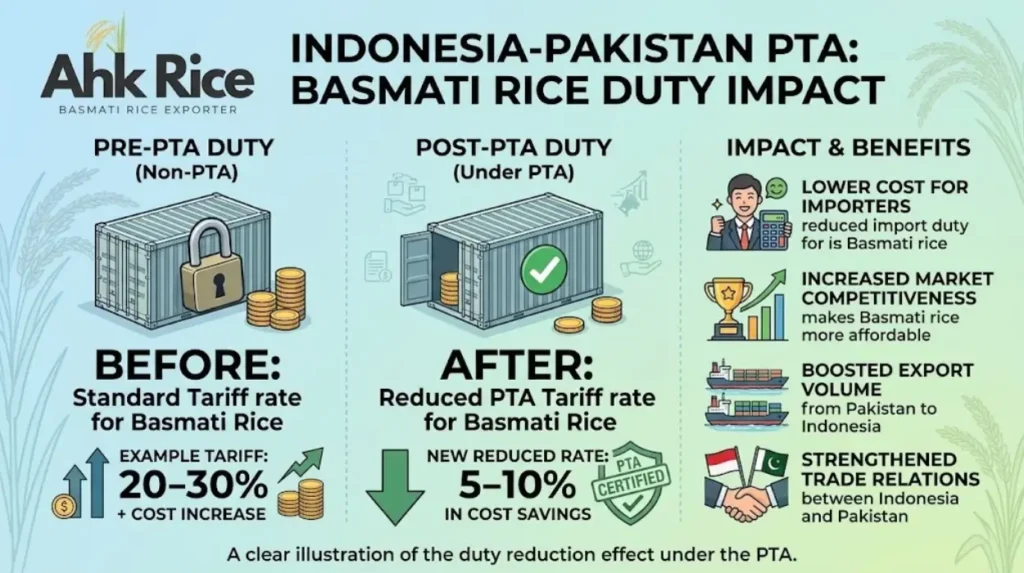
The Indonesia-Pakistan Preferential Trade Agreement establishes preferential tariff commitments for qualifying products. Its later amendment expanded the Indonesian concession schedule, but preferential treatment requires the product to satisfy the applicable tariff line and rules of origin.
The Indonesia-Pakistan Preferential Trade Agreement, commonly called IP-PTA, was signed on 3 February 2012 and became effective on 1 September 2013.
Indonesia and Pakistan later signed a Protocol of Amendment in 2018. Indonesia implemented the amended protocol from 1 March 2019. The amendment expanded the Indonesian concessions from 232 tariff lines to 279 tariff lines.
The agreement reduces or eliminates MFN tariffs for products covered by its schedules. It therefore creates a preferential framework rather than automatically giving every Pakistani product a zero-duty rate.
This distinction is important for Basmati importers. The country of origin, HS classification, concession schedule and origin documentation must all align.
What documents are needed to claim preferential treatment?
A Pakistani Basmati shipment needs correct commercial, customs, transport and origin documentation. Preferential tariff treatment also depends on satisfying the Indonesia-Pakistan agreement’s rules of origin and presenting the required certificate of origin.
Typical shipment documentation includes:
- Commercial invoice
- Packing list
- Bill of lading
- Certificate of origin
- Phytosanitary documentation
- Import permits and regulatory approvals
- Customs declaration
- Product specifications
- Inspection or laboratory documents when required
The certificate of origin is particularly important when an importer seeks preferential treatment.
Indonesia’s trade authority explains that FTA tariff preferences depend on meeting rules of origin. A product does not receive the preferential rate simply because it was shipped from a partner country.
For Pakistani Basmati, the origin chain should therefore be documented from Pakistani production and processing through export.
What are the main components of the landed cost?
The landed cost of Pakistani Basmati in Indonesia combines the rice purchase price, freight, insurance where applicable, customs duty, taxes, port charges, inspection, handling, documentation and domestic delivery rather than import duty alone.
A simplified landed-cost structure is:
Product value + freight + insurance + customs duty + taxes + port charges + handling + inland transport + compliance costs
For example, a shipment with a US$100,000 customs value and 5% import duty incurs US$5,000 in duty. The final landed cost remains higher because freight, port handling, taxes and other charges are separate cost components.
This is why comparing suppliers only by FOB price produces an incomplete purchasing decision.
A lower FOB price can lose its advantage if freight, packaging, compliance or inland distribution costs are significantly higher.
What Basmati grades are imported into Indonesia?
Indonesian buyers can source several Pakistani Basmati grades, with product selection determined by cooking performance, grain length, processing method, broken percentage, market segment and packaging requirements rather than tariff classification alone.
1121 Basmati
1121 is known for long grain length and strong cooked elongation. It is used for premium rice, biryani, restaurants and retail packs.
Super Kernel Basmati
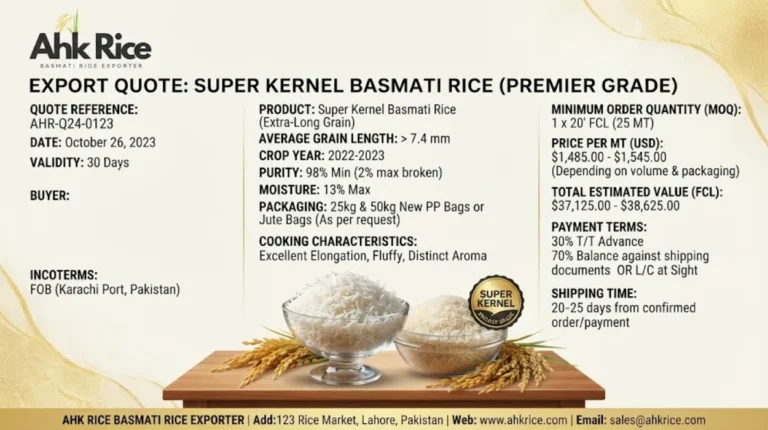
Super Kernel is a traditional Pakistani Basmati variety associated with Punjab. It provides aromatic cooking characteristics and is used in retail, foodservice and wholesale markets.
1509 Basmati
1509 is associated with shorter crop duration and high yield. It provides a commercial alternative where buyers prioritise cost efficiency and consistent bulk supply.
Sella Basmati
Sella is parboiled rice. Golden Sella and other Sella forms are used where longer holding time, grain separation and catering performance are important.
Steam Basmati
Steam processing produces a white cooked appearance while retaining the characteristic long-grain format. It is common in retail and foodservice applications.
Indonesia’s current regulatory framework specifically recognises Basmati within the HS 1006.30 category.
Where is Pakistani Basmati rice grown and how is it processed?
Pakistani Basmati is primarily associated with Punjab, where suitable soil, climate and irrigation support aromatic rice production. Processing moves from paddy intake through cleaning, husking, milling, grading, Sortex separation, quality testing, packing and container loading.
The production chain starts with paddy harvested from rice-growing areas of Punjab.
A typical export process follows these stages:
- Paddy intake: harvested rice enters the processing facility.
- Cleaning: stones, dust and foreign material are removed.
- Dehusking: the husk is separated from the grain.
- Milling: brown rice is milled according to the required specification.
- Grading: grain length and broken percentage are controlled.
- Sortex separation: colour and defective grains are separated.
- Processing: Steam or Sella treatment is applied where required.
- Laboratory testing: moisture, broken percentage and other specifications are checked.
- Packing: rice is packed into bulk or retail formats.
- Container loading: finished bags are loaded according to the shipment plan.
This chain creates the product specification that Indonesian buyers evaluate alongside price.
What are the benefits of importing Pakistani Basmati into Indonesia?
Pakistani Basmati gives Indonesian buyers access to aromatic long-grain rice from a major producing country, with multiple varieties and processing formats suited to retail, restaurants, catering, wholesale distribution and specialty food markets.
Pakistan is an established rice supplier to Indonesia. World Bank WITS data records Pakistan as one of Indonesia’s major suppliers of HS 100630 rice, with 665,096 tonnes exported to Indonesia in 2024 at a reported trade value of about US$388.3 million.
The product range supports different commercial requirements.
Premium retailers can select long-grain varieties. Restaurants can select Steam or Sella formats. Foodservice distributors can purchase bulk bags. Private-label operators can specify packaging sizes and product grades.
The import relationship also benefits from the established Indonesia-Pakistan trade framework.
What are common misconceptions about Indonesian Basmati import duty?
The most common mistake is treating the tariff rate as the complete import cost. Correct HS classification, origin eligibility, import controls, documentation, customs valuation, taxes and logistics all affect the amount an Indonesian importer ultimately pays.
Misconception 1: Pakistani origin automatically means zero duty
It does not. Preferential treatment depends on the applicable concession and origin requirements.
Misconception 2: All rice has the same tariff
It does not. Indonesia separates Basmati, Hom Mali, parboiled, aromatic and other rice categories within its tariff structure.
Misconception 3: The 5% tariff is the landed cost
It is not. Import duty is only one component of the total import expense.
Misconception 4: HS 1006.30 covers every rice product
HS 1006.30 covers semi-milled or wholly milled rice. Brown rice, paddy and broken rice use different classifications.
Misconception 5: Import duty is the only regulatory issue
Indonesia’s 2026 import framework also imposes specific requirements for agricultural commodities. The Ministry of Trade’s 2026 regulation identifies Basmati under HS 1006.30.50 and sets import-control requirements for relevant rice categories.
Frequently Asked Questions
What is the import duty on Basmati rice in Indonesia?
Pakistani semi-milled or wholly milled rice has historically been subject to a 5% tariff under HS 1006.30. The exact rate for a shipment must be confirmed against the applicable Indonesian tariff schedule and preferential treatment.
What is the HS code for Basmati rice in Indonesia?
Indonesia identifies Basmati rice under HS 1006.30.50 in its rice import-control framework. api-
Does the Indonesia-Pakistan PTA make Basmati rice duty-free?
Not automatically. The IP-PTA provides preferential tariff commitments for qualifying products, but importers must meet the applicable concession and rules-of-origin requirements.
Is import duty calculated on the FOB price?
Customs duty is calculated from the customs value established under Indonesian customs valuation rules. The customs value is not necessarily identical to the supplier’s FOB price.
Does Indonesian import duty include freight and port charges?
No. Import duty is a separate cost from freight, port handling, inspection, inland delivery and other import-related expenses.