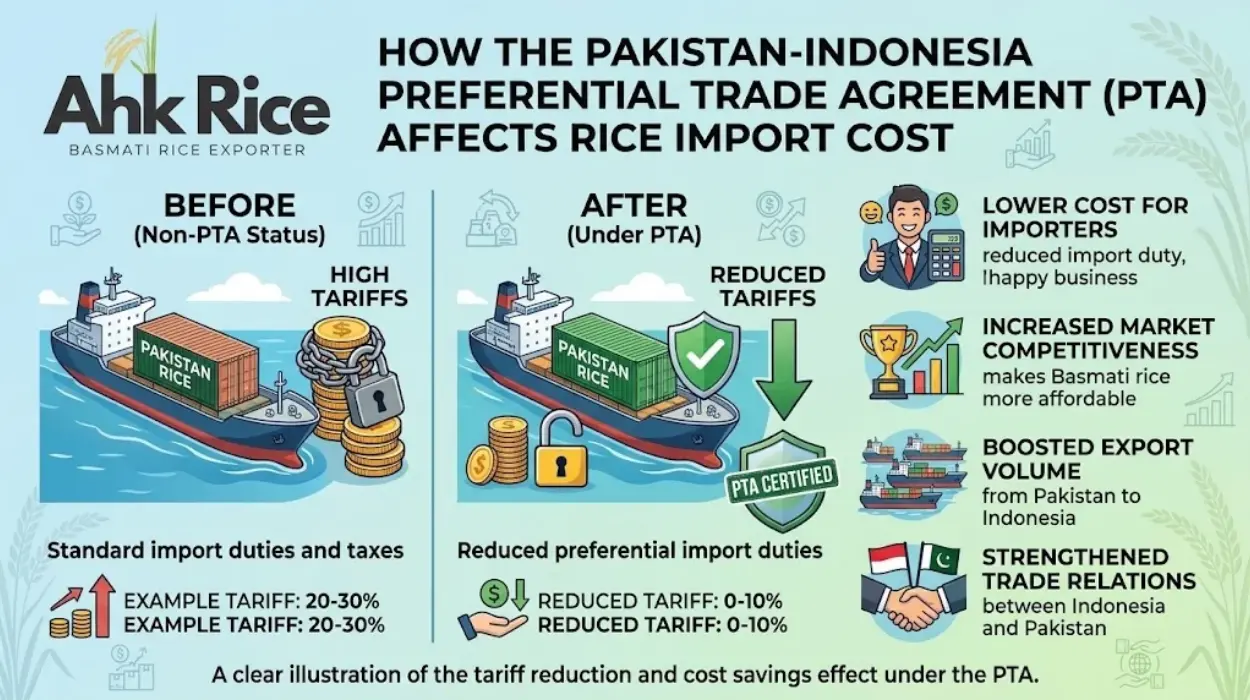
How the Pakistan-Indonesia Preferential Trade Agreement Affects Rice Import Costs
The Pakistan-Indonesia Preferential Trade Agreement can reduce the tariff component of Pakistani rice imports into Indonesia, but the lowest landed cost comes from combining PTA eligibility with correct HS classification, origin documentation, freight planning, and efficient port clearance. The agreement is therefore a cost-management tool rather than a complete landed-cost solution.
For importers evaluating Pakistani Basmati, the first step is understanding how Pakistani rice is prepared for Indonesia’s import market. The Indonesia-Pakistan Preferential Trade Agreement, or IP-PTA, was signed in 2012 and became operational in September 2013. Its later amendment expanded the number of tariff concessions, with the revised protocol implemented from 1 March 2019.
The agreement matters because Indonesia has historically applied different tariff treatment according to product classification and trade arrangement. The IP-PTA provides preferential treatment only for listed tariff lines. Indonesia’s trade authorities identify rice under HS heading 1006, with semi- or wholly milled rice commonly falling under HS 1006.30.
What is the Pakistan-Indonesia Preferential Trade Agreement?
The IP-PTA is a bilateral trade agreement that gives selected Pakistani products preferential access to Indonesia, including agricultural products such as rice, while requiring importers to satisfy the applicable tariff classification and origin conditions.
The Indonesia-Pakistan Preferential Trade Agreement is a bilateral arrangement between the Government of Indonesia and the Government of Pakistan. It was signed on 3 February 2012 after negotiations that began under the broader Framework Agreement on Comprehensive Economic Partnership.
The original agreement covered 232 Indonesian tariff lines and 311 Pakistani tariff lines under the HS 2012 classification. A protocol signed in January 2018 expanded the concessions, and Indonesia implemented the amended arrangement from 1 March 2019. The revised framework increased the Indonesian concession schedule to 279 tariff lines and the Pakistani schedule to 320 tariff lines.
A separate unilateral concession also gave Pakistan zero-duty access on 20 additional tariff lines. Pakistani government sources describe these concessions as covering major export interests and state that the additional market access became effective on 1 March 2019.
Rice was specifically identified among the Pakistani export products targeted for additional concessions during the PTA review. Contemporary Pakistani government reporting described the arrangement as including rice and other agricultural and textile products.
The commercial implication is straightforward. An Indonesian importer comparing Pakistani rice with a supplier facing the normal applicable tariff should evaluate the preferential rate before comparing supplier quotations. A lower FOB price does not automatically create the lower landed cost.
How does the PTA change the landed cost of Pakistani rice?
The PTA reduces import cost only through the preferential tariff applicable to the shipment, while freight, insurance, port charges, taxes, inspection, documentation, and inland delivery remain separate components of Indonesian landed cost.
Landed cost begins with the supplier price and continues through international transportation and Indonesian import clearance. A useful calculation is:
Landed cost = FOB or CIF value + applicable import duty + taxes + port charges + inspection + customs clearance + inland logistics + other applicable costs.
The PTA primarily affects the import-duty component. It does not eliminate ocean freight or terminal handling. It does not automatically remove customs procedures. It does not replace food, quarantine, labelling, or import licensing requirements.
For example, assume an importer purchases 25 MT of Pakistani rice at a hypothetical CIF value of US$1,100 per MT. The shipment value is US$27,500. If the applicable tariff treatment changes the duty from a hypothetical 10% normal rate to a preferential 0% rate, the direct tariff difference is US$2,750.
That US$2,750 is a useful saving, but the final landed cost still includes other expenses. The importer therefore needs a complete cost sheet rather than comparing the tariff alone.
The calculation also depends on the exact Indonesian HS code. Indonesian tariff schedules distinguish rice products by classification, including milled, parboiled, broken, and other categories. Current Indonesian tariff documentation lists rice under HS 1006 and specific milled/parboiled categories under HS 1006.30.
This makes classification one of the most important cost-control steps.
How do Pakistani rice and alternative sourcing approaches compare?
Pakistani rice becomes more cost-competitive when PTA preference, suitable grain specifications, reliable freight, and compliant origin documents are combined; alternative suppliers can still win when their tariff treatment or freight advantage offsets Pakistan’s product advantage.
| Attribute | Pakistani Rice with PTA | Pakistani Rice Without Preference | Non-PTA Supplier |
|---|---|---|---|
| Supplier origin | Pakistan | Pakistan | Other exporting country |
| Tariff treatment | Preferential rate when eligible | Normal applicable rate | Depends on Indonesia’s tariff regime |
| Origin proof | Required for preference claim | Standard commercial documentation | Origin documents for its trade regime |
| FOB price | Supplier and grade dependent | Supplier and grade dependent | Supplier and market dependent |
| Landed cost | Potentially lower | Higher when normal duty applies | Depends on tariff + freight |
| Product positioning | 1121, 1509, Super Kernel and other Pakistani grades | Same Pakistani grades | Depends on competing origin |
| Best use case | Importers optimizing total landed cost | Buyers prioritizing availability | Buyers seeking alternative supply economics |
The strongest comparison is not FOB against FOB. It is landed cost against landed cost.
A Pakistani 1121 shipment can carry a higher FOB price than a standard long-grain product from another origin while still producing an attractive commercial result if the importer obtains the applicable preferential treatment and sells the rice into a premium segment.
The reverse also applies. A low Pakistani FOB quotation does not guarantee competitiveness if the shipment does not qualify for the required preference or incurs higher logistics and compliance costs.
What are the available solutions for Indonesian rice importers?
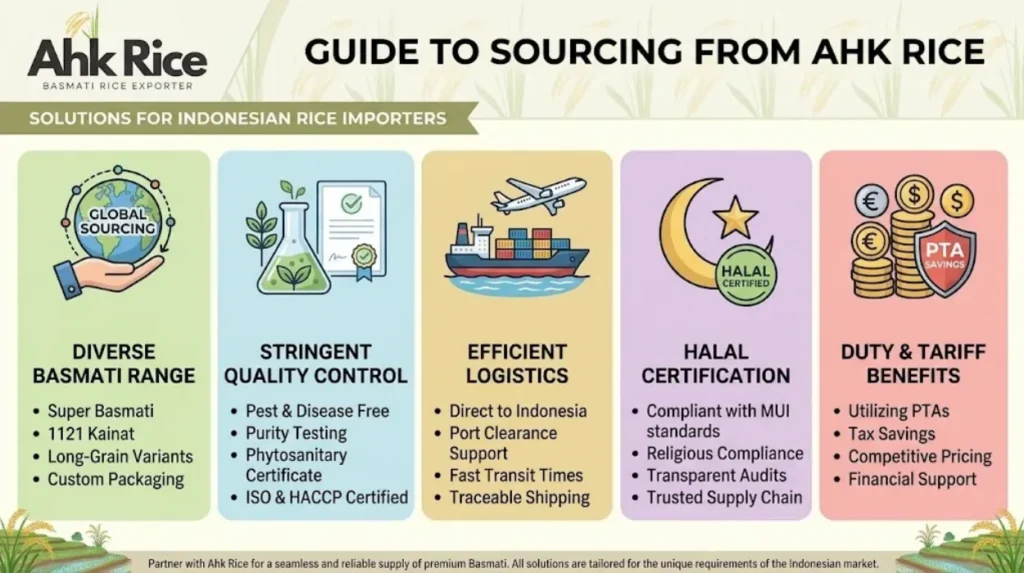
Indonesian buyers have four practical sourcing approaches: PTA-qualified Pakistani rice, standard Pakistani rice, alternative-origin rice, and a blended sourcing strategy that assigns different grades to different market segments.
PTA-qualified Pakistani rice
This is the first option to evaluate when the selected rice falls within the applicable preferential tariff schedule and the shipment satisfies origin requirements.
The advantage is a potential reduction in customs duty without changing the physical product. The buyer retains access to Pakistani Basmati characteristics while improving the tariff position.
This approach works particularly well for importers already purchasing Pakistani rice and seeking better landed economics.
Standard Pakistani rice
A buyer can also import Pakistani rice under the normal tariff treatment when the selected product does not qualify for the relevant preference or when documentation does not support a preferential claim.
This approach provides sourcing flexibility but removes the tariff advantage. It becomes more attractive when the supplier price is substantially lower or when the importer needs a specific grade that cannot be structured under the preferred tariff route.
Alternative-origin sourcing
Indonesian buyers can compare Pakistani rice with rice from other origins. The correct comparison includes tariff, freight, product specifications, quality consistency, and market positioning.
A supplier with a lower FOB price can lose its advantage after Indonesian import costs are added. A supplier with a higher FOB price can become competitive when its tariff treatment and freight structure are stronger.
Multi-grade sourcing
A fourth approach is to divide purchasing by consumer segment.
Premium retail and specialty foodservice can use long-grain Pakistani Basmati such as 1121 or Super Kernel. More price-sensitive wholesale and foodservice channels can evaluate 1509 or other suitable grades.
This approach prevents the importer from using one rice specification for every customer segment.
Which method works best for different Indonesian market regions?
Jakarta and western Java favor high-volume import economics and efficient container logistics, while eastern and secondary markets require greater attention to inland freight, distributor margins, and stock planning.
Indonesia is geographically fragmented, so the port selected for the shipment influences the final economics.
Jakarta and western Indonesia
Jakarta and the surrounding western Indonesian market provide strong distribution infrastructure and access to large consumer and foodservice markets. Tanjung Priok is therefore an important logistics reference for Pakistani rice shipments.
Premium Pakistani Basmati grades can be positioned toward modern retail, specialty wholesalers, restaurants, catering businesses, and South Asian-oriented food channels. 1121 and Super Kernel provide strong premium-grade positioning because of long grain length, aroma, and cooked appearance.
For high-volume buyers, the PTA advantage becomes more valuable when multiplied across several full-container shipments.
Surabaya and eastern Indonesia
Surabaya provides an important distribution base for East Java and eastern Indonesian markets. Buyers serving secondary cities should calculate the additional inland distribution cost after port clearance.
1509 can be useful for buyers seeking long-grain characteristics with stronger price positioning. 1509 Steam, Sella, or Creamy Sella can be evaluated according to the cooking, presentation, and foodservice requirements of the buyer.
The correct grade depends on the end user rather than the tariff alone.
How do grade, price, and shelf life compare?
1121 and Super Kernel suit premium positioning, while 1509 offers a stronger cost-oriented option; actual prices vary by crop, grade, packing, quantity, freight, and Incoterm, so importers should compare current quotations rather than fixed market averages.
| Market / Grade | Typical Buyer Positioning | Indicative Price Approach | Shelf-Life Planning |
|---|---|---|---|
| 1121 Basmati | Premium retail, restaurants, specialty wholesalers | Higher premium-grade pricing | Long storage when properly packed and stored |
| Super Kernel | Premium ethnic retail and foodservice | Premium pricing | Long storage with controlled moisture and packaging |
| 1509 Basmati | Value-focused retail and foodservice | More cost-oriented | Long storage when properly processed and stored |
| Steam Rice | Fresh white appearance, restaurants, retail | Mid-to-premium depending on grade | Requires controlled storage conditions |
| Sella Rice | Catering, banquets, institutional foodservice | Competitive for volume buying | Strong storage and holding performance |
Prices per MT should never be treated as fixed Indonesia market quotations. They change with crop year, grain length, broken percentage, moisture, processing method, packing, order volume, freight, and Incoterm.
AHK Rice’s Indonesian market material also identifies 1509 Creamy Sella as a cost-oriented option compared with premium 1121 Basmati, with Indonesian wholesalers evaluating grain length, cooking performance, price, and target application together.
Shelf life is equally important. A cheaper product with poor storage performance can create higher effective costs through breakage, quality deterioration, stock losses, or customer complaints. Proper moisture control, packaging, warehouse conditions, and stock rotation therefore form part of the landed-cost calculation.
What are the pros and cons of using the PTA for rice imports?
The main advantage is tariff efficiency on eligible Pakistani rice; the main limitation is that preference depends on the exact tariff line and compliance documentation, so the PTA cannot be treated as an automatic zero-duty facility.
Advantages
The first advantage is lower tariff exposure when the shipment qualifies for preferential treatment. This directly improves landed cost.
The second advantage is stronger pricing flexibility. An importer can retain part of the tariff saving as margin or use it to create a more competitive wholesale price.
The third advantage is better supplier comparison. Once the preferential tariff is confirmed, Pakistani suppliers can be compared on a true landed-cost basis.
The fourth advantage is access to differentiated Pakistani Basmati grades. The buyer can select 1121, Super Kernel, or 1509 according to market positioning rather than buying solely on lowest FOB price.
Limitations
The first limitation is tariff-line dependency. The importer must verify the exact HS classification and current preferential treatment.
The second limitation is documentation. Pakistan’s operational certification procedures authorize the Trade Development Authority of Pakistan to issue Certificates of Origin for qualifying exports to Indonesia.
The third limitation is that preferential duty does not remove other import costs.
The fourth limitation is that Indonesia’s regulatory environment remains relevant. Rice imports can involve customs, food, quarantine, labelling, inspection, and import-control requirements. Indonesia’s 2026 rice export rules also demonstrate that rice remains a closely regulated commodity category, particularly under HS 1006.30.
What factors should Indonesian buyers use to make the final decision?
The best sourcing decision combines tariff eligibility, rice specification, delivered price, documentation strength, logistics, and customer requirements instead of selecting the supplier with the lowest FOB quotation.
| Decision factor | What the importer should check |
|---|---|
| 1. PTA eligibility | Confirm the exact HS code and applicable preferential rate |
| 2. Product specification | Compare grain length, broken %, moisture, processing, aroma, and cooking performance |
| 3. Landed price | Calculate CIF, duty, taxes, port, inspection, clearance, and inland costs |
| 4. Documentation | Confirm Certificate of Origin and complete commercial/export documents |
| 5. Market fit | Match 1121, Super Kernel, or 1509 with retail, foodservice, wholesale, or catering demand |
The tariff should therefore be checked before negotiating the final supplier price. Once eligibility is confirmed, the importer can request quotations based on the correct grade, packing, quantity, and destination port.
AHK Rice operates from Punjab and supplies Pakistani Basmati varieties including 1121, Super Kernel, and 1509 to international buyers. Its end-to-end approach covers processing, custom packaging, documentation, and export handling.
For Indonesian importers, the practical solution is to build the purchase around the complete shipment rather than the rice price alone. The right product specification, preferential tariff treatment, origin certificate, packaging, container loading, freight, and destination logistics must work together.
How should an Indonesian importer structure a PTA-based rice purchase?
A practical PTA-based purchase starts with HS-code verification, continues with product and origin confirmation, then moves to sample approval, quotation comparison, documentation, container loading, and Indonesian customs clearance.
The first stage is product selection. The buyer identifies the required variety, processing method, grain length, broken percentage, moisture, packing size, and annual volume.
The second stage is tariff verification. The importer confirms the Indonesian HS code and checks whether the selected product receives the applicable IP-PTA preference.
The third stage is origin documentation. The exporter prepares the required Certificate of Origin and commercial documents needed to support the preferential claim.
The fourth stage is quotation comparison. Buyers should compare at least FOB and CIF economics before deciding. CIF is more useful when evaluating the immediate port-level landed position because it incorporates ocean freight and insurance into the supplier quotation.
The fifth stage is quality control. A commercial sample should be approved before bulk production. The final shipment should match the agreed specifications and approved sample.
The sixth stage is logistics planning. Container size, packing configuration, port destination, vessel schedule, and customs clearance should be incorporated into the cost model.
This workflow reduces the risk of treating the PTA as a simple discount. It turns the agreement into one component of a controlled import strategy.
What is the best overall strategy for Indonesian rice buyers?
The strongest strategy is to source the appropriate Pakistani rice grade under confirmed PTA eligibility, document Pakistani origin correctly, negotiate a complete landed-cost quotation, and match the product to the Indonesian customer segment.
The IP-PTA creates a meaningful cost advantage for eligible Pakistani exports, but the agreement works inside a larger import system.
For premium markets, 1121 and Super Kernel can support higher-value positioning. For cost-sensitive wholesale and foodservice applications, 1509 provides another option. Sella and Steam processing can further differentiate the product according to cooking performance and customer requirements.
The commercial objective is not simply to obtain the lowest tariff. It is to obtain the lowest sustainable cost for the required quality level.
That requires a supplier that understands Pakistani Basmati specifications, origin documentation, export processing, packaging, and international shipment coordination.
For buyers ready to evaluate this approach commercially, the decision-focused resource Cut Indonesian Landed Costs with PTA-Eligible Pakistani Basmati Rice from AHK Rice should be placed after the decision framework or immediately before the final conclusion. It is the natural next step after the article has explained how tariff preference interacts with product selection and landed cost.
Frequently Asked Questions
Does the Pakistan-Indonesia PTA apply to Pakistani rice?
Yes. Rice was included among the Pakistani export interests targeted for preferential access during the PTA review. The exact benefit depends on the applicable Indonesian tariff line and the shipment’s eligibility requirements.
Does the PTA make all Pakistani rice duty-free in Indonesia?
No. The PTA covers specified tariff lines. Importers must verify the exact HS classification and current preferential treatment for the specific rice product before calculating the duty saving.
When did the amended Pakistan-Indonesia PTA become effective?
The amended protocol was implemented by both countries from 1 March 2019.
What HS code is used for Pakistani Basmati rice in Indonesia?
Rice is classified under HS heading 1006. Semi- or wholly milled rice is commonly classified under HS 1006.30, but the exact Indonesian tariff subheading must be verified against the product specification.
What documents support a PTA claim?
The importer should ensure that the shipment has the required origin documentation and commercial documents. Pakistan’s operational certification procedures authorize TDAP to issue Certificates of Origin for goods exported to Indonesia under the IP-PTA.
Which Pakistani rice grade is best for Indonesia?
There is no single best grade for every buyer. 1121 and Super Kernel suit premium retail and foodservice positioning, while 1509 provides a more cost-oriented long-grain option. The correct selection depends on customer segment, cooking requirements, price target, and order volume.
How should Indonesian buyers compare Pakistani rice prices?
Buyers should compare landed cost per MT rather than FOB price alone. The calculation should include product price, freight, insurance, applicable duty, taxes, port charges, inspection, customs clearance, and inland transportation.
Can the PTA reduce the final retail price in Indonesia?
Yes, when the applicable preferential tariff reduces import costs and the importer passes part of the saving through the supply chain. The final retail price also depends on distributor margins, warehousing, domestic transport, packaging, and retail costs.