What Is Pakistani Basmati Rice and Why Do UAE Importers Prefer It?
Pakistani Basmati rice is an aromatic long-grain rice cultivated mainly in Pakistan’s designated Basmati-growing regions, especially Punjab. UAE importers source it for its long grains, aroma, cooking performance, variety range, and established Pakistan-UAE trade route. Here is why: Pakistani Basmati combines distinctive grain characteristics with commercial grades such as 1121, Super Kernel, and 1509.
What is Pakistani Basmati rice?
Pakistani Basmati rice is a GI-protected aromatic rice produced from approved varieties within Pakistan’s defined geographical area. Its defining characteristics include slender grains, natural aroma, cooking elongation, separate cooked grains, and distinctive taste.
Pakistan registered Basmati rice as a Geographical Indication under its Geographical Indications Act 2020. The Trade Development Authority of Pakistan maintains the Basmati specification framework. The defined production area covers specific districts across Punjab, Sindh, Khyber Pakhtunkhwa, Balochistan, and Azad Jammu and Kashmir.
Punjab remains central to Pakistani Basmati production. The Punjab Agriculture Department identifies Super Basmati, Basmati 515, Basmati 2000, Basmati 385, and PK 1121 Aromatic among its fine and aromatic rice varieties. PK 1121 Aromatic has a listed grain length of 8.16 mm in the department’s variety information.
Basmati differs from ordinary long-grain rice through its aroma, slender grain structure, cooking behavior, and traditional cultivation geography. The grain also elongates during cooking while retaining a separate appearance.
Pakistan’s Basmati identity therefore combines origin, variety, grain characteristics, processing, and food quality controls. These attributes form the foundation of its international market position.
With the product defined, the next question is how Pakistani Basmati moves from cultivated paddy to export-ready rice.
How is Pakistani Basmati rice cultivated and processed?
Pakistani Basmati rice moves through cultivation, harvesting, drying, milling, dehusking, polishing, grading, sorting, inspection, and packaging before exporters load it for international shipment.
How is Basmati cultivated?
Basmati cultivation starts with approved seed varieties suited to the production region. Farmers prepare fields, transplant or sow rice, manage irrigation, control weeds, and monitor crop development until the grain reaches harvest maturity.
Punjab provides major production zones for aromatic rice. The region’s agricultural conditions support traditional Basmati cultivation and newer aromatic varieties used in export markets.
How is Basmati processed?
Export processing follows defined physical and quality stages. The sequence differs slightly by product grade and processing method.
- Clean the paddy to remove field debris and foreign material.
- Dry the paddy to control moisture before milling.
- De-husk the grain to remove the outer husk.
- Mill the rice to remove bran layers according to the required finish.
- Polish the grain to achieve the specified surface appearance.
- Sort by length to separate grains according to size.
- Sort by colour to remove discoloured grains and visible defects.
- Grade the rice according to broken percentage, grain length, moisture, and appearance.
- Inspect the finished rice before packing and shipment.
Steam and Sella products add controlled parboiling and drying stages. Golden Sella, for example, receives parboiling treatment before drying, milling, grading, and packing.
The final specification normally covers grain length, broken percentage, moisture, foreign matter, damaged grains, colour, and packaging format.
This processing chain explains why two rice products from the same crop can serve different commercial markets. The next section separates the main grades used in international trade.
Which Pakistani Basmati grades are exported?
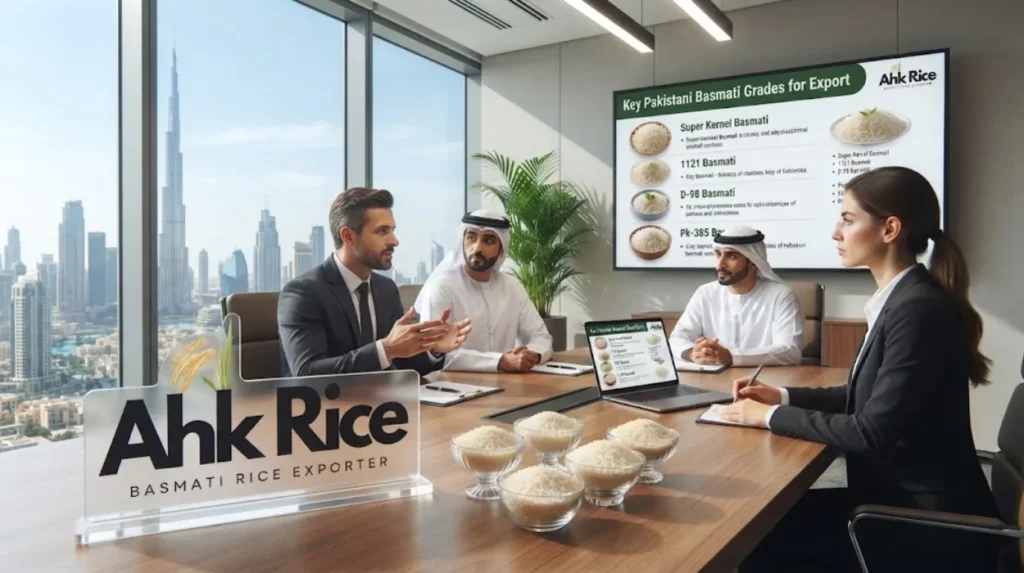
Pakistan exports multiple Basmati grades, with1121, Super Kernel, and 1509 Basmati rice serving distinct retail, foodservice, catering, wholesale, and private-label requirements across international markets.
What is 1121 Basmati?
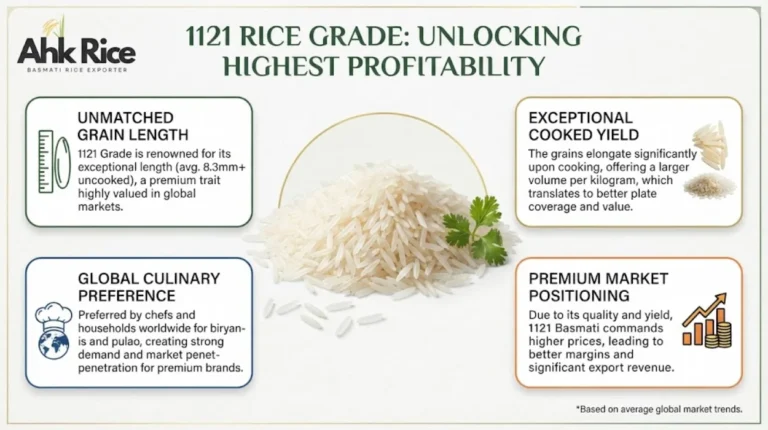
1121 Basmati is an extra-long aromatic rice used extensively in premium retail, foodservice, catering, and export markets. Its long grain and strong cooking elongation support dishes such as biryani, pulao, and rice-based banquet meals.
1121 appears in several processing forms, including White, Steam, Golden Sella, Creamy Sella, and Brown. Each form targets different preparation, presentation, and distribution requirements.
What is Super Kernel Basmati?
Super Kernel Basmati is a traditional aromatic Pakistani Basmati variety associated with Punjab. Commercial specifications commonly focus on grain length, aroma, moisture, broken percentage, and uniformity.
Super Kernel serves premium ethnic retail, wholesale, foodservice, and South Asian distribution channels. UAE buyers also source Super Kernel for consumer packs and foodservice applications.
What is 1509 Basmati?
1509 Basmati is an aromatic variety known for long grains, high yield, and shorter crop duration than traditional Basmati types. Commercial specifications commonly place raw grain length around 8.10–8.40 mm.
1509 appears as White, Steam, and parboiled products. Its combination of long grain presentation and commercial efficiency makes it suitable for wholesale, catering, restaurants, institutional foodservice, and private-label products.
These grades show why Pakistani Basmati is not one uniform product. The next question is why UAE importers select different grades for different channels.
Why do UAE importers prefer Pakistani Basmati rice?
UAE importers source Pakistani Basmati for its aromatic profile, long-grain formats, established supply chain, diverse grades, flexible packaging, and suitability for retail, wholesale, catering, foodservice, and re-export.
UAE rice demand includes Indian and Pakistani Basmati alongside rice from the United States, Australia, Thailand, Egypt, and the Philippines. USDA’s 2026 UAE grain report identifies Indian and Pakistani Basmati as prevalent products in the local market.
Pakistan also has an established shipment relationship with the UAE. Volza recorded 2,304 shipments of Indian, Basmati, and rice products from Pakistan to the UAE between July 2024 and June 2025. The database identified 337 buyers and 248 suppliers during that period.
Recent shipment records show 1121 Sella, Super Basmati, Super Kernel Brown, and 1509 parboiled rice moving from Pakistan into the UAE. These records demonstrate the variety of specifications used within the UAE market.
UAE demand also extends beyond domestic consumption. Dubai functions as a major trading and redistribution centre, while imported rice moves through wholesale, retail, catering, foodservice, and re-export channels.
For a buyer comparing Pakistani and Indian Basmati, the relevant criteria include grain length, aroma, processing method, broken percentage, price, packaging, origin documentation, and shipment terms. A detailed comparison belongs in the next-stage consideration article: Pakistani Basmati vs Indian Basmati Rice: Grain, Aroma and Price Differences for UAE Buyers.
The grade range explains product selection; the next section covers the applications that create demand.
Where is Pakistani Basmati rice used?
Pakistani Basmati serves retail, wholesale, restaurants, catering, foodservice, institutional kitchens, private-label brands, ethnic grocery stores, and re-export operations in the UAE and other international markets.
Retail applications
Retail buyers commonly select 1121 and Super Kernel for premium consumer packs. Packaging can range from small household bags to larger formats designed for ethnic grocery distribution.
Foodservice applications
Restaurants use long-grain Basmati for biryani, pulao, grilled-meat meals, and rice-based menus. Grain separation and cooked elongation directly influence plate presentation.
Catering applications
Catering companies require predictable cooking performance across large quantities. Steam and Sella grades provide processing options for banquet kitchens, institutional meals, and high-volume preparation.
Wholesale applications
Wholesale buyers purchase multiple grades according to price segment and customer demand. 1121 targets premium positioning, Super Kernel serves aromatic Basmati demand, and 1509 provides a long-grain option for cost-conscious distribution.
Private-label applications
Private-label importers specify rice variety, grain length, broken percentage, moisture, polishing level, packaging material, bag size, and branding. Exporters then process and pack the rice against the approved specification.
These use cases connect rice characteristics with commercial requirements. The next section explains the quality and certification framework behind UAE imports.
What certifications and documents apply to Pakistani Basmati rice?
UAE rice imports require documented food-safety compliance, correct product labelling, origin documentation, and shipment records, while certifications depend on the product, importer, authority, and intended market channel.
The UAE government states that imported food must carry clear, non-removable labels and supporting documentation from the country of origin. Food safety oversight operates through federal and emirate-level authorities, including Dubai and Sharjah municipal authorities.
Common export documentation includes:
- Commercial invoice — states product value and transaction details.
- Packing list — identifies package quantity, weight, and packing format.
- Certificate of origin — establishes the product’s exporting country.
- Phytosanitary certificate — documents plant-health compliance where required.
- Health or conformity documents — support applicable food-safety requirements.
- Laboratory analysis — verifies specified quality and safety parameters.
- Inspection certificate — records third-party inspection where contractually required.
- Halal documentation — applies according to buyer and market requirements.
Pakistan’s Basmati GI framework also provides a geographical and specification structure for Pakistani Basmati. TDAP identifies Basmati as a protected Pakistani GI and provides the corresponding specification framework.
The UAE’s MoIAT explains that its Halal National Mark verifies conformity with approved halal standards. The mark is optional, while halal certification requirements depend on applicable products and market arrangements.
Documentation therefore supports more than customs clearance. It connects the rice’s origin, specifications, food safety, packaging, and shipment identity.
With compliance established, the final issue is understanding common misconceptions about Pakistani Basmati.
What are common misconceptions about Pakistani Basmati rice?
Pakistani Basmati is not a single grade, and longer grain alone does not define quality; variety, origin, processing, moisture, broken percentage, aroma, and inspection all matter.
Is all Pakistani Basmati the same?
No. 1121, Super Kernel, 1509, Super Basmati, and other approved varieties have different agronomic and commercial characteristics.
Does longer grain always mean better rice?
No. Grain length is one specification. Aroma, cooking behavior, broken percentage, moisture, cleanliness, uniformity, and processing quality also determine suitability.
Is Sella the same as White Basmati?
No. White Basmati follows conventional milling and polishing. Sella receives parboiling and drying before final milling. Golden Sella therefore has a different colour, texture, and cooking profile.
Does UAE demand only premium Basmati?
No. UAE buyers source different grades for different price segments. Recent shipment records include 1121 Sella, Super Kernel, Super Kernel Brown, Super Basmati, and 1509 parboiled products.
Does Pakistani Basmati only serve South Asian consumers?
No. UAE distribution includes retail, restaurants, catering, wholesale, foodservice, and re-export channels. Basmati’s aroma and long-grain cooking performance support multiple cuisines and commercial formats.
Understanding these distinctions prevents buyers from evaluating rice through grain length alone. The complete specification connects variety, processing, quality, application, documentation, and destination requirements.
Frequently Asked Questions
What is Pakistani Basmati rice?
Pakistani Basmati rice is an aromatic long-grain rice cultivated in Pakistan’s designated Basmati geographical area. It includes commercial varieties such as 1121, Super Kernel, and 1509.
Why do UAE importers buy Pakistani Basmati rice?
UAE importers source Pakistani Basmati for its aromatic profile, long grains, cooking performance, grade diversity, established export supply, and suitability for retail, foodservice, catering, wholesale, and re-export.
Which Pakistani Basmati varieties are popular in the UAE?
Commonly traded varieties include 1121, Super Kernel, Super Basmati, and 1509. Shipment records also show White, Steam, Sella, Brown, and parboiled formats entering the UAE.
What is the difference between 1121 and 1509 Basmati?
1121 is associated with premium extra-long grain and strong aromatic positioning. 1509 combines long grain characteristics with high yield and shorter crop duration, making it suitable for volume-oriented applications.
Is Pakistani Basmati rice a protected geographical indication?
Yes. Pakistan registered Basmati rice as a Geographical Indication under its 2020 GI framework, with TDAP providing the Pakistani Basmati specification framework.