Pakistani Basmati vs Indian Basmati Rice: Grain, Aroma and Price Differences for UAE Buyers
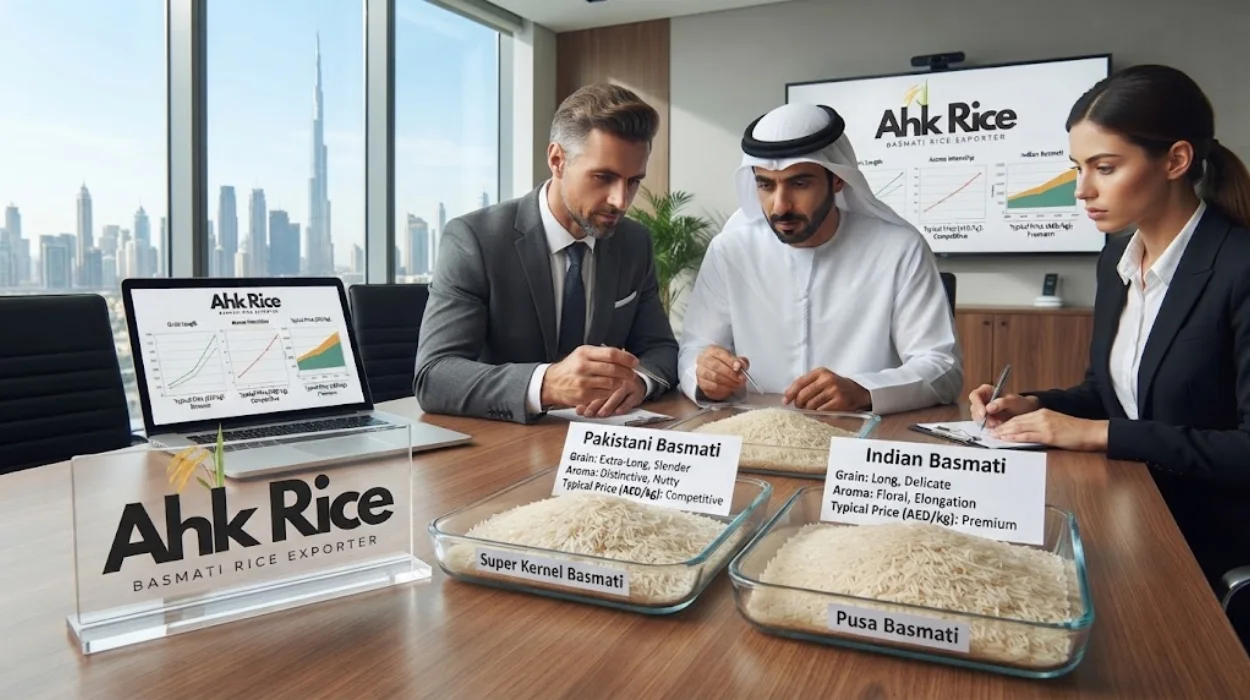
Pakistani Basmati offers stronger traditional aroma and competitive FOB pricing, while Indian Basmati offers broader 1121 volume and strong visual grain uniformity. Here is why: UAE buyers compare origin, variety, grain length, aroma, processing, price, and supply reliability rather than country name alone. The right choice depends on the required specification and customer segment.
The UAE is a major destination for both origins. In December 2025, Pakistan exported 74,897 tonnes of rice to the UAE, including 16,850 tonnes of Basmati. (source: Pakistan rice trade data reported by Dawn, January 2026). Buyers evaluating the market should first understand Pakistan’s Basmati rice demand and UAE import market before comparing individual grades.
AHK Rice supplies Pakistani Basmati from Punjab through sourcing, milling, grading, sorting, packaging, inspection, and export coordination. Its main commercial varieties include 1121, Super Kernel, and 1509. The comparison below focuses on specifications that affect UAE retail, wholesale, foodservice, and re-export decisions.
What are the available solutions for UAE Basmati buyers?
The main sourcing solutions are Pakistani 1121, Pakistani Super Kernel, Indian 1121, and Indian Pusa-type Basmati grades. Each option targets different combinations of grain appearance, aroma, cooking performance, price, and customer expectations.
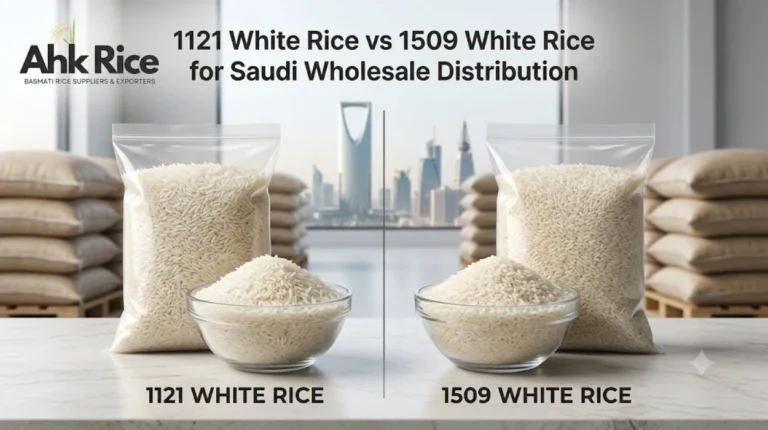
Pakistani 1121 is a long-grain Basmati suited to premium retail, foodservice, and biryani applications. Pakistani Super Kernel provides a traditional aromatic profile with a distinctive grain structure. Pakistani 1509 targets buyers seeking efficient pricing, shorter cultivation cycles, and commercial volume.
Indian Basmati covers several important export grades. Indian 1121 is widely used for long-grain retail and foodservice. Indian Pusa varieties, including 1509 and other developed cultivars, target commercial buyers seeking high yields and competitive supply.
The UAE market supports both origins because consumers include South Asian expatriates alongside broader regional buyers. Around 98% of UAE rice imports are milled or semi-milled, showing the importance of processed rice rather than paddy supply. (source: USDA Foreign Agricultural Service UAE market report).
Pakistani Basmati
Pakistani Basmati originates mainly from Punjab. Traditional production areas include districts across the Punjab Basmati belt. Pakistani milling converts harvested paddy into cleaned, dehusked, polished, graded, and sorted export rice.
Pakistani Super Kernel is especially relevant for buyers prioritising aroma. The grain develops a pronounced fragrance during cooking and maintains a separate cooked texture. This makes it suitable for biryani, pulao, premium retail, and foodservice.
Pakistani 1121 provides longer grain presentation and strong cooking elongation. It fits premium retail packs where consumers associate long grains with higher-value Basmati.
Pakistani 1509 provides a commercial alternative. Its shorter maturity cycle and strong yield support volume-oriented sourcing. The variety also works across retail, catering, restaurants, and private-label applications.
Indian Basmati
Indian Basmati originates across several northern Indian production regions. Major areas include Punjab, Haryana, western Uttar Pradesh, Uttarakhand, and adjoining Basmati-growing areas.
Indian 1121 is one of the most recognised international Basmati grades. Indian Pusa varieties also occupy significant export positions. India exported a record 6.4 million tonnes of Basmati in 2025, with the UAE among its major buyers. (source: Reuters, January 2026).
Indian supply therefore provides substantial availability and strong competition across UAE procurement channels. The wider supply base also gives importers more options across mills, grades, packaging formats, and price levels.
With the available solutions established, the next step is comparing their specifications rather than comparing country names alone.
How do Pakistani and Indian Basmati compare?
Pakistani Basmati generally leads on traditional aroma and Super Kernel availability, while Indian Basmati provides strong 1121 scale and competitive commercial supply. The specification determines the practical difference for UAE buyers.
| Attribute | Pakistani Basmati | Indian Basmati |
|---|---|---|
| Main growing region | Punjab, Pakistan | Punjab, Haryana, Uttarakhand, western Uttar Pradesh |
| Key export varieties | 1121, Super Kernel, 1509 | 1121, Pusa 1121, Pusa 1509, traditional grades |
| Raw grain profile | Long-grain and traditional aromatic types | Long-grain and developed Basmati types |
| Aroma | Strong in Super Kernel and traditional grades | Strong in premium Basmati, varying by variety and ageing |
| Cooking behaviour | Long elongation with firm, separate grains | Strong elongation and visual grain presentation |
| Indicative FOB range | About US$1,135–US$1,205/MT for selected Pakistani grades | Varies by variety, crop, processing, and supplier |
| UAE suitability | Premium retail, biryani, HORECA, wholesale, re-export | Retail, HORECA, wholesale, re-export |
The Pakistani price range above reflects indicative September 2026 FOB Karachi levels published for UAE sourcing. Pakistani 1121 White was listed around US$1,165–US$1,205/MT, while 1121 Sella was around US$1,135–US$1,175/MT. Super Kernel was around US$1,165–US$1,205/MT. (source: published UAE Pakistan rice market pricing, September 2026).
Indian Basmati pricing requires the same specification discipline. A buyer should compare variety, raw grain length, broken percentage, moisture, processing type, ageing, packing, quantity, and Incoterm before declaring one origin cheaper.
FOB price alone does not establish landed cost. UAE buyers should add ocean freight, insurance where applicable, destination charges, customs clearance, inspection, local transport, packaging requirements, and financing costs.
The comparison becomes more useful after separating premium grain demand from cost-sensitive volume demand.
Which grain and aroma profile works best in the UAE?
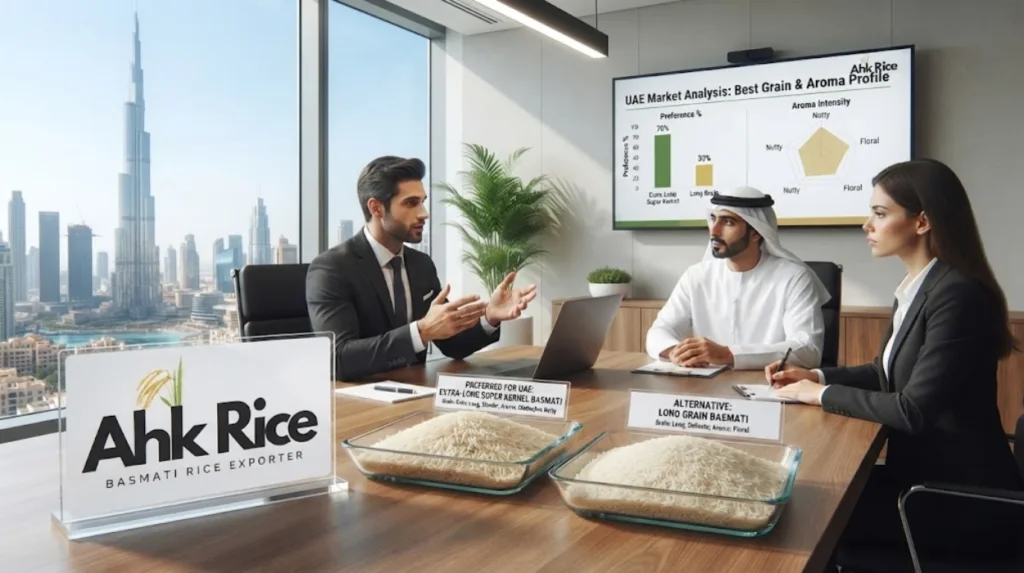
1121 works best for long-grain visual presentation, while Super Kernel works best for buyers prioritising traditional aroma and distinctive cooked character. The choice should follow the end customer rather than origin preference.
1121 Basmati for visual grain length
1121 Basmati is a strong choice for premium retail and biryani applications. The variety produces long cooked grains with pronounced elongation. Retailers can position the visual appearance as a key quality attribute.
Pakistani 1121 and Indian 1121 should be compared using the same measurement basis. Raw grain length and cooked grain length are different specifications. A procurement sheet should never compare one supplier’s raw measurement with another supplier’s cooked measurement.
Super Kernel for aroma
Super Kernel is a Pakistani Basmati variety associated with traditional aroma and firm cooked grains. Its commercial value comes from the combination of fragrance, texture, and cooking performance.
Super Kernel fits UAE retailers serving customers who recognise traditional Pakistani Basmati characteristics. It also suits restaurants and catering operations where aroma contributes directly to the eating experience.
1509 for commercial efficiency
1509 targets a different procurement objective. The variety matures faster than traditional Basmati types and supports high-volume cultivation. Pakistani 1509 is therefore useful for buyers balancing Basmati positioning with cost control.
The UAE buyer should match 1509 to price-sensitive retail, catering, and foodservice channels. Premium visual positioning remains better suited to selected 1121 grades.
With grain and aroma separated by use case, the next comparison is price and shelf-life performance.
How do price and shelf life compare?
Pakistani Basmati can provide competitive FOB pricing, while Sella processing provides strong storage suitability for UAE distribution and wholesale inventory. Final economics depend on grade, processing, origin, freight, and storage conditions.
India remains the largest rice supplier to the UAE by total rice import value, while Pakistan holds a strong second position. In MY 2024/25, UAE rice imports reached 1,171,097 tonnes, with India supplying 786,444 tonnes and Pakistan supplying 347,803 tonnes. (source: USDA Foreign Agricultural Service citing Trade Data Monitor).
For UAE buyers, this creates a competitive two-origin sourcing environment. India provides significant supply scale. Pakistan provides another major supply base with strong Basmati participation.
Price comparison
Indicative Pakistani FOB prices show how processing affects procurement value. Pakistani 1121 Sella was priced below comparable 1121 White levels in the cited September 2026 market listing. (source: published UAE Pakistan rice market pricing, September 2026).
Indian Basmati pricing changes with crop availability, export volumes, milling costs, currency movements, and government policy. India’s rice exports increased sharply in 2025 after export restrictions were lifted, with total rice exports reaching 21.55 million tonnes. (source: Reuters, January 2026).
For a UAE buyer, the correct comparison is therefore landed cost per metric tonne, not the headline FOB price.
Shelf-life comparison
White Basmati requires controlled storage and disciplined stock rotation. Sella and Golden Sella provide strong options for buyers requiring processed rice with robust storage characteristics.
Golden Sella is particularly suited to catering, institutional foodservice, wholesale, and long-distribution cycles. Its parboiling process improves grain firmness and reduces cooking breakage.
Steam rice suits buyers seeking a fresher white appearance and strong retail presentation. Golden Sella suits buyers prioritising storage resilience and large-scale cooking.
Shelf life depends on moisture, packaging, warehouse temperature, humidity, pest control, and product condition. A fixed shelf-life number should therefore come from the approved product specification rather than a generic country comparison.
The price and storage comparison shows why UAE procurement should evaluate total operating cost instead of unit price alone.
Which method works best for different UAE market cases?
Pakistani Super Kernel suits aroma-led premium demand, Pakistani 1121 suits premium long-grain demand, and 1509 suits cost-focused volume distribution. Indian 1121 remains strong where supply scale and competitive commercial sourcing dominate.
Premium retail
Premium retail benefits from 1121 or Super Kernel. 1121 creates strong visual shelf appeal. Super Kernel creates a stronger traditional aroma proposition.
Packaging also influences this segment. Retailers can use 1 kg, 2 kg, 5 kg, or larger formats according to customer demand and distribution strategy.
HORECA
HORECA buyers should prioritise cooking consistency, grain integrity, breakage, and yield per cooked kilogram. 1121 supports long-grain biryani presentation. Super Kernel supports aromatic traditional dishes.
Golden Sella works particularly well for catering operations requiring consistent cooked grain performance across large batches.
Wholesale and re-export
Wholesale distributors should prioritise landed cost, shelf life, packaging, availability, and documentation. Pakistani 1509 can serve price-sensitive channels. Pakistani 1121 and Super Kernel serve higher-value Basmati segments.
The UAE is also an important re-export hub. Trade reporting identifies the UAE as a major gateway for rice moving into wider Gulf and regional markets. (source: Rice News Today market report).
With market applications defined, buyers can reduce the decision to a practical procurement framework.
What are the pros and cons of each origin?
Pakistani Basmati provides strong aroma options and competitive sourcing, while Indian Basmati provides exceptional scale and extensive grade availability. Neither origin wins every procurement objective.
Pakistani Basmati
Pros
- Strong Super Kernel aroma
- Competitive 1121 and Sella pricing
- Strong UAE market presence
- Multiple Basmati processing formats
- Short Karachi-to-UAE shipping route
Cons
- Smaller overall rice export scale than India
- Variety availability differs by mill
- Premium grades require specification-based sourcing
Indian Basmati
Pros
- Very large export supply
- Strong 1121 availability
- Broad mill and supplier base
- Strong UAE distribution presence
- Competitive commercial pricing
Cons
- Pricing changes with Indian export policy
- Supplier quality varies between mills
- Variety names require specification verification
India and Pakistan both supply the UAE at substantial scale. The UAE imported 347,803 tonnes from Pakistan in MY 2024/25, while India supplied 786,444 tonnes. (source: USDA Foreign Agricultural Service citing Trade Data Monitor).
These advantages and disadvantages lead directly to the procurement decision.
What factors should UAE buyers use before choosing?
UAE buyers should rank specification, aroma, grain length, landed price, shelf life, documentation, and supply continuity before selecting an origin. This prevents country preference from replacing measurable procurement criteria.
| Decision factor | Pakistani choice | Indian choice | Best application |
|---|---|---|---|
| Aroma | Super Kernel | Premium Basmati | Aroma-led retail |
| Grain appearance | 1121 | 1121 | Premium retail and biryani |
| Cost control | 1509 / selected 1121 | Competitive 1121 and Pusa | Volume distribution |
| Storage | Sella / Golden Sella | Sella / Golden Sella | Catering and wholesale |
| Supply strategy | Pakistan-origin programme | India-origin programme | Dual sourcing |
A specification sheet should define grain length, broken percentage, moisture, foreign matter, damaged grains, processing type, crop year, packing format, and inspection requirements.
A sample should then be tested through cooking trials. The buyer should compare aroma, elongation, firmness, breakage, colour, and cooked yield.
A commercial order should follow approved samples and confirmed specifications. The final contract should state the exact variety, processing type, packing, quantity, Incoterm, inspection terms, and shipping schedule.
With these decision factors established, the choice between Pakistani and Indian Basmati becomes a specification decision rather than a country-level argument.
What should UAE buyers choose?
Choose Pakistani Super Kernel for traditional aroma, Pakistani 1121 for premium long-grain positioning, 1509 for cost-sensitive volume, and Indian 1121 for broad commercial sourcing. The best option depends on the buyer’s customer and operating model.
A premium Dubai retailer serving South Asian households can prioritise Super Kernel or 1121. A catering distributor can prioritise Golden Sella for storage and batch cooking. A price-sensitive wholesaler can compare Pakistani 1509 against Indian commercial grades.
A UAE importer should also compare suppliers using identical specifications. A lower quotation does not represent better value when it contains higher broken percentage, weaker grain length, unsuitable moisture, or inferior packaging.
AHK Rice provides Pakistani 1121, Super Kernel, and 1509 through end-to-end processing and export coordination. The supplier’s role is to align the selected variety with the buyer’s required specification, packaging, quantity, and destination.
The final sourcing decision should therefore come from a matched sample, specification sheet, landed-cost calculation, and documented commercial terms.
Frequently Asked Questions
Is Pakistani Basmati better than Indian Basmati?
Neither origin is universally better. Pakistani Basmati provides strong traditional aroma, especially Super Kernel. Indian Basmati provides large-scale 1121 supply and broad commercial availability. UAE buyers should compare matching varieties and processing specifications.
Is Pakistani Basmati cheaper than Indian Basmati?
Pakistani Basmati can offer competitive FOB pricing. Actual price depends on variety, processing, crop, grade, packing, quantity, and Incoterm. UAE buyers should compare landed cost rather than FOB alone.
Which Pakistani Basmati is best for UAE buyers?
1121 suits premium long-grain retail and biryani. Super Kernel suits aroma-focused premium demand. 1509 suits cost-sensitive volume distribution. Golden Sella suits catering and wholesale storage requirements.
Which Basmati has stronger aroma?
Traditional Pakistani Super Kernel is recognised for a pronounced aromatic profile. Aroma also depends on variety, crop, ageing, storage, and processing. Buyers should confirm aroma through a cooking sample before placing volume orders.
Is Indian 1121 better than Pakistani 1121?
Indian and Pakistani 1121 can both deliver long cooked grains and strong Basmati characteristics. The better commercial choice depends on grain specification, broken percentage, aroma, processing, price, and supplier consistency.
Which Basmati is better for UAE catering?
Golden Sella and other Sella grades suit catering operations requiring firm grains and consistent batch cooking. 1121 works well for premium biryani presentation. Super Kernel suits menus where traditional aroma is a major selling attribute.
How should UAE buyers compare Pakistani and Indian rice prices?
Compare FOB price, freight, insurance, destination charges, clearance, packaging, inspection, and financing. Calculate the complete landed cost per metric tonne before selecting the supplier.
Why is the UAE important for Pakistani Basmati?
The UAE is a major Pakistani rice destination and an important regional distribution market. Pakistan exported 74,897 tonnes of rice to the UAE in December 2025, including 16,850 tonnes of Basmati. (source: Dawn, January 2026).