What is rice import regulations Indonesia 2026?
Rice import regulations Indonesia 2026 define legal rules, licensing procedures, quotas, and compliance requirements governing how rice enters Indonesia, controlled by agencies such as the Ministry of Agriculture and BULOG to ensure food security, price stability, and quality standards nationwide.
Rice import regulations Indonesia 2026 refer to the full legal framework that controls rice entry into Indonesia.
These rules define who can import rice, how much can be imported, and under which conditions imports are approved.
Indonesia treats rice as a strategic food commodity.
The government regulates imports to protect domestic farmers and stabilize consumer prices.
The system is based on coordination between multiple institutions.
The Ministry of Agriculture Indonesia handles agricultural safety and plant health approvals.
BULOG manages state rice reserves and stabilizes market supply.
Regulations cover three core layers.
The first layer is import licensing eligibility.
The second layer is quota allocation based on national demand and harvest cycles.
The third layer is quality and phytosanitary compliance for food safety.
In practice, rice imports are not continuous throughout the year.
They are activated when domestic production falls below national consumption requirements.
Examples of regulated scenarios include emergency imports during drought years or controlled imports before Ramadan demand peaks.
This structure ensures Indonesia does not depend fully on foreign rice supply while still allowing imports for food security balance.
How do Indonesia rice import permits work?
Indonesia rice import permit system requires importers to obtain approval documents from the Ministry of Agriculture trade licenses and allocation quotas ensuring only authorized entities can import rice under strict monitoring inspection and reporting rules enforced by government authorities officially.
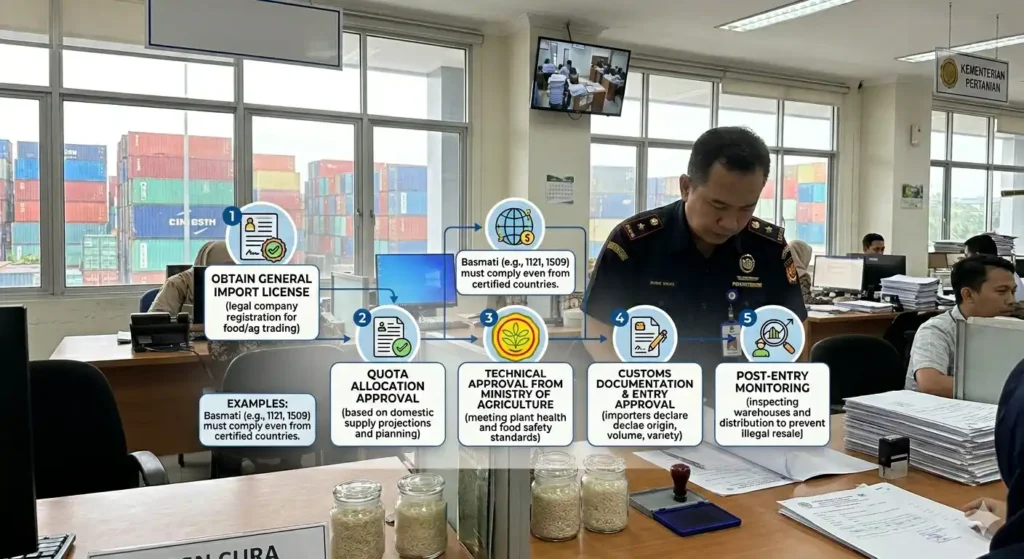
The Indonesia rice import permit system operates through a multi-stage approval process.
No importer can bring rice into Indonesia without official authorization.
The first step is obtaining a general import license.
This license confirms the company is legally registered for food or agricultural commodity trading.
The second step is quota allocation approval.
Quotas are issued based on domestic supply projections and government import planning.
The third step is technical approval from the Ministry of Agriculture Indonesia.
This approval confirms that the rice shipment meets plant health and food safety standards.
Each shipment is also tracked through customs documentation.
Importers must declare origin, volume, and variety before entry approval.
Monitoring continues after entry into the country.
Authorities inspect warehouses and distribution channels to prevent illegal resale or price manipulation.
Examples include importers of Basmati rice varieties such as 1121 and 1509, which must still comply with Indonesian regulatory approval even when sourced from certified exporting countries.
What are key components of Ministry of Agriculture rice Indonesia import system?
The Ministry of Agriculture rice import system in Indonesia includes licensing validation phytosanitary inspection import quota allocation quality control standards and coordination with customs and BULOG to regulate rice inflow maintain domestic production balance and protect national food security policies.
The Ministry of Agriculture Indonesia acts as the technical authority in rice import regulation.
Its role is to ensure imported rice does not threaten agriculture sustainability or food safety.
The first component is licensing validation.
This ensures only eligible companies can apply for import permission.
The second component is phytosanitary inspection.
This process checks for pests, diseases, and contamination risks in imported rice shipments.
The third component is quota allocation.
Quotas are based on national consumption data and local harvest output.
The fourth component is quality control standards.
Rice must meet size, moisture, and purity thresholds before entry approval.
The fifth component is inter-agency coordination.
The ministry works with customs authorities and BULOG for enforcement and distribution alignment.
Examples include coordination during low-harvest years when imports are increased to stabilize supply.
This system ensures imported rice supports national food balance rather than disrupting local agricultural markets.
What is BULOG rice policy role in imports?
BULOG, Indonesia’s state logistics agency, manages rice import distribution buffer stock levels price stabilization and procurement planning ensuring national availability during shortages controlling market volatility and coordinating imports with government agencies to maintain strategic food reserves across Indonesia effectively nationwide.
BULOG Indonesia is the central institution for rice logistics and price control.
It is responsible for managing national rice reserves and market stability.
Its first role is import absorption.
When rice imports are approved, BULOG distributes or stores them depending on national demand.
Its second role is buffer stock management.
BULOG maintains strategic rice reserves to respond to shortages or price spikes.
Its third role is price stabilization.
It releases rice into the market when prices increase beyond government thresholds.
Its fourth role is procurement planning.
It coordinates domestic purchase from farmers and integrates imported rice into the supply chain.
Examples include emergency rice release programs during supply shortages or inflation control interventions in major cities like Jakarta and Surabaya.
BULOG acts as a balancing mechanism between domestic production and international imports.
What certifications are required including Halal rice Indonesia?
Rice imports in Indonesia require phytosanitary certificates country of origin documents halal certification from BPJPH and quality conformity reports to ensure compliance with food safety laws religious standards and national import regulations enforced by relevant Indonesian authorities strictly nationwide compliance.
Rice import certification in Indonesia is a multi-document compliance system.
Each shipment must meet food safety, legal, and religious requirements.
The first required document is the phytosanitary certificate.
This confirms the rice is free from pests and agricultural diseases.
The second requirement is the country of origin certificate.
This verifies the exporting country and production traceability.
The third requirement is halal certification Indonesia.
This is issued by BPJPH (Badan Penyelenggara Jaminan Produk Halal).
It confirms that rice processing complies with Islamic dietary standards.
The fourth requirement is quality conformity certification.
This ensures the rice meets Indonesian grading and safety benchmarks.
Examples include imported long-grain rice shipments that must be verified both at origin and upon arrival before customs clearance.
These certifications ensure imported rice is safe, traceable, and acceptable for Indonesian consumers.
Which countries and companies can import rice into Indonesia use cases?
Only licensed Indonesian importers state agencies like BULOG and approved trading companies can import rice into Indonesia subject to quotas government approvals and international trade agreements with shipments controlled to balance domestic supply stabilize prices and ensure food security compliance.
Rice import eligibility in Indonesia is strictly controlled.
Only authorized entities can participate in the import process.
State agencies such as BULOG have priority rights for import operations.
They manage national reserves and emergency supply chains.
Licensed private importers can participate under government-issued quotas.
These companies must meet financial, operational, and regulatory requirements.
International trade agreements also influence sourcing countries.
Indonesia imports rice from countries with approved agricultural and trade compliance systems.
Examples include commercial importers handling specialty rice varieties such as long-grain or aromatic rice for food service sectors and retail distribution.
Imports are used for three main purposes.
The first is price stabilization during inflation periods.
The second is supply balancing during low harvest seasons.
The third is meeting industrial and food service demand.
This system ensures controlled participation in rice trade while maintaining national food sovereignty.
What are common problems or misconceptions in Indonesia rice import regulations?
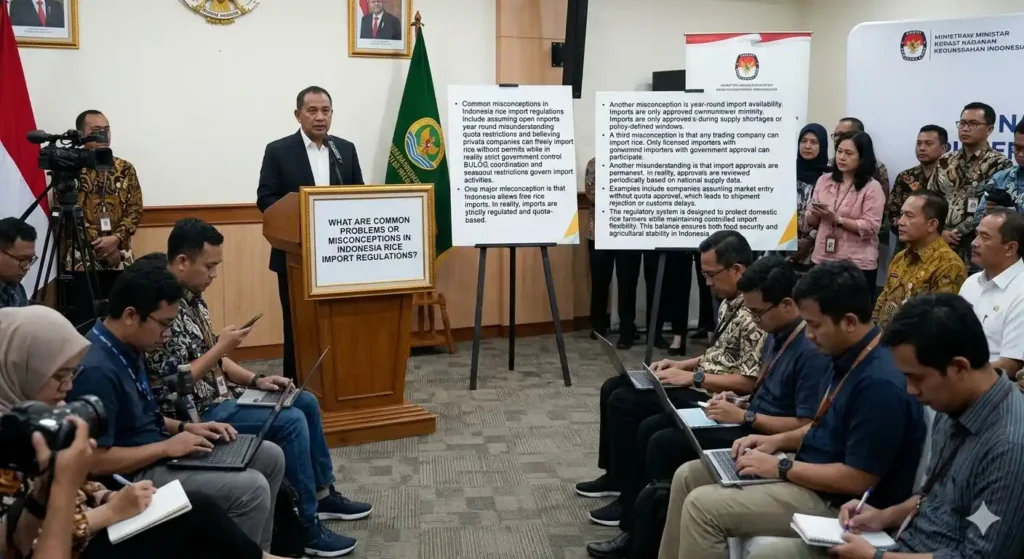
Common misconceptions in Indonesia rice import regulations include assuming open imports year round misunderstanding quota restrictions and believing private companies can freely import rice without permits while in reality strict government control BULOG coordination and seasonal restrictions govern import activities.
One major misconception is that Indonesia allows free rice imports.
In reality, imports are strictly regulated and quota-based.
Another misconception is year-round import availability.
Imports are only approved during supply shortages or policy-defined windows.
A third misconception is that any trading company can import rice.
Only licensed importers with government approval can participate.
Another misunderstanding is that import approvals are permanent.
In reality, approvals are reviewed periodically based on national supply data.
Examples include companies assuming market entry without quota approval, which leads to shipment rejection or customs delays.
The regulatory system is designed to protect domestic rice farmers while maintaining controlled import flexibility.
This balance ensures both food security and agricultural stability in Indonesia.
What are benefits of structured import regulation system?
A structured import regulation system in Indonesia ensures stable rice prices controlled supply chains farmer protection food security and transparent licensing enabling government agencies to manage imports efficiently while preventing market shortages and maintaining national agricultural sustainability long term stability.
A structured import regulation system creates predictable food supply management.
It ensures that rice availability remains stable across urban and rural markets.
One key benefit is price stabilization.
Controlled imports prevent sudden inflation in rice markets.
Another benefit is farmer protection.
Import timing is adjusted to avoid disrupting domestic harvest cycles.
Food security is strengthened through coordinated reserves managed by BULOG.
This ensures emergency supply availability during crises or droughts.
Transparent licensing improves trade accountability.
Only verified companies participate in import operations.
Examples include coordinated import releases during seasonal shortages to stabilize national consumption demand.
The system also strengthens agricultural planning.
Domestic farmers receive predictable market conditions due to regulated import timing.