What Labelling Rules Apply to Basmati Rice Sold in the USA?
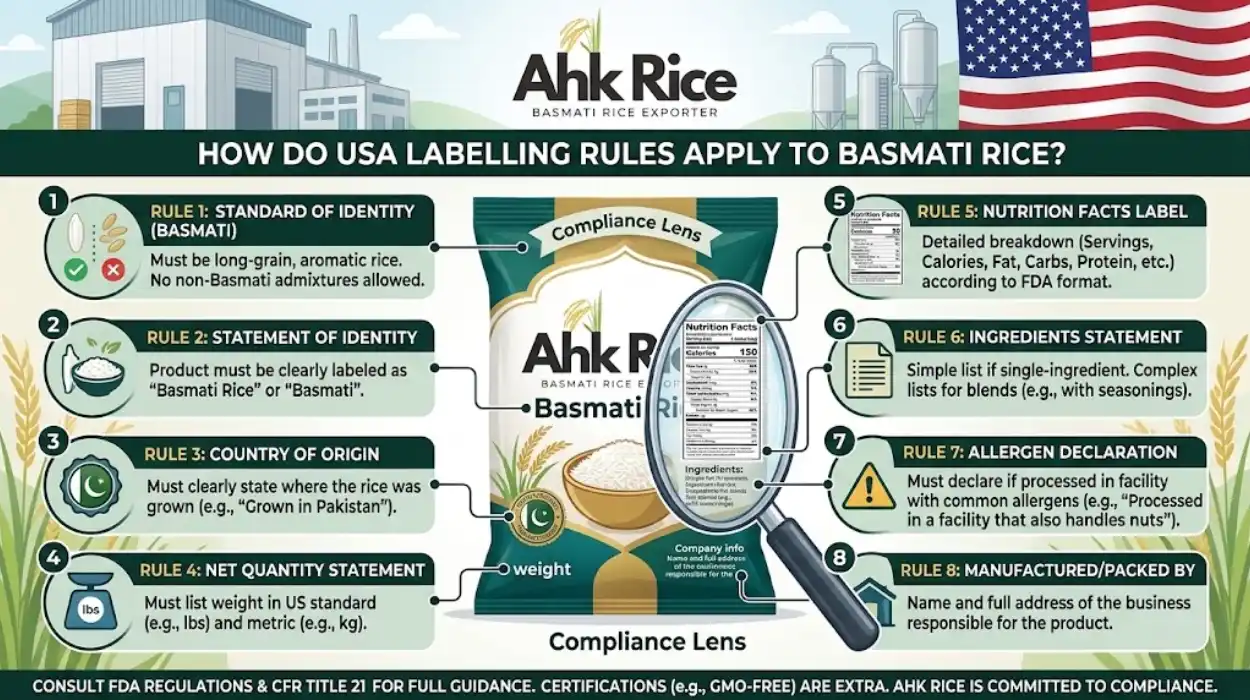
Basmati rice sold in the United States must follow applicable U.S. food-labeling requirements, including truthful product identification, net quantity declarations, and English-language labeling. Imported rice also requires country-of-origin marking under U.S. Customs and Border Protection rules. Nutrition Facts and allergen declarations depend on the product and applicable exemptions.
For importers, distributors, and private-label brands, understanding these requirements helps prevent misbranding, relabeling costs, and shipment delays. Pakistani Basmati rice varieties, including 1121, Super Kernel, and 1509 Basmati rice, need labels that accurately describe the grain, processing method, package weight, and origin. The exact requirements depend on whether the rice is plain, seasoned, or sold as a prepared product.
What Are the U.S. Labelling Rules for Basmati Rice?
U.S. labeling rules require imported packaged rice to carry truthful, non-misleading information in English and comply with applicable FDA food-labeling regulations. Importers must also meet country-of-origin marking requirements, declare net quantity, and provide other mandatory information applicable to the product.
The U.S. Food and Drug Administration (FDA) regulates most packaged foods, including ordinary milled rice. U.S. Customs and Border Protection (CBP) administers country-of-origin marking requirements for imported goods. These responsibilities are related but separate.
A retail bag of Pakistani Basmati rice should identify the food clearly, state its net quantity, and provide the required business identification. The label must not make unsupported claims about grain quality, health benefits, geographic origin, or certifications.
For example, a 5 lb bag can identify the product as “Basmati Rice” and display its net weight. A variety name such as “1121 Basmati Rice” adds product-specific information when accurate.
FDA examines imported food for compliance with applicable safety and labeling rules. The agency does not preapprove every imported food label or shipment. Importers remain responsible for ensuring that products meet the requirements before entering U.S. commerce.
How Does Food Labelling Work for Imported Basmati Rice?
Imported Basmati rice passes through a labeling and import-compliance process involving the exporter, U.S. importer, customs authorities, and FDA where applicable. Each party must ensure that product information, origin marking, shipment documentation, and food-safety obligations are consistent.
The process starts when the exporter confirms the rice variety, grade, processing method, and intended package size. The importer then determines the applicable U.S. label requirements and approves the packaging artwork.
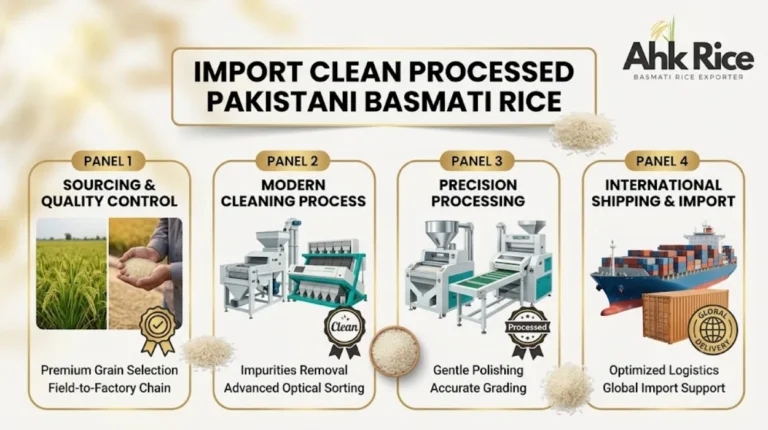
The exporter prepares the rice through cleaning, milling, grading, and sorting. Depending on the product, processing also includes steaming or parboiling. The final packaging must accurately represent the product inside.
Before shipment, the commercial invoice, packing list, product specifications, and origin documents should agree with the goods being exported. FDA prior notice and applicable food-facility registration requirements must also be addressed. The importer must evaluate its Foreign Supplier Verification Program (FSVP) responsibilities.
At entry, authorities can examine the shipment, request documentation, collect samples, or take enforcement action when requirements are not met. Correct artwork reduces avoidable errors, but it does not replace food-safety compliance.
Which Information Must Appear on a Basmati Rice Bag?
A U.S. retail rice label generally identifies the food, declares net quantity, and provides the required manufacturer, packer, or distributor details. Nutrition Facts and ingredient declarations apply according to FDA rules and exemptions, while imported products require appropriate country-of-origin marking.
The label’s principal display panel is the part most likely to be seen at the point of sale. It normally carries the product identity and net quantity.
The information panel contains other required information where applicable. Businesses should review label placement, type size, readability, and the relationship between mandatory statements.
| Label component | What it communicates | Example |
|---|---|---|
| Product identity | The food inside the package | Basmati Rice |
| Variety or grade | The specific rice type, if accurately claimed | 1121 Basmati Rice |
| Net quantity | The amount of rice, excluding packaging | Net Wt. 5 lb (2.27 kg) |
| Country of origin | Where the imported product originates | Product of Pakistan |
| Responsible business | The applicable manufacturer, packer, or distributor identification | Distributed by [U.S. business name and address] |
| Ingredients | Ingredients when an ingredient statement is required | Ingredients: Basmati rice |
| Nutrition Facts | Required nutrition information unless an exemption applies | FDA-compliant Nutrition Facts panel |
The table is a planning guide, not a substitute for reviewing the applicable regulations. For example, the ingredients statement is generally not required for a food consisting of a single ingredient when the applicable exemption applies. Nutrition labeling also has exemptions with specific eligibility conditions.
The U.S. business name and address must be presented in the manner required by FDA regulations. If the named business is not the actual manufacturer, qualifying wording such as “Distributed by” or “Manufactured for” identifies its relationship to the product.
Are Nutrition Facts Mandatory on Imported Basmati Rice Bags?
Nutrition Facts labeling generally applies to packaged retail foods unless the product or business qualifies for an applicable exemption. Importers must confirm eligibility under FDA rules rather than assume that plain rice is automatically exempt because it contains one ingredient.
A Nutrition Facts panel communicates the nutritional content of a packaged food. Depending on the applicable format and requirements, it includes serving size, calories, and specified nutrients.
Plain Basmati rice consists of one ingredient, but that fact alone does not establish a blanket exemption from nutrition labeling. FDA regulations provide exemptions for certain foods and businesses, subject to eligibility conditions and restrictions.
A rice importer should establish whether the product qualifies for an exemption before finalizing artwork. Nutrition or health claims can affect the availability of an exemption. A product making claims about fiber, sodium, or another nutrient requires particular attention to the relevant rules.
Nutrition information must be accurate and presented in the applicable FDA format. Importers should not copy nutrition values from a different rice variety or processed product without confirming that the information represents the product being sold.
For example, a plain white Basmati rice product and a seasoned rice mix have different ingredient profiles. The seasoned mix requires evaluation of its added ingredients and applicable labeling obligations.
Businesses should use FDA’s current labeling guidance to determine whether the Nutrition Facts panel is mandatory and which format applies.
What Country-of-Origin Information Is Required for Pakistani Basmati Rice?
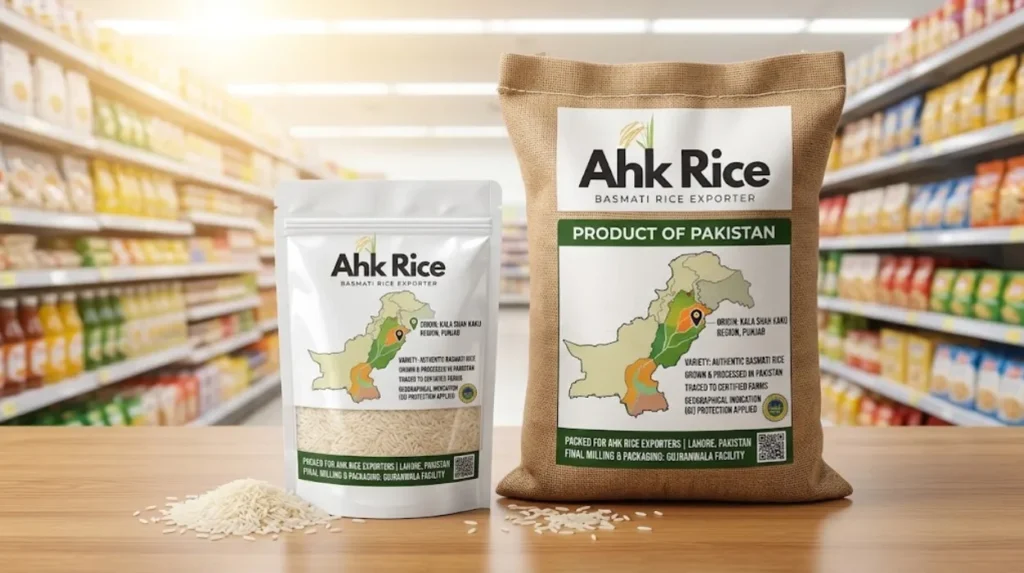
Imported Basmati rice must comply with applicable U.S. country-of-origin marking requirements. For rice grown and processed in Pakistan, a clear statement such as “Product of Pakistan” accurately identifies the origin when supported by the shipment’s production and import records.
CBP rules generally require imported foreign-origin goods to be marked in English with the country of origin in a conspicuous and legible manner, subject to applicable exceptions. The marking must allow the ultimate purchaser to identify the origin.
For Pakistani Basmati rice, the origin statement should match the actual product and supporting documentation. A Pakistani exporter should not use “Product of India” or another country designation for rice originating in Pakistan.
The USDA’s retail Country of Origin Labeling (COOL) program covers specified commodities, including certain meats, fish, produce, nuts, and ginseng. Ordinary packaged rice is not included in that list. However, this does not remove the separate CBP country-of-origin marking requirement for imported rice.
A country name, flag, or marketing phrase should not create a misleading impression about where the rice was grown or produced. Origin statements must be truthful and consistent with applicable customs rules.
Importers should confirm how the marking applies to the retail package and any outer shipping container.
How Do FDA Allergen Rules Apply to Plain Basmati Rice?
Plain Basmati rice is not one of the nine major U.S. food allergens. A single-ingredient rice product does not require a major-allergen declaration solely because it contains rice, but added ingredients and relevant manufacturing cross-contact risks require separate evaluation.
U.S. federal law identifies nine major food allergens: milk, eggs, fish, crustacean shellfish, tree nuts, peanuts, wheat, soybeans, and sesame. When a major allergen is present as an ingredient, its source must be declared according to the applicable labeling rules.
Plain white, brown, steamed, or parboiled rice does not automatically contain one of these allergens. However, seasoned rice products can contain allergenic ingredients such as soy sauce containing soy or wheat.
Manufacturing facilities also need to assess cross-contact risks. Rice processed or packed on shared equipment can encounter allergen residues from other products. Businesses must evaluate their actual processes and determine appropriate controls and labeling.
A precautionary statement such as “May contain wheat” is not a substitute for effective allergen controls. Such statements should not be used casually or without a risk-based justification.
Importers should compare the product formulation, ingredient records, facility controls, and final label. FDA does not establish a general allergen threshold that makes every low-level presence acceptable.
How Are Basmati Rice Varieties Processed Before Packaging?
Export Basmati rice is cleaned, milled, graded, sorted, and packed according to its variety and commercial specification. Processing determines the product’s appearance, grain condition, and preparation characteristics, while the label must accurately describe the finished rice.
Basmati rice is grown in South Asian regions, including Punjab in Pakistan. Pakistan’s commercial varieties include 1121, Super Kernel, and 1509. Each variety has distinct grain characteristics and buyer applications.
What Are the Main Processing Steps?
- Paddy cleaning: Removes straw, stones, dust, and other foreign material.
- Dehusking: Removes the outer husk to produce brown rice.
- Milling: Removes bran layers to produce white rice when the product specification requires it.
- Grading: Separates whole kernels and broken grains according to agreed size and quality limits.
- Optical sorting: Uses sorting equipment to remove discolored kernels and selected defects.
- Steam treatment or parboiling: Applies a defined process when producing the relevant rice type.
- Final inspection and packing: Checks the finished lot against specifications before sealing the bags.
These stages help establish consistent product quality. They do not independently establish organic status, food-safety certification, or compliance with every U.S. import requirement.
Which Basmati Rice Grades Are Sold in International Markets?
Commercial Basmati products include different varieties, processing styles, and broken-grain grades. Buyers select them according to grain length, appearance, aroma, cooking performance, price, and end use, while the label must describe the actual product accurately.
- 1121 Basmati: Known for its long grain and is sold in white, Steam, Golden Sella, Creamy Sella, brown, and broken forms.
- Super Kernel Basmati: A traditional Pakistani variety valued for its characteristic aroma and use in retail and foodservice markets.
- 1509 Basmati: A shorter-duration crop variety available in white and processed forms, including Steam and Sella.
- Broken Basmati rice: Contains broken kernels and is sold according to the agreed broken-grain specification.
Steam and Sella describe processing styles, not separate rice varieties. Labels should not confuse a variety name with a processing designation.
Which Certifications and Compliance Checks Matter for U.S. Rice Imports?
U.S. rice importers must meet applicable food-safety and import requirements, while certifications depend on the product, facility, buyer, and specific claims. FDA does not issue blanket preapproval for each imported rice label, product, or shipment.
Importers should confirm the relevant requirements before shipment. These include applicable FDA food-facility registration, prior notice, and FSVP responsibilities. The rice must meet applicable food-safety standards, including limits governing contaminants and pesticide residues.
Buyers also request supporting documents such as a certificate of analysis, product specification, certificate of origin, or independent inspection report. The exact documents depend on the transaction and destination requirements.
HACCP-based controls and ISO 22000 food-safety management certification can support a supplier’s food-safety system. They do not replace U.S. legal obligations. Organic claims require compliance with applicable U.S. organic rules, and halal claims need suitable substantiation.
Importers should distinguish between a legal requirement, a voluntary certification, and a buyer-specific condition. This distinction prevents unnecessary label claims and helps teams verify which documents are relevant to the shipment.
What Common Labelling Mistakes Should Rice Importers Avoid?
Common mistakes include incorrect origin statements, inaccurate net weight, unsupported nutrition claims, incomplete business identification, and unverified allergen information. Importers should review the finished artwork against product records and applicable FDA and customs requirements before production.
A frequent mistake is assuming that a label approved for another country automatically meets U.S. rules. U.S. requirements differ in nutrition formatting, language, measurement declarations, and other details.
Another error is treating “Basmati,” “organic,” “non-GMO,” or “gluten-free” as interchangeable quality terms. Each claim communicates a different attribute and needs appropriate factual or regulatory support.
Net quantity must represent the rice itself, not the packaging. Product names must match the contents, and the origin statement must agree with the actual country of origin.
Importers should also avoid adding an allergen warning without assessing the product and manufacturing risks. Equally, they should not omit required allergen declarations when a major allergen is present as an ingredient.
A final review should check the product identity, net quantity, responsible business details, origin marking, nutrition requirements, ingredient information, claims, and consistency with shipment documents.
Frequently Asked Questions
What Information Must Appear on Imported Basmati Rice Bags?
Imported Basmati rice must meet applicable U.S. food-labeling and customs marking requirements. Labels generally identify the product and net quantity and provide the required responsible business details. Country-of-origin marking must also comply with CBP rules. Nutrition Facts and ingredient declarations depend on applicable FDA requirements and exemptions.
Is Nutrition Facts Labelling Mandatory for Plain Basmati Rice?
Nutrition Facts labeling generally applies to packaged retail foods unless an exemption applies. Plain rice is not automatically exempt simply because it contains one ingredient. Importers must check the applicable FDA rules, business eligibility, and any nutrition or health claims before approving packaging artwork.
Does Basmati Rice Need an Allergen Warning in the USA?
Plain Basmati rice is not one of the nine major food allergens recognized under U.S. federal law. A major-allergen declaration is required when a relevant allergen is present as an ingredient. Importers should also assess cross-contact risks and maintain appropriate manufacturing controls.
How Should Pakistani Rice State Its Country of Origin?
Rice originating in Pakistan can use a clear, accurate statement such as “Product of Pakistan,” subject to applicable marking rules. The origin declaration must agree with the actual product and supporting records. Importers should verify the placement and presentation of the marking before shipment.
Do Pakistani Basmati Rice Exporters Need FDA Approval for Their Labels?
FDA does not preapprove every imported food label or shipment. Exporters and U.S. importers remain responsible for compliance with applicable labeling and import requirements. They should review the product identity, origin, net quantity, business details, nutrition information, and ingredients before finalizing retail packaging.