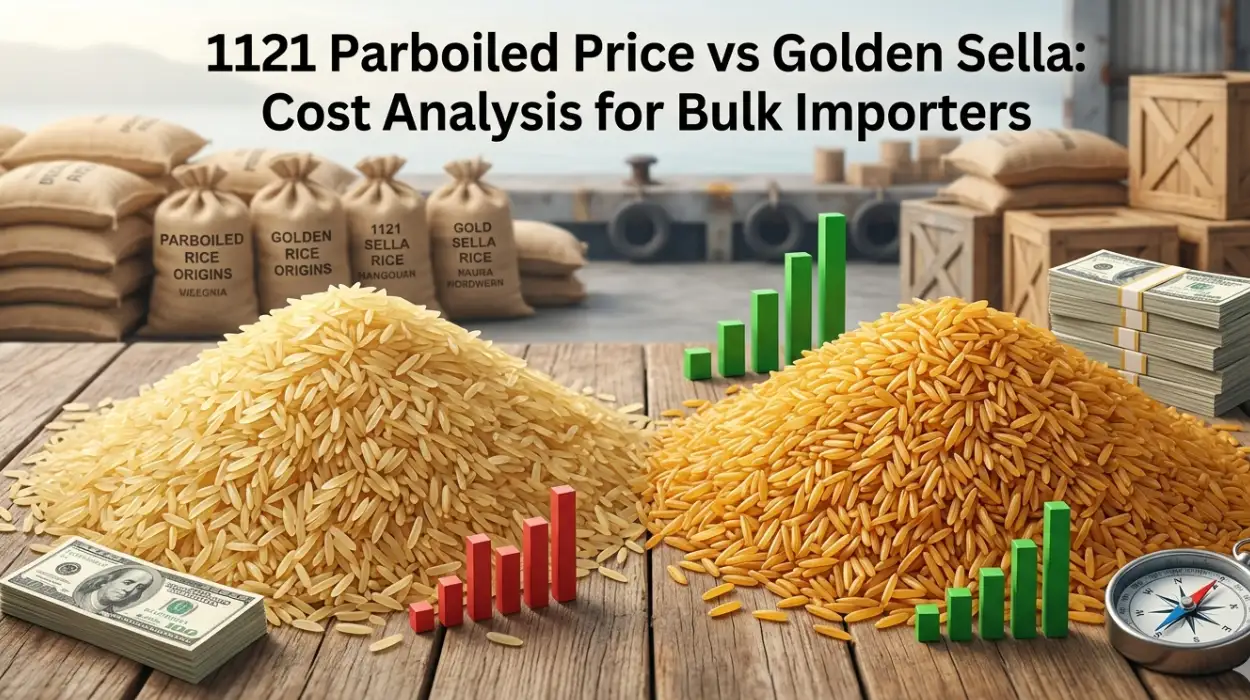
1121 Parboiled Price vs Golden Sella: Cost Analysis for Bulk Importers
1121 parboiled usually delivers lower entry cost, while golden sella often delivers stronger premium positioning and tighter appearance consistency for bulk importers. For buyers comparing parboiled vs golden sella cost, the right choice depends on target market, shelf-life expectations, specification tolerance, and the landed price per MT.
The first product mention naturally fits on parboiled GI and processing, while the service-page anchor fits where the buyer evaluates commercial supply and certification fit. I have kept both link placements context-aware in line with your requested structure.
What are the available solutions?
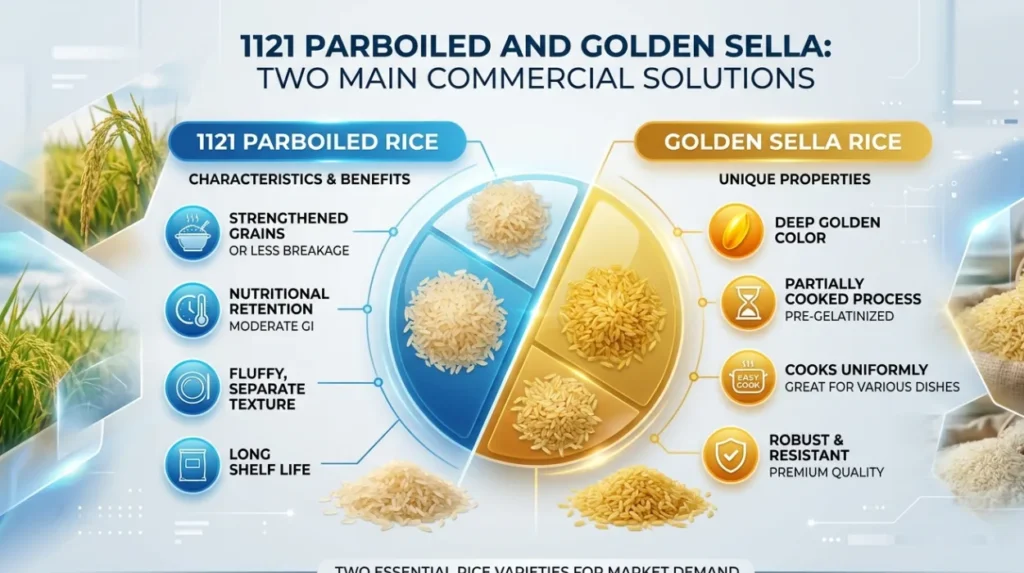
1121 parboiled and golden sella are the two main commercial solutions, and both serve bulk importers differently because they balance cost, grain appearance, and cooking performance in different ways. 1121 parboiled is the practical value option for high-volume buyers. Golden sella is the more appearance-led option for markets that pay for stronger visual uniformity and export presentation.
For readers who need the background first, the earlier educational article on parboiled basmati lower glycaemic index than white rice explains why parboiling changes starch structure and digestion behaviour. That context matters because cost decisions in bulk rice trade are not only about price; they are also about product category, end-market expectation, and consumer positioning.
1121 is a high-yield basmati variety that performs well in parboiled form because the kernel stays long, stable, and competitive on price. Golden sella is also parboiled, but it usually receives a stronger colour transformation and a more premium market presentation. In import trade, these two formats often sit in separate buying bands even when the underlying variety is the same.
How do different approaches compare?
The best comparison is landed cost, market fit, and grain appearance, because these 3 factors determine whether 1121 parboiled or golden sella creates stronger import value. 1121 parboiled generally has a lower purchase price per MT. Golden sella generally commands a higher price because it carries stronger visual uniformity and a premium export identity.
The price gap exists because processing intensity, colour development, and buyer perception influence the commercial rate. Parboiled 1121 usually sits as a cost-efficient specification for large-volume buyers who prioritise stable cooking and volume control. Golden sella usually attracts buyers who want a visually cleaner product and a format that supports premium retail or foodservice presentation.
Specification comparison table
| Attribute | 1121 Parboiled | Golden Sella |
|---|---|---|
| Variety base | 1121 basmati | 1121 basmati or similar premium basmati |
| Processing type | Parboiled | Parboiled with stronger colour finish |
| Grain appearance | Light golden to pale amber | Deeper golden, more uniform |
| Head rice recovery | High | High |
| Cooking texture | Firm, separate grains | Firmer, more visually premium |
| Typical bulk price per MT | Lower | Higher |
| Best use case | High-volume import, cost control | Premium retail, presentation-led trade |
This table shows the central trade-off. 1121 parboiled wins on cost efficiency. Golden sella wins on visual premium and buyer perception. Importers that sell into value-sensitive channels normally benefit from 1121 parboiled. Importers that sell into presentation-sensitive channels normally prefer golden sella.
The difference is also visible in customer perception. Golden sella often signals a more premium finish at point of sale, even when the cooked performance is similar. 1121 parboiled is often chosen where buyers want reliable performance at a lower acquisition cost. In basmati cost analysis, that distinction often matters more than the variety name alone.
Which method works best for different cases?
1121 parboiled works best for cost-sensitive bulk importers, while golden sella works best for buyers who need stronger shelf appeal and premium market signalling. The deciding factor is not only the rice itself. It is the channel into which the rice enters after import.
For foodservice buyers, 1121 parboiled often delivers stronger value. It gives long grains, stable cooking, and better price control across large container orders. That matters for buyers who manage food margins tightly and require consistent volume. It also works well where the final consumer does not pay for visual premium at the same level as retail shoppers.
For supermarket and branded retail buyers, golden sella often fits better. The grain colour and polished appearance support a cleaner visual shelf presence. The market pays for perception as much as performance in these channels. That means golden sella can justify a higher per-MT cost if the buyer expects stronger retail conversion.
For distributors selling into mixed markets, the decision usually depends on segmentation. Some customers want the lowest landed cost possible. Others want a more premium-looking basmati that supports higher resale margins. In that case, the importer often splits volumes between the two formats to balance margin protection and shelf positioning.
What are the pros and cons?
1121 parboiled offers better cost efficiency and easier volume procurement, while golden sella offers stronger premium presentation and better shelf differentiation. Each format creates a different commercial outcome depending on how the importer earns margin. The right choice follows the buyer’s route-to-market, not only the rice specification.
1121 parboiled pros and cons
- Reduce acquisition cost by choosing a lower price per MT, which supports margin in high-volume channels.
- Maintain cooking consistency because parboiling keeps the grain firm and separate after boiling.
- Support large shipments because 1121 parboiled is widely traded and easier to benchmark in the market.
- Accept weaker visual premium because the grain finish is less distinctive than golden sella.
- Limit retail differentiation when the buyer needs stronger shelf impact or premium branding.
Golden sella pros and cons
- Strengthen shelf appearance by using a deeper golden finish that reads as more premium in retail settings.
- Improve buyer perception because the format often aligns with export-grade presentation expectations.
- Support higher resale positioning in channels where appearance influences consumer choice.
- Increase purchase cost because the finish and market positioning usually command a premium.
- Reduce value efficiency when the buyer only needs functional rice without premium visual signalling.
The pros and cons show why the two products are not direct substitutes in every case. A lower price does not automatically create better value. A higher price does not automatically create better quality. The answer depends on whether the importer values landed cost, visual quality, or downstream resale power more heavily.
What are the decision factors for importers?
The 5 strongest decision factors are target market, landed price per MT, retail positioning, shelf life expectations, and container-level consistency. These factors determine whether 1121 parboiled or golden sella creates the better commercial result. Importers who assess all 5 usually make fewer specification mistakes.
Decision framework table
| Decision factor | 1121 Parboiled | Golden Sella |
|---|---|---|
| Target market | Value-led, bulk, foodservice | Premium retail, presentation-led trade |
| Landed price per MT | Lower | Higher |
| Shelf life expectation | Strong | Strong |
| Visual positioning | Functional and clean | Premium and more polished |
| Margin strategy | Volume-led margin | Presentation-led margin |
Target market is the first filter. Buyers in price-sensitive markets usually choose 1121 parboiled because it keeps import cost lower. Buyers in premium presentation markets choose golden sella because the product supports shelf differentiation. This is where 1121 grade price comparison becomes commercially useful, because the same variety can produce different outcomes under different processing and sales assumptions.
Landed price per MT is the second filter. Bulk importers do not buy ex-factory rice in isolation. They buy a landed product that includes freight, packing, documentation, and port handling. If the price gap between 1121 parboiled and golden sella is large enough, 1121 usually wins. If the buyer can recover the premium through retail pricing, golden sella remains viable.
Shelf life is the third filter. Both formats are stable when properly milled, dried, packed, and stored. Parboiled rice generally handles handling stress well because of its hardened kernel structure. That makes both categories useful for export, warehousing, and redistribution. In practical terms, shelf life is not usually the deciding factor unless packaging or moisture control is weak.
Visual positioning is the fourth filter. Golden sella has the advantage where consumer perception matters. 1121 parboiled suits buyers who want quality without paying for a more premium finish. This distinction matters in branded retail, institutional catering, and export distribution where packaging influences buying decisions.
Margin strategy is the fifth filter. Importers who move large tonnage through fast-turnover channels often prefer 1121 parboiled because it lowers procurement risk and preserves margin through scale. Importers that sell smaller volumes at higher value per pack often prefer golden sella because the product supports a stronger presentation premium.
How do shelf life and storage compare?
Both products have strong shelf stability, but golden sella usually performs better in premium visual retention while 1121 parboiled delivers stronger price efficiency in long-storage bulk trade. The difference is less about survival and more about how the product looks and behaves after handling.
Parboiled rice naturally has a harder structure than raw milled white rice, so it stores well when moisture is controlled. 1121 parboiled usually retains functional quality efficiently across bulk storage cycles. Golden sella also stores well, but its deeper finish is part of its commercial value, so cosmetic stability matters more in premium trade.
For importers, this means storage conditions must remain consistent. Moisture control, insect protection, packaging strength, and warehouse temperature shape final shelf outcome more than the rice label alone. In practical basmati cost analysis, storage quality can erase or protect the benefit of an apparently cheaper MT price.
What is the price per MT comparison in practice?
1121 parboiled usually sits below golden sella on a per-MT basis, and the price gap reflects processing finish, buyer demand, and market presentation value rather than a difference in basic eating quality. The exact spread changes with season, container availability, crop size, and destination market.
A bulk importer comparing both formats normally evaluates three price layers. First is ex-mill or origin pricing. Second is freight and port cost. Third is buyer resale potential. If 1121 parboiled enters at a lower rate and the market accepts it without premium finish, it creates stronger value. If golden sella sells faster or at a higher unit price downstream, the higher import cost becomes defensible.
This is why a clean parboiled vs golden sella cost evaluation always includes resale logic. A cheaper product that moves slowly is not better than a pricier product that sells at a faster margin. The comparison only works when price is linked to channel demand.
Which option should bulk importers choose?
Bulk importers should choose 1121 parboiled for cost-led volume trade and golden sella for appearance-led premium trade. The decision is simple when the market strategy is clear. It becomes difficult only when the importer tries to use one specification for two different customer segments.

Choose 1121 parboiled when the buyer needs lower landed cost, strong cooking quality, and reliable tonnage movement. Choose golden sella when the buyer needs better shelf presentation, premium retail identity, and stronger visual differentiation. Choose a split strategy when the importer serves both value and premium channels. That is often the most commercially balanced option.
This is also where product origin and supplier capability matter. A supplier with end-to-end processing, custom packaging, and export handling reduces the risk of specification drift across shipments. In that context, certified Muslim markets fits best when a buyer has already decided that this specific export format matches its market needs.