Why 1121 Basmati Rice Is Popular in International Markets
1121 Basmati Rice dominates global trade because it delivers extra-long grain length, high elongation after cooking, and consistent export-grade milling quality. Here is why: 1121 Basmati Rice cultivates in Punjab, Pakistan and India under controlled irrigation zones, then undergoes strict milling, grading, and export sorting for premium markets across the Middle East and Europe.
The grain achieves uniform performance because processors mill and polish it under moisture-controlled conditions and export it in multiple commercial grades.
What is 1121 Basmati Rice?
1121 Basmati Rice is a high-yield, extra-long grain rice variety cultivated in South Asia, known for 8.3–8.5 mm grain length and strong elongation after cooking. It serves premium export markets requiring aroma, length, and consistent texture.1121 Basmati Rice originates from hybrid breeding programs that improved grain elongation and yield stability. Farmers cultivate it in Punjab’s fertile plains using canal irrigation and controlled harvesting cycles.
Cultivation focuses on uniform maturity because uneven maturity reduces milling recovery and export quality. Farmers harvest paddy when moisture reaches optimal thresholds to protect grain integrity.
Processing centers mill the paddy through multi-stage systems. Dehusking removes the outer hull. Polishing enhances grain brightness. Grading separates broken, long, and premium kernels.
Exporters like AHK Rice supply this variety in multiple processed forms. These include raw, steam, and golden sella categories used for different global cuisines.
With the definition of 1121 Basmati Rice established, the next step is understanding how its processing system transforms raw paddy into export-grade rice.
How does 1121 Basmati Rice processing work?
1121 Basmati Rice processing works through sequential milling, parboiling, drying, polishing, and grading systems that convert harvested paddy into export-standard rice with controlled moisture, uniform grain length, and contamination-free output.
Processing starts at milling facilities where paddy is cleaned and dehulled under controlled mechanical pressure.
Clean paddy enters vibrating screens that remove dust, stones, and foreign particles. Cleaned grains move to de-husking machines that separate husk from brown rice kernels.
Parboiling applies steam and heat treatment to strengthen grain structure. Parboiled rice retains nutrients and reduces breakage during milling.
Drying stabilizes moisture levels to 12–13%, ensuring long shelf life and storage stability in humid export environments.
Polishing removes bran layers and improves appearance for retail and bulk export specifications.
Grading separates rice into export categories based on length and broken ratio.
Key processing steps include:
- Clean paddy removal of impurities and dust
- De-husk separation of hull and brown rice
- Parboil steam stabilization of grain strength
- Dry moisture reduction for storage stability
- Polish bran removal for export finish
- Grade sort by length and broken percentage
With processing mechanics established, the structure of grain quality depends on its core physical and chemical components.
What are the key components of 1121 Basmati Rice?
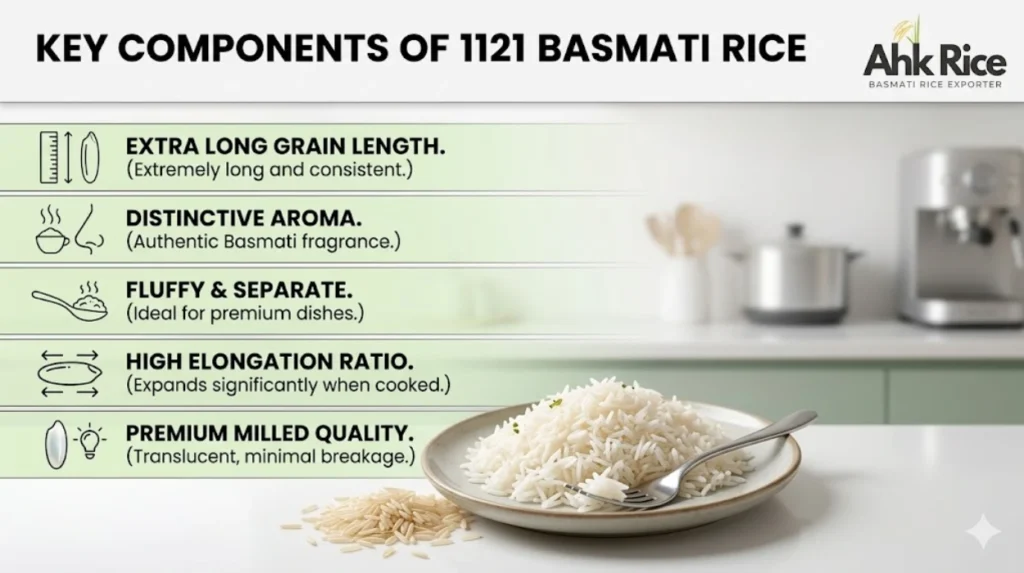
Key components of 1121 Basmati Rice include grain length, aroma compounds, amylose content, moisture ratio, and milling recovery rate, which collectively define export quality and cooking performance.
Grain length determines market classification. Export-grade 1121 requires 8.3 mm minimum length before cooking and elongation up to 2.2 times after cooking.
Aroma compounds originate from natural 2-acetyl-1-pyrroline concentration. This compound develops during cultivation in fertile Punjab soil.
Amylose content controls texture. Higher amylose produces separate, fluffy grains preferred in Middle Eastern and European cuisines.
Moisture ratio controls shelf stability. Export rice maintains 12–13% moisture content to prevent microbial growth during shipping.
Milling recovery defines economic efficiency. Higher recovery reduces export cost per ton and improves trade competitiveness.
With core components defined, the next focus shifts to the benefits that make this rice dominant in global trade.
What are the benefits of 1121 Basmati Rice?
1121 Basmati Rice provides long grain expansion, high cooking elongation, strong aroma retention, and stable export storage, making it suitable for bulk international food supply chains.
Long grain expansion improves visual appeal in plated dishes and catering services. Restaurants in Gulf countries prefer long, separate grains for rice-based meals.
Cooking elongation enhances portion value. One kilogram produces higher plate volume compared to standard long grain rice.
Aroma retention remains stable after boiling due to naturally occurring aromatic compounds preserved during controlled parboiling.
Storage stability increases export viability. In controlled warehouses at 30–40°C, parboiled variants maintain quality for up to 18 months.
Cost efficiency improves supply chain margins because milling recovery rates reduce wastage during processing.
With benefits established, the next focus shifts to how international markets use and import this rice variety.
Where is 1121 Basmati Rice used in global markets?
1121 Basmati Rice is used in Gulf catering, European retail brands, African food distribution networks, and Asian ethnic restaurants due to its long grain structure and cooking consistency.
Gulf markets such as UAE and Saudi Arabia import large volumes for catering companies serving rice-based dishes in hotels and restaurants.
European markets use 1121 Basmati Rice in branded retail packaging targeting ethnic food consumers and premium grocery chains.
African markets distribute it through wholesale importers supplying urban food systems and institutional buyers.
Asian markets use it in restaurants specializing in biryani, pilaf, and mixed rice dishes requiring aromatic grains.
Industrial food manufacturers incorporate it into ready-to-eat meals because of its stability after reheating.
[Insert Link to MOFU Article] appears here because buyers comparing grades need structured decision data between 1121 and alternative basmati categories.
With use cases defined, the next section addresses confusion and misconceptions that affect buyer decisions.
What are common problems or misconceptions about 1121 Basmati Rice?
Common misconceptions about 1121 Basmati Rice include confusion between steam and golden sella grades, misunderstanding grain length stability, and incorrect assumptions about aging and storage life.
Many buyers assume all 1121 Basmati behaves the same. In reality, processing type changes cooking behavior and shelf life.
Golden Sella 1121 undergoes parboiling, which strengthens grain structure. Steam 1121 retains softer texture and shorter storage tolerance.
Golden Sella lasts longer than Steam. In a 40°C warehouse in the UAE, Golden Sella maintains quality for 18 months. Steam requires consumption within 12 months. Iraqi catering buyers storing rice in non-climate-controlled facilities require Golden Sella specification.
Another misconception involves grain breakage. Buyers assume breakage depends only on quality. Breakage depends on milling pressure and moisture control.
A third misconception involves aroma loss. Aroma remains stable when rice is stored in sealed, moisture-controlled packaging systems.
With misconceptions clarified, the final understanding comes from aligning grades, processing, and market expectations into a structured export framework.
Frequently Asked Questions
Why is 1121 Basmati Rice preferred in export markets?
1121 Basmati Rice is preferred because it delivers high elongation, uniform grain length, and stable storage performance, which meet Gulf and European import standards.
What are the main grades of 1121 Basmati Rice?
Main grades include Raw, Steam, and Golden Sella, each processed differently to control texture, color, and shelf life for export requirements.
Which countries import 1121 Basmati Rice?
Major importers include UAE, Saudi Arabia, Iraq, UK, Germany, and African trading hubs, which use it for retail and foodservice distribution.
How long does 1121 Basmati Rice last in storage?
Properly stored 1121 Basmati Rice lasts 12–18 months, depending on whether it is steam or golden sella processed.
What makes Golden Sella different from Steam rice?
Golden Sella undergoes parboiling, which increases grain strength and shelf life, while Steam rice retains a softer texture with shorter storage stability.