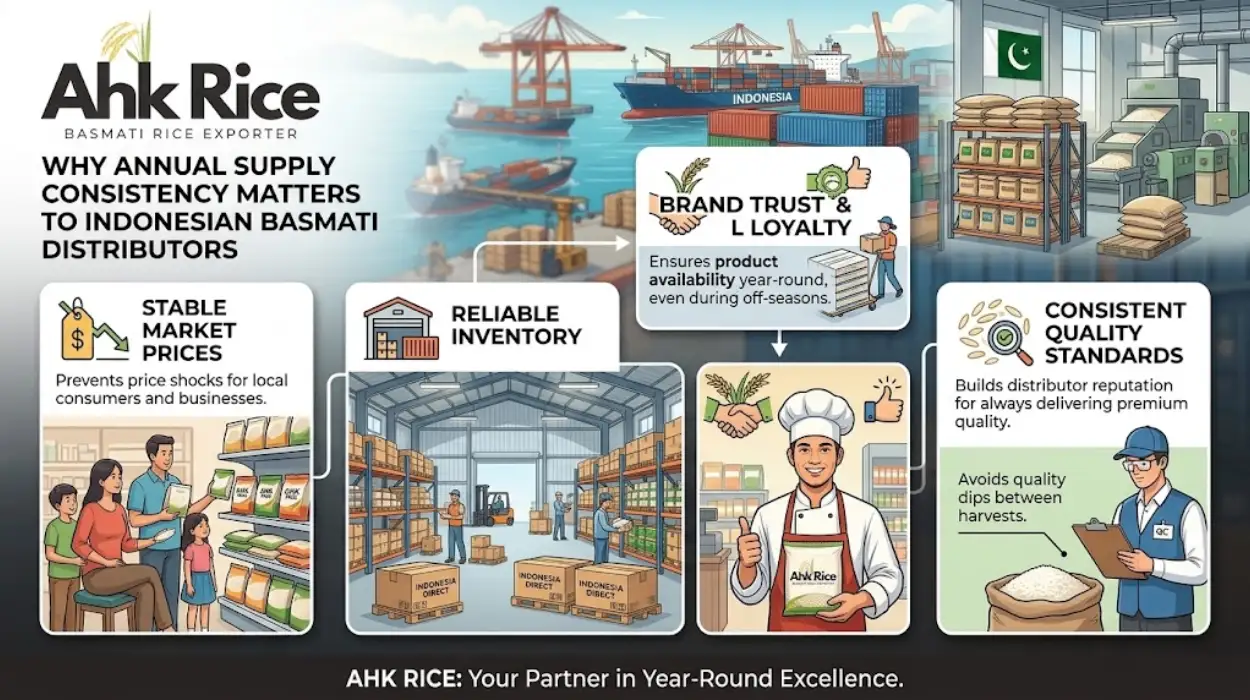
Why Does Annual Supply Consistency Matter to Indonesian Basmati Rice Distributors?
Annual supply consistency protects Indonesian distributors from stockouts, uneven quality, and unpredictable procurement costs. Here is why: distributors need reliable rice volumes, stable specifications, and coordinated shipments to serve retailers, wholesalers, restaurants, and foodservice buyers throughout the year.
Pakistan produces Basmati rice in Punjab and other suitable agricultural regions. Indonesian distributors source varieties such as 1121, Super Kernel, and 1509 Basmati rice for different market segments. Each variety has distinct grain characteristics, processing methods, and cooking applications.
Annual supply consistency connects farming, milling, quality control, packaging, and export logistics. A distributor that understands this connection can build a more reliable procurement plan.
What Is Annual Supply Consistency in Basmati Rice Distribution?
Annual supply consistency means receiving agreed rice volumes, grades, and specifications throughout a 12-month procurement cycle. It connects production planning, inventory management, shipment scheduling, and quality verification into one supply system.
Annual supply consistency does not mean receiving identical quantities every month. A distributor can order larger volumes before peak retail seasons and smaller volumes during slower periods.
The essential requirement is predictable availability. A supplier must communicate production capacity, available grades, shipment schedules, and quality specifications before the distributor commits to sales contracts.
What Does Supply Consistency Include?
Supply consistency includes several connected commercial requirements:
- Volume continuity: Availability of agreed quantities across multiple orders.
- Quality continuity: Consistent grain length, moisture, broken percentage, and processing grade.
- Shipment continuity: Regular dispatches that support planned inventory levels.
- Specification continuity: Stable packaging, labeling, and product identification.
- Communication continuity: Timely updates about production, inspection, and shipment status.
For example, a distributor selling 1121 Steam Basmati Rice to Indonesian supermarkets needs regular access to the same grade. A shipment containing a different processing type changes cooking results and retail positioning.
With the definition established, the next question is how supply consistency develops from Pakistani agriculture to Indonesian distribution.
How Does the Pakistani Basmati Rice Supply Chain Work?
Pakistani Basmati rice supply consistency develops through coordinated cultivation, harvesting, milling, grading, packaging, and export operations. Each stage controls a different factor affecting the final shipment.
Where Is Pakistani Basmati Rice Cultivated?
Pakistan cultivates Basmati rice primarily in Punjab, where suitable soil, irrigation, and seasonal conditions support aromatic rice production. Punjab includes important rice-growing areas such as Gujranwala, Hafizabad, Sheikhupura, and Sialkot.
Basmati rice grows during the warm agricultural season. Farmers cultivate rice in prepared fields, manage irrigation, and harvest mature paddy. Crop timing influences milling schedules and the availability of newly harvested rice.
How Is Basmati Rice Processed?
Pakistani rice processing converts harvested paddy into cleaned, graded, and packaged rice. The process includes:
- Clean the paddy: Remove stones, dust, straw, and other foreign material.
- De-husk the grain: Remove the outer husk from harvested paddy.
- Mill the rice: Separate the edible grain from remaining husk and bran.
- Polish the grain: Remove surface bran according to the required processing specification.
- Sort by length: Separate grains into long-grain and other size categories.
- Sort by colour: Remove discoloured grains and visible defects.
- Grade the rice: Classify the product by grain length, broken percentage, and quality requirements.
- Pack the rice: Fill approved packaging formats for retail, wholesale, or foodservice distribution.
- Load the shipment: Prepare the packaged rice for container dispatch and export documentation.
These stages establish the physical and commercial characteristics of the rice. Processing consistency supports repeat orders because distributors can compare new shipments against previously approved specifications.
With the supply chain established, the next question is which rice grades Indonesian distributors can source from Pakistan.
Which Pakistani Basmati Rice Grades Suit Indonesian Distributors?
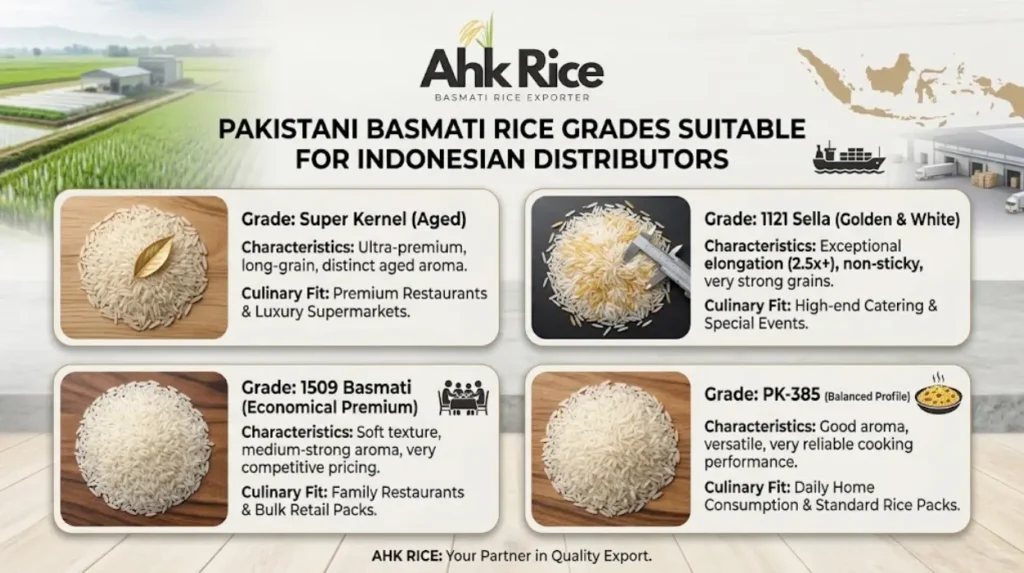
1121, Super Kernel, and 1509 provide distinct grain profiles for Indonesian retail, wholesale, restaurant, and foodservice markets. Each variety supports different purchasing requirements.
What Is 1121 Basmati Rice?
1121 Basmati is a long-grain rice variety known for its elongated grain and aromatic cooking profile. Its grain length and cooking performance make it suitable for premium retail, catering, and restaurant applications.
1121 is available in Steam, White, and Sella processing types. Steam rice undergoes steam treatment during processing. Sella rice undergoes parboiling and drying before milling.
What Is Super Kernel Basmati Rice?
Super Kernel Basmati is a premium Pakistani rice variety with long grains and a distinctive aroma. Its grain structure supports applications requiring attractive cooked rice and consistent serving quality.
Super Kernel is available in White, Steam, and Sella processing types. Indonesian distributors select the processing type according to cooking requirements and market positioning.
What Is 1509 Basmati Rice?
1509 Basmati is a long-grain rice variety used in retail, wholesale, and foodservice markets. Its processing options include Steam, White, and Sella.
1509 supports distributors seeking a long-grain product for mid-premium or value-focused market segments. The correct grade depends on grain specifications, cooking performance, and the buyer’s target price.
What Are the Main Processing Differences?
| Processing type | Main characteristic | Typical distribution application |
|---|---|---|
| White | Milled rice with a natural white appearance | Retail and wholesale |
| Steam | Steam-treated rice with firm cooked grains | Restaurants and foodservice |
| Sella | Parboiled and dried rice with improved grain firmness | Wholesale and long-distance distribution |
The correct processing type depends on the buyer’s required cooking result, packaging format, and distribution conditions.
With the main varieties and processing types defined, the next question is how annual consistency benefits Indonesian distributors.
What Benefits Does Annual Supply Consistency Provide?
Annual supply consistency reduces procurement disruption, supports predictable inventory, and protects the product specifications that Indonesian distributors promise to their customers. These benefits connect supply planning with commercial performance.
How Does Consistency Protect Inventory?
Inventory continuity helps distributors maintain stock during regular sales periods and seasonal demand increases. A distributor that sells rice through supermarkets needs enough inventory to support replenishment schedules.
For example, a wholesaler selling 100 tonnes of 1121 Steam monthly requires a procurement plan that covers regular sales and additional demand during Ramadan or major Indonesian holidays.
Annual planning also reduces emergency purchases. Emergency procurement creates pressure on freight arrangements, supplier selection, and quality verification.
How Does Consistency Support Quality?
Quality consistency helps distributors maintain the same cooking experience across repeat shipments. Rice specifications include grain length, moisture, broken percentage, colour, and processing type.
A distributor selling premium Basmati rice needs stable grain appearance and cooking performance. A shipment with excessive broken grains changes the product’s retail presentation and customer expectations.
How Does Consistency Improve Procurement Planning?
Procurement planning connects expected sales with supplier production and shipment schedules. Distributors can forecast monthly requirements, arrange warehouse capacity, and prepare import documentation.
A 12-month plan also supports packaging decisions. Retail distributors may require 1 kg, 5 kg, or 10 kg bags, while wholesalers commonly purchase larger formats.
With the benefits established, the next question is where Indonesian distributors apply annual supply consistency.
Where Do Indonesian Distributors Use Annual Supply Consistency?
Indonesian distributors use annual supply consistency across retail, wholesale, restaurants, foodservice, and private-label channels. Each channel requires different volumes, packaging formats, and quality specifications.
Retail Distribution
Retail distributors supply supermarkets, grocery stores, and independent shops. They need stable packaging, product labeling, and replenishment schedules.
For example, a supermarket chain selling 5 kg Basmati rice bags requires consistent packaging and product specifications across its stores.
Wholesale Distribution
Wholesale distributors supply restaurants, caterers, retailers, and regional resellers. They often purchase larger quantities and require predictable shipment schedules.
A wholesaler serving several Indonesian cities needs sufficient inventory to cover warehouse transfers and customer orders.
Restaurant and Foodservice Distribution
Restaurants and foodservice operators purchase rice for repeated menu preparation. They require consistent cooking performance and grain quality.
For example, a restaurant group serving biryani needs rice that produces predictable grain separation and appearance across its locations.
Private-Label Distribution
Private-label distributors sell rice under their own brand names. They need consistent packaging, labeling, and product specifications across production cycles.
A private-label distributor launching 5 kg retail bags requires the same grade and packaging standards for each shipment.
With the use cases established, the next question is which supply problems disrupt annual distribution plans.
What Common Problems Affect Annual Basmati Rice Supply?
Common supply problems include inconsistent quality, insufficient production planning, delayed shipments, and unclear specifications. Each problem creates a different risk for Indonesian distributors.
Inconsistent Quality
Inconsistent quality occurs when different shipments contain different grain lengths, broken percentages, or processing types. This problem affects retail appearance and cooking results.
A distributor should compare shipment specifications against the approved product standard before accepting repeat orders.
Unplanned Production Changes
Unplanned production changes affect availability during peak demand periods. Crop timing, milling capacity, and packaging schedules influence the supplier’s ability to dispatch rice.
Distributors should request production and shipment schedules before finalizing annual purchasing commitments.
Shipment Delays
Shipment delays create inventory shortages and affect customer delivery schedules. Port operations, documentation, container availability, and customs clearance influence transit time.
Distributors should include realistic shipping schedules and inventory buffers in their procurement plans.
Misunderstanding Supply Continuity
Supply continuity does not mean unlimited rice availability. It means the supplier and distributor agree on quantities, specifications, delivery schedules, and communication procedures.
A distributor should distinguish between annual production capacity and confirmed shipment commitments. These are separate commercial concepts.
With the main risks established, the next question is how distributors compare suppliers for reliable annual sourcing.
How Should Indonesian Distributors Compare Pakistan Rice Suppliers for Supply Continuity?
Indonesian distributors should compare Pakistani rice suppliers through production capacity, quality specifications, processing control, packaging capability, and export planning. These factors reveal whether a supplier supports repeat procurement.
The comparison should begin with the supplier’s available varieties and processing grades. A distributor should confirm access to 1121, Super Kernel, and 1509 according to its target market.
The next factor is processing consistency. A supplier should define grain length, broken percentage, moisture, colour, and processing type for each product.
Packaging capability also matters. Retail, wholesale, and foodservice buyers require different bag sizes and labeling specifications.
Export planning completes the comparison. Distributors should review documentation, inspection procedures, shipment scheduling, and communication practices before committing to annual supply arrangements.
For a detailed comparison framework, the next-stage article explores how Indonesian distributors should compare Pakistan rice suppliers for supply continuity.
Frequently Asked Questions
Why does annual supply consistency matter to Indonesian Basmati rice distributors?
Annual supply consistency helps distributors maintain inventory, stable product quality, and predictable procurement schedules. It supports regular deliveries to retailers, wholesalers, restaurants, and foodservice customers.
Which Pakistani Basmati rice varieties are commonly used by Indonesian distributors?
The main varieties include 1121, Super Kernel, and 1509. Each variety has different grain characteristics and processing options for retail, wholesale, and foodservice markets.
What processing types are available for Pakistani Basmati rice?
Common processing types include White, Steam, and Sella. Each type has distinct processing characteristics that influence grain firmness, appearance, and cooking performance.
How can distributors reduce rice supply disruptions?
Distributors can reduce disruptions through annual procurement planning, agreed product specifications, realistic shipment schedules, and regular communication with suppliers.
What should Indonesian distributors check before selecting a Pakistani rice supplier?
Distributors should check production capacity, available varieties, quality specifications, processing control, packaging capability, export documentation, and shipment planning.