Indonesia’s Expanding Rice Market and the Role of Pakistani Imports in 2026
Indonesia’s rice market expansion in 2026 is driven by population demand, supply volatility, and premium grain diversification, and Pakistani basmati imports stabilize high-value segments. Here is why: Indonesia faces recurring production gaps during dry-cycle seasons, while urban catering and retail demand increase for aromatic long-grain rice, creating structural import dependency on reliable origins like Pakistan.
Indonesia imports rice not only for volume but also for quality segmentation in premium foodservice channels. Pakistan supplies 1121, Super Kernel, and 1509 basmati varieties that fill aroma-based demand gaps in Indonesian retail and hospitality sectors. These flows are structured through grading, milling, polishing, and export certification systems controlled by exporters such as AHK Rice.
Indonesia also diversifies sourcing to balance price shocks from Thailand and India, while maintaining aromatic alternatives for high-income consumers. This structural shift creates a consistent niche for Pakistani basmati rice in commercial import planning.
In parallel, readers can explore foundational rice export mechanics in this export grade rice fundamentals guide that explains grading, polishing, and shipment workflows for global buyers.
What are the available solutions for Indonesia’s rice import and supply diversification?
Available solutions include domestic procurement stabilization, regional ASEAN imports, and premium basmati sourcing from Pakistan, each addressing different demand layers such as bulk consumption, retail quality segmentation, and hospitality-grade aromatic rice required in Indonesia’s expanding food economy.
Domestic procurement relies on Indonesian paddy cultivation cycles, irrigation systems, and government buffer stocks. This system stabilizes baseline consumption but fails during drought-linked yield drops. Rice is cultivated in Java and Sumatra, harvested seasonally, and distributed through state-controlled logistics channels.
ASEAN imports include Thai white rice and Vietnamese long-grain rice. These products serve bulk retail and institutional feeding programs. Rice is milled, sorted, and shipped in high-volume contracts, often prioritizing price efficiency over aroma or grain elongation.
Pakistani basmati imports focus on aromatic segmentation. 1121 and 1509 varieties are cultivated in Punjab, then milled, dehusked, polished, graded, and certified before export shipment. These grains target premium restaurants and retail packaging in Indonesia.
Available solution categories
- Domestic stabilization systems
- ASEAN bulk import channels
- Pakistani aromatic basmati imports
Domestic systems reduce dependency risk but cannot meet peak demand cycles. ASEAN imports reduce cost per MT but lack aromatic profile. Pakistani imports fill premium culinary gaps.
With solution types defined, the next step is comparing how these approaches differ across price, quality, and shelf stability.
How do different import approaches compare in price, quality, and shelf life?
ASEAN rice delivers lowest cost per MT, Pakistani basmati delivers highest aromatic value, and domestic Indonesian rice delivers stability, but each differs significantly in shelf life, grain structure, and catering suitability for commercial buyers in 2026.
Thai white rice averages $520–$580/MT, Vietnamese rice averages $500–$560/MT, while Pakistani 1121 basmati ranges $900–$1,150/MT depending on grade and polishing level. These price gaps reflect processing intensity and grain elongation value.
Shelf life differs due to moisture control and parboiling methods. Golden Sella basmati maintains quality for 18–24 months in controlled warehouses. Steam basmati lasts 12–18 months, while standard white rice in ASEAN supply lasts 10–14 months.
Quality comparison is driven by grain length, aroma retention, and cooking expansion ratio. Pakistani basmati expands up to 2.5x in cooking volume, while ASEAN rice expands less but offers uniform texture for bulk kitchens.
Specification comparison table (7 attributes)
| Attribute | Pakistani Basmati | Thai Rice | Vietnamese Rice |
|---|---|---|---|
| Grain length | 8.3–8.5 mm | 6.2–7.0 mm | 6.0–6.8 mm |
| Aroma level | High natural aroma | Medium | Low |
| Expansion ratio | Up to 2.5x | 1.8x | 1.7x |
| Processing types | Steam / Sella / Raw | Milled white | Milled white |
| Shelf life | 12–24 months | 10–14 months | 10–13 months |
| Price per MT | $900–$1,150 | $520–$580 | $500–$560 |
| Target use | Premium retail & catering | Bulk consumption | Institutional supply |
Pakistani basmati dominates premium segmentation despite higher cost. ASEAN rice dominates cost-sensitive procurement contracts.
With comparative metrics established, the next question focuses on which import method performs best for specific commercial use cases.
Which import method works best for different commercial cases in Indonesia?
Pakistani basmati works best for premium restaurants, ASEAN rice works best for institutional feeding programs, and domestic rice works best for government stock stabilization, depending on price sensitivity, aroma requirement, and storage infrastructure availability.
Premium hospitality buyers in Jakarta and Bali require aromatic rice with long grain separation. Pakistani 1121 and Super Kernel basmati satisfy this requirement due to high elongation and fragrance retention after cooking.
Mass catering suppliers prefer Thai and Vietnamese rice due to lower procurement cost and consistent bulk texture. These buyers prioritize cost per serving rather than aroma intensity or grain aesthetics.
Government procurement uses domestic rice when available because it reduces import dependency and supports local cultivation cycles. However, it cannot consistently meet urban demand spikes.
Market region comparison
| Region | Preferred Grade | Price per MT | Shelf Life | Use Case |
|---|---|---|---|---|
| Indonesia (Retail & Hospitality) | 1121 Basmati Steam | $950–$1,150 | 12–18 months | Premium dining |
| Indonesia (Bulk Supply) | Thai/Vietnam Rice | $500–$580 | 10–14 months | Institutions |
| Middle East (GCC Catering) | Golden Sella Basmati | $1,000–$1,200 | 18–24 months | Large catering units |
Middle Eastern buyers prefer Golden Sella due to warehouse storage conditions. Indonesian buyers prioritize steam basmati for aroma consistency.
For procurement clarity, buyers often connect product evaluation with structured export sourcing services such as the [commercial rice sourcing framework](BOFU ARTICLE ANCHOR – decision-stage integration).
With use cases defined, the next section evaluates advantages and disadvantages of each import strategy.
What are the pros and cons of each rice import strategy?
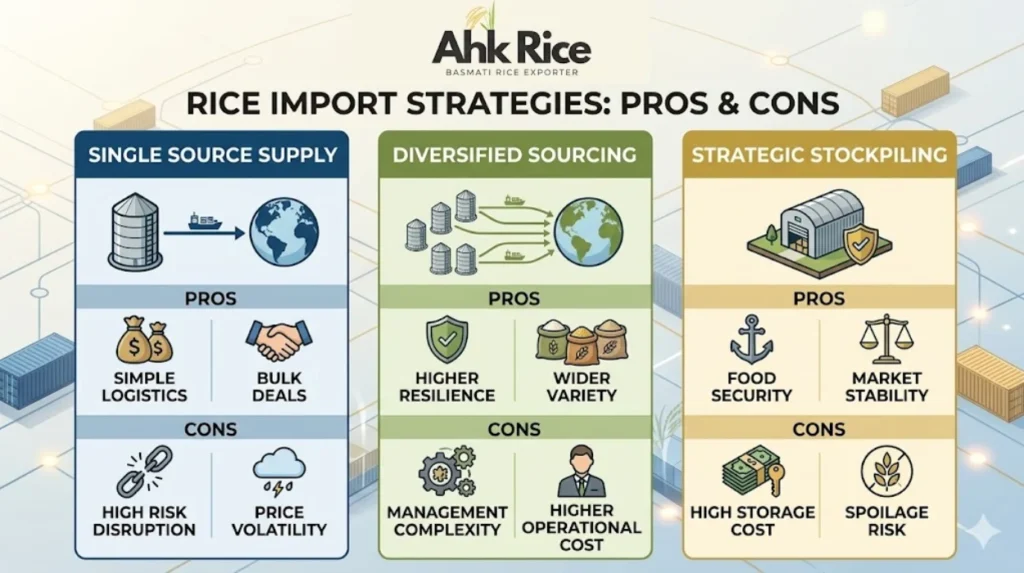
Pakistani basmati provides premium aroma and export value but higher cost, ASEAN rice provides affordability but lower sensory quality, and domestic rice provides stability but inconsistent surplus availability during climate disruptions and harvest variability.
Pakistani basmati advantages include aroma retention, long grain expansion, and certification compliance for export markets. Milling processes include polishing, grading, and length sorting, ensuring uniform quality for retail packaging.
Pakistani basmati disadvantages include higher freight-adjusted cost per MT and longer procurement cycles due to certification and inspection requirements.
ASEAN rice advantages include price efficiency, stable supply chain, and faster dispatch cycles. ASEAN rice disadvantages include limited aroma, lower grain elongation, and reduced premium branding value.
Domestic rice advantages include national supply stability and reduced import dependency. Domestic rice disadvantages include seasonal variability and limited export-grade standardization.
Pros and cons summary
- Aroma advantage: Pakistani basmati strong differentiation
- Cost advantage: ASEAN rice bulk affordability
- Stability advantage: Domestic procurement continuity
- Storage advantage: Golden Sella long shelf cycle
Pakistani basmati becomes essential when branding and culinary differentiation matter more than cost optimization.
With advantages clarified, the next section explains how buyers should structure their procurement decisions.
What decision factors should importers consider before choosing rice supply sources?
Importers should evaluate grain quality, price per MT, shelf life, certification requirements, logistics lead time, and end-use application before selecting rice supply sources for Indonesian commercial and retail markets in 2026.
Grain quality determines consumer acceptance in retail packaging. Long grain basmati performs better in premium supermarket positioning compared to standard white rice categories.
Price per MT determines contract viability for bulk institutional supply chains. Small price differences significantly affect annual procurement budgets for large distributors.
Shelf life determines storage feasibility in tropical climates. High humidity regions require longer stability grains such as Golden Sella basmati.
Certification requirements include phytosanitary inspection, fumigation verification, and export grading certificates. These documents ensure compliance with Indonesian import regulations.
Logistics lead time affects supply chain continuity. Pakistani exports typically require coordinated milling, inspection, and dispatch scheduling before shipment.
Decision framework table (5 rows)
| Factor | Pakistani Basmati | ASEAN Rice | Domestic Rice |
|---|---|---|---|
| Cost efficiency | Medium | High | High |
| Aroma quality | Very High | Low | Medium |
| Shelf stability | High | Medium | Low |
| Supply reliability | High | Very High | Medium |
| Market positioning | Premium | Bulk | Local |
This framework shows how procurement strategy must align with market positioning rather than price alone.
With decision factors clarified, the overall structure of Indonesia’s rice import ecosystem becomes more predictable.
Conclusion and strategic outlook for 2026 rice trade
Indonesia’s rice import structure in 2026 operates as a three-tier system combining domestic stability, ASEAN bulk imports, and Pakistani premium basmati segmentation. Each layer solves a different consumption requirement.
Pakistani basmati remains the strongest option for aroma-driven markets and high-value hospitality sectors. ASEAN rice dominates volume procurement. Domestic rice ensures baseline national food security.
Exporters like AHK Rice integrate milling, grading, polishing, and dispatch systems to meet segmented global demand while maintaining consistency across grades such as 1121, Super Kernel, and 1509.
Frequently Asked Questions
Why is Indonesia increasing rice imports in 2026?
Indonesia increases imports due to seasonal production gaps and rising urban consumption. Climate variability reduces yield consistency in key growing regions.
Which rice type is most preferred in Indonesian restaurants?
Pakistani 1121 basmati is most preferred due to aroma strength, long grain structure, and cooking expansion performance.
What is the cheapest rice import option for Indonesia?
Vietnamese and Thai rice remain the lowest-cost options due to large-scale milling and bulk export systems.
How long does Pakistani basmati rice last in storage?
Pakistani Golden Sella basmati lasts up to 24 months under controlled humidity and warehouse conditions.
Is Pakistani rice suitable for mass catering?
Yes, steam and sella varieties are widely used in catering due to expansion ratio and aroma retention.