Why Should Minnesota Buyers Evaluate Rice Suppliers Beyond Price?
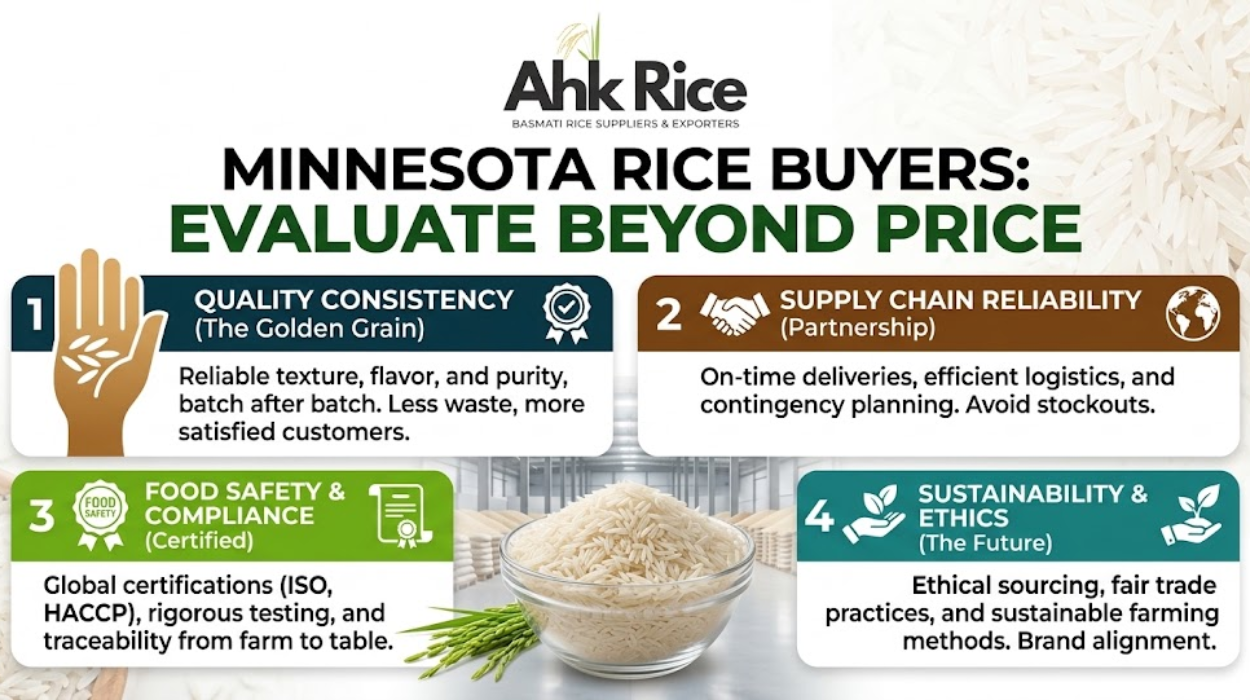
Minnesota rice buyers should evaluate suppliers beyond price because the delivered value of imported rice depends on specification accuracy, food safety, processing consistency, documentation, shipment reliability, packaging, and supply capacity. A lower quoted price becomes less valuable when quality or delivery failures increase total procurement cost.
Rice procurement is a commercial process that extends beyond selecting the lowest quotation. A Minnesota importer, distributor, restaurant group, food manufacturer, or retailer needs to evaluate the complete supply chain from cultivation and milling in the origin country to customs entry and warehouse receipt in the United States.
This matters for Pakistani Basmati rice because the product is an aromatic long-grain rice with defined physical and cooking characteristics. Pakistan is a major global rice exporter. USDA’s April 2026 Pakistan Grain and Feed Annual forecasts 2026/27 Pakistani rice production at 9.8 million metric tons and exports at 5.0 million metric tons.
The supplier therefore needs to demonstrate more than a competitive FOB or CIF quotation. The buyer needs evidence that the quoted product, shipment, documentation, and commercial terms match the purchase specification.
What does supplier evaluation mean for Minnesota rice buyers?
Supplier evaluation is the structured comparison of a rice exporter’s product quality, processing controls, capacity, compliance, documentation, logistics, packaging, commercial terms, and performance history before a purchase decision is made. Price becomes one measurable factor within the complete procurement assessment.
A rice supplier is an organization that sources, processes, grades, packages, documents, and exports rice to an international buyer. A supplier assessment examines whether that organization can repeatedly deliver the required specification.
For Minnesota buyers, the evaluation starts with the product definition. The buyer should identify rice variety, grain length, milling type, processing method, broken percentage, moisture level, foreign matter tolerance, damaged grains, packaging format, net weight, labeling requirements, and destination.
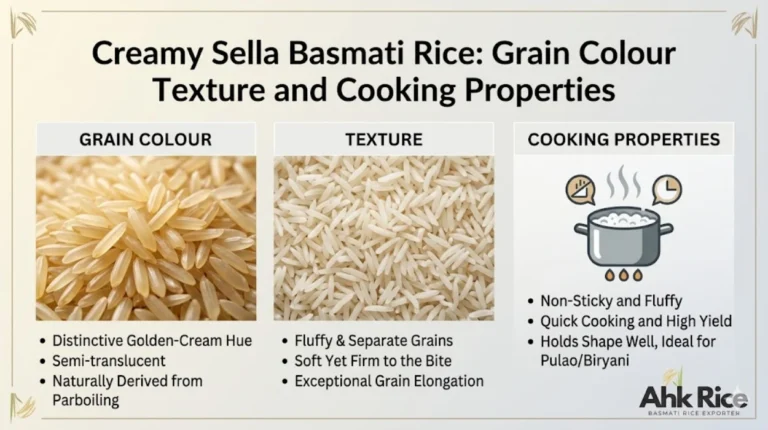
Common Pakistani Basmati varieties include 1121 Basmati, Super Kernel Basmati, and 1509 Basmati. Processing formats include white rice, steam rice, and parboiled or Sella rice. Each specification produces different cooking characteristics and commercial applications.
The buyer should also separate product price from landed cost. Landed cost includes the purchase price plus applicable freight, insurance, customs-related charges, broker costs, port handling, inland transportation, storage, inspection, and quality-related expenses.
A supplier with a slightly higher unit quotation can therefore produce a lower total procurement cost when it delivers the correct grade consistently and avoids preventable claims, delays, rework, and replacement purchases.
How does Pakistani Basmati rice move from cultivation to export?
Pakistani Basmati rice moves through cultivation, harvesting, paddy reception, cleaning, drying, aging where specified, milling, sorting, grading, optical inspection, quality testing, packaging, final inspection, documentation, container loading, port handling, ocean transportation, U.S. entry, and inland delivery.
Basmati rice is cultivated primarily in the Punjab region of Pakistan, where agricultural conditions support aromatic long-grain varieties. Paddy is the harvested rice grain with its husk still attached.
The first processing stage is paddy reception. The processor checks incoming paddy for moisture, impurities, variety, and physical condition. Cleaning removes materials such as stones, straw, dust, and other foreign matter.
The next stage is drying or moisture conditioning. Moisture management affects milling performance and storage stability. Rice is then milled to remove the husk and, for white rice, the bran layers.
Rice processing differs according to the final product. White rice receives conventional milling. Steam or parboiled rice undergoes controlled hydrothermal treatment before drying and milling. The processing method affects grain strength, cooking behavior, color, and texture.
After milling, the rice passes through grading equipment. Length graders separate broken kernels from head rice. Thickness and density separation remove unwanted fractions. Optical sorting identifies defects based on visual characteristics.
Quality control then checks the finished rice against the purchase specification. Testing can cover moisture, broken grains, grain dimensions, foreign matter, damaged grains, milling degree, and other agreed parameters.
The finished product is packed in the agreed commercial format. Packaging can include retail bags, private-label packs, woven polypropylene bags, laminated bags, or bulk formats depending on the buyer’s distribution model.
The export stage adds documentation, container loading, port handling, vessel scheduling, ocean transportation, customs entry, and inland movement. Each stage affects the final delivery outcome.
Which supplier components should Minnesota buyers evaluate?
The main supplier components are product specification, production capacity, processing controls, quality assurance, food-safety compliance, packaging, documentation, logistics capability, communication, commercial terms, and performance history. These components show whether a supplier can deliver consistent rice rather than only an attractive initial quotation.
Product specification
The supplier should provide a written specification rather than relying on product names alone. A request for “premium Basmati” does not define a measurable commercial product.
A stronger specification identifies variety, grain length, processing type, broken percentage, moisture, foreign matter, damaged grains, crop or production details where relevant, packaging, net weight, and tolerance limits.
Production capacity
Production capacity is the quantity a supplier can process, grade, pack, inspect, and prepare for export within a defined period.
Minnesota buyers with recurring demand should compare monthly processing capacity with their expected purchase volume. A supplier that can fulfill one container but cannot support repeated orders presents a different procurement risk from a supplier with established production capacity.
Processing and quality control
Processing consistency controls the physical uniformity of the shipment. Buyers should evaluate cleaning, milling, grading, sorting, inspection, sampling, and laboratory testing procedures.
Examples include checking broken kernels, moisture content, foreign matter, chalky grains, damaged grains, and grain-length distribution.
Food safety and compliance
U.S. food imports must meet U.S. legal requirements. FDA states that imported food must be safe, sanitary, and properly labeled, and that facilities involved in producing, storing, or handling covered food must meet applicable registration requirements.
The Foreign Supplier Verification Program, or FSVP, is the U.S. importer’s system for verifying that foreign suppliers produce food in a manner that provides the required level of public-health protection and that the food satisfies applicable FDA requirements.
The supplier should therefore provide accurate facility information, product documentation, lot identification, specifications, and records required by the buyer’s compliance program.
Export documentation
Documentation supports customs clearance and product traceability. Depending on the transaction and destination requirements, documents can include commercial invoices, packing lists, certificates of origin, bills of lading, inspection or laboratory reports, and phytosanitary documentation.
Pakistan’s export framework identifies phytosanitary certification through the Department of Plant Protection where required by the importing country’s National Plant Protection Organization.
Packaging
Packaging protects rice during handling, storage, and transportation. Buyers should compare material construction, sealing, bag strength, moisture protection, labeling, palletization, container loading, and package size.
A retail distributor has different packaging requirements from a foodservice buyer purchasing 20 kg or 25 kg bags. A supplier should be able to align packaging with the commercial application.
Logistics capability
International rice supply includes multiple logistical stages. A supplier needs reliable coordination between processing completion, container loading, port delivery, vessel booking, export documentation, and shipment tracking.
The buyer should evaluate how the supplier handles schedule changes, document corrections, container issues, and communication during transit.
What are the benefits of evaluating suppliers beyond price?
A broader supplier evaluation reduces quality variation, compliance exposure, shipment disruption, specification disputes, inventory shortages, and hidden procurement costs. It also gives Minnesota buyers measurable criteria for comparing suppliers across product quality, capacity, logistics, documentation, and long-term supply performance.
The first benefit is specification consistency. A buyer receives a defined product rather than a product that changes from shipment to shipment.
The second benefit is lower operational risk. Consistent packaging and loading reduce handling problems. Accurate documents reduce avoidable clearance issues. Reliable scheduling improves inventory planning.
The third benefit is food-safety control. FDA requires imported food to meet applicable U.S. requirements, and prior notice is required for covered imported food shipments.
Prior Notice gives FDA advance information about an incoming food shipment. For waterborne shipments, FDA guidance states that Prior Notice must be received and confirmed at least 8 hours before arrival when applicable.
The fourth benefit is better landed-cost control. A buyer can compare suppliers using the same commercial basis and then account for freight, handling, inspection, customs, inland delivery, and quality-related expenses.
The fifth benefit is supply continuity. USDA’s May 2026 global rice outlook forecasts U.S. rice imports at 1.425 million metric tons for 2026 and 1.475 million metric tons for 2027, with growing demand for fragrant varieties identified as an import driver.
This market environment makes supplier reliability relevant to buyers serving retail, foodservice, and specialty rice demand.
Where are Pakistani Basmati varieties used in international markets?
Pakistani Basmati varieties serve retail, foodservice, wholesale, restaurant, catering, ethnic grocery, private-label, and food-manufacturing markets across North America, the Middle East, Europe, Africa, and other destinations where aromatic long-grain rice has established consumer demand.
Different markets prioritize different specifications. Retail buyers often focus on package presentation, grain appearance, cooking consistency, labeling, and shelf performance.
Restaurants frequently prioritize grain length, aroma, cooked separation, yield, and repeatability. Foodservice distributors often prioritize larger package sizes, stable specifications, dependable supply, and competitive landed cost.
Pakistan’s export position supports this international market structure. USDA data places Pakistan among the world’s leading rice exporters, while the 2026 Pakistan country forecast expects 5.0 million metric tons of rice exports in 2026/27.
For Minnesota buyers, the relevant question is not simply which country offers the lowest quotation. The relevant question is whether the supplier’s product specification and supply system fit the buyer’s intended market.
What certifications and documents should buyers examine?
Certification and documentation should be evaluated according to the product, destination, buyer program, and applicable law. Important areas include FDA food-facility requirements, FSVP documentation, phytosanitary certification when required, laboratory reports, certificates of origin, inspection records, and recognized food-safety certifications where contractually required.
A certification is evidence that an organization, process, facility, or product meets defined requirements. It does not replace product specifications or shipment-level verification.
Minnesota importers should distinguish regulatory requirements from commercial certifications. FDA compliance is a legal requirement for applicable imported food. A private food-safety certification is a separate assurance mechanism.
The supplier should identify the exact facility associated with the shipment and provide documentation that matches the exported product. Buyers should check names, addresses, lot references, dates, product descriptions, and quantities across documents.
Laboratory reports also need context. A report is useful when the tested sample represents the shipped lot and the analytical parameters match the purchase specification.
What are the most common mistakes when choosing rice suppliers?
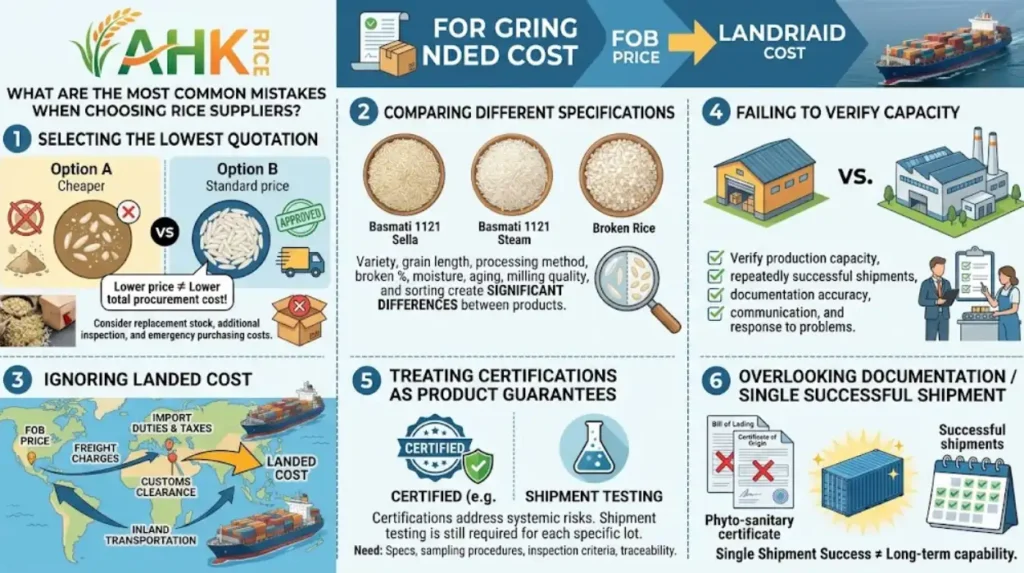
The most common mistakes are selecting the lowest quotation, comparing different rice specifications as identical products, ignoring landed cost, failing to verify capacity, treating certifications as product guarantees, overlooking documentation, and judging supplier performance from a single successful shipment.
The first misconception is that lower price always means lower procurement cost. A cheaper shipment that requires replacement stock, additional inspection, or emergency purchasing does not remain cheaper after those costs are included.
The second misconception is that all Basmati rice is equivalent. Variety, grain length, processing method, broken percentage, moisture, aging, milling quality, and sorting can create significant differences between products.
The third misconception is that certification eliminates the need for quality control. Certification and shipment testing address different risks. Buyers still need specifications, sampling procedures, inspection criteria, and lot traceability.
The fourth misconception is that one successful container proves long-term supply capability. A serious evaluation examines repeated shipment performance, production capacity, documentation accuracy, communication, and response to problems.
The fifth misconception is that freight is the only logistics variable. Production readiness, container availability, port handling, vessel schedules, customs procedures, and inland transportation all influence the final delivery timeline.
How should Minnesota buyers build a practical supplier scorecard?
A practical scorecard converts supplier evaluation into measurable categories so Minnesota buyers can compare competing exporters using the same criteria. Product specification, quality, compliance, capacity, logistics, documentation, commercial terms, and performance should receive defined scoring weights.
A simple scorecard can use 100 points:
| Evaluation category | Suggested weight |
|---|---|
| Product specification and consistency | 20 |
| Quality control and laboratory testing | 15 |
| Food safety and regulatory compliance | 15 |
| Production and supply capacity | 15 |
| Logistics and delivery performance | 10 |
| Packaging and labeling | 10 |
| Export documentation | 5 |
| Commercial terms and landed cost | 5 |
| Communication and service history | 5 |
| Total | 100 |
This framework prevents price from dominating the decision before technical requirements are confirmed.
A buyer can then establish minimum thresholds. For example, a supplier can require full compliance in food-safety documentation before commercial scoring begins. Product specifications can also be treated as pass-or-fail requirements when they are critical to the intended application.
The next procurement stage is a deeper assessment of the exporter itself. That assessment examines production capability, quality systems, documentation, logistics controls, commercial reliability, and evidence from previous export activity. This creates a logical bridge from general supplier evaluation to structured international partner assessment.
Once Minnesota buyers establish these evaluation criteria, the next step is:
Assessing international rice export partners against documented procurement, quality, compliance, capacity, and logistics requirements.
Frequently Asked Questions
Why should Minnesota buyers evaluate rice suppliers beyond price?
Minnesota buyers should evaluate rice suppliers beyond price because quality, compliance, production capacity, packaging, documentation, logistics, and delivery reliability directly affect total procurement cost.
What factors should Minnesota buyers compare when selecting a rice supplier?
Buyers should compare rice variety, grain specifications, moisture, broken percentage, processing method, quality controls, certifications, production capacity, packaging, documentation, logistics, and landed cost.
Which Pakistani Basmati rice varieties are commonly supplied internationally?
Common Pakistani Basmati varieties include 1121 Basmati, Super Kernel Basmati, and 1509 Basmati. These varieties are supplied in different processing formats, including white, steam, and Sella rice.
Where is Pakistani Basmati rice grown?
Pakistani Basmati rice is primarily cultivated in Punjab, where the region’s agricultural conditions support aromatic, long-grain Basmati varieties.
How is Pakistani Basmati rice processed for export?
Export rice passes through paddy reception, cleaning, drying or conditioning, milling, grading, sorting, quality testing, packaging, inspection, documentation, container loading, and international shipment.