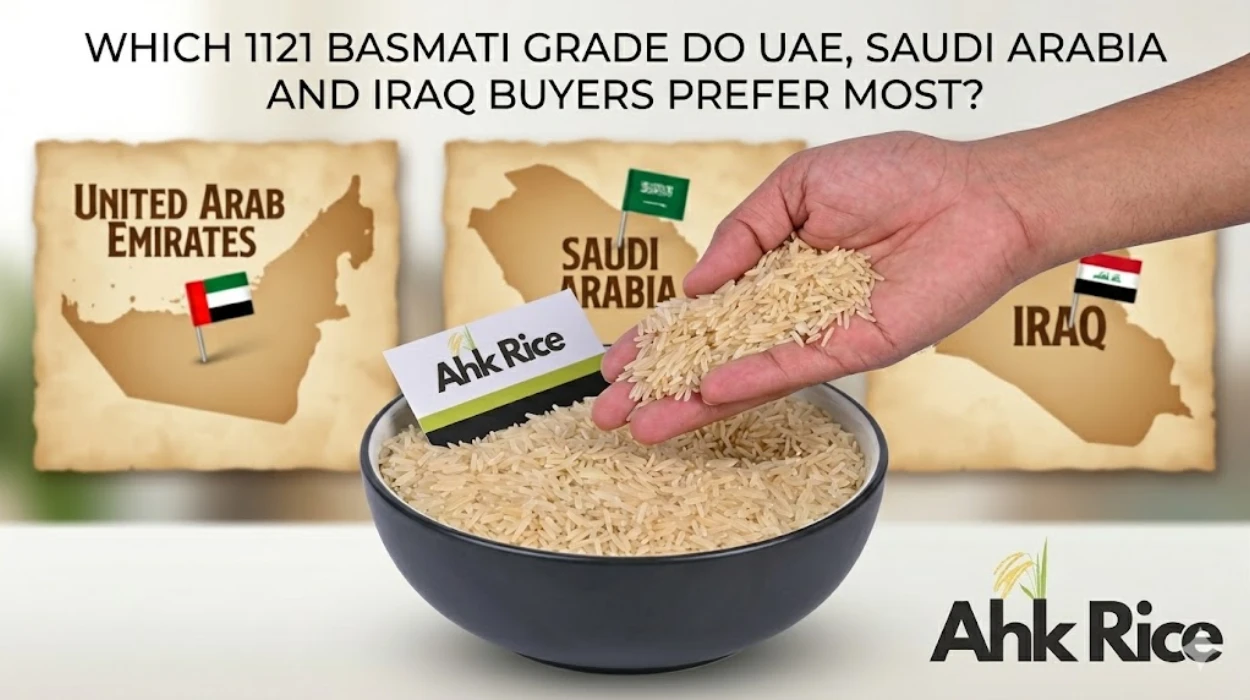
Which 1121 Basmati Grade Do UAE Saudi Arabia and Iraq Buyers Prefer Most?
1121 Golden Sella Basmati dominates UAE, Saudi Arabia, and Iraq imports because it delivers longer shelf life, higher yield after cooking, and better resistance to heat during storage. Here is why: Gulf climates demand stability, and Golden Sella outperforms Steam and White grades under these conditions.
1121 Basmati rice defines premium long-grain rice in global trade. Buyers across the Gulf Cooperation Council (GCC) prioritize grain length, cooking performance, and storage durability. AHK Rice processes and exports 1121 Basmati in multiple grades, each engineered for a specific buyer segment.
Understanding grade preference requires evaluating processing method, grain integrity, and market usage. For a complete foundational overview of how 1121 Basmati is cultivated and processed, review this detailed guide on understanding 1121 basmati rice production and grading standards. This builds the base for comparing buyer preferences across the Gulf.
What are the available 1121 Basmati grade solutions for Gulf buyers?
1121 Basmati grades include Golden Sella, Creamy Sella, Steam, and White Rice, each designed for specific cooking performance, storage conditions, and buyer segments across UAE, Saudi Arabia, and Iraq markets.
Core 1121 Basmati Grades Explained
1121 Basmati grades differ based on processing method. Each method alters grain strength, color, and cooking behavior.
Specification Comparison Table (Core Grades)
| Attribute | Golden Sella | Creamy Sella | Steam | White |
|---|---|---|---|---|
| Processing Method | Parboiled (high pressure) | Parboiled (mild) | Steamed | Raw milled |
| Grain Length (mm) | 8.30–8.50 | 8.20–8.40 | 8.10–8.30 | 8.00–8.20 |
| Color | Yellow-golden | Off-white creamy | Light white | Pure white |
| Cooking Expansion | 2.5–3.0x | 2.3–2.7x | 2.0–2.5x | 1.8–2.2x |
| Shelf Life | 18–24 months | 16–20 months | 12–16 months | 10–12 months |
| Breakage Resistance | Very high | High | Medium | Low |
| Target Market | Bulk catering | Mid-tier retail | Premium retail | Local consumption |
Golden Sella undergoes intensive parboiling. This process gelatinizes starch and strengthens the grain. Steam rice uses controlled steaming instead of soaking and pressure treatment. White rice skips parboiling entirely, resulting in softer grains.
Golden Sella dominates bulk imports. Steam rice targets branded retail shelves. White rice serves niche markets with immediate consumption needs.
With grade definitions established, the next step is comparing how these options perform across Gulf markets.
How do 1121 Basmati grades compare across UAE, Saudi Arabia, and Iraq?
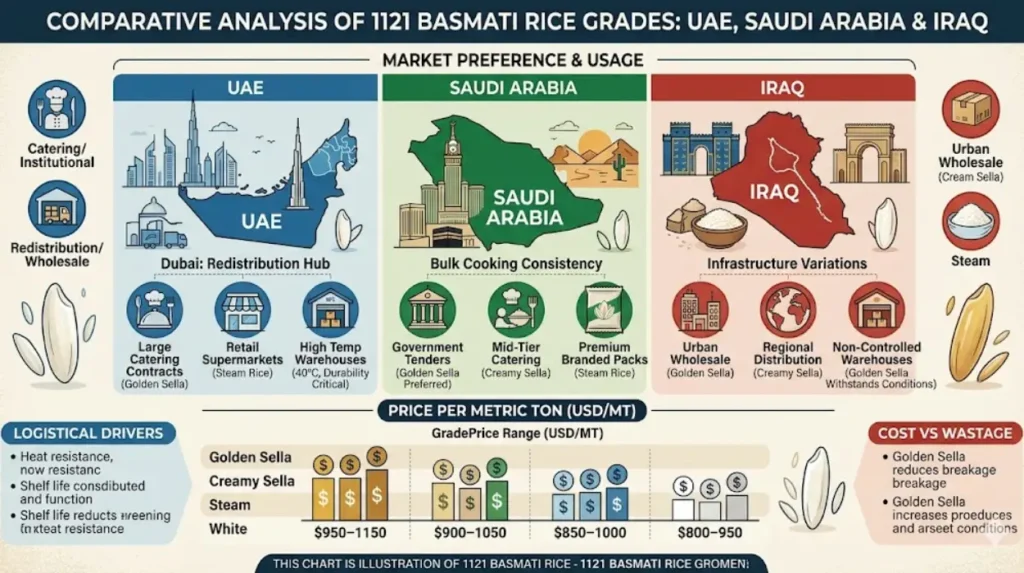
Golden Sella leads in UAE and Saudi Arabia catering sectors, while Iraq imports both Golden Sella and Creamy Sella due to infrastructure differences and storage conditions.
Regional Demand Breakdown
UAE Market Preference
UAE imports prioritize food service and re-export trade. Dubai acts as a redistribution hub (source: REAP export data, December 2025).
- Golden Sella dominates large catering contracts
- Steam rice appears in retail supermarkets
- White rice demand remains limited
Golden Sella performs better in UAE warehouses. High temperatures reach 40°C in storage zones, making durability critical.
Saudi Arabia Market Preference
Saudi Arabia imports large volumes for institutional use (source: Pakistan Bureau of Statistics, FY2024-25).
- Golden Sella preferred for government tenders
- Creamy Sella used in mid-tier catering
- Steam rice used in premium branded packs
Saudi buyers prioritize consistency in bulk cooking. Golden Sella maintains grain separation in large pots.
Iraq Market Preference
Iraq differs due to infrastructure variation.
- Golden Sella used in urban wholesale markets
- Creamy Sella preferred in regional distribution
- Steam rice limited due to shorter shelf life
Iraq buyers often store rice in non-controlled warehouses. Golden Sella withstands these conditions better.
Price per Metric Ton Comparison
| Grade | Price Range (USD/MT) |
|---|---|
| Golden Sella | $950–$1150 |
| Creamy Sella | $900–$1050 |
| Steam | $850–$1000 |
| White | $800–$950 |
Golden Sella commands a premium due to processing cost and durability. However, buyers accept higher pricing because of lower wastage.
Golden Sella reduces breakage during transport. Steam rice requires faster turnover to avoid quality loss.
With regional comparisons clear, the next question is which grade works best for specific buyer scenarios.
Which 1121 Basmati grade works best for different buyer cases?
Golden Sella suits high-volume catering, Steam suits retail branding, and Creamy Sella balances cost and performance for mid-tier buyers across GCC and Iraq markets.
Use Case-Based Selection
Bulk Catering Buyers
Golden Sella performs best for catering.
- Maintains grain length after cooking
- Resists overcooking in large batches
- Reduces wastage during transport
In UAE catering kitchens, Golden Sella maintains texture for 6–8 hours after cooking.
Retail Importers
Steam rice works best for retail.
- Offers bright white appearance
- Appeals to premium consumers
- Cooks faster than parboiled grades
Retail buyers prioritize visual quality over shelf life.
Budget-Conscious Buyers
Creamy Sella provides balance.
- Lower cost than Golden Sella
- Better durability than Steam rice
- Acceptable cooking performance
Iraqi distributors prefer Creamy Sella for regional supply chains.
Shelf Life Comparison by Climate
- Golden Sella lasts 18–24 months in hot climates
- Steam rice lasts 12–16 months
- White rice requires consumption within 10–12 months
Golden Sella retains quality longer in non-climate-controlled storage. This makes it ideal for Iraq and rural Saudi regions.
With use cases defined, the next step is evaluating advantages and limitations of each grade.
What are the pros and cons of each 1121 Basmati grade?
Golden Sella offers durability and yield, Steam offers visual appeal, and White rice offers low cost but reduced stability, making each grade suitable for different operational priorities.
Golden Sella
Pros
- High breakage resistance
- Long shelf life
Cons
- Higher cost
- Yellow color may not suit
Golden Sella reduces losses during shipping. This improves net margins for bulk importers.
Steam Rice
Pros
- Faster cooking
- Suitable for branding
Cons
- Lower shelf life
- Higher breakage risk
Steam rice suits supermarkets but fails in long storage conditions.
White Rice
Pros
- Lowest price
- Soft texture
- Faster cooking
Cons
- Short shelf life
- High breakage
White rice requires immediate consumption. This limits export viability.
Creamy Sella
Pros
- Balanced price-performance
- Acceptable grain strength
Cons
- Less perception
- Color variation
Creamy Sella fits mid-tier buyers in Iraq and smaller GCC markets.
With advantages and limitations clear, the final step is identifying decision factors for buyers.
What decision factors determine the best 1121 Basmati grade?
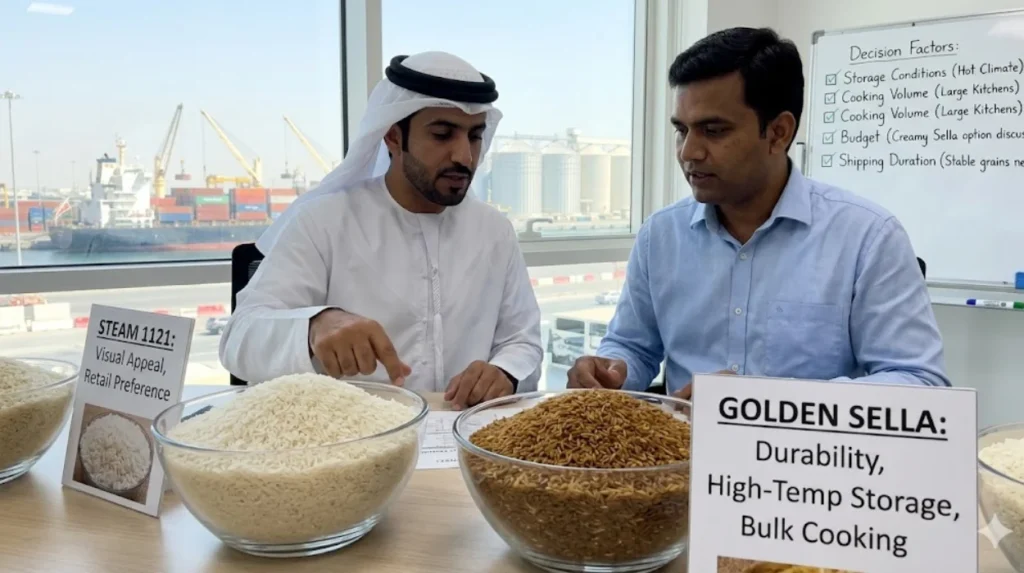
Climate, storage conditions, cooking volume, and price sensitivity determine the correct 1121 Basmati grade selection for UAE, Saudi Arabia, and Iraq buyers.
Key Decision Factors
Storage Environment
- Hot climates demand durable grains.
- Golden Sella performs best in high-temperature warehouses.
Cooking Volume
- Large-scale kitchens require strong grains.
- Golden Sella maintains structure in bulk cooking.
Market Positioning
- Retail brands need visual appeal.
- Steam rice delivers clean white grains.
Budget Constraints
- Cost-sensitive buyers prioritize value.
- Creamy Sella offers optimal balance.
Supply Chain Duration
- Long shipping routes require stable grains.
- Golden Sella reduces losses during transit.
Decision Framework Table
| Scenario | Recommended Grade | Reason |
|---|---|---|
| UAE Catering | Golden Sella | High durability |
| Saudi Bulk Supply | Golden Sella | Consistent cooking |
| Iraq Distribution | Creamy Sella | Cost-performance |
| Retail Supermarkets | Steam | Visual appeal |
| Short-Term Use | White | Low cost |
Golden Sella remains the dominant choice across all major Gulf markets. Its performance aligns with climate and operational demands.
With decision factors clarified, buyers can now align grade selection with business objectives.
Final Insight: Choosing the Right 1121 Grade for GCC and Iraq
1121 Golden Sella leads because it solves the Gulf region’s core problem: heat and storage instability. Steam and Creamy Sella fill niche roles based on branding and cost.
Buyers who prioritize durability and yield select Golden Sella. Buyers focused on presentation select Steam. Buyers balancing cost and performance choose Creamy Sella.
For a deeper evaluation of sourcing strategies, supplier capabilities, and export specifications, explore how choosing a reliable 1121 basmati exporter for Gulf and Iraq markets impacts procurement outcomes.
Frequently Asked Questions
Which 1121 Basmati grade is most preferred in the UAE?
Golden Sella dominates UAE imports because it withstands high temperatures and supports bulk catering operations. UAE buyers prioritize long shelf life and grain strength for large-scale kitchens and re-export activities.
Why do Saudi Arabia buyers choose Golden Sella over Steam rice?
Golden Sella offers better consistency in bulk cooking because it maintains grain structure and reduces breakage. Saudi institutional buyers require stable performance in large cooking volumes, which Steam rice cannot consistently deliver.
What 1121 Basmati grade is best for Iraq markets?
Creamy Sella and Golden Sella are both preferred because they balance durability and cost. Iraqi buyers often store rice in non-climate-controlled warehouses, where parboiled grades perform better than Steam or White rice.
How does shelf life differ between 1121 Basmati grades?
Golden Sella lasts up to 24 months, while Steam lasts around 12–16 months and White rice lasts 10–12 months. Parboiling increases grain strength, making Golden Sella more suitable for hot climates.
Which 1121 grade is best for retail packaging in GCC countries?
Steam rice works best for retail because it offers a bright white appearance and faster cooking time. Retail consumers prioritize visual quality and texture over long storage stability.