1121 Brown vs 1121 White Basmati: Which Grade Has Better Export Margins?
1121 white basmati delivers higher short-term export margins, while 1121 brown basmati generates higher long-term value in premium health markets. Here is why: white rice sells faster with broader demand, while brown rice captures price premiums in niche segments with stable growth.
1121 brown vs white basmati export margins depend on processing cost, market demand, shelf life, and buyer segment. Exporters must evaluate both volume-driven markets and premium health-driven markets before selecting a grade.
For a foundational understanding of basmati grain structure, processing, and grading logic, review this contextual guide on basmati rice composition and processing methods before comparing margins.
What are the available export solutions for 1121 brown vs white basmati?
1121 brown basmati targets premium health food markets, while 1121 white basmati serves mass retail and foodservice segments with faster turnover and wider distribution.
Solution 1: 1121 Brown Basmati (Whole Grain, Unpolished)
1121 brown basmati retains bran layers after dehusking. This structure preserves fiber, minerals, and vitamins. Exporters position this grade as a health food rice.
Processing steps for brown basmati:
- Clean the paddy
- Dehusk the grain
- Dry to controlled moisture
- Sort by length
- Grade for export
Brown basmati avoids polishing. This reduces processing cost but increases storage sensitivity.
Solution 2: 1121 White Basmati (Polished Grain)
1121 white basmati undergoes full milling and polishing. This process removes bran layers to create a smooth, white grain with longer shelf stability.
Processing steps for white basmati:
- Clean the paddy
- Dehusk the grain
- Polish the surface
- Grade by length
- Sort by color
- Dry to export moisture
- Pack for shipment
White basmati requires additional polishing and sorting. This increases processing cost but improves visual appeal and shelf life.
With both solutions defined, the next step is to compare their specifications and export economics.
How do 1121 brown and white basmati compare in specifications and margins?
White basmati achieves faster turnover and stable margins, while brown basmati commands higher per-ton prices but requires targeted buyers and controlled logistics.
Specification Comparison Table
Export Specification Overview
| Attribute | 1121 Brown Basmati | 1121 White Basmati |
|---|---|---|
| Grain Length | 8.0–8.2 mm | 8.2–8.4 mm |
| Processing Level | Dehusked only | Fully polished |
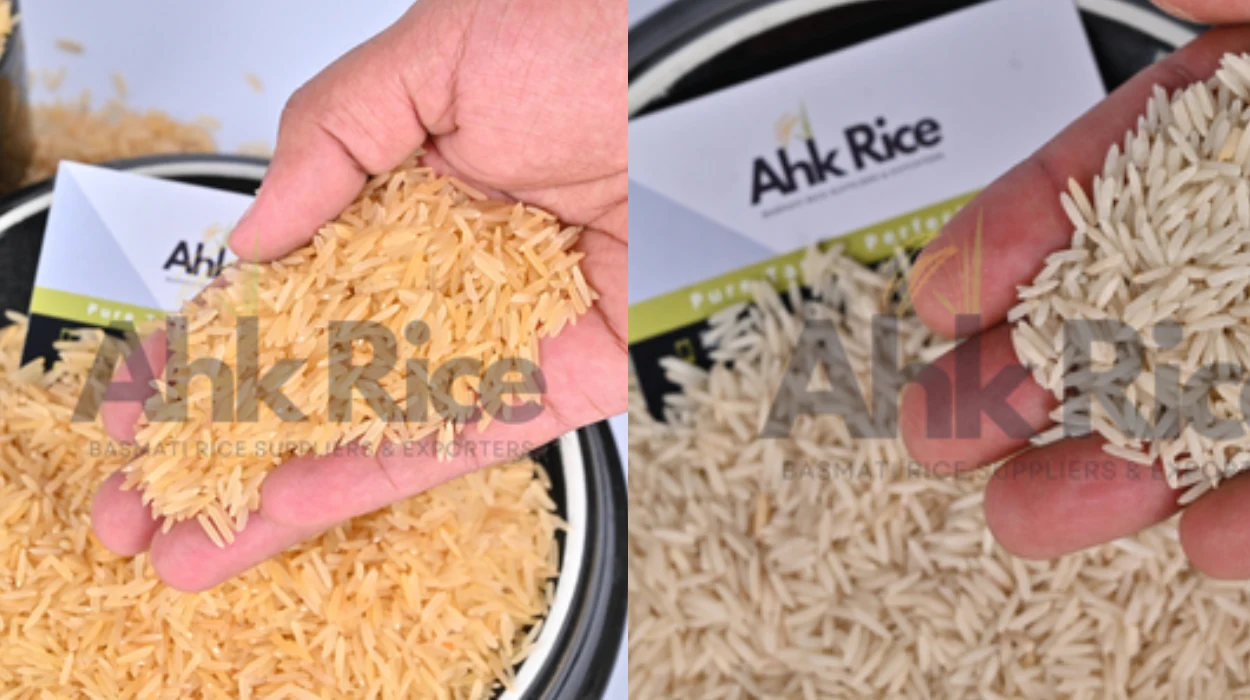
| Color | Light brown | Pearl white |
| Moisture Content | 12–13% | 12–14% |
| Shelf Life | 6–12 months | 12–24 months |
| Broken Ratio | 2–5% | 1–2% |
| Average Price/MT | $1,050–$1,200 | $900–$1,050 |
Brown basmati commands a higher price per metric ton. White basmati maintains lower price but higher volume.
Price vs Margin Dynamics
White basmati generates margin through volume. A container shipped to Africa or the Middle East sells quickly. This reduces holding costs and inventory risk.
Brown basmati generates margin through premium pricing. EU buyers pay higher rates for organic or whole grain rice. This increases per-unit profitability.
Shelf Life Impact
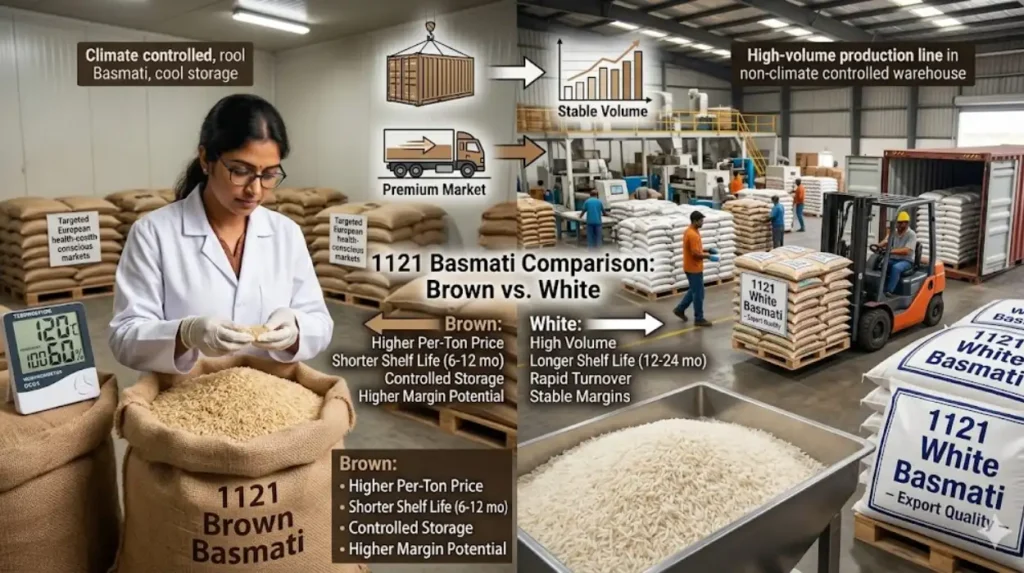
White basmati stores longer due to polishing. In humid markets like West Africa, white rice maintains quality for 18–24 months. Brown rice requires faster consumption within 6–12 months.
Storage Example
White basmati performs better in non-climate-controlled warehouses. Brown basmati requires controlled storage to avoid rancidity.
With the technical comparison complete, the next step is to evaluate market demand across regions.
Which markets prefer brown vs white basmati for export margins?
EU markets prefer brown basmati for health positioning, while Middle East and African markets prefer white basmati for affordability and cooking familiarity.
European Union (Health Food Segment)
EU buyers import brown basmati for organic and whole grain categories. Retailers position it as high-fiber rice.
Demand drivers:
- Health-conscious consumers
- Organic certification requirements
- Premium retail pricing
Brown rice export demand EU continues to grow due to dietary trends (source: EU agri-food import report, 2025).
Price advantage:
Brown basmati sells at 15–25% higher retail value compared to white rice in EU supermarkets.
Middle East & Africa (Volume Markets)
Middle Eastern and African buyers prioritize white basmati. Consumers prefer soft texture and long grain elongation after cooking.
Demand drivers:
- Catering sector demand
- Price-sensitive consumers
- Traditional cooking preferences
White basmati dominates bulk imports due to faster cooking and familiar taste.
Price example:
White basmati sells at $900–$1,050/MT, enabling high-volume trade (source: REAP export data, December 2025).
Market Fit Summary
- EU → Brown basmati → Premium margin
- Gulf → White basmati → Volume margin
- Africa → White basmati → Price-driven demand
With regional demand established, the next step is to determine which method works best for specific export cases.
Which method works best for different export cases?
White basmati works best for bulk and fast-moving markets, while brown basmati works best for niche, high-margin, and certified supply chains.
Case 1 — Bulk Export Strategy
White basmati fits bulk export strategies. Exporters load 20–25 MT containers and dispatch quickly.
Advantages:
- Faster sales cycles
- Lower storage risk
- High liquidity
Example:
A Dubai distributor imports white basmati monthly. The product moves within weeks due to catering demand.
Case 2 — Premium Retail Strategy
Brown basmati fits premium retail channels. Exporters supply smaller volumes with higher margins.
Advantages:
- Higher per-unit profit
- Strong brand positioning
- Stable niche demand
Example:
A German organic retailer imports brown basmati in branded packaging. The product sells at a premium due to health positioning.
Case 3 — Mixed Portfolio Strategy
Exporters combine both grades to balance risk. White basmati generates cash flow. Brown basmati builds margin.
Balanced strategy:
- 70% white basmati for volume
- 30% brown basmati for premium
With use cases defined, the next step is to evaluate pros and cons with real export implications.

What are the pros and cons of 1121 brown vs white basmati?
White basmati offers scalability and stability, while brown basmati offers premium pricing but requires controlled handling and targeted buyers.
Pros of Brown Basmati
- Higher price per MT
- Health-driven demand
- Premium retail positioning
Example:
Organic-certified brown basmati sells at 20% higher margins in EU retail chains.
Cons of Brown Basmati
- Shorter shelf life
- Limited buyer base
- Sensitive storage requirements
Example:
Brown rice stored in humid conditions develops rancidity faster.
Pros of White Basmati
- Longer shelf life
- Wider market acceptance
- Faster turnover
Example:
White basmati remains stable for 18–24 months in Gulf warehouses.
Cons of White Basmati
- Lower price per MT
- Competitive pricing pressure
- Commodity positioning
Example:
African markets negotiate aggressively, reducing exporter margins.
With pros and cons evaluated, the next step is to define clear decision factors for exporters.
What decision factors determine better export margins?
Export margins depend on market selection, storage capability, certification access, and capital turnover requirements.
Decision Framework Table
| Factor | Brown Basmati Decision | White Basmati Decision |
|---|---|---|
| Market Type | EU, premium retail | Africa, Middle East |
| Capital Turnover | Slow, high margin | Fast, moderate margin |
| Storage Infrastructure | Climate-controlled | Standard warehouse |
| Certification Need | Organic, health labels | Standard export compliance |
| Risk Level | Higher niche risk | Lower market risk |
Key Decision Logic
Market selection determines profitability. Exporters targeting Europe should prioritize brown basmati. Exporters targeting bulk markets should prioritize white basmati.
Storage capacity defines feasibility. Brown rice requires controlled environments. White rice tolerates wider conditions.
Certification access increases margin. Organic-certified brown basmati captures higher price brackets.
With decision factors clarified, the final step is to align strategy with export goals.
Final Evaluation: Which grade has better export margins?
White basmati delivers consistent margins through volume, while brown basmati delivers higher margins per unit in premium markets.
White basmati dominates global trade due to scalability. Brown basmati grows in value-driven segments with strong future demand.
The optimal strategy combines both grades. This approach balances liquidity and profitability.
For exporters evaluating premium opportunities, review the detailed breakdown of EU-focused brown basmati supply chains and wholesale requirements in this advanced guide on supplying brown basmati to European health food buyers.
Frequently Asked Questions
Which grade offers better export margins for basmati rice?
1121 white basmati provides consistent margins through volume, while 1121 brown basmati achieves higher per-unit margins in premium markets. The choice depends on whether the exporter prioritizes turnover speed or price premium.
What makes brown basmati more valuable in export markets?
Brown basmati retains its bran layer, increasing fiber and nutrient content, which positions it as a health food product. This allows exporters to target higher-priced retail segments, especially in Europe.
Which regions show strong demand for brown basmati rice?
European markets show the highest demand for brown basmati due to health-conscious consumers and organic food trends. This demand supports premium pricing and stable niche growth.
Why does white basmati dominate global exports?
White basmati dominates due to longer shelf life, wider consumer acceptance, and faster cooking characteristics. These factors make it suitable for bulk markets in the Middle East and Africa.
How does shelf life impact export profitability?
Shelf life directly affects storage risk and inventory turnover, with white basmati lasting up to 24 months and brown basmati lasting 6–12 months. Longer shelf life reduces losses and improves trade efficiency.