Pakistan Basmati Rice in Morocco: North Africa Trade Market Overview
Pakistan Basmati rice supplies Morocco with long-grain aromatic rice for retail, hospitality, and foodservice distribution. Morocco imports Pakistani Basmati because the grain offers 7.2–8.4 mm length, strong aroma retention, and high cooked elongation. Here is why: Pakistan cultivates Basmati in Punjab’s irrigated belt, mills multiple export grades, and ships containerized cargo through Karachi ports into North African trade channels.
What Is Pakistan Basmati Rice in the Morocco and North Africa Trade?
Pakistan exports aromatic long-grain rice varieties including 1121, Super Kernel, and 1509 Basmati to Morocco through bulk and containerized trade channels.
Pakistan Basmati rice refers to aromatic rice cultivated in Punjab’s rice-growing districts. Key cultivation regions include Gujranwala, Hafizabad, Sheikhupura, Sialkot, and Narowal. These regions receive irrigation from the Indus Basin canal system. Farmers cultivate Basmati during the Kharif season and harvest between October and November.
Morocco imports rice because local production remains limited. Moroccan importers source Basmati for supermarkets, restaurants, wedding caterers, and ethnic food distributors. North African consumers prefer long-grain rice because the grain stays separate after cooking.
Pakistan exported over 5 million metric tons of rice during FY2024-25, including significant Basmati volumes to Africa and the Middle East (source: Pakistan Bureau of Statistics, FY2024-25). Morocco remains a strategic North African destination because Casablanca and Tangier ports support regional redistribution.
What Makes Pakistani Basmati Different From Other Rice Origins?
Pakistani Basmati delivers stronger aroma, longer grain elongation, and lower breakage percentages than many non-Basmati origins.
Pakistani Basmati develops aroma because Punjab’s soil contains mineral-rich alluvial deposits. Farmers cultivate the crop in humid monsoon conditions. The grains mature slowly, which improves fragrance and texture.
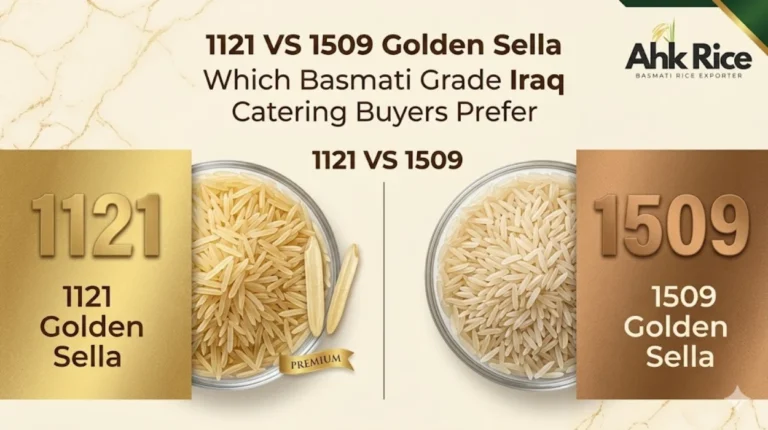
Indian Basmati and Pakistani Basmati share genetic origins. Pakistani exporters focus heavily on steam, sella, and white rice grades for Middle Eastern and African markets. Moroccan distributors often compare these grades based on shelf life, cooking style, and catering performance.
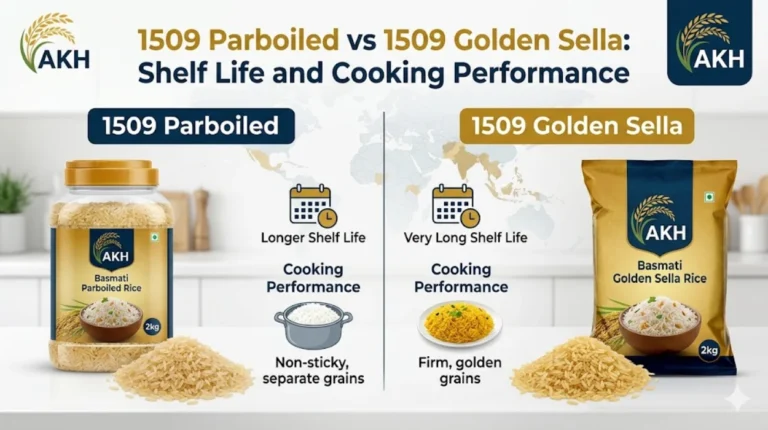
Golden Sella lasts longer than Steam rice. In a 40°C warehouse environment, Golden Sella maintains quality for up to 18 months. Steam rice requires consumption within approximately 12 months. Moroccan wholesalers storing inventory during summer periods often select Golden Sella because the grade tolerates warmer storage conditions.
Which Pakistani Basmati Grades Enter Morocco?
1121 Basmati, 1509 Basmati, and Super Kernel Basmati represent the main Pakistani export grades entering Morocco.
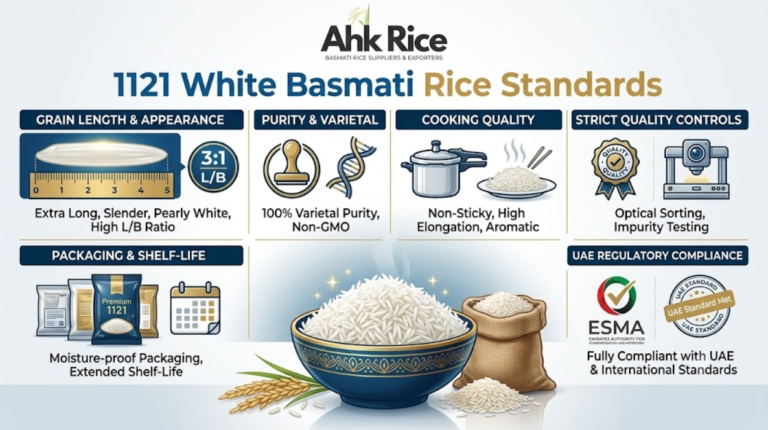
1121 Basmati contains extra-long grains measuring 8.2–8.4 mm before cooking. The grain elongates significantly after cooking. Moroccan foodservice operators use 1121 for premium rice dishes because the grain appearance remains uniform.
1509 Basmati matures earlier than 1121. The grain provides strong yield efficiency and competitive export pricing. Importers distribute 1509 in retail packaging because the grade balances affordability and aroma.
Super Kernel Basmati contains traditional slender grains with a softer texture. North African consumers familiar with classic Basmati styles often select Super Kernel for home cooking applications.
With the trade definition established, the next question is how Pakistan processes and exports Basmati into Moroccan supply chains.
How Does Pakistan Process and Export Basmati Rice to Morocco?
Pakistan processes Basmati through cleaning, dehusking, polishing, grading, testing, and container loading before export dispatch to Morocco.
Rice export operations begin immediately after harvesting. Farmers dry the paddy to safe moisture levels between 12% and 14%. Millers transport the paddy into processing facilities for industrial milling.
Which Processing Steps Prepare Basmati for Export?
Export-ready Basmati passes through multiple processing stages that improve purity, grain consistency, and shelf stability.
- Clean the paddy to remove dust, straw, and stones.
- Dehusk the grain using rubber roll shellers.
- Polish the rice to improve surface appearance.
- Grade the kernels by length and thickness.
- Sort damaged grains using optical color sorters.
- Test moisture levels and broken percentages.
- Fumigate cargo before container loading.
- Pack rice into PP, BOPP, or woven bags.
- Load containers for customs clearance and dispatch.
Pakistani exporters operate integrated milling systems because Moroccan buyers require uniform specifications. Optical sorting removes black grains, chalky kernels, and foreign material. Modern mills inspect export batches through laboratory testing before shipment.
How Does Sella Processing Change Basmati Rice?
Sella processing strengthens grain structure and extends shelf stability through controlled parboiling and drying.
Millers soak paddy in heated water during the parboiling process. Steam pressure pushes nutrients into the grain. Drying systems then reduce moisture before milling begins.
Golden Sella contains a yellow-golden tone because heat changes the grain surface during parboiling. Steam rice undergoes lighter thermal treatment and maintains a softer white appearance.
Moroccan catering companies often procure Golden Sella because the grain resists breakage during large-scale cooking. Steam rice suits retail consumers preferring softer texture and lighter color.
Distributors comparing these grades often review grain length, texture, and catering suitability through detailed specification analysis. A useful comparison appears in the article discussing how Moroccan distributors evaluate long-grain export categories through practical import decisions in different Pakistani Basmati specifications for Moroccan buyers.
How Does Pakistan Ship Rice to Morocco?
Pakistan ships rice through Karachi ports using containerized sea freight routes into Casablanca and Tangier.
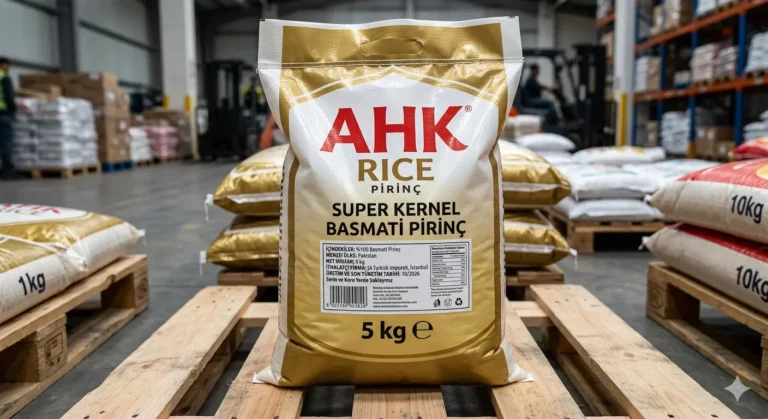
Exporters load rice into 20-foot and 40-foot containers. Standard packaging includes 5 kg, 10 kg, 25 kg, and 50 kg bags. Importers select packaging according to retail or wholesale distribution requirements.
Sea transit from Karachi to Morocco generally ranges between 22 and 35 days, depending on shipping routes and transshipment schedules. North African buyers often coordinate shipments around Ramadan demand cycles because rice consumption increases significantly during seasonal retail periods.
With export logistics explained, the next question concerns the technical components Moroccan buyers evaluate before procurement.
What Components Define Pakistani Basmati Export Specifications?
Grain length, broken percentage, moisture level, purity, aroma, and packaging determine Pakistani Basmati export specifications.
Rice buyers evaluate measurable quality factors before procurement. Moroccan importers compare specification sheets because retail positioning and catering performance depend on grain consistency.
Which Grain Specifications Matter Most?
Long grain size, low breakage, and controlled moisture levels define premium Pakistani Basmati exports.
| Specification | Export Range |
|---|---|
| Grain Length | 7.2–8.4 mm |
| Moisture | 12–14% |
| Broken Percentage | 1–5% |
| Purity | 92–95% |
| Crop Type | New Crop / Aged Crop |
| Color | White / Golden / Creamy |
| Packaging | 5–50 kg |
Moroccan supermarkets often prioritize visual appearance because consumers inspect grain length directly through transparent packaging. Catering distributors prioritize cooking expansion because high-yield rice reduces foodservice costs.
1121 rice elongates more than Super Kernel during cooking. Cooked grain length frequently exceeds 17 mm under controlled preparation conditions. Super Kernel provides softer texture and traditional aroma. Moroccan restaurants serving Mughlai and Gulf-inspired cuisine often select 1121 because presentation quality influences customer perception.
Which Certifications Support Rice Imports Into Morocco?
Phytosanitary certificates, fumigation certificates, and quality inspection documents support Pakistani rice imports into Morocco.
Export documentation verifies product safety and customs compliance. Common export documents include:
- Phytosanitary certificate
- Fumigation certificate
- Certificate of origin
- Packing list
- Commercial invoice
- Bill of lading
- Quality inspection report
Moroccan customs authorities inspect imported food cargo because grain imports require sanitary compliance. Exporters test shipments for moisture, foreign matter, and contamination before dispatch.
Which Packaging Formats Enter North African Markets?
Retail bags and wholesale sacks dominate Pakistani Basmati packaging formats in Morocco and North Africa.
Retail distributors commonly use laminated BOPP packaging because printed branding improves shelf visibility. Wholesale traders use woven polypropylene sacks because the material supports heavy cargo handling.
North African distributors frequently procure:
- 5 kg retail packs for supermarkets
- 10 kg family packs for household consumption
- 25 kg catering packs for restaurants
- 50 kg wholesale sacks for redistribution
With specifications defined, the next question concerns why Moroccan importers continue increasing Basmati procurement.

Why Does Morocco Import Pakistani Basmati Rice?
Morocco imports Pakistani Basmati because urban consumption, hospitality demand, and food distribution networks require aromatic long-grain rice.
Moroccan urbanization increases packaged food consumption. Supermarkets in Casablanca, Rabat, Marrakech, and Tangier distribute imported rice through expanding retail chains.
North African consumers use Basmati in family meals, wedding events, restaurant dishes, and international cuisine preparation. Pakistani rice competes strongly because the grain offers aroma and elongation at competitive pricing levels.
Which Moroccan Industries Use Imported Basmati?
Hospitality, catering, retail, and wholesale food distribution sectors consume imported Pakistani Basmati.
Hotels purchase long-grain rice because buffet presentation requires separated grains. Catering companies prefer Golden Sella because the rice maintains structure during bulk preparation.
Retail chains distribute smaller packs because urban consumers increasingly purchase packaged imported food products. Ethnic grocery stores also stock Pakistani Basmati for South Asian and Middle Eastern communities.
Why Does North Africa Prefer Long-Grain Rice?
Long-grain rice remains popular in North Africa because the grain texture suits regional cooking methods and large meal preparation.
North African cuisine often includes rice with grilled meat, stews, and spice-based dishes. Basmati absorbs flavor while remaining separated after cooking. Short-grain rice behaves differently because starch concentration increases stickiness.
Moroccan distributors also value storage efficiency. Golden Sella tolerates warmer climates more effectively than softer white rice categories. In inland warehouse conditions exceeding 35°C, parboiled rice maintains structural stability for longer periods.
With import demand explained, the next question concerns misconceptions and operational challenges in the Moroccan rice trade.
What Problems and Misconceptions Exist in the Pakistan-Morocco Rice Trade?
Quality inconsistency, incorrect grade labeling, and confusion between Steam and Sella rice create common trade problems.
Rice buyers frequently misunderstand grade terminology. Some distributors classify all long-grain rice as Basmati, although true Basmati requires specific varietal characteristics including aroma and elongation.
Why Do Buyers Confuse Steam and Golden Sella Rice?
Steam rice and Golden Sella rice differ in processing, shelf stability, and cooking behavior.
Steam rice undergoes lighter thermal treatment. The grain remains softer and whiter after milling. Golden Sella undergoes stronger parboiling treatment and develops a golden appearance.
Golden Sella handles bulk catering better because the grains resist breakage during repeated heating. Steam rice provides softer texture for household cooking. Moroccan importers selecting the wrong category often face consumer dissatisfaction because cooking expectations differ.
Why Does Broken Percentage Matter in Moroccan Imports?
Higher broken percentages reduce visual quality and lower cooking consistency.
Premium retail buyers often require 2% or lower broken rice because consumers associate uniform grain appearance with quality. Wholesale catering buyers sometimes accept higher broken percentages because cost efficiency becomes more important.
Broken rice absorbs water unevenly during cooking. Uneven hydration changes texture consistency. Moroccan restaurants serving plated rice dishes prioritize whole kernels because visual presentation affects customer perception.
Why Do Storage Conditions Affect Rice Quality?
Temperature and humidity directly influence aroma retention and grain stability.
Rice stored above recommended moisture levels develops quality deterioration faster. Exporters maintain moisture between 12% and 14% because lower moisture improves storage safety during long sea transit.
Golden Sella retains structure longer than Steam rice under high-temperature storage conditions. Moroccan inland distributors often select parboiled grades because warehouses experience elevated summer temperatures.
With misconceptions clarified, the final question concerns the long-term direction of Pakistani Basmati in North African trade.
How Is Pakistani Basmati Expanding Across North Africa?
Pakistani Basmati expands across North Africa through retail growth, foodservice demand, and diversified packaging formats.
North African food imports continue increasing because urban populations consume more packaged staples. Pakistan strengthens its trade position through consistent grain supply and expanded milling capacity.
Rice exporters now produce multiple grades targeting separate market segments. Retail supermarkets require branded packaging and visual consistency. Catering importers prioritize cooking performance and warehouse durability.
Which Trends Influence Future Morocco Rice Imports?
Retail packaging growth, catering demand, and premium long-grain preferences shape future Moroccan rice imports.
Urban consumers increasingly purchase packaged rice instead of loose commodity sacks. Supermarkets prefer traceable products with clear labeling and certification documentation.
Foodservice demand also expands because tourism and hospitality sectors continue growing across Morocco and wider North Africa. Long-grain aromatic rice supports restaurant menus serving Gulf, South Asian, and fusion cuisine.
Pakistani exporters continue improving milling technology because modern optical sorting and grading systems increase export consistency. North African buyers increasingly compare exact specifications instead of purchasing generic commodity rice categories.
The Pakistan-Morocco rice corridor now connects agricultural production in Punjab with expanding consumer demand across North Africa through specialized Basmati grades, structured export processing, and standardized trade logistics.
Frequently Asked Questions
What types of Pakistani Basmati rice enter Morocco?
Pakistan exports 1121 Basmati, 1509 Basmati, and Super Kernel Basmati to Morocco. These grades serve different market segments. 1121 suits premium retail and catering because of its extra-long grain length. 1509 supports cost-efficient retail distribution. Super Kernel fits traditional aromatic rice demand across North African households.
Why does Morocco import rice from Pakistan?
Morocco imports Pakistani rice because local rice production remains limited while urban food demand continues growing. Pakistani Basmati offers strong aroma, long grain length, and high cooking expansion. Moroccan supermarkets, restaurants, hotels, and catering companies use imported Basmati for retail and foodservice operations.
What is the difference between Golden Sella and Steam Basmati rice?
Golden Sella rice undergoes parboiling before milling, while Steam rice receives lighter heat treatment. Golden Sella maintains grain structure longer during storage and bulk cooking. Steam rice provides a softer texture and lighter color. Moroccan catering companies often choose Golden Sella because the grain tolerates repeated heating during large-scale meal preparation.
How long does Pakistani rice shipping take from Pakistan to Morocco?
Sea freight shipments from Karachi ports to Morocco usually take between 22 and 35 days. Transit time depends on shipping routes, port congestion, and transshipment schedules. Exporters load rice into containerized cargo before customs clearance and international dispatch.
Which certifications support Pakistani rice exports to Morocco?
Pakistani rice exports to Morocco commonly include phytosanitary certificates, fumigation certificates, certificates of origin, and quality inspection reports. These documents verify cargo safety, moisture compliance, and export authenticity. Moroccan customs authorities inspect imported food shipments before market distribution.