1121 Parboiled Basmati Rice: Benefits for Catering Buyers Worldwide
1121 parboiled basmati rice delivers long grain length, high yield, extended shelf life, and stable cooking performance for bulk catering operations. Here is why: the parboiling process hardens the grain, locks nutrients, and reduces breakage during milling and cooking.
What is 1121 parboiled basmati rice?
1121 parboiled basmati rice is a long-grain aromatic rice processed through soaking, steaming, and drying to strengthen the kernel and improve cooking stability.
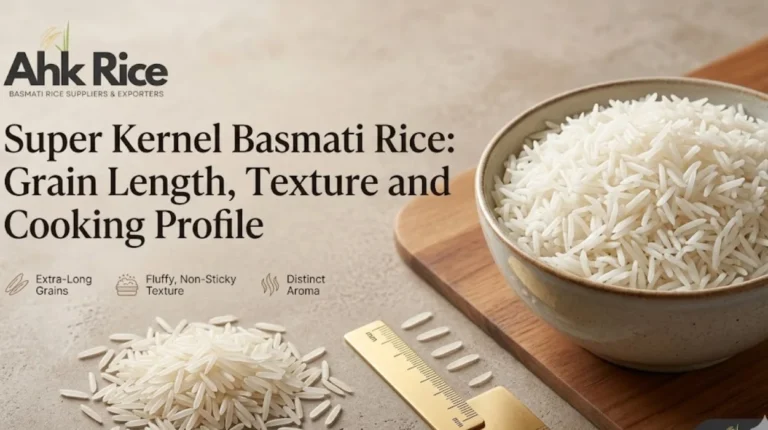
1121 basmati rice is a premium variety cultivated in Punjab, Pakistan and northern India. Farmers cultivate and harvest the crop under controlled irrigation cycles that support elongation and aroma development. The grain length typically measures 8.20–8.40 mm before cooking.
Parboiling transforms raw paddy into a harder and more durable grain. Processors soak the harvested paddy in water, steam it under pressure, and dry it before milling. This treatment gelatinizes the starch and fixes the bran nutrients inside the kernel.
Catering buyers classify this rice as a catering grade rice because it performs consistently in high-volume kitchens. Hotels, airlines, and institutional kitchens require rice that cooks uniformly across large batches.
With the definition established, the next question is how the parboiling process actually works.
How does the parboiling process work for 1121 basmati rice?
The process uses 5 controlled steps: soaking, steaming, drying, milling, and grading to convert raw paddy into durable, long-grain rice.
Step-by-step processing method
- Clean the paddy to remove dust, stones, and husk residues
- Soak the paddy in water at 65–70°C for 4–6 hours
- Steam the soaked paddy under pressure for 5–10 minutes
- Dry the steamed paddy to 12–13% moisture content
- Mill, dehusk, polish, and grade the rice by length
Parboiling changes the internal structure of the grain. Starch gelatinization occurs during steaming. This process prevents grain breakage during milling. Milling yields increase by 3–5% compared to raw rice.
Drying is a critical stage. Processors control temperature and airflow to avoid cracks. Uniform drying ensures that grains maintain structural integrity during storage and cooking.
Grading separates rice into multiple categories. Length sorters and color sorters classify grains into export-ready specifications such as extra-long grain, double polished, and color-sorted premium grades.
This controlled process explains why parboiled rice performs better in catering environments. The next section defines the key components that influence quality.
What are the key components of 1121 parboiled basmati rice quality?
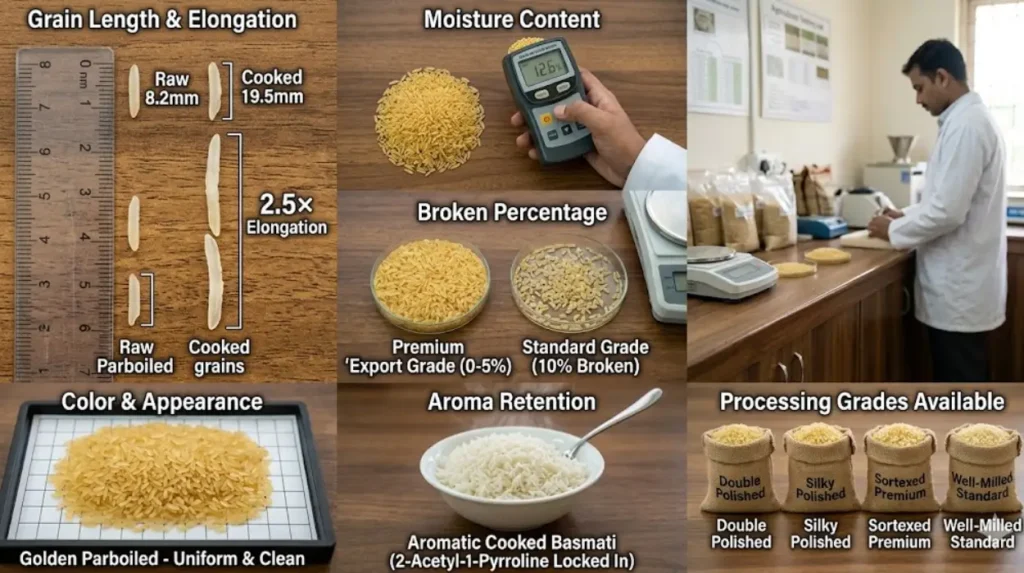
Quality depends on grain length, moisture level, color uniformity, broken percentage, and aroma retention.
Grain length and elongation
1121 basmati rice achieves up to 2.5× elongation after cooking. Long grains improve plate presentation in catering services such as buffets and banquets.
Moisture content
Moisture must remain within 12–13% for export. Lower moisture extends storage life and prevents fungal growth during shipment.
Broken percentage
Export grades specify 0–5% broken grains for premium catering use. Lower broken percentage ensures uniform cooking and visual appeal.
Color and appearance
Parboiled rice appears golden or yellow due to heat treatment. Color sorters remove black or damaged grains to maintain uniformity.
Aroma retention
Basmati rice contains natural aromatic compounds such as 2-acetyl-1-pyrroline. Parboiling locks these compounds inside the grain.
Processing grades available
1121 parboiled basmati rice is available in 7 processing grades:
- Double polished
- Silky polished
- Sortexed premium
- Well-milled standard
- Single polished
- Reprocessed grade
- Broken grade
Each grade serves a specific buyer segment. For example, hotels use premium sortexed rice, while institutional kitchens use standard grades for cost efficiency.
These components define measurable quality. The next section explains how these qualities translate into real benefits.
What benefits does 1121 parboiled basmati rice provide to catering buyers?
1121 parboiled basmati rice provides higher yield, longer shelf life, consistent cooking, and reduced waste in large-scale kitchens.
Higher cooking yield
Parboiled rice absorbs more water during cooking. One kilogram produces 2.5–3.0 kilograms of cooked rice. Catering kitchens reduce raw material costs because of higher output.
Extended shelf life
Parboiled rice lasts 18–24 months under dry storage conditions. Raw basmati typically lasts 12 months. In hot climates such as the Gulf, extended shelf life reduces spoilage losses.
Consistent cooking properties
Parboiled rice maintains grain separation after cooking. The grains remain non-sticky even after prolonged holding times in buffet service.
Reduced breakage
Hardened grains resist mechanical stress. Breakage during transport and cooking decreases by up to 50% compared to raw rice.
Nutritional retention
Parboiling drives vitamins and minerals into the grain. The final product retains more nutrients compared to polished white rice.
Cost control in bulk operations
Catering buyers manage large inventories. Parboiled rice reduces waste, improves yield, and stabilizes food costs across operations.
These benefits explain why global buyers prefer parboiled rice. The next section outlines where this rice is used.
Where do catering buyers use 1121 parboiled basmati rice?
Catering buyers use 1121 parboiled basmati rice in hotels, airlines, restaurants, and institutional food services that require high-volume consistency.
Hotel and banquet catering
Hotels use long-grain basmati for buffet service. The rice maintains structure during extended serving times.
Airline catering
Airlines require rice that holds texture after reheating. Parboiled rice meets this requirement due to its hardened structure.
Restaurant chains
Quick-service and fine-dining restaurants use basmati for dishes such as biryani and pulao. Consistency across outlets is critical.
Institutional catering
Hospitals, schools, and military kitchens prepare rice in bulk. Parboiled rice ensures predictable results across large batches.
Export markets
Key importing regions include:
- Middle East (UAE, Saudi Arabia, Qatar)
- Africa (Kenya, Nigeria, South Africa)
- Europe (UK, Germany)
- Asia (Malaysia, Indonesia)
Pakistan exports over 4 million tons of rice annually (source: Pakistan Bureau of Statistics, FY2024–25). A significant share includes basmati varieties for catering markets.
Use cases show where demand exists. The next section addresses common misconceptions.
What are common problems and misconceptions about parboiled basmati rice?
Common misconceptions include reduced quality, altered taste, and limited applications, but these claims do not match processing science or market usage.
Misconception: Parboiled rice has lower quality
Parboiled rice delivers higher structural strength. Grain integrity improves during milling and cooking. Premium grades match or exceed raw rice quality standards.
Misconception: Parboiled rice tastes different
Parboiling modifies texture but preserves aroma. Flavor remains suitable for traditional dishes such as biryani and mandi.
Misconception: Parboiled rice is only for low-end markets
Premium catering buyers in the Gulf and Europe use parboiled rice for consistency. High-end hotels select silky polished and sortexed grades.
Misconception: Shelf life is the same as raw rice
Parboiled rice lasts significantly longer. In a 40°C warehouse in the UAE, parboiled rice maintains quality for 18–24 months, while raw rice requires faster turnover.
Common handling problems
Improper storage creates quality issues. Buyers must:
- Store in dry, ventilated warehouses
- Maintain temperature below 25°C when possible
- Use fumigation protocols for pest control
These clarifications remove uncertainty around the product. The next section connects processing differences with buyer decisions.
How do processing variations affect catering performance?
Processing variations such as steaming intensity, polishing level, and grading directly impact cooking behavior, shelf life, and visual quality.
Steaming intensity
Higher steaming pressure creates harder grains. Harder grains perform better in bulk cooking.
Polishing level
Double polishing improves appearance but reduces surface nutrients. Catering buyers select polishing based on presentation requirements.
Grading precision
Advanced sorting ensures uniform grain size. Uniform grains cook evenly, which is essential for large-scale kitchens.
Comparison with other processing types
Parboiled rice differs from other variants in processing and performance. A deeper understanding of these differences supports accurate procurement decisions. Readers exploring detailed distinctions between parboiled and other processing types can review the comparison of processing techniques in the supporting article: 1121 parboiled vs golden sella processing difference.
These variations explain why buyers specify exact grades. The next section connects certifications to global trade.
What certifications apply to 1121 parboiled basmati rice exports?
Export-quality 1121 parboiled basmati rice meets international standards through food safety, quality, and compliance certifications.
Common certifications
- ISO 22000 (food safety management)
- HACCP (hazard analysis and control points)
- SGS inspection reports (third-party quality verification)
- Phytosanitary certificate (plant health compliance)
- Certificate of origin (trade documentation)
Quality inspection process
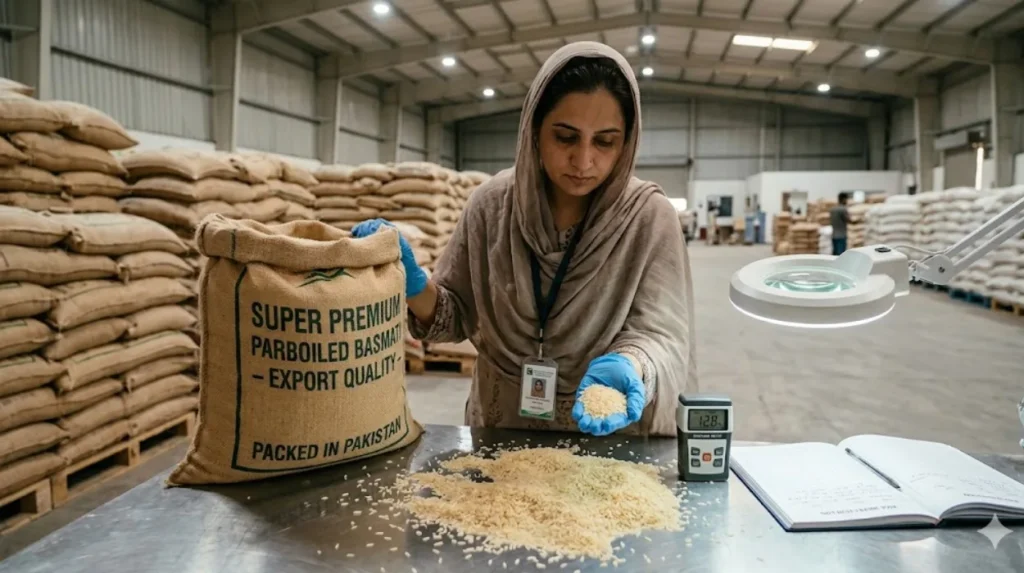
Inspectors test rice for:
- Moisture percentage
- Broken grain ratio
- Foreign matter content
- Grain length and uniformity
Testing ensures that each shipment meets buyer specifications. Certification builds trust across international markets.
With certifications defined, the full product lifecycle is now clear from cultivation to export.
Frequently Asked Questions
What defines 1121 parboiled basmati rice for catering use?
1121 parboiled basmati rice is defined by 8.20–8.40 mm grain length, 2.5× elongation, and 12–13% moisture, ensuring consistent cooking and high yield in bulk kitchens.
How long does parboiled basmati rice last in storage?
Parboiled basmati rice maintains quality for 18–24 months in dry conditions, outperforming raw basmati which typically lasts 12 months under similar storage environments.
Why do catering buyers prefer parboiled rice over raw rice?
Catering buyers choose parboiled rice for higher yield, reduced breakage, and stable cooking performance across large batches in hotels, airlines, and institutional kitchens.
What is the cooking yield of 1121 parboiled basmati rice?
One kilogram of 1121 parboiled basmati rice produces 2.5–3.0 kilograms of cooked rice, supporting cost control in high-volume food service operations.
Which markets import 1121 parboiled basmati rice for catering?
Major import markets include UAE, Saudi Arabia, Qatar, Kenya, Nigeria, UK, and Malaysia, where bulk catering demand drives consistent procurement.