Pakistan vs India 1121 White Basmati: Quality Compliance and Price 2026
The main available sourcing options for 1121 white basmati are Pakistan‑origin and India‑origin supply, each with its own grain specifications, ageing window, export compliance, and price structure.
Pakistan‑origin 1121 white basmati comes from irrigated basmati belts in Punjab, where the grain is milled, aged, and packed for export to 15+ countries. India‑origin 1121 white basmati comes from regions such as Haryana, Punjab, and Uttar Pradesh, also processed through segments for export and domestic premium markets. Both countries export 1121 white basmati to EU, Gulf, UK, and other regions, but the禾usive microstructure, ageing practices, and compliance handling differ.
AHK Rice supplies 1121 white basmati from Pakistan with end‑to‑end processing, so the 12‑month ageing option is one of the spec levers available within the Pakistan‑origin pool.
How do Pakistan and India 1121 white basmati compare?
Pakistan and India 1121 white basmati compare clearly on raw grain length, ageing style, compliance routes, and 2026 export price per MT, with Pakistan‑origin often skewing longer and simpler in some export channels.
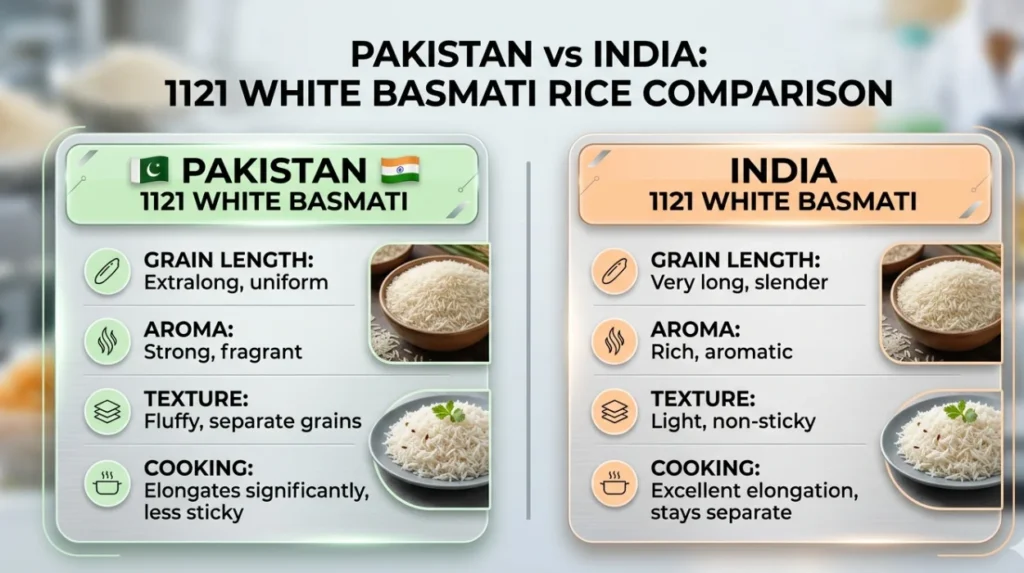
Both countries grow the 1121 variety, which is known for extra long raw grain and strong cooking elongation. However, post‑2023, Pakistan has increased basmati exports sharply, reporting roughly 1.8 million MT against India’s 90,000–100,000 MT in 2024, according to Pakistan‑based export data. That shift has changed the commercial balance, especially for 1121 white basmati shipped to the Middle East, EU, and UK.
Below is a 7‑row specification comparison table that focuses on 1121 white basmati as a 2026, EU‑oriented export commodity:
| Attribute | Pakistan‑origin 1121 white basmati | India‑origin 1121 white basmati |
|---|---|---|
| Typical raw grain length | Often 8.0–8.3 mm, within the longest commercially traded basmati band | Typically 7.8–8.2 mm, still extra long but sometimes slightly shorter on average |
| Common ageing window | Often 12‑month aged sets for premium packs | Often 12‑month aged, with some 6‑month lines for value‑oriented packs |
| Grain structure | High elongation, long separated grains, brighter white finish | Similar elongation, but some lots show more grain taper |
| Export compliance complexity | Phytosanitary, origin, food safety, plus residue checks for EU / UK | Similar documents, but often more complex due to tighter export‑policy coordination |
| 2026 price per MT (indicator range) | Lower‑to‑mid in many EU channels due to higher export volume | Mid‑to‑high due to export‑policy constraints and higher demand in key markets |
| Moisture control approach | Stable, low‑moisture storage for long‑term ageing | Similar storage, but with more variation by exporter and warehouse |
| Brand/origin label clarity in EU | Clear “Pakistan”‑flagged packs in many retail channels | Clear “India”‑flagged packs, often emphasising traditional basmati districts |
This table shows that the grain itself is very alike, but the origin‑based context changes compliance, price, and channel positioning. The 1121 white basmati from Pakistan and India are not the same brand, but they are the same variety treated differently by the supply chain.
How do EU and Gulf markets differ?
EU and Gulf markets differ in how they treat Pakistan‑ and India‑origin 1121 white basmati, with EU buyers often more sensitive to labelling and compliance, while Gulf buyers focus on volume, grain length, and brand‑name strength.
In the EU, sample request value transparent origin labelling, residue documentation, and food‑safety certificates. EU‑oriented 1121 white basmati is often sold in smaller packs, with clear “Pakistan” or “India” origin labels and compliance headers. The 2026 framework means that any lot must pass EU‑level tests for moisture, insect damage, and chemical residues.
In Gulf channels such as UAE and Saudi Arabia, 1121 white basmati is often bought in bulk or large retail packs. The emphasis is on grain length, whiteness, and consistency across the lot. Pakistan has reported a sharp rise in rice exports in 2025–26, with basmati volumes up around 20–25% year‑on‑year, which supports the argument that many Gulf buyers see Pakistan‑origin 1121 as a stable, high‑volume option.
What is the 2026 price per MT situation?
The 2026 price per MT for 1121 white basmati shows Pakistan‑origin at a generally lower or mid‑range level and India‑origin at a mid‑ to high‑level, depending on grade, ageing, and destination‑region margins.
In EU and UK channels, 1121 white basmati may trade in a roughly 14–18 USD/kg band as a premium branded product, which maps to around 1,400–1,800 USD/MT at the wholesale level (illustrative only, excluding freight and duty). India‑origin 1121 often anchors the higher end because of limited export volumes and stronger domestic demand. Pakistan‑origin 1121 tends to be more price‑competitive, especially for bulk‑oriented buyers, due to higher export volumes and simpler logistics in some lanes.
Gulf and Asian markets may see slightly different price gradients because of freight and insurance. The 2026 numbers therefore must be viewed as indicative ranges, not fixed contract points. The core takeaway is that origin matters, but the ageing window, packing size, and certification load also influence the final MT price.
How does shelf life and stability differ?
Shelf life and stability differ mainly by storage practice, not by origin, but Pakistan‑origin 1121 white basmati often follows a more standardised 12‑month ageing model while India‑origin shows more fragmentation across warehouse formats.
Both Pakistan and India store 1121 white basmati in controlled‑moisture facilities, with typical storage life around 18–24 months under dry, cool conditions. The 12‑month ageing window is treated as a sweet spot for aromatic development and texture tightening, so many export‑grade 1121 white basmati packs from both countries align with that window.
However, Pakistan’s export‑booster environment has led to more standardised handling for 1121 destined for EU, UAE, and China, where buyers request clean, well‑documented lots. Indian exporters also provide high‑quality 1121, but the compliance landscape is more complex, which can create variability in shelf‑life perception even if the grain itself is similar.
What are the pros and cons of each route?
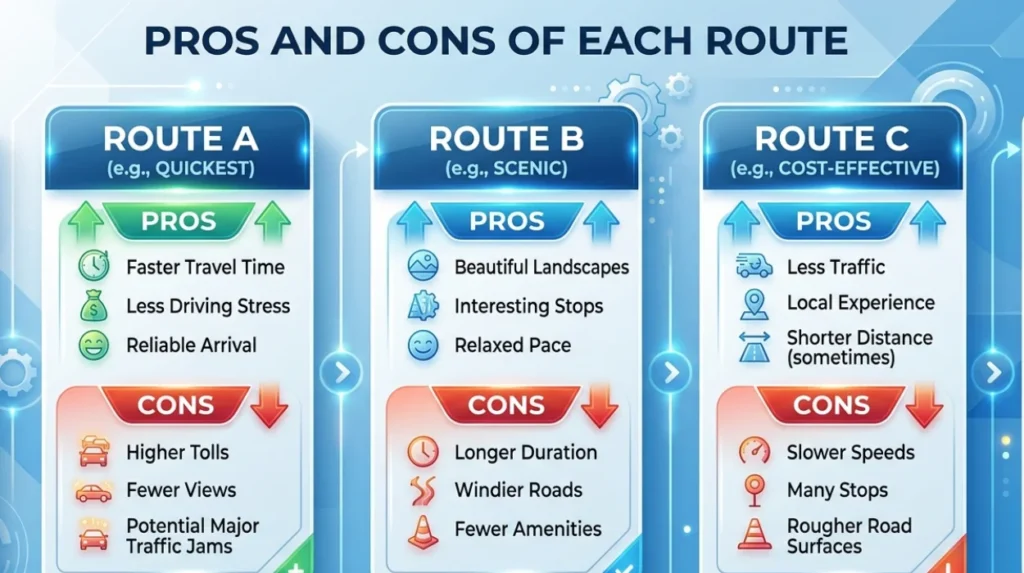
Pakistan‑origin 1121 white basmati is stronger on grain length, export volume, and value for money, while India‑origin 1121 is stronger on brand legacy and perceived premium positioning in some channels.
Pros of Pakistan‑origin 1121 white basmati:
- Often longer raw grain, suitable for “extra long grain” labelling.
- Lower‑to‑mid price per MT due to higher export volumes and simpler logistics in some lanes.
- Stable 12‑month ageing schemes for premium packs.
- Strong growth in EU and Gulf exports, which supports long‑term channel reliability.
Pros of India‑origin 1121 white basmati:
- Deep brand‑name recognition in many retail shelves.
- Established lab‑test and certification routines for EU and Gulf.
- Clear origin‑labelling tied to specific basmati districts.
- Premium pricing power in markets that value “Indian basmati” as a category.
Cons of Pakistan‑origin 1121:
- Less brand‑name weight in some legacy channels.
- Buyers must invest more in label‑design and messaging to build trust.
Cons of India‑origin 1121:
- Higher price per MT in many export‑oriented deals.
- More complex export‑policy and compliance architecture.
- Some lots show more grain‑length variance if not carefully graded.
What decision factors should buyers weigh?
Buyers should weigh grain specification, origin‑label perception, compliance load, exporting‑cost structure, ageing window, and destination‑region acceptance when choosing between Pakistan‑ and India‑origin 1121 white basmati.
A 5‑row decision‑framework table can make the trade‑offs explicit:
| Decision factor | Pakistan‑origin 1121 | India‑origin 1121 |
|---|---|---|
| Grain length and cooking | Extra long, strong separation, high raw grain length | Extra long, strong separation, slightly more length variance |
| Origin‑label perception in EU | Neutral to positive, but needs clear branding support | Strong brand‑legacy appeal in many retail lines |
| Compliance and lab‑testing | Straightforward, standard routes for EU, GCC, and China | Slightly more complex, but well‑documented |
| 2026 price per MT trend | Generally lower‑to‑mid, good value for long‑grain | Mid‑ to high‑range, with higher premium lift |
| 12‑month ageing robustness | Well‑established, often used in premium packs | Also 12‑month common, but more variable by exporter |
Buyers who prioritise grain length and cost efficiency often lean toward Pakistan‑origin 1121 white basmati, especially for private‑label or own‑brand retail. Buyers who want to lean on an established “Indian basmati” story often choose India‑origin, accepting the higher price and more complex paperwork.