Rice Packaging Sizes and EU Labelling Standards for Germany in 2026
Rice packaging sizes and EU labelling standards in Germany 2026 define how rice is packed, weighted, and labelled for retail and wholesale distribution under EU food law. These rules control net weight, nutritional labeling, traceability codes, language requirements, and packaging material compliance across all imported rice products entering the German market.
Rice packaging in Germany follows strict alignment with EU food information regulations. The central framework is Regulation (EU) No 1169/2011, which defines mandatory food label elements. For rice imports, every bag must show product name, net weight, origin country, lot code, importer details, and nutritional declaration.
The system also integrates traceability requirements under EU hygiene law. Each rice batch must be traceable back to milling and polishing units. This ensures food safety verification during audits and inspections at German customs and retail distribution centers.
Packaging sizes are standardized to support retail consistency. The German market packaging rice structure is dominated by consumer-friendly weights such as 500g, 1kg, 2kg, and 5kg. These sizes align with household consumption patterns and supermarket shelf optimization.
Eco compliance has also become central in 2026. Eco packaging rice Germany trends require recyclable or biodegradable materials. Plastic reduction targets influence bag composition, labeling adhesives, and printing inks used for rice export packaging.
How does rice packaging compliance work in the German retail market?
Rice packaging compliance in Germany works through a layered approval system involving EU regulation checks, German import verification, customs documentation, and retail buyer specification audits. Every rice shipment must meet labeling, safety, packaging material, and traceability standards before entering retail distribution channels or warehouse clearance.
The compliance process begins at the exporter level. Mills and exporters prepare packaging according to EU labeling rules. Labels must include multilingual requirements, but German language labeling remains mandatory for retail sales.
Customs authorities in Germany verify product classification under HS codes and cross-check documentation such as phytosanitary certificates and certificates of origin. Any mismatch in packaging weight or labeling leads to shipment delays.
Retail buyers add another layer of compliance. Supermarkets in Germany enforce private standards that often exceed EU minimums. These include barcode placement, shelf-life formatting, and QR-based traceability systems.
The compliance flow also includes packaging inspection for material safety. Food-grade certification is required for all contact layers. Ink safety standards ensure no chemical migration into rice during storage.
Exporters like AHK RICE follow structured compliance pipelines to match buyer specifications across different EU regions while maintaining consistent packaging integrity.
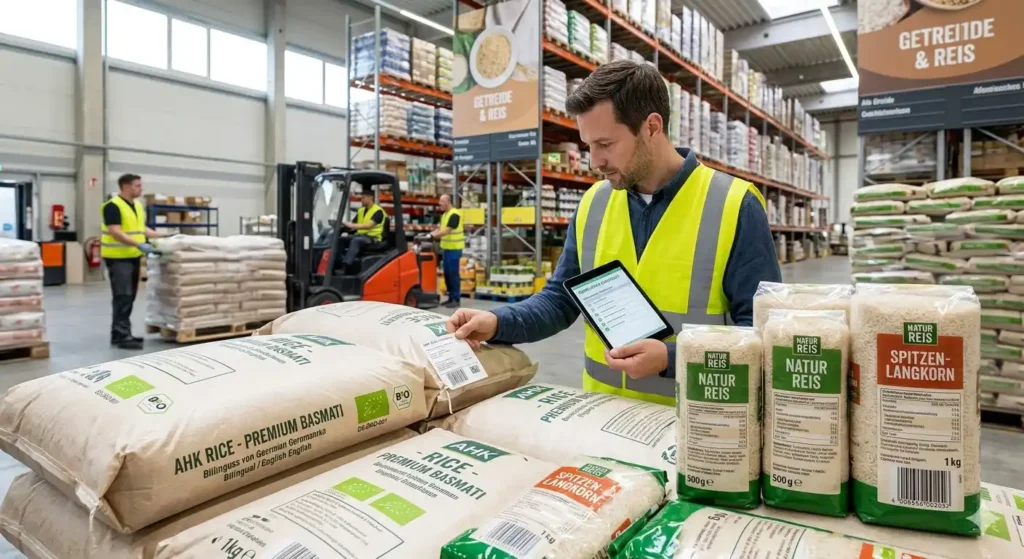
What are standard rice packaging sizes used in Germany and EU markets?
Standard rice packaging sizes in Germany and EU markets include 500g, 1kg, 2kg, 3kg, and 5kg retail packs, along with 10kg and 20kg institutional bags. These sizes are designed for household consumption, horeca supply chains, and wholesale distribution across supermarkets and ethnic food retail channels.
Retail rice weight Germany standards prioritize smaller consumer packs due to high supermarket turnover rates. The 1kg pack remains the most common unit for basmati rice in German households.
500g packs are used for premium or specialty rice segments. These smaller units target trial purchases and premium branding strategies in organic or aromatic rice categories.
2kg and 5kg packaging sizes dominate mid-range family consumption. These sizes balance price efficiency and storage convenience, making them common in German supermarket chains.
For institutional buyers, 10kg and 20kg bags are standard. These are supplied to hotels, catering services, and food processing companies. Bulk packaging must follow stricter durability and moisture barrier requirements.
EU rice bag sizes are also influenced by logistics optimization. Pallet stacking efficiency and container loading standards determine outer carton dimensions and weight distribution during export.
What are key components of EU-compliant rice packaging?
EU-compliant rice packaging includes product labeling, net weight declaration, origin marking, batch traceability codes, nutritional information, allergen disclosure, barcode systems, and food-safe packaging materials designed to prevent contamination and preserve grain quality throughout transportation and retail storage.
Labeling is the most critical component. Every rice pack must clearly display product identity, such as Basmati rice variety (1121, Super Kernel, or 1509). The label must also include milling date and best-before date.
Traceability codes ensure every batch can be tracked back to processing units. This is essential for food safety audits in Germany and across EU border inspections.
Nutritional labeling includes energy, carbohydrates, protein, and fat content per 100g. This information must follow standardized EU format to ensure consistency across all imported food products.
Packaging material must be certified food-grade. Multi-layer polypropylene or biodegradable kraft paper is commonly used. Eco packaging rice Germany standards push exporters toward recyclable mono-material structures.
Barcode and QR systems are used for retail automation. These enable scanning at checkout and inventory management across supermarket chains.
What benefits do standardized rice packaging sizes provide in Germany?
Standardized rice packaging sizes in Germany provide consistent retail shelf management, improved logistics efficiency, predictable consumer purchasing behavior, reduced supply chain errors, and compliance with EU regulatory frameworks, ensuring smoother import clearance and higher market acceptance across supermarkets and wholesale distribution networks.
Retailers benefit from predictable shelf planning. Fixed sizes like 1kg and 5kg allow uniform shelf spacing, which improves product visibility and stock rotation.
Logistics systems operate more efficiently when packaging sizes are standardized. Container loading patterns become predictable, reducing shipping waste and optimizing freight costs per metric ton.
Consumer behavior in Germany also aligns with standardized packaging. Households prefer repeatable purchase sizes, especially for staple foods like rice.
Compliance benefits are significant. Standardized packaging reduces customs rejection rates because labeling and weight consistency minimize regulatory mismatches during inspection.
For exporters, standardized EU rice bag sizes reduce production complexity. Mills can streamline bagging lines and reduce changeover time between product categories.
Where is packaged rice used in Germany and EU distribution channels?
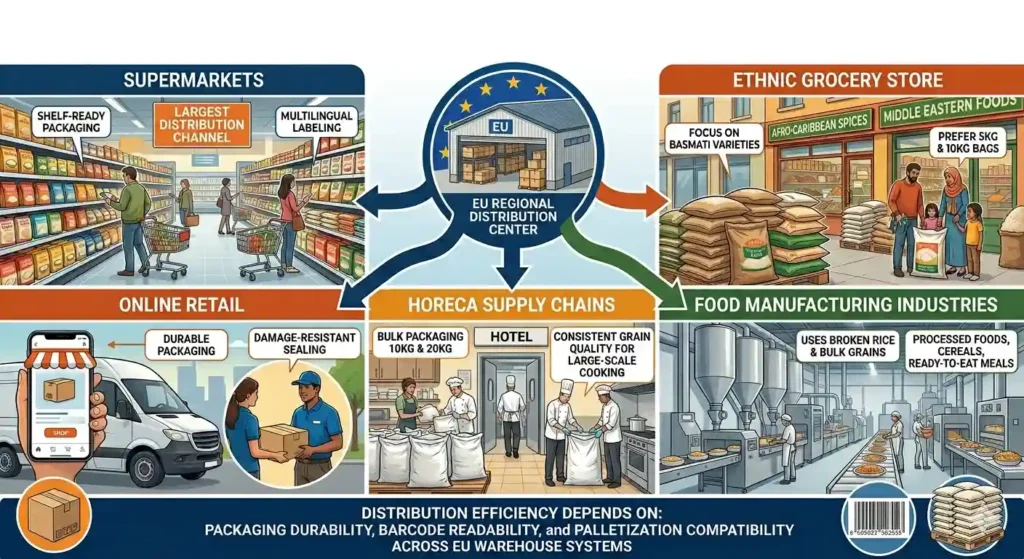
Packaged rice in Germany is distributed through supermarkets, ethnic grocery stores, online retail platforms, wholesale importers, horeca supply chains, and food manufacturing industries, with each channel requiring specific packaging sizes, labeling formats, and logistical handling standards aligned with EU food distribution systems.
Supermarkets represent the largest distribution channel. Chains require strict compliance with shelf-ready packaging, barcode placement, and multilingual labeling standards.
Ethnic grocery stores focus on basmati rice varieties from South Asia. These outlets prefer 5kg and 10kg bags due to high consumption rates in immigrant households.
Online retail platforms require durable packaging with damage-resistant sealing. Packaging must withstand long-distance courier handling without moisture exposure.
Horeca supply chains use bulk packaging sizes like 10kg and 20kg. Hotels and restaurants require consistent grain quality for large-scale cooking operations.
Food manufacturing industries use broken rice and bulk grains. These are used in processed foods, cereals, and ready-to-eat meals across EU production facilities.
Distribution efficiency depends on packaging durability, barcode readability, and palletization compatibility across European warehouse systems.
What are common problems and misconceptions in rice packaging compliance?
Common problems in rice packaging compliance include incorrect labeling language formats, inconsistent net weight declarations, non-compliant packaging materials, missing traceability codes, and misconceptions that EU standards are uniform across all member states without considering country-specific retail enforcement variations like Germany’s stricter labeling audits.
One frequent issue is incorrect multilingual labeling. Many exporters fail to include mandatory German language descriptions, leading to customs delays or retail rejection.
Another problem is weight inconsistency. Packaging machines sometimes produce net weight deviations beyond EU tolerance limits, which triggers compliance failure during inspection.
Traceability errors also occur when batch codes are not properly linked to production records. This breaks the EU audit trail requirement and increases rejection risk.
A common misconception is that all EU countries follow identical retail rules. Germany enforces stricter retail compliance checks compared to several other EU states, especially for barcode accuracy and recycling labeling.
Packaging material errors are also frequent. Non-certified plastic layers or inks lead to non-compliance with food safety migration standards.
The shift toward eco packaging rice Germany requirements has created confusion among exporters who still use multi-material laminated bags that are not recyclable under 2026 sustainability targets.