1121 Golden Sella vs Creamy Sella: Price Difference and Which to Stock
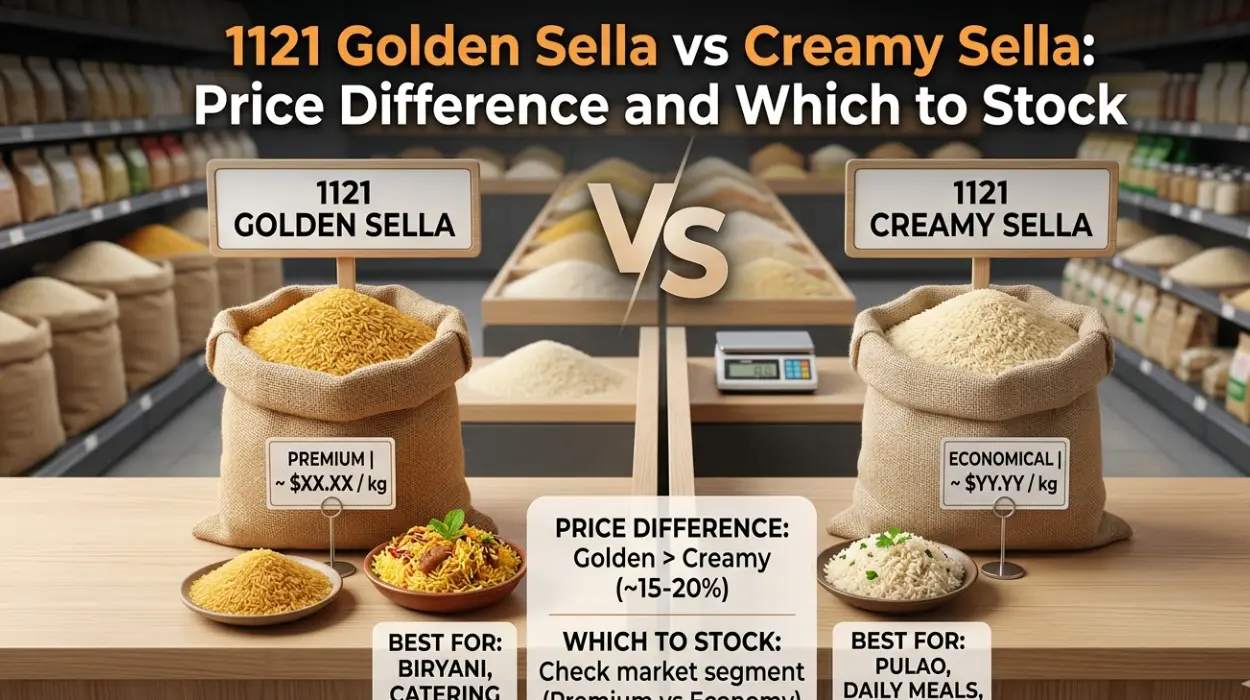
1121 Golden Sella typically trades at a 15–25 USD per metric ton premium over 1121 Creamy Sella due to longer‑grain‑specifications, higher‑grade‑requirements, and stronger‑market‑perception as a festive‑premium product. Buyers who understand this 1121 Golden Sella vs Creamy Sella price difference and stocking impact can make more informed decisions about which grade to warehouse for Middle Eastern, European, and African‑demand.
How does the 1121 Golden Sella vs Creamy Sella price difference affect stocking decisions?
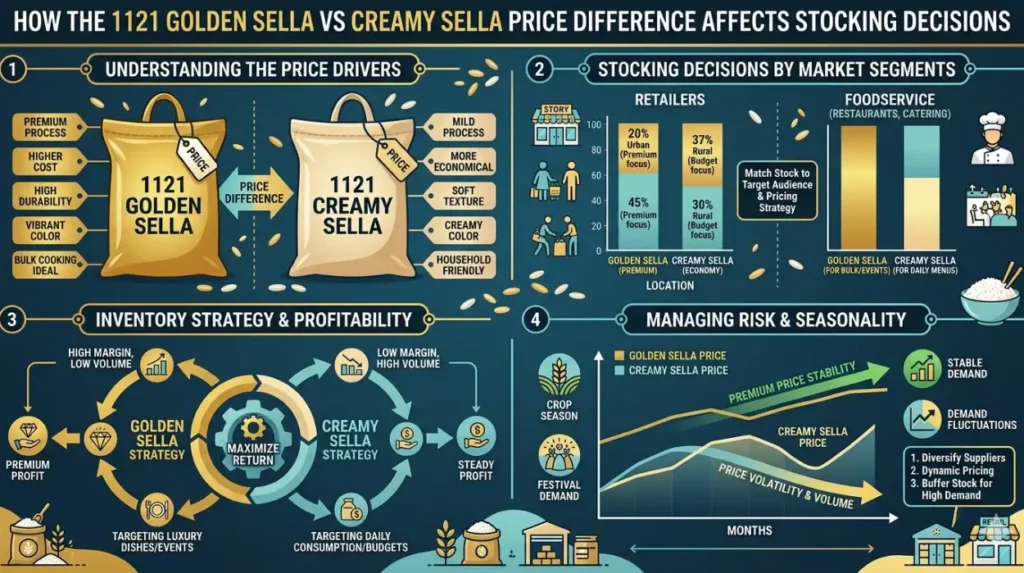
The 1121 Golden Sella vs Creamy Sella price difference affects stocking decisions by shifting profit‑margins, inventory‑holding‑costs, and shelf‑life‑considerations depending on the target‑market and grade‑preference.
AHK Rice quotes 1121 Golden Sella in the 980–1,050 USD per metric ton FOB‑Karachi band for 18–20%‑broken‑A‑grade, whereas Creamy Sella generally sits in the 960–1,010 USD/MT range for 22–25%‑broken‑standard‑grade. This 20–40 USD/MT gap narrows when Golden Sella‑orders accept higher‑broken‑percentages or bulk‑volumes, but the colour‑premium‑mechanism persists.
In Middle‑Eastern‑markets, Golden Sella‑packs retail at roughly 10–15% above Creamy Sella because consumers associate the golden‑hue with premium‑festive‑Basmati. In contrast, East‑African‑buyers often treat Creamy Sella as their primary‑mid‑grade, accepting a 5–7% price‑difference only when Golden Sella is clearly‑branded and differentiated.
Stocking‑strategy‑implications:
- Golden Sella suits higher‑margin‑retail, labelled‑festive‑packs, and HORECA‑segments.
- Creamy Sella better fits budget‑bundles, institutional‑contracts, and blended‑loads.
Understanding these margins lets buyers allocate warehouse‑space and import‑quotas to match expected‑turnover‑rates and working‑capital‑constraints.
How do 1121 Golden Sella and Creamy Sella grades compare in specifications?
1121 Golden Sella and Creamy Sella grades compare in specifications through grain‑length, broken‑content, chalk, colour‑intensity, aroma, and milling‑level, which define their fit‑for‑purpose and pricing‑band.
| Feature | 1121 Golden Sella | 1121 Creamy Sella |
|---|---|---|
| Average raw grain length (mm) | 8.2–8.3 | 7.8–8.0 |
| Broken % (A‑grade) | 18–20% | 22–25% |
| Chalk limit (Max) | 1–2% | 2–3% |
| Moisture limit (Max) | 12.5% | 12.5% |
| Colour intensity | Bright golden‑yellow | Soft‑ivory to light‑yellow |
| Aroma strength | High‑Basmati‑type | High‑but‑slightly‑muted |
| Typical packaging use | 1–5 kg retail, festive packs | 5–25 kg retail, value‑packs, canteens |
Golden Sella retains more of the parboiled‑bran‑layer, giving it a clear‑golden‑look and firmer‑texture, whereas Creamy Sella is milled more thoroughly, losing some of the outer‑pigmented‑layer and gaining a softer‑mouthfeel.
For buyers who want to understand how 1121 Golden Sella’s colour arises from parboiling, an earlier What makes 1121 Golden Sella Basmati its characteristic golden colour guide explains the chemistry and processing steps in detail.
How do Golden and Creamy Sella prices differ by market region?
Golden and Creamy Sella prices differ by market region mainly through moisture‑protection‑costs, packaging‑level, and perceived‑festive‑value, which widen the 1121 Golden Sella vs Creamy Sella gap in the Middle East and compress it in parts of Africa.
In the UAE, Saudi Arabia, and Qatar, Golden Sella commonly sells at 1,000–1,070 USD/MT FOB‑Karachi, while Creamy Sella runs 970–1,030 USD/MT, creating a 30–40 USD/MT‑premium. These markets prioritise colour‑consistency and branding, so buyers accept higher‑cif‑rates for 5‑kg branded‑packs with nitrogen‑flushing and inner‑liners.
In the UK and EU, the 1121 Golden Sella vs Creamy Sella price gap is narrower at 1,000–1,060 USD/MT for Golden Sella and 980–1,030 USD/MT for Creamy Sella, because flavour‑and‑safety‑standards often outweigh pure‑colour‑preference.
East‑African‑importers in Kenya, Uganda, and Tanzania typically see 960–1,020 USD/MT for Golden Sella and 940–990 USD/MT for Creamy Sella, with many blending the two grades to maintain a golden‑appearance at a mid‑range‑cost.
How do shelf life and storage conditions compare between Golden and Creamy Sella?
Golden and Creamy Sella share similar shelf life under ideal conditions, but moisture‑control and packaging‑level significantly affect their practical‑best‑quality‑period and bran‑stability.
Parboiled‑1121 grades generally retain 18–24 months of best‑quality in cool‑dry storage at 12–15°C and 50–60% relative‑humidity, with Golden Sella sometimes showing a 2–3‑month‑advantage because the retained‑bran‑layer resists moisture‑sorption better than fully‑milled‑Creamy Sella.
In hot‑humid‑environments, such as warehouses in the Middle East operating at 30–40°C, unopened‑Golden Sella‑packs often stay within premium‑quality for 12–18 months, while Creamy Sella can lose some of its cream‑smooth‑texture after 10–14 months if not packed with poly‑liners or nitrogen‑flushing.
East‑African‑buyers who store 1121 Golden Sella and Creamy Sella in basic‑PP‑bags must monitor moisture‑levels closely, as exceeding 14% can trigger faster‑flavour‑loss and harder‑grains in parboiled‑Basmati.
How do Golden and Creamy Sella stocking strategies compare?
Golden and Creamy Sella stocking strategies compare by aligning inventory‑mix with target‑market‑preference, expected‑turnover‑rate, and profit‑structure rather than defaulting to a single‑grade‑allocations.
A 5‑row‑decision‑framework helps buyers choose which to stock more heavily:
| Factor | Strategy for Golden Sella | Strategy for Creamy Sella |
|---|---|---|
| Target market (examples) | UAE, Saudi, Qatar, branded‑EU‑retail | East Africa, CIS‑value‑segments, blended‑loads |
| Price sensitivity | Moderate‑to‑high, accepts 10–15% premium | Higher, drives 5–7% price‑difference tolerance |
| Packaging level | 1–5 kg, branded, nitrogen‑flushed | 5–25 kg, bulk‑and‑value‑packs |
| Shelf‑life priority | 18–24 months, colour‑retention‑critical | 15–20 months, texture‑and‑cost dominant |
| Stock‑role | Festive‑demand‑core, impulse‑BUY‑brick | Steady‑flow‑core, rotation‑and‑blending base |
Importers who specialise in Middle‑Eastern‑festival‑seasons tend to keep 60–70% of 1121 Sella‑inventory as Golden Sella, with 30–40% as Creamy Sella for blending or mid‑range‑offers. African‑and‑CIS‑operators often invert this, using Creamy Sella as the primary‑stock and Golden Sella as a limited‑seasonal‑premium‑add‑on.
What are the pros and cons of stocking 1121 Golden Sella versus Creamy Sella?
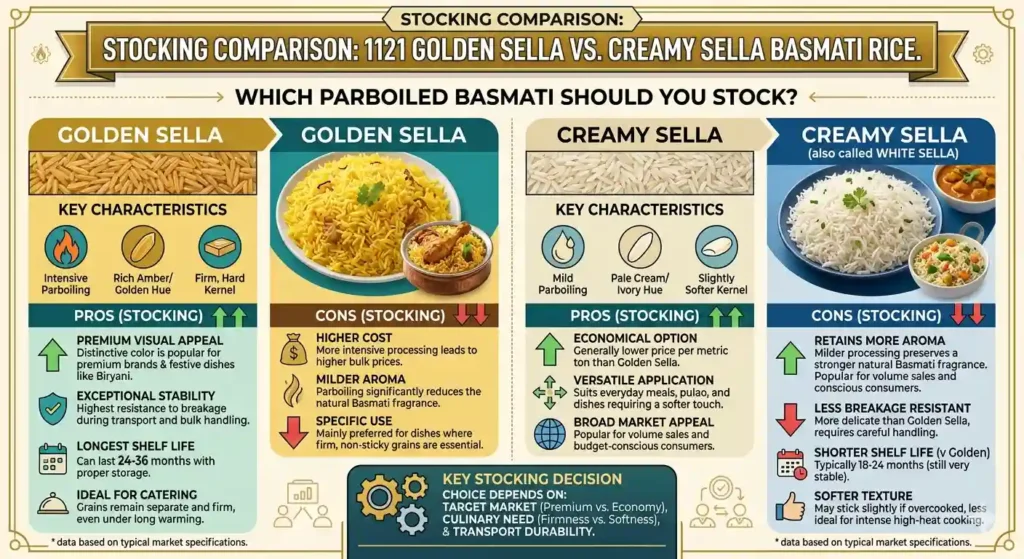
Stocking 1121 Golden Sella versus Creamy Sella presents distinct pros and cons around margin, perception, shelf‑life, blending‑flexibility, and working‑capital‑exposure.
Pros for Golden Sella:
- Higher perceived‑value allows bigger mark‑ups in retail and HORECA.
- Stronger festive‑narrative supports premium‑pack‑designs and shelf‑positioning.
- Slightly better moisture‑resistance in the retained‑bran‑layer can extend practical‑shelf‑life.
Cons for Golden Sella:
- 20–40 USD/MT premium requires careful working‑capital‑planning and efficient‑turnover.
- Colour‑consistency expectations raise grading‑pressure and re‑inspection‑risk if moisture or storage‑conditions vary.
- Seasonal‑demand spikes can create short‑term‑overstocking or under‑stocking issues.
Pros for Creamy Sella:
- Lower‑cost‑base suits value‑segments, institutions, and blended‑loads.
- Slightly broader‑grain‑mix tolerance reduces the risk of exceeding broken‑and‑chalk‑limits.
- Softer‑texture appeals to buyers who prefer less‑distinctive‑Gold‑tone and more‑neutral‑mouthfeel.
Cons for Creamy Sella:
- Lower‑perceived‑value makes it harder to differentiate from standard‑parboiled‑non‑Basmati unless packaging emphasises aroma.
- More vulnerable to negative‑texture‑feedback if storage‑humidity exceeds 14%.
AHK Rice builds 1121 Golden Sella and Creamy Sella on the same‑parboiling‑and‑milling‑platform, so each shipment can be custom‑packaged and documented to suit the target‑market’s grade‑and‑price‑expectations.