Rice Packaging Sizes and BM Labelling Standards for Malaysia in 2026
Rice packaging Malaysia Bahasa label 2026 refers to the standardized system of rice bag sizes, packaging materials, and mandatory Bahasa Melayu labeling rules applied to rice sold or imported in Malaysia in 2026. It defines weight formats, food safety disclosures, Halal marking, origin, and compliance information on retail and wholesale rice packs.
This system exists to regulate transparency in food distribution across Malaysia. It ensures consumers understand product origin, rice variety, and certification status in Bahasa Melayu, the official national language.
The regulation applies to both imported and locally packed rice. Exporters from regions such as Punjab must follow these rules before distribution into Malaysian retail chains.
The system combines packaging engineering, food law, and labeling compliance. It affects rice varieties such as 1121 Basmati, Super Kernel, and 1509 long grain rice, which are commonly traded in Malaysian supermarkets.
How does rice packaging and labeling system work in Malaysia?
The Malaysian rice packaging and labeling system works through a regulated chain of mill processing, packaging conversion, labeling in Bahasa Melayu, certification approval, and customs inspection before retail release. Each stage ensures traceability, safety, and compliance with national food laws and import requirements.
Rice enters Malaysia through licensed importers who declare product type, weight, and origin. The packaging must display standardized details in Bahasa Melayu, including product name, net weight, country of origin, and storage instructions.
Customs authorities verify documentation before release. After clearance, the rice is distributed into retail packaging formats such as 1 kg, 2 kg, 5 kg, and 10 kg bags.
Retail compliance ensures that every rice package includes mandatory elements like ingredient declaration, milling grade, and certification marks. Non-compliant packaging is rejected before market entry.
What are the standard Malaysian rice bag sizes used in retail and wholesale?
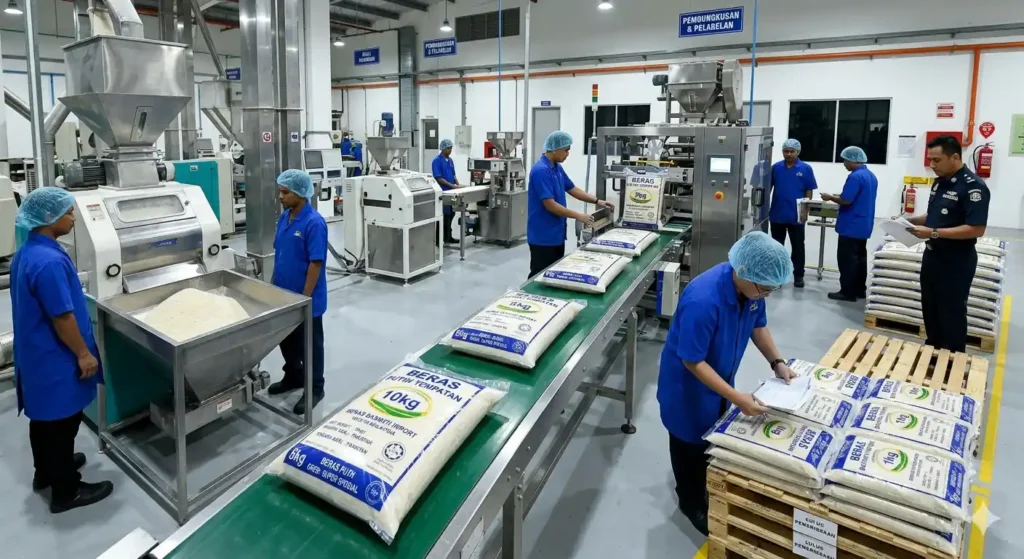
Standard Malaysian rice bag sizes include 1 kg, 2 kg, 5 kg, 10 kg, 20 kg, and 50 kg formats. Retail packs mainly use 1–5 kg sizes, while wholesale and food service sectors use 10–50 kg bags depending on consumption scale and distribution requirements.
Retail packaging dominates urban supermarkets across Malaysia. Families typically purchase 5 kg packs due to storage convenience and consumption patterns.
Food service industries such as restaurants and catering businesses prefer 10 kg and 25 kg bags for operational efficiency. Wholesale distributors rely on 50 kg sacks for bulk handling and reprocessing.
Packaging material varies with size. Small retail packs use laminated polypropylene or vacuum-sealed plastic for freshness. Larger bags use woven polypropylene for durability and transport stability.
These packaging sizes apply to imported basmati rice varieties from exporters such as AHK RICE supplying long grain rice to multiple Asian markets.
What are key components of Bahasa Melayu rice packaging labels?
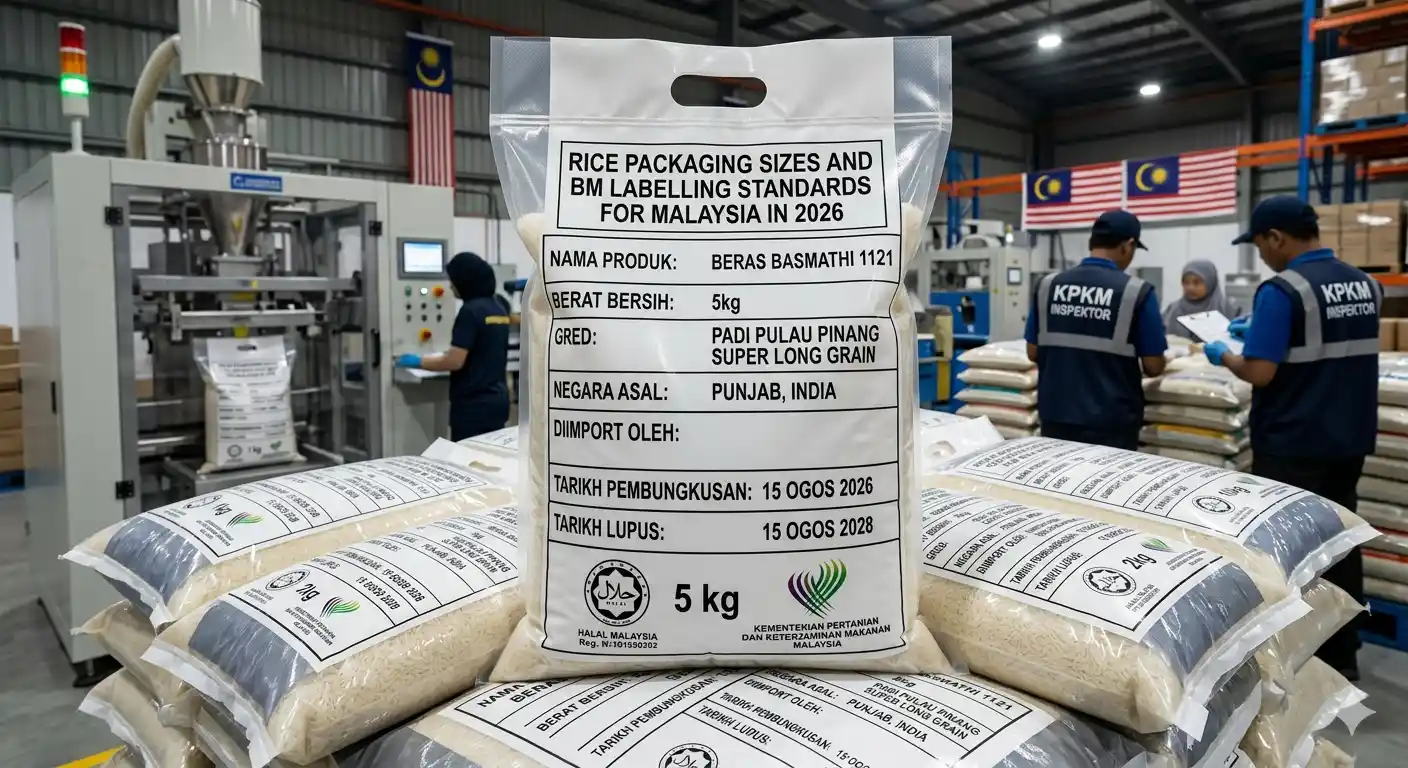
Key components of Bahasa Melayu rice packaging labels include product name, net weight, ingredient type, country of origin, importer details, storage instructions, production batch code, expiry date, and certification logos such as Halal marking, all written in Bahasa Melayu for consumer clarity.
Each label must use Bahasa Melayu as the primary language. English may appear as secondary text, but it cannot replace Malay compliance information.
Common label fields include “Berat Bersih” (net weight), “Negara Asal” (country of origin), and “Tarikh Luput” (expiry date). These ensure standardized communication across retail chains.
Batch coding enables traceability in case of quality checks or food safety audits. This system supports recall procedures and quality verification at import and retail levels.
Packaging also includes nutritional panels for specific rice types. These panels describe carbohydrate content, energy values, and cooking instructions in standardized formats.
What are Halal logo requirements on rice packaging in Malaysia?
Halal logo requirements on rice packaging in Malaysia mandate certification from recognized Islamic authorities, clear display of the Halal mark, and verification of production processes ensuring no contamination with non-Halal substances throughout milling, storage, and packaging stages.
The Halal certification system is strictly regulated in Malaysia. It applies to both domestic and imported rice products.
Imported rice must be processed in certified facilities or handled through approved packaging lines that maintain Halal integrity.
The Halal logo must be clearly visible on the front packaging panel. It cannot be obscured or altered in size or color.
Inspection authorities verify supply chain integrity before approval. This includes storage segregation, transport hygiene, and packaging material compliance.
Rice exporters targeting Malaysian markets must ensure Halal compliance documentation is prepared before shipment to avoid customs rejection.
What certifications apply to imported rice in Malaysia?
Imported rice in Malaysia requires certifications such as phytosanitary certificates, Halal certification, food safety compliance documentation, and country-of-origin verification. These certifications ensure rice meets agricultural safety, religious compliance, and consumer protection standards before entering Malaysian retail distribution channels.
Phytosanitary certificates confirm that rice is free from pests, contamination, and agricultural hazards. This is mandatory for all rice imports.
Food safety certifications verify that milling and packaging follow international hygiene standards. This includes ISO and HACCP compliance in many export markets.
Halal certification is required for retail distribution and must align with Malaysian religious compliance frameworks.
Country-of-origin documentation ensures traceability of rice supply chains. This supports transparency for consumers and regulatory authorities.
Exporters from rice-producing regions such as Punjab provide certification bundles before shipment to avoid delays at Malaysian ports.
How is rice packaging designed step by step from mill to export?
Rice packaging design follows a structured process: paddy procurement, milling, grading, polishing, weight segregation, packaging selection, labeling in Bahasa Melayu, certification application, quality inspection, and final export shipment preparation under regulated storage conditions.
The process begins with paddy harvesting and procurement from rice-growing regions.
Milling removes husk layers and separates rice based on grain length and quality. Grades such as 1121 and Super Kernel are sorted during this phase.
Polishing enhances grain appearance and standardizes texture for retail presentation.
Weight segregation divides rice into retail or bulk packaging categories such as 1 kg or 50 kg formats.
Packaging materials are selected based on shelf life requirements and export destination.
Labels are printed in Bahasa Melayu and verified for compliance before sealing.
Final inspection ensures certification alignment and packaging integrity before shipment to markets like Malaysia.
What are benefits of standardized rice packaging sizes?
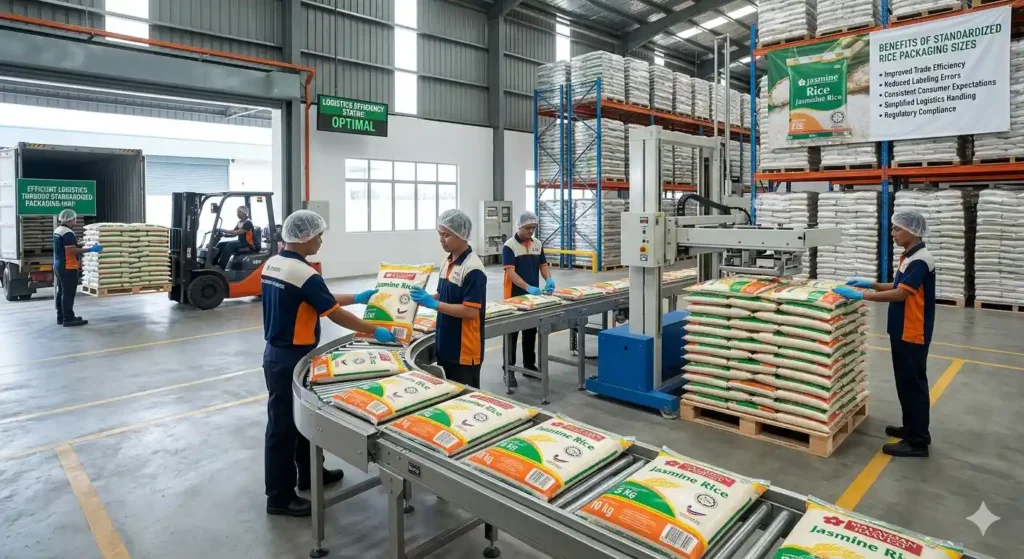
Standardized rice packaging sizes improve trade efficiency, reduce labeling errors, ensure consistent consumer expectations, simplify logistics handling, and enable regulatory compliance across import and retail distribution systems in Malaysia and other importing markets.
Uniform packaging reduces confusion in retail environments. Consumers can compare prices across identical weight categories.
Logistics operations become more efficient due to predictable palletization and storage dimensions.
Retailers benefit from consistent shelf planning and inventory tracking.
Exporters achieve smoother customs clearance due to standardized documentation linked with packaging weights.
Standardization also improves food safety tracking. Each packaging unit can be traced through batch codes and certification records.
What are common problems and misconceptions in rice packaging Malaysia?
Common problems include incorrect Bahasa Melayu labeling, missing Halal certification, inconsistent weight declarations, poor packaging material selection, and misconceptions that English-only labels are acceptable, which is not compliant with Malaysian food packaging regulations.
One major issue is incomplete translation into Bahasa Melayu. Labels must prioritize Malay terminology.
Another problem is incorrect net weight printing. Even small discrepancies lead to rejection during inspection.
Some exporters assume Halal certification is optional, but it is mandatory for retail rice distribution.
Packaging material failure also occurs when low-grade plastic reduces shelf life in humid climates.
Misconception persists that international labels alone are sufficient. Malaysia requires localized compliance regardless of origin country.