Shipping Rice from Pakistan to Morocco Casablanca Port in 2026
Rice shipping from Pakistan to Morocco in 2026 is the structured export movement of milled or paddy rice from Karachi ports to Casablanca Port using containerized sea freight, following defined logistics timelines, documentation, and international trade compliance protocols.
Rice shipping refers to the physical and administrative process of transporting rice from origin to destination across international waters. In this case, the origin is Pakistan, a major exporter of Basmati and non-Basmati rice, and the destination is Morocco, a rice-importing country with demand concentrated in urban consumption centers such as Casablanca.
The shipment begins at processing facilities located in Punjab, where rice varieties such as 1121 Basmati, Super Kernel Basmati, and IRRI types are milled, graded, and packed. These goods are then transported by road to Karachi’s export terminals, including Port Qasim and Karachi Port.
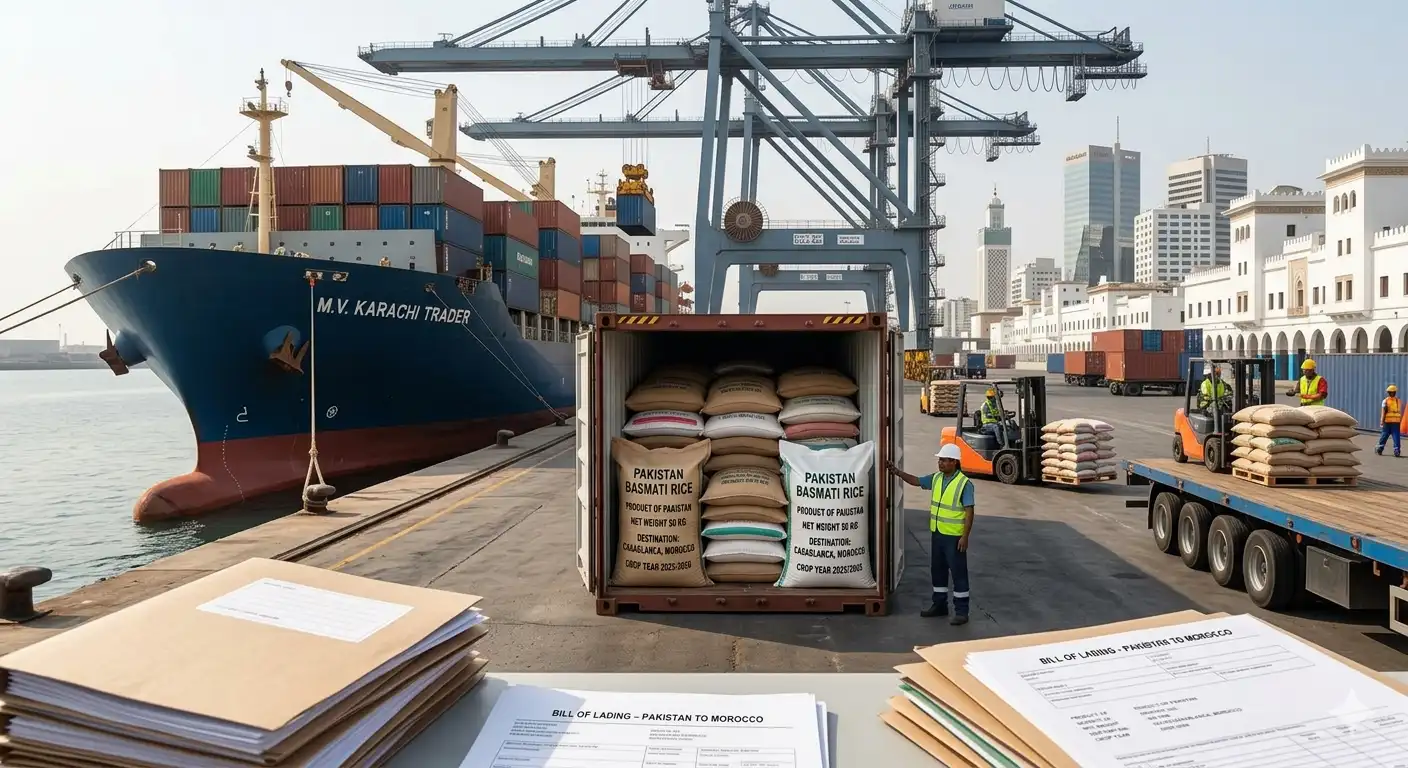
Casablanca Port functions as Morocco’s primary commercial maritime gateway. It handles containerized agricultural commodities under strict import regulations. The shipping process includes container booking, customs clearance, bill of lading issuance, and final delivery to Moroccan importers.
How does the rice shipping process from Pakistan to Casablanca Port work?
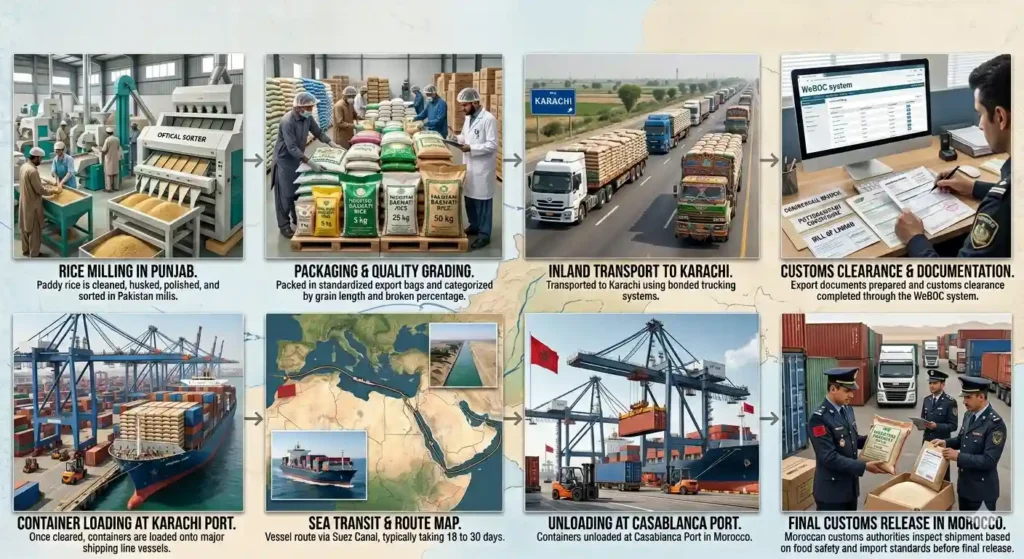
The process follows a linear sequence: rice milling, quality grading, packaging, inland transport to Karachi, customs clearance, container loading, sea transit via Suez Canal, unloading at Casablanca Port, and final customs release in Morocco within 18 to 30 days.
Step-by-step shipping workflow
The process starts at rice mills in Punjab. Paddy rice is cleaned, husked, polished, and sorted using optical sorters. Each batch is categorized based on grain length, moisture content, and broken percentage.
After processing, rice is packed in standardized export bags. Common packaging formats include 5 kg, 10 kg, 25 kg, and 50 kg polypropylene or woven bags. These are palletized or directly stacked into containers.
Containers are transported to Karachi using bonded trucking systems. Export documentation is prepared at this stage. Key documents include:
- Commercial invoice
- Packing list
- Phytosanitary certificate
- Certificate of origin
- Bill of lading
Customs clearance in Pakistan is completed through the WeBOC system. Once cleared, containers are loaded onto vessels operating through major shipping lines.
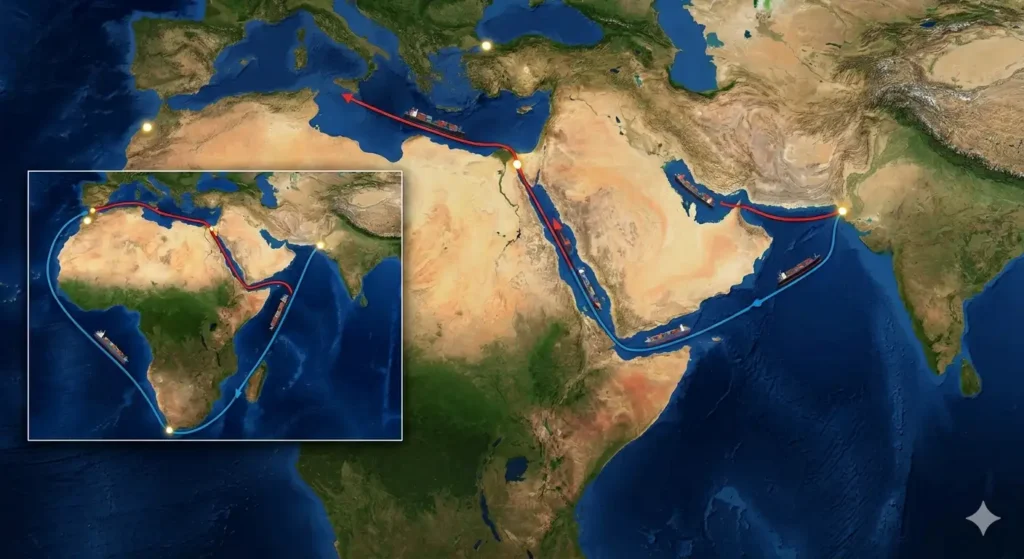
The vessel route typically passes through the Arabian Sea, Red Sea, and Suez Canal, entering the Mediterranean before reaching Casablanca. Upon arrival, Moroccan customs authorities inspect the shipment based on food safety and import standards.
What is the shipping duration from Karachi to Casablanca Port in 2026?
The average shipping duration from Karachi to Casablanca Port in 2026 ranges between 18 to 26 days for direct routes and 24 to 32 days for transshipment routes, depending on carrier schedules, port congestion, and routing via Mediterranean hubs.
Shipping time depends on the selected freight method. Direct services are limited but faster. Transshipment routes involve stopping at intermediate ports such as Jeddah, Port Said, or Algeciras.
Transit time breakdown
- Inland transport (Punjab to Karachi): 2 to 3 days
- Port handling and customs clearance: 3 to 5 days
- Sea freight (Karachi to Casablanca): 18 to 26 days
- Import clearance in Morocco: 2 to 4 days
Total end-to-end duration ranges between 25 and 38 days.
Delays occur due to port congestion, incomplete documentation, or inspection holds. For example, peak shipping seasons between September and December increase congestion due to agricultural exports.
What are the key components of rice shipping logistics?
Rice shipping logistics consist of five core components: product preparation, packaging, documentation, freight booking, and customs compliance, each ensuring that rice reaches Morocco in acceptable quality and legal condition.
Product preparation
Rice must meet export quality standards. Moisture content is maintained between 12% and 14%. Broken grain percentage is strictly controlled, for example 5%, 10%, or 25% broken categories.
Packaging systems
Export packaging protects rice during transit. Materials include:
- Polypropylene woven bags
- BOPP laminated bags
- Jute bags for premium shipments
Packaging also includes labeling in Arabic or French for Moroccan compliance.
Documentation
Documentation ensures legal movement across borders. Missing documents result in shipment delays or rejection. Each document serves a specific purpose, such as verifying origin or confirming food safety.
Freight booking
Shipping lines allocate containers and vessel space. Common container types include 20-foot containers with a capacity of 24 to 26 metric tons of rice.
Customs compliance
Both Pakistan and Morocco enforce agricultural import regulations. Compliance includes pest-free certification, fumigation records, and adherence to maximum residue limits.
What are the benefits of shipping rice via sea freight to Morocco?
Sea freight provides cost efficiency, high volume capacity, standardized containerization, and predictable transit schedules, making it the primary logistics method for rice exports between Pakistan and Morocco.
Sea freight allows exporters to move bulk quantities at lower cost per ton compared to air freight. A single 20-foot container carries over 24 metric tons, making it suitable for large-scale importers.
Containerization ensures cargo safety. Rice remains protected from moisture, contamination, and physical damage. Sealed containers reduce handling risks during transit.
Shipping schedules are structured weekly or biweekly. This allows importers to plan inventory cycles. For example, Moroccan distributors align shipments with Ramadan demand cycles, where rice consumption increases.
Sea routes also provide global connectivity. The Karachi to Casablanca route integrates into major international shipping lanes via the Suez Canal, ensuring consistent access.
What are the common use cases of rice shipping from Pakistan to Morocco?
Rice shipping is used for wholesale import, retail distribution, food service supply, and government procurement, supporting Morocco’s domestic consumption and food security requirements.
Wholesale distribution
Importers purchase rice in bulk containers and distribute it across Moroccan cities. These include Casablanca, Rabat, and Marrakesh. Wholesale markets handle large quantities for resale.
Retail packaging
Imported rice is repacked into branded consumer packs such as 1 kg, 5 kg, and 10 kg. Supermarkets and grocery chains sell these products directly to consumers.
Food service industry
Hotels, restaurants, and catering businesses rely on consistent rice imports. Basmati rice is used in dishes such as pilaf and biryani served in international cuisine restaurants.
Government procurement
Public sector agencies import rice to stabilize food supply. Strategic reserves are maintained to control price fluctuations.
What are the common problems and misconceptions in rice shipping?
Common problems include incorrect documentation, moisture damage, shipment delays, and misunderstanding transit times, while misconceptions involve assuming fixed delivery durations and ignoring regulatory differences between Pakistan and Morocco.
Documentation errors
Incomplete or incorrect documents cause customs delays. For example, missing phytosanitary certificates lead to shipment holds at Casablanca Port.
Moisture and quality issues
Improper packaging allows moisture ingress. This affects grain quality, leading to discoloration or fungal growth. Controlled humidity during packing prevents this issue.
Transit delays
Shipping schedules are affected by port congestion or rerouting. Assuming fixed delivery dates results in planning errors for importers.
Misconception about direct routes
Many assume direct shipping exists for all shipments. In reality, most routes involve transshipment, which increases transit time by 5 to 10 days.
Regulatory misunderstanding
Morocco applies strict food safety standards. Importers must comply with labeling, pesticide limits, and inspection protocols. Ignoring these leads to shipment rejection.
How does rice quality classification impact shipping and transit?
Rice quality classification determines packaging, pricing, inspection priority, and acceptance in Moroccan markets, directly influencing shipping decisions and transit handling procedures.
Rice is classified based on grain length, aroma, and broken percentage. For example:
- 1121 Basmati: extra-long grain, premium export quality
- Super Kernel Basmati: traditional long grain, aged varieties
- IRRI-6: non-aromatic, shorter grain, economical
Higher-grade rice requires stricter packaging and handling. Premium Basmati is often packed in branded BOPP bags to maintain market positioning.
Lower-grade rice is shipped in bulk packaging. This reduces cost but requires careful moisture control.
Moroccan buyers prefer consistent grain length and low broken ratios. Shipments are inspected upon arrival to verify these parameters.
How do shipping routes and the Suez Canal affect transit time?
Shipping routes passing through the Suez Canal reduce distance between Karachi and Casablanca by approximately 6,000 kilometers, enabling faster transit compared to routes around the Cape of Good Hope.
The Suez Canal connects the Red Sea to the Mediterranean Sea. This route shortens travel distance significantly. Vessels from Karachi enter the Arabian Sea, pass through the Gulf of Aden, and enter the Red Sea before crossing the canal.
Without the canal, ships must travel around Africa. This increases transit time by 10 to 15 days.
However, canal congestion or geopolitical disruptions affect schedules. Shipping lines adjust routes based on operational conditions.
How do packaging and container loading affect shipping efficiency?
Efficient packaging and optimized container loading increase cargo volume utilization, reduce damage risk, and maintain rice quality throughout the 20 to 30-day sea journey.
Container loading follows strict weight and stacking guidelines. A 20-foot container carries up to 26 metric tons. Bags are stacked to prevent shifting during transit.
Palletization improves handling efficiency. It reduces loading time and ensures uniform weight distribution.
Vacuum or liner bags are used for premium shipments. These protect rice from moisture and oxygen exposure.
Incorrect loading leads to cargo movement and bag rupture. This causes product loss and contamination.