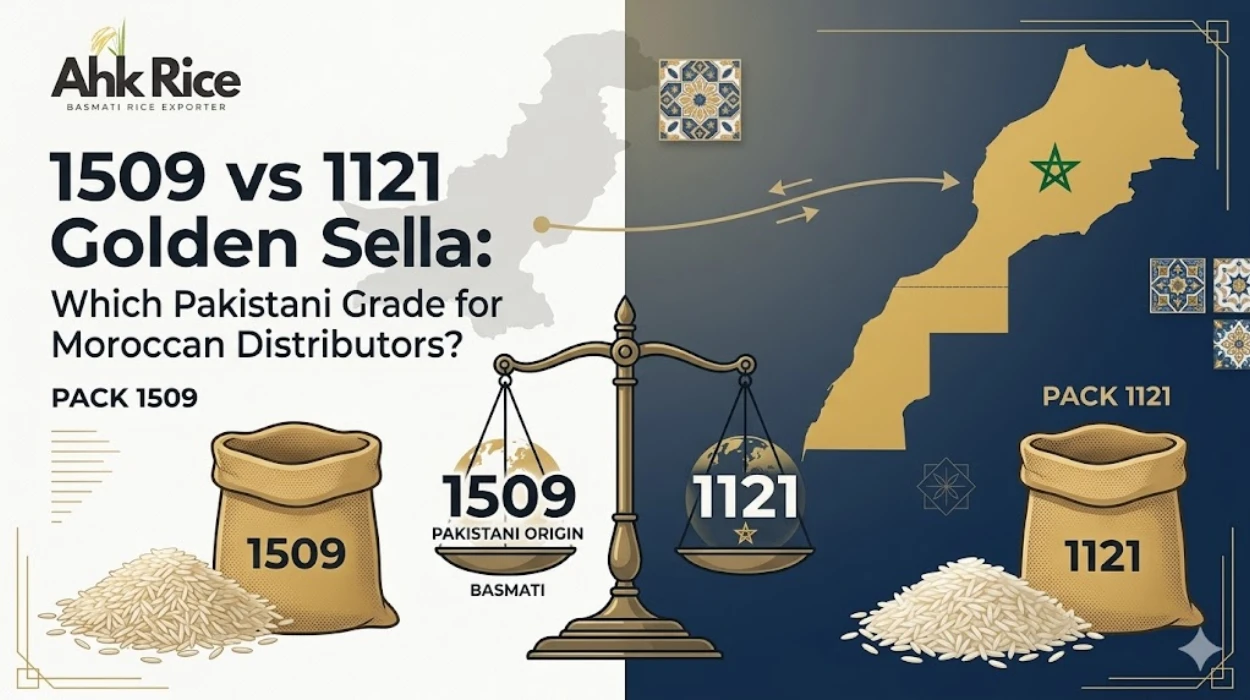
1509 vs 1121 Golden Sella: Which Pakistani Grade for Moroccan Distributors?
1509 vs 1121 Golden Sella Pakistani Moroccan distributors comparison shows a clear segmentation: 1121 dominates premium retail channels, while 1509 dominates bulk catering efficiency. Here is why: grain length, parboiling stability, cooking expansion, and cost per metric ton create distinct trade advantages across Moroccan import and North African foodservice demand.
Golden Sella basmati rice refers to parboiled rice where paddy is soaked, steamed, dried, dehusked, polished, and graded before export. This process locks nutrients and stabilizes grain structure for long-distance shipping into North Africa.
Moroccan distributors import both grades for different consumption channels such as hotels, institutional catering, and retail supermarkets.
Understanding these two grades determines profit margin stability, shipment losses, and repeat contract volume.
For broader rice trade fundamentals and export context, refer to this foundational guide on Pakistani basmati export systems: Pakistan Basmati Rice Morocco Trade fundamentals and grading structure.
With grading fundamentals established, the next step is to understand how each solution performs in commercial supply chains.
What are the available solutions?
The available solutions include 1509 Golden Sella basmati for cost-efficient bulk trade and 1121 Golden Sella basmati for premium grain length markets. Here is why: 1509 prioritizes yield efficiency and stable cooking performance, while 1121 prioritizes extra-long grain presentation and higher retail value positioning in Moroccan distribution channels.
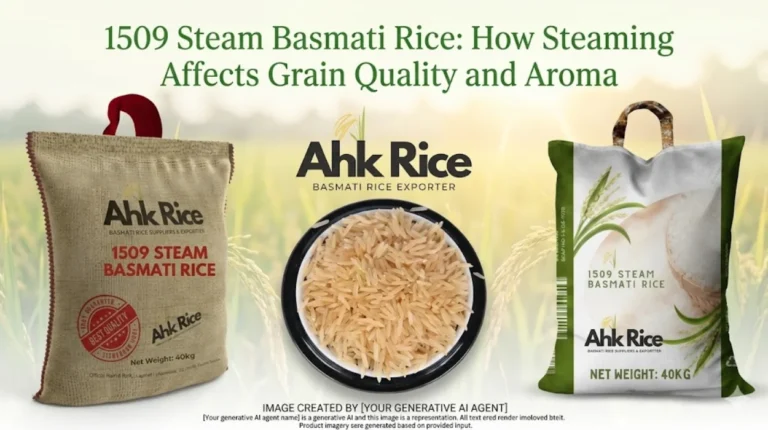
1509 Golden Sella is a parboiled basmati variant with controlled elongation and strong structural integrity after cooking.
It is widely used in catering contracts, institutional kitchens, and value-based import programs across North Africa.
1509 Golden Sella basmati (AHK Rice Morocco 1509 basmati wholesale CIF Casablanca) enables Moroccan importers to secure consistent CIF shipments into Casablanca with predictable breakage rates and stable storage behavior.
1121 Golden Sella is a premium long-grain basmati with superior elongation after cooking.
It is commonly preferred in retail packaging and premium hospitality segments in Morocco.
Processing for both grades includes:
- Clean paddy preparation
- De-husking operation
- Parboiling stabilization
- Drying and moisture control
- Polishing refinement
- Length grading
- Optical color sorting
These steps ensure export consistency for long-distance shipping into North Africa.
With available solutions defined, the next step is evaluating how each approach performs across measurable trade attributes.
How do different approaches compare?
1509 and 1121 Golden Sella differ across grain length, cooking expansion, breakage rate, export price, storage stability, aroma intensity, and retail positioning. Here is why: each attribute directly impacts Moroccan distributor profitability through packaging efficiency, shelf life, and buyer segmentation across wholesale and retail supply chains.
Specification Comparison Table
| Attribute | 1509 Golden Sella | 1121 Golden Sella |
|---|---|---|
| Grain Length | 7.0–7.2 mm | 8.3–8.5 mm |
| Breakage Rate | Low (2–3%) | Very low (1–2%) |
| Cooking Expansion | High volume gain | Very high elongation |
| Aroma Intensity | Medium basmati aroma | Strong premium aroma |
| Export Position | Catering-focused bulk trade | Retail premium segment |
| Moisture Stability | 12–13% controlled range | 12–13% controlled range |
| Price Index (MT) | Lower cost base | Higher premium cost |
1509 Golden Sella provides cost efficiency per metric ton, improving distributor margins in high-volume contracts.
1121 Golden Sella increases shelf appeal, improving retail price realization in Moroccan supermarkets.
Golden Sella processing ensures both grades remain stable during long-distance shipping.
This is critical for North African ports where container dwell time often exceeds 20–30 days.
With comparison established, the next question is which grade performs better in specific market environments.
Which method works best for different cases?
1509 Golden Sella works best for Moroccan catering, institutional supply, and price-sensitive importers, while 1121 Golden Sella works best for retail supermarkets and premium hospitality demand. Here is why: consumption behavior in Morocco splits between bulk foodservice demand and branded retail preference across urban and tourism-driven cities.
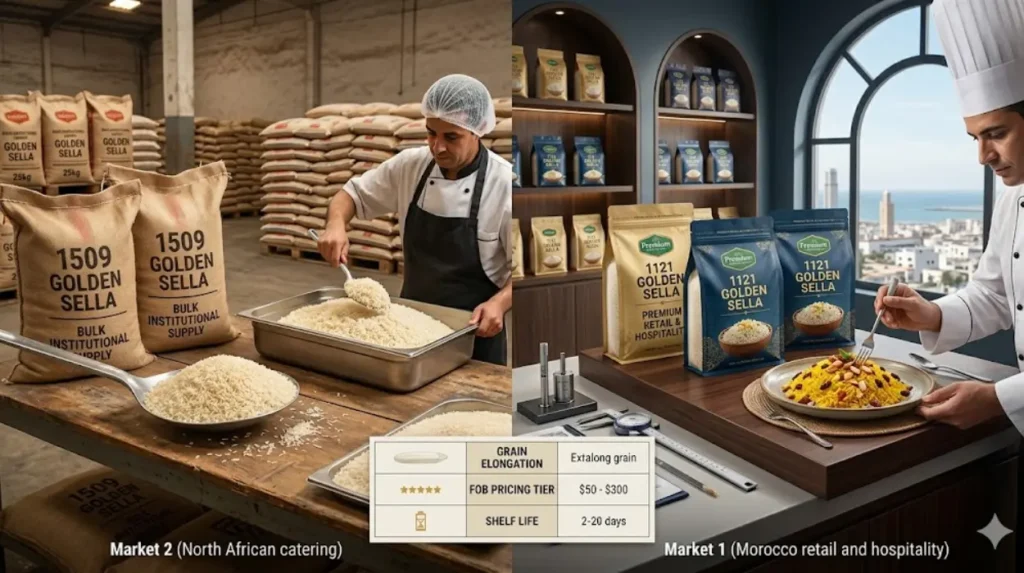
Market 1: Morocco retail and hospitality demand
Morocco retail channels prioritize 1121 Golden Sella for visual presentation and grain elongation.
Hotels in Marrakech and Casablanca prefer long grain aesthetics for plated rice dishes.
Moroccan supermarkets position 1121 as a premium imported basmati SKU with higher shelf value.
Consumers associate longer grain with higher quality perception.
Market 2: North African catering and institutional demand
North Africa catering buyers prioritize 1509 Golden Sella for yield efficiency and cost control.
Industrial kitchens in Algeria, Tunisia, and inland Morocco use high-volume cooking systems.
1509 reduces procurement cost per serving, improving contract competitiveness for distributors.
It performs consistently in large-scale cooking environments with standardized recipes.
Price and shelf life comparison
1509 Golden Sella maintains stability for up to 18 months in dry warehouse conditions at 40°C.
1121 Golden Sella maintains similar storage life but requires tighter humidity control for premium aroma retention.
1509 Golden Sella is typically USD 60–90 per MT cheaper than 1121 in FOB pricing tiers.
1121 Golden Sella commands premium pricing due to grain aesthetics and retail positioning strength.
With market segmentation understood, the next section evaluates advantages and limitations of each grade.
Pros and cons (with examples)
1509 Golden Sella provides cost stability and cooking consistency for bulk trade, while 1121 Golden Sella delivers superior visual appeal and premium pricing potential. Here is why: each grade is optimized for different buyer psychology, distribution systems, and end-use cooking environments across Morocco and North Africa.
1509 Golden Sella advantages
- Cost efficiency improves bulk contract margins
- Cooking yield supports institutional kitchens
- Breakage control reduces packaging loss
- Supply stability supports long-term contracts
1509 Golden Sella limitations
- Grain length reduces premium retail appeal
- Aroma intensity remains moderate in comparison
- Branding potential is lower in supermarket shelves
1121 Golden Sella advantages
- Grain elongation increases visual premium value
- Aroma strength supports hospitality positioning
- Retail demand improves price realization
- Brand differentiation strengthens importer portfolio
1121 Golden Sella limitations
- Higher procurement cost reduces bulk competitiveness
- Requires stricter storage humidity control
- Less efficient for low-margin catering contracts
Example scenario:
A Moroccan catering distributor using 1509 reduces cost per plate by 12–18% in institutional menus.
A Casablanca supermarket using 1121 increases retail margin by 15–25% through premium branding positioning.
With pros and cons defined, the next step is identifying decision-making factors.
Decision factors
Selection between 1509 and 1121 Golden Sella depends on contract size, target buyer segment, storage conditions, pricing strategy, and branding position. Here is why: Moroccan distributors operate dual-channel supply systems requiring different rice specifications for retail and institutional demand balance.
Decision Framework Table
| Factor | 1509 Golden Sella Choice | 1121 Golden Sella Choice |
|---|---|---|
| Buyer Type | Catering and bulk buyers | Retail supermarkets |
| Margin Strategy | Cost reduction focus | Premium pricing focus |
| Storage System | Large warehouses | Controlled humidity storage |
| Consumption Volume | High daily usage | Moderate retail turnover |
| Brand Positioning | Value supply chain | Premium import identity |
1509 Golden Sella is optimal when procurement prioritizes volume stability and cost efficiency.
1121 Golden Sella is optimal when branding and shelf differentiation determine sales growth.
Contact AHK Rice to align shipment structure with Moroccan import requirements and optimize CIF Casablanca delivery schedules.
With decision factors established, distributors can now align sourcing strategy with market demand segmentation.
Final synthesis for Moroccan distributors
1509 vs 1121 Golden Sella selection depends entirely on trade objective: cost leadership or premium retail positioning. Here is why: Moroccan rice distribution operates in a dual economy where catering demand drives volume and retail demand drives margin expansion across imported basmati categories from Pakistan.
1509 supports large-scale institutional supply chains with predictable cost structures.
1121 supports brand-driven retail ecosystems with higher consumer perceived value.
Both grades originate from Pakistan’s basmati belt in Punjab, where controlled cultivation, milling, and grading ensure export consistency.
This enables Moroccan importers to maintain stable supply contracts throughout seasonal demand cycles.
Golden Sella processing ensures both grades remain resilient during shipping to North African ports.
This reduces cargo risk and improves importer confidence in long-distance trade lanes.
For procurement strategy, distributors should align grade selection with customer segmentation rather than price alone.
This ensures margin optimization across both wholesale and retail channels.
For deeper export systems, compliance standards, and Morocco-specific trade documentation, refer to: AHK Rice Morocco 1509 basmati wholesale CIF Casablanca.
Frequently Asked Question
What is the main difference between 1509 and 1121 Golden Sella basmati?
1509 Golden Sella is designed for bulk efficiency with lower cost and stable cooking yield, while 1121 Golden Sella focuses on extra-long grain appearance and premium retail value. Moroccan distributors use 1509 for catering contracts and 1121 for supermarket and hospitality segments.
Which rice grade is better for Moroccan catering businesses?
1509 Golden Sella is better for catering businesses in Morocco because it delivers consistent volume, lower procurement cost, and stable cooking performance. It reduces per-plate cost, making it suitable for large-scale institutional food service operations.
Why do Moroccan importers prefer 1121 Golden Sella for retail markets?
1121 Golden Sella is preferred in Moroccan retail because of its longer grain, stronger aroma, and premium visual appeal. It increases shelf value in supermarkets and supports higher retail pricing compared to mid-range basmati grades.
How does shelf life compare between 1509 and 1121 Golden Sella?
Both grades maintain strong shelf stability for up to 12–18 months under proper storage. However, 1509 performs better in less controlled warehouses, while 1121 requires slightly better humidity control to preserve aroma and premium quality.
Which grade gives better profit margins for Moroccan distributors?
Profit margins depend on the channel. 1509 Golden Sella improves margins in bulk catering due to lower cost, while 1121 Golden Sella improves retail margins due to premium pricing and higher consumer demand in supermarkets.