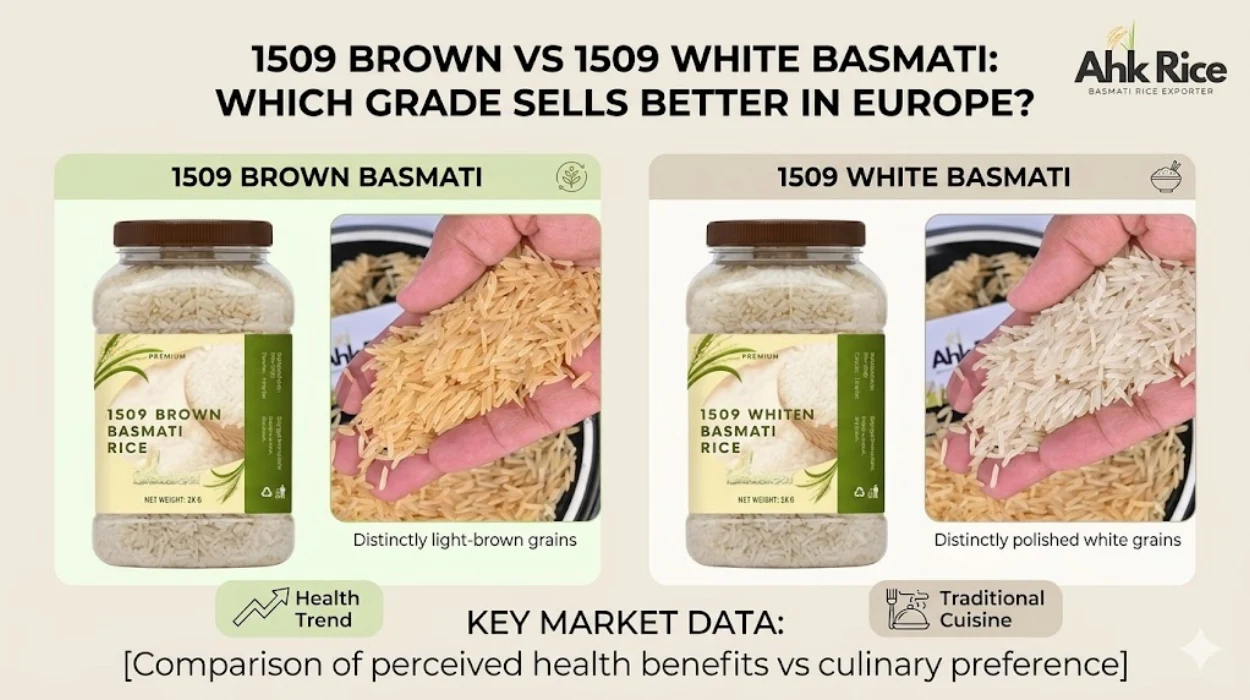
1509 Brown vs 1509 White Basmati: Which Grade Sells Better in Europe?
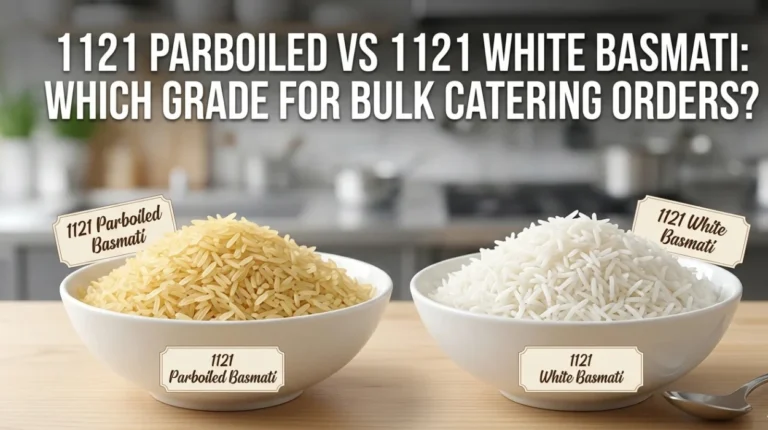
1509 white basmati sells better in Europe in volume-driven retail and catering channels, while 1509 brown basmati leads in premium health food niches. Here is why: European buyers separate rice demand into functional nutrition markets and mass consumption markets, and each grade matches a different purchasing behavior, storage system, and certification requirement structure.
1509 white basmati dominates because importers prioritize cooking consistency, longer shelf stability, and lower per-ton cost in bulk procurement cycles. 1509 brown basmati grows faster in health-focused retail because EU consumers associate bran retention with fiber density and clean-label positioning.
In this analysis, we connect processing, grading, and market demand into a clear export decision model for buyers working with exporters like AHK Rice, a trusted Pakistani Basmati rice exporter based in Punjab, supplying 1121, Super Kernel, and 1509 varieties to 15+ countries, with full export processing and packaging systems. Explore deeper specifications in this foundational guide on 1509 brown basmati EU health food sample.
For broader category understanding of long grain basmati segmentation, see our educational guide on 1509 brown basmati rice export specification , which explains cultivation zones, milling stages, and export classification systems.
What are the available solutions for 1509 brown vs white basmati in Europe?
Available solutions for European basmati buyers include brown 1509 for health-focused retail, white 1509 for mass catering supply, blended procurement contracts for mixed retail portfolios, and private-label customization programs that adjust polishing levels, packaging formats, and certification layers according to EU import regulations and consumer positioning strategies.
Solution 1: Brown 1509 basmati supply model
Brown 1509 basmati retains bran layers during milling and dehusking, producing higher fiber content and slower glycemic response. European organic retailers and health chains prefer this grade because inspectors verify nutrient density claims through EU labeling frameworks and third-party certification systems.
Solution 2: White 1509 basmati supply model
White 1509 basmati undergoes full polishing, removing bran layers through controlled milling and grading systems. Importers in Germany, France, and Spain prefer this grade because chefs demand uniform grain expansion, fast cooking cycles, and stable storage under warehouse conditions.
Solution 3: Hybrid procurement contracts
Hybrid procurement contracts combine brown and white shipments in separate SKUs. Retailers segment SKUs by consumer intent, placing brown rice in health aisles and white rice in mainstream food sections to maximize category penetration.
Solution 4: Private label customization model
Private label programs adjust polishing ratios, bag sizes, and EU labeling compliance layers. Exporters like AHK Rice inspect, grade, and certify rice batches before dispatching under retailer-owned branding systems.
With solution categories defined, the next step is understanding how these approaches differ in pricing, processing, and consumer acceptance across Europe.
How do different approaches compare in pricing, processing, and demand?
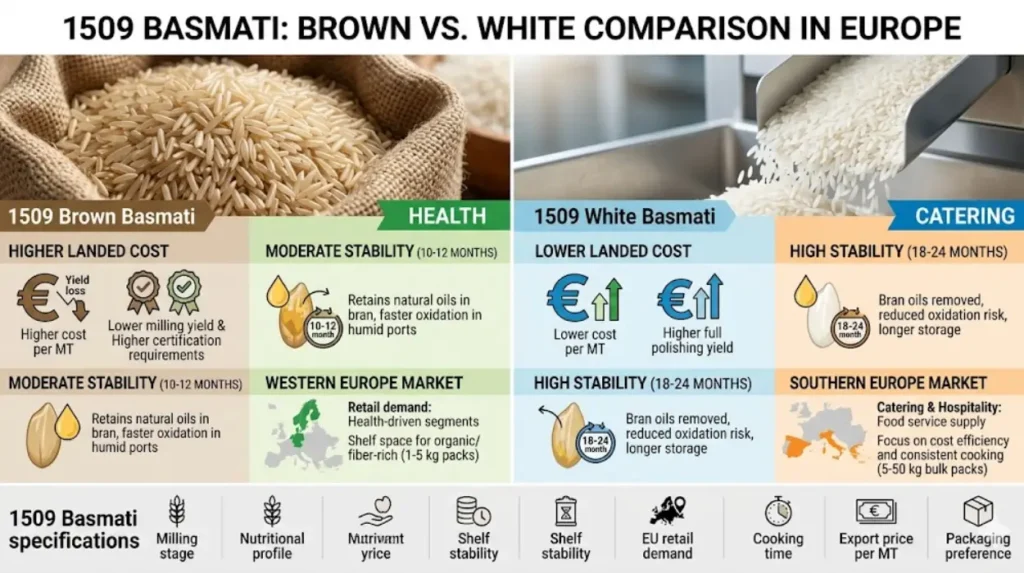
Brown 1509 basmati costs higher per ton in European import channels due to lower milling yield and higher certification requirements, while white 1509 basmati achieves lower landed cost, faster turnover, and broader distribution acceptance across retail and catering sectors in Germany, France, and Southern European import hubs.
Specification comparison table (7 attributes)
| Attribute | 1509 Brown Basmati | 1509 White Basmati |
|---|---|---|
| Milling stage | Dehusked, unpolished grain | Fully milled, polished grain |
| Nutritional profile | Higher fiber retention | Lower fiber, higher digestibility |
| Shelf stability | Moderate stability | High stability |
| EU retail demand | Health food segment | Mass retail + catering |
| Cooking time | Longer hydration cycle | Faster cooking cycle |
| Export price per MT | Higher due to yield loss | Lower due to full polishing yield |
| Packaging preference | Small retail packs (1–5 kg) | Bulk + institutional (5–50 kg) |
Europe market comparison: Western vs Southern regions
Western Europe prioritizes brown 1509 basmati in health-driven retail channels. Germany, Netherlands, and Nordic countries allocate shelf space for organic and fiber-rich rice categories because consumer demand aligns with nutritional labeling.
Southern Europe prioritizes white 1509 basmati in catering and hospitality supply chains. Spain, Italy, and Greece focus on cost efficiency and cooking consistency for large-scale food service operations.
Price per MT comparison (import structure)
Brown 1509 basmati typically trades at a higher landed cost due to yield reduction during milling and sorting. White 1509 basmati achieves lower cost per metric ton because polishing increases usable output ratio.
In controlled warehouse conditions at 20–25°C in Rotterdam, brown rice maintains stable quality for approximately 10–12 months. White rice maintains stability for 18–24 months under identical storage conditions due to reduced oil content exposure.
Shelf life comparison scenario
Brown basmati retains natural oils in bran layers, which oxidize faster in humid European coastal ports. White basmati removes bran oils during polishing, reducing oxidation risk during long shipping cycles from Pakistan to EU entry ports.
With structural differences clarified, the next focus is identifying which method performs best in real European purchasing scenarios.
Which method works best for different European buyer cases?
White 1509 basmati works best for large-scale catering, hospitality procurement, and supermarket private label supply chains, while brown 1509 basmati works best for organic retailers, health food distributors, and premium wellness-focused consumer brands across EU metropolitan markets.
Case 1: Supermarket retail chains
White 1509 basmati performs best in supermarket chains because consumers prioritize affordability, cooking speed, and familiar taste profiles. Retail buyers standardize SKUs across multiple countries to reduce procurement complexity.
Case 2: Health food retailers
Brown 1509 basmati performs best in health-focused retailers because fiber retention aligns with EU wellness labeling standards. Buyers inspect nutritional declarations and prefer minimally processed grain systems.
Case 3: Catering and hospitality
White 1509 basmati dominates catering supply because chefs require consistent grain elongation and predictable cooking output. Large kitchens in hotels and airlines prioritize operational speed over nutrient density positioning.
Case 4: E-commerce grocery platforms
Hybrid demand emerges in online grocery channels. Platforms list both brown and white SKUs, allowing segmented consumer targeting based on dietary preference filters.
Case 5: Institutional food procurement
White basmati dominates institutional procurement due to lower per-meal cost structures and extended shelf stability across centralized warehouses.
With application-based performance defined, the next section evaluates advantages and limitations of each grade in detail.
What are the pros and cons of brown vs white 1509 basmati?
Brown 1509 basmati delivers higher nutritional density and premium positioning but faces shorter shelf stability and higher import cost, while white 1509 basmati delivers operational efficiency, longer shelf life, and lower cost but lacks fiber retention and premium health labeling strength in European retail segmentation.
Pros of brown 1509 basmati
- Nutritional density increases fiber intake and micronutrient retention
- Market positioning strengthens in EU health food categories
- Retail differentiation improves shelf visibility in organic sections
Cons of brown 1509 basmati
- Shelf stability decreases due to bran oil oxidation
- Import cost increases due to lower milling yield
- Cooking time increases, requiring longer preparation cycles
Pros of white 1509 basmati
- Shelf stability extends across long distribution cycles
- Cooking performance remains consistent in commercial kitchens
- Import cost decreases due to higher milling efficiency
Cons of white 1509 basmati
- Nutritional density reduces after polishing
- Health food positioning weakens in organic retail channels
- Premium branding requires additional certification layers
Practical example comparison
White basmati maintains structure in a 40°C Gulf storage warehouse for up to 18 months, making it suitable for re-export logistics. Brown basmati performs better in short-cycle EU retail systems where inventory turnover occurs within 3–6 months.
With strengths and limitations established, the next step is identifying the key decision factors influencing European import behavior.
What are the key decision factors for European importers?
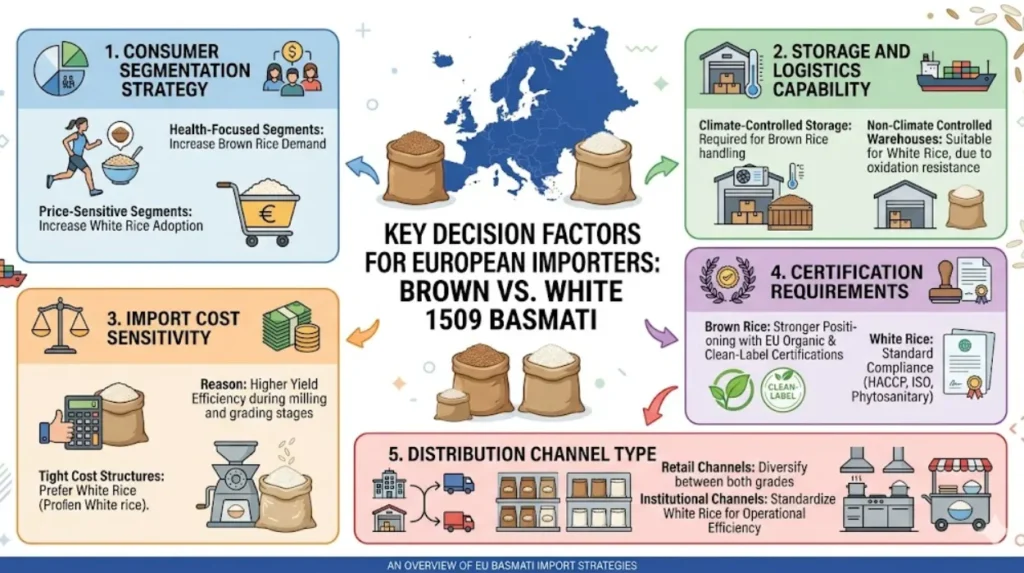
European importers choose between brown and white 1509 basmati based on shelf stability requirements, consumer segmentation strategy, import cost per metric ton, certification compliance needs, and downstream distribution channel structure across retail, catering, and organic health food networks.
Decision factor 1: Consumer segmentation strategy
Consumer segmentation determines grade selection. Health-focused segmentation increases brown rice demand, while price-sensitive segmentation increases white rice adoption.
Decision factor 2: Storage and logistics capability
Storage systems with climate control enable brown rice handling. Non-climate-controlled warehouses require white rice due to oxidation resistance.
Decision factor 3: Import cost sensitivity
Importers with tight cost structures prefer white rice due to higher yield efficiency during milling and grading stages.
Decision factor 4: Certification requirements
EU organic and clean-label certifications strengthen brown rice positioning. White rice relies on HACCP, ISO, and standard phytosanitary compliance.
Decision factor 5: Distribution channel type
Retail channels diversify between both grades, while institutional channels standardize white rice for operational efficiency.
Decision framework table (5-row model)
| Factor | Brown 1509 Basmati | White 1509 Basmati |
|---|---|---|
| Consumer health demand | High fit | Moderate fit |
| Cost optimization | Low fit | High fit |
| Storage flexibility | Low fit | High fit |
| Retail differentiation | High fit | Moderate fit |
| Institutional supply chains | Low fit | High fit |
With decision variables clarified, the final step is aligning procurement strategy with market entry timing and export sourcing structure.
Strategic conclusion for Europe-bound buyers
1509 white basmati dominates Europe in volume-driven trade because it supports cost efficiency, long shelf life, and institutional supply chains. 1509 brown basmati grows in influence because EU health trends reward fiber-rich and minimally processed grain categories.
Exporters like AHK Rice enable both models through controlled milling, grading, polishing, and certification systems that align with EU import inspection frameworks. Buyers choose grade positioning based on channel strategy rather than grain quality alone.
Frequently Asked Questions
Is 1509 brown basmati or white basmati more popular in Europe?
White 1509 basmati is more popular in Europe by volume because it dominates retail supermarkets, catering, and food service supply chains. Brown 1509 basmati has smaller but faster-growing demand in health food and organic retail segments, especially in Germany, Netherlands, and Nordic countries where fiber-rich diets are prioritized.
Why do European buyers choose white 1509 basmati over brown?
European buyers choose white 1509 basmati because it offers longer shelf life, lower import cost per metric ton, and consistent cooking performance in large-scale kitchens. White rice also fits institutional procurement systems where storage stability and standardized cooking results matter more than nutritional retention.
Is brown 1509 basmati considered healthier in the EU market?
Brown 1509 basmati is considered healthier in the EU market because it retains the bran layer, which increases fiber content and slows carbohydrate absorption. Health food retailers and organic stores position it as a premium wellness product under clean-label and natural food categories.
How does shelf life differ between brown and white 1509 basmati?
White 1509 basmati has a longer shelf life, typically 18–24 months under standard warehouse conditions, because polishing removes bran oils that oxidize. Brown 1509 basmati usually maintains optimal quality for 10–12 months due to natural oil content in the bran layer, especially in warmer storage environments.
Which rice grade is better for bulk import to Europe?
White 1509 basmati is better for bulk import because it reduces cost per ton, supports long-distance shipping stability, and integrates easily into supermarket and catering supply chains. Brown 1509 basmati is better suited for niche import programs focused on organic and health-oriented retail distribution.