Rice Packaging Sizes and FSA Labelling Requirements for UK Market 2026
Rice packaging and FSA labelling for the UK market define the exact pack sizes, material standards, and mandatory food information required by the UK Food Standards Agency to ensure traceability, safety, and consumer clarity in retail and wholesale rice distribution.
Rice packaging refers to the physical containment of rice in measured units such as 1 kg, 5 kg, or 20 kg bags. FSA labelling refers to the regulated data printed on those packages. These two elements work together to make rice compliant with UK food law.
In 2026, packaging and labelling rules in the United Kingdom operate independently after Brexit. The UK Food Standards Agency (FSA) governs food labelling, while packaging must meet environmental and safety regulations. Every rice exporter must align both packaging size and label structure with these requirements before entering the UK market.
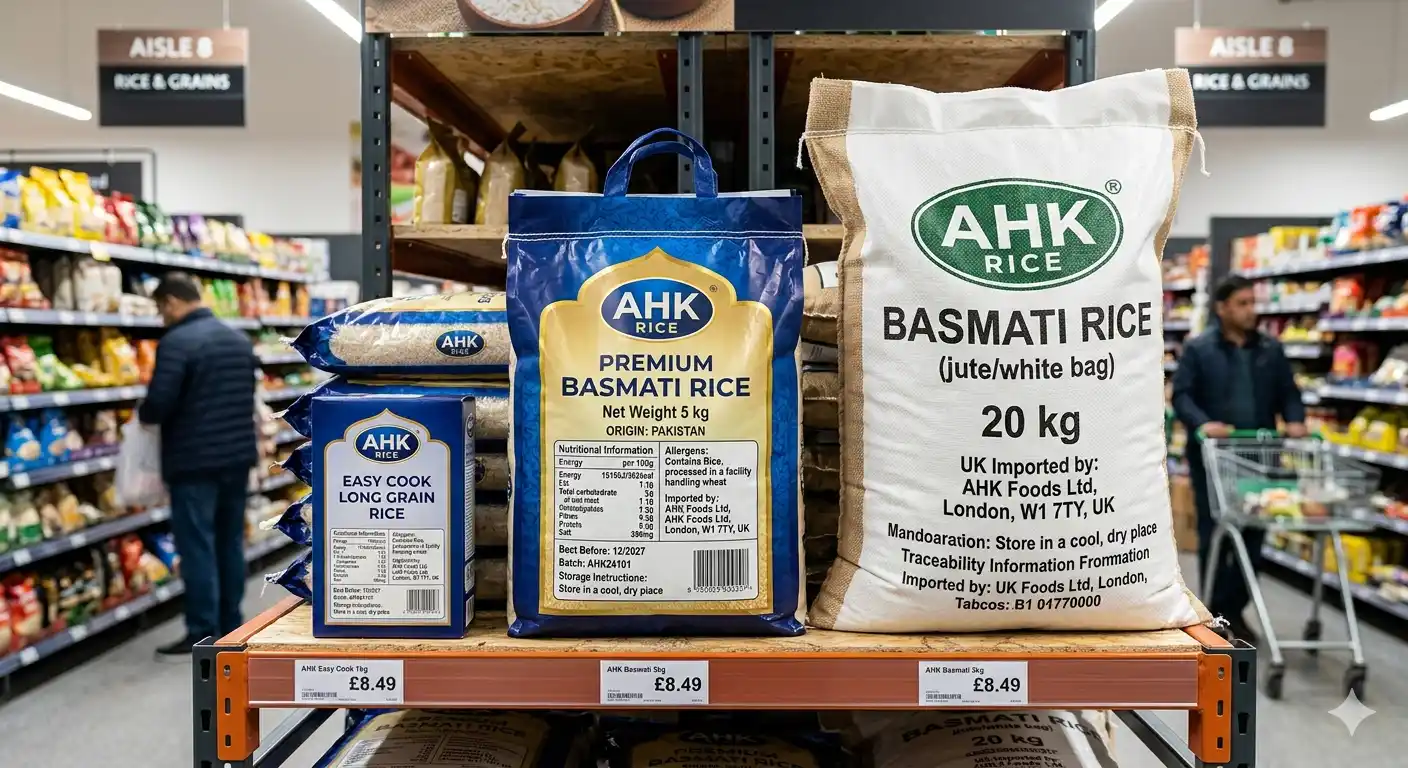
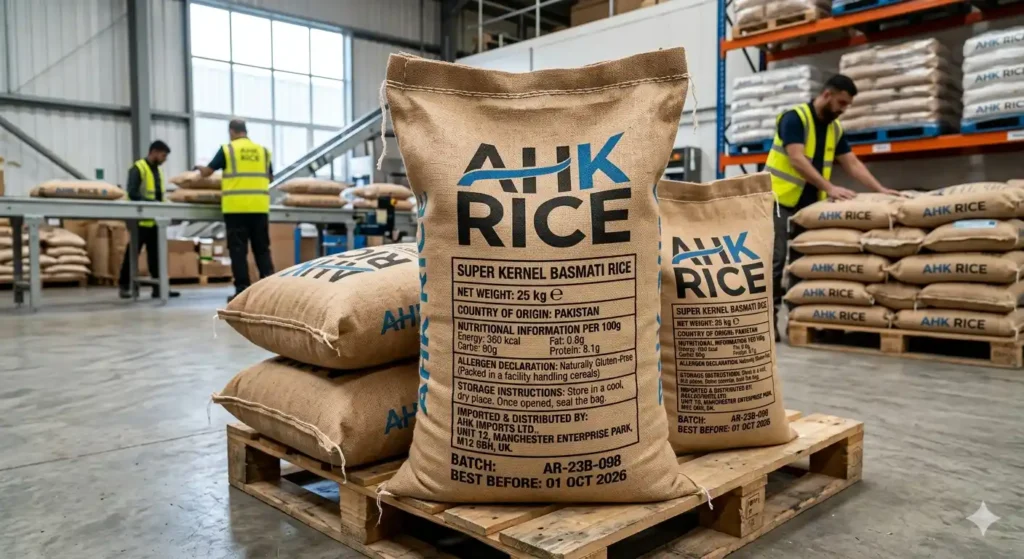
For example, a 5 kg retail basmati rice bag sold in London must display origin, nutritional values, allergen status, and importer details in English. A 20 kg wholesale sack shipped to Birmingham must include batch traceability and storage instructions.
How do rice packaging sizes and FSA labelling requirements work in practice?
Rice packaging sizes and FSA labelling requirements work through standardized weight categories combined with legally structured label elements, ensuring each rice product meets retail, wholesale, and foodservice compliance before entering the UK distribution chain.
The system starts with defining the target market segment. Retail markets use small consumer packs. Wholesale and foodservice sectors use bulk packaging. Each segment has specific expectations.
Packaging sizes are selected first. Common categories include:
- Small retail packs: 500 g, 1 kg, 2 kg
- Medium retail packs: 5 kg, 10 kg
- Bulk packs: 20 kg, 25 kg
After selecting the size, the label is structured according to FSA rules. Every package must include:
- Product name (e.g., Basmati Rice 1121 Steam)
- Net weight in metric units
- Country of origin (e.g., Pakistan)
- Nutritional information per 100 g
- Allergen declaration (even if none present)
- Storage instructions
- Importer or distributor address in the UK
For example, a 10 kg bag of Super Kernel Basmati sold in Manchester must include all these elements printed clearly and permanently.
The process ends with compliance verification. Exporters ensure that packaging integrity and label accuracy meet UK inspection standards before shipment.
What are the key components of rice packaging and labelling for the UK?
The key components of rice packaging and labelling include packaging material, size classification, label structure, traceability coding, and compliance markings, all designed to meet UK regulatory, logistical, and consumer information requirements.
Packaging material
Rice packaging materials must protect against moisture, contamination, and physical damage. Common materials include:
- Woven polypropylene bags (example: 25 kg export sacks)
- BOPP laminated bags (example: branded 5 kg retail packs)
- Paper bags with inner liners (example: eco-friendly 1 kg packs)
Each material must maintain grain quality during shipping and storage.
Size classification
Packaging size determines market placement. Retail shelves require manageable weights. Bulk buyers demand efficiency.
Examples include:
- 1 kg for household consumption
- 5 kg for family usage
- 20 kg for restaurants and catering businesses
Label structure
The label must follow a fixed hierarchy. The product name appears first. Nutritional data follows. Legal identifiers come last.
Font size and readability matter. Minimum font height must be 1.2 mm for mandatory information. Labels must be in English.
Traceability coding
Each package must include a batch number and production date. This enables tracking from farm to shelf.
For example, a batch code like “PK1121-0626-L1” identifies origin, variety, production month, and line number.
Compliance markings
Packaging must include recycling symbols and food safety indicators. These markings align with UK environmental and safety laws.
What are the standard rice packaging sizes used in the UK market?
Standard rice packaging sizes in the UK market range from 500 grams to 25 kilograms, segmented into retail, wholesale, and foodservice categories based on consumer demand, storage convenience, and distribution efficiency.
Retail packaging dominates supermarket shelves. Common sizes include:
- 500 g (trial or premium packs)
- 1 kg (standard household unit)
- 2 kg (value packs)
- 5 kg (family packs)
Wholesale and foodservice sectors use larger packs:
- 10 kg (small restaurants)
- 20 kg (medium-scale catering)
- 25 kg (bulk distribution)
Each size serves a specific use case. A 1 kg pack suits individual consumers in urban areas. A 20 kg sack supports high-volume cooking in restaurants.
British retailers prefer consistent packaging formats. This ensures shelf uniformity and easier inventory handling.
What are the benefits of standardized rice packaging and FSA labelling?
Standardized rice packaging and FSA labelling improve product safety, supply chain efficiency, consumer trust, and regulatory compliance by ensuring clear information, consistent sizing, and traceable distribution across the UK market.
Standardization reduces confusion. Consumers understand exactly what they are buying. A 5 kg pack always represents the same quantity and label structure.
Clear labelling improves food safety. Nutritional values and storage instructions guide proper consumption.
Traceability enhances accountability. If a quality issue arises, batches can be identified and recalled quickly.
Retail efficiency increases. Uniform packaging sizes simplify shelf planning and logistics.
For example, supermarkets like Tesco and Sainsbury’s rely on consistent packaging dimensions to optimize storage and display systems.
What are the main use cases of rice packaging sizes in the UK?
Rice packaging sizes in the UK are used across retail, wholesale, foodservice, and private label sectors, each requiring specific pack formats to match consumption patterns, storage capacity, and distribution scale.
Retail use case
Retail packaging targets individual consumers. Small and medium packs dominate.
Examples include:
- 1 kg basmati rice for daily cooking
- 5 kg packs for large families
Foodservice use case
Restaurants and catering businesses require bulk packaging.
Examples include:
- 20 kg sacks for Indian restaurants
- 25 kg bags for event catering services
Wholesale distribution
Importers and distributors handle large volumes.
Examples include:
- Palletized 25 kg bags
- Bulk shipments in container loads
Private label brands
Supermarkets create their own branded rice products.
Examples include:
- Store-brand 1 kg premium basmati
- Economy 10 kg value packs
Each use case defines packaging size, design, and labelling complexity.
What are common problems and misconceptions in UK rice packaging and labelling?
Common problems in UK rice packaging and labelling include incorrect weight declarations, incomplete FSA information, poor material quality, and misunderstanding post-Brexit regulations, leading to shipment delays, penalties, and rejected imports.
One common issue is incorrect net weight declaration. Packages must match the printed weight exactly. Any deviation leads to compliance failure.
Another problem is missing label elements. Some exporters omit importer addresses or nutritional data. This results in rejected shipments.
Material quality also creates issues. Low-grade packaging fails during transit, causing product damage.
A major misconception involves post-Brexit rules. Exporters assume EU labelling standards apply directly to the UK. This assumption leads to non-compliance.
For example, using EU language formats instead of English-only labels violates UK requirements.
How does post-Brexit regulation affect rice packaging and labelling in 2026?
Post-Brexit regulation requires rice exporters to follow UK-specific FSA labelling laws, independent import documentation, and localized packaging standards, replacing EU harmonized systems with distinct national compliance requirements.
The UK now operates its own food labelling framework. This affects exporters directly.
Labels must include a UK-based importer or distributor. EU-based addresses no longer satisfy requirements.
Country of origin must be clearly stated. Generic terms like “non-EU origin” are not accepted.
Documentation processes have also changed. Customs declarations and food safety certifications must align with UK authorities.
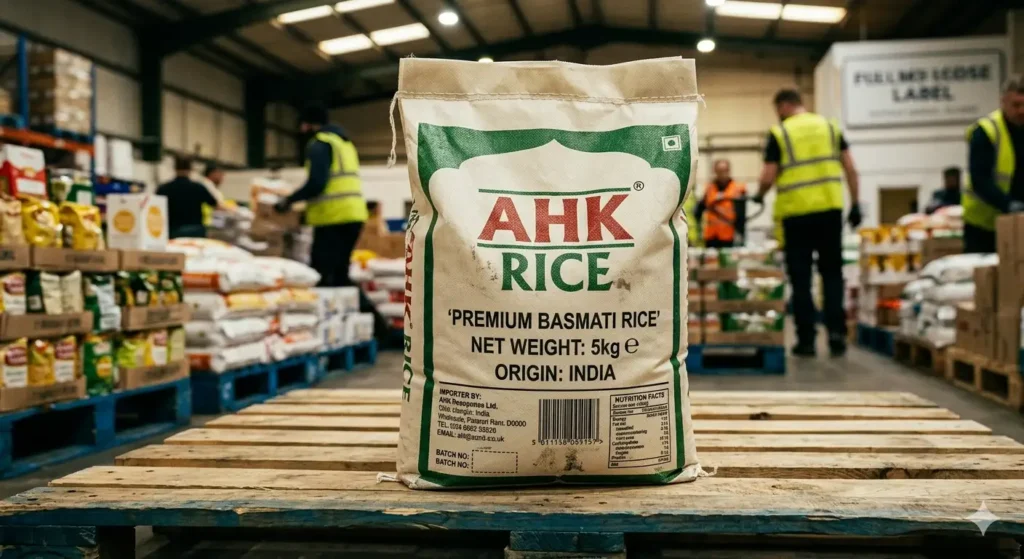
For example, a Pakistani exporter shipping basmati rice must ensure that packaging includes a verified UK importer address and complies with FSA nutritional labelling standards.
This shift increases the importance of accurate packaging and label design.