Why European Buyers Prefer Super Kernel Basmati Over Indian Varieties
European buyers prefer Super Kernel Basmati from Pakistan because it delivers longer grain length, stronger aroma retention, and more consistent EU-compliant processing than Indian alternatives. Here is why: controlled milling, stricter export grading, and better post-harvest handling create measurable quality advantages.
European importers evaluate rice as a technical commodity. They compare grain length, breakage ratio, moisture, and aroma stability under storage. Super Kernel Basmati from Pakistan meets these parameters with higher consistency than most Indian-origin equivalents.
In this context, understanding how Super Kernel is defined, processed, and exported becomes critical. For a foundational explanation of Basmati varieties and grading systems, refer to this detailed guide on Basmati classification and processing standards.
What are the available solutions for European Basmati sourcing?
European buyers choose between three main sourcing options: Pakistani Super Kernel, Indian traditional Basmati, and blended aromatic rice. Each option differs in grain length, compliance level, and price per metric ton.
Pakistani Super Kernel Basmati
Super Kernel Basmati is a long-grain aromatic rice cultivated in Punjab, Pakistan. The grain length averages 7.2–7.5 mm, with elongation reaching 2.0x after cooking.
Pakistani exporters process Super Kernel through structured steps:
- Clean the harvested paddy
- Dehusk the grain
- Polish to required whiteness
- Sort by grain length
- Grade by breakage percentage
- Inspect for impurities
- Pack under controlled conditions
This process ensures uniformity across shipments.
Indian Traditional Basmati
Indian Basmati includes varieties like Pusa and traditional Dehradun types. Grain length is slightly shorter, typically 6.8–7.2 mm, with more variability in batches.
Indian supply chains often involve multiple intermediaries. This increases inconsistency in grading and moisture control.
Blended Aromatic Rice
Blended rice mixes Basmati with non-Basmati aromatic grains. Buyers use this option to reduce cost.
Blended rice reduces aroma intensity and cooking elongation. European premium retailers avoid this category.
With these sourcing options defined, the next step is to compare their technical specifications.
How do Super Kernel and Indian Basmati compare technically?
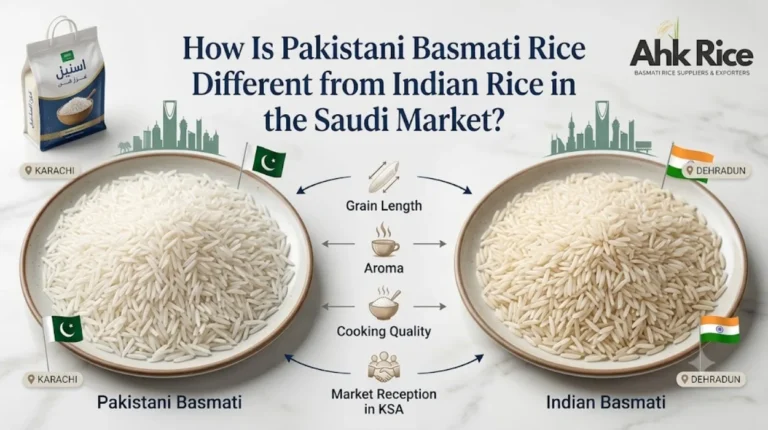
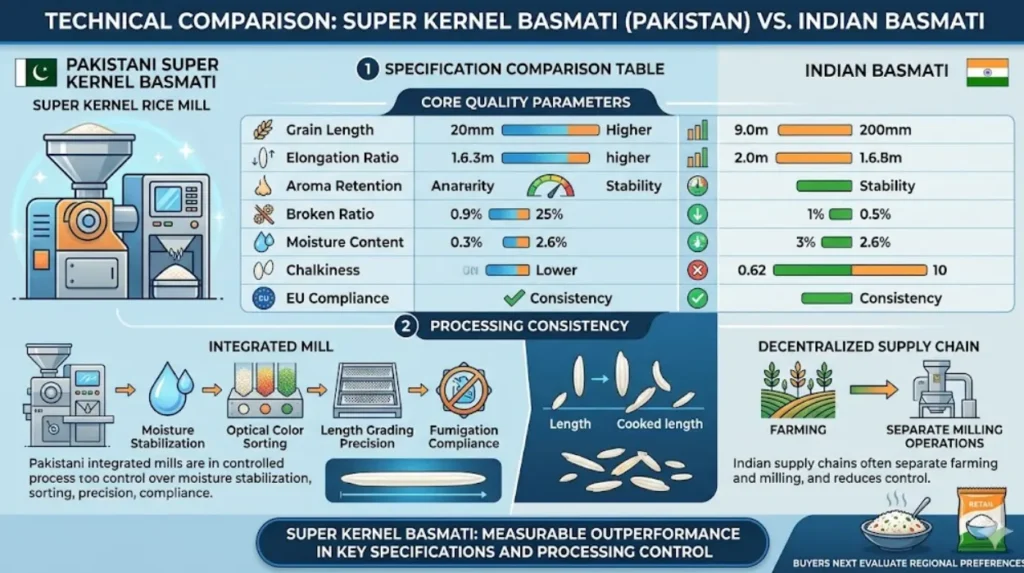
Super Kernel Basmati outperforms Indian varieties in grain length, uniformity, aroma stability, and EU compliance consistency. The difference is measurable across seven key specifications.
Specification Comparison Table
Core Quality Parameters
| Attribute | Pakistani Super Kernel | Indian Basmati |
|---|---|---|
| Grain Length | 7.2–7.5 mm | 6.8–7.2 mm |
| Elongation Ratio | 2.0x–2.2x | 1.8x–2.0x |
| Aroma Retention | High (stable after 12 months) | Medium (declines faster) |
| Broken Ratio | 1–5% export grade | 5–10% common |
| Moisture Content | 12–13% controlled | 13–14% variable |
| Chalkiness | Low | Moderate |
| EU Compliance | High consistency | Moderate consistency |
Super Kernel Basmati maintains longer grains after cooking. This matters in European retail packaging because visual quality drives consumer preference.
Processing Consistency
Pakistani exporters operate integrated mills. These facilities control:
- Moisture stabilization
- Optical color sorting
- Length grading precision
- Fumigation compliance
Indian supply chains often separate farming and milling operations. This reduces control over final output.
With technical differences established, buyers next evaluate regional preferences.
Which market regions prefer which type of Basmati?
Northern and Western Europe prefer Super Kernel Basmati, while price-sensitive Eastern European markets sometimes accept Indian varieties due to lower cost per metric ton.
Western Europe (Germany, UK, France)
Western European buyers prioritize quality and compliance. Retail chains demand:
- Low pesticide residue levels
- Uniform grain length
- Stable aroma after storage
Super Kernel Basmati meets these requirements consistently. This aligns with import regulations under the European Union food safety regulations.
Eastern Europe (Poland, Romania)
Eastern European buyers focus more on pricing. Indian Basmati appears in this segment due to lower initial cost.
However, quality complaints increase over time due to inconsistent batches.
Price Per Metric Ton Comparison
| Origin | Price Range (USD/MT) |
|---|---|
| Pakistani Super Kernel | $950–$1150 |
| Indian Basmati | $850–$1050 |
(source: Rice Exporters Association of Pakistan, 2025)
Super Kernel costs more upfront. However, lower rejection rates reduce total landed cost.
Shelf Life Comparison
Super Kernel Basmati maintains quality longer under storage.
- 18 months shelf life in controlled EU warehouses
- Indian Basmati averages 12–14 months
In a 20°C warehouse in Germany, Super Kernel retains aroma for 16 months. Indian rice shows noticeable aroma loss after 12 months.
With regional preferences clear, the next step is evaluating which option fits specific buyer needs.
Which method works best for different buyer cases?
Super Kernel Basmati works best for premium retail and horeca sectors, while Indian varieties fit budget retail segments with lower quality expectations.
Premium Retail Chains
Premium supermarkets require consistency. Super Kernel delivers:
- Uniform grain appearance
- Strong aroma after cooking
- Low breakage
This ensures customer satisfaction and repeat purchases.
Food Service (HORECA)
Hotels and restaurants require elongation and aroma. Super Kernel performs better in bulk cooking.
In large-scale kitchens, grain separation remains intact after steaming. Indian varieties tend to clump under high-volume cooking.
Budget Retail
Budget retailers focus on price. Indian Basmati fits this segment.
However, inconsistent quality increases customer complaints. This affects brand perception.
With use cases clarified, buyers need a structured evaluation method.
What are the pros and cons of each option?
Super Kernel offers higher quality and consistency, while Indian Basmati offers lower upfront cost but higher variability. The trade-off is between reliability and price.
Pakistani Super Kernel Pros
- Higher grain length consistency
- Stronger aroma retention
- Lower rejection rates
- Better EU compliance alignment
Pakistani Super Kernel Cons
- Higher price per metric ton
- Limited supply compared to India
Indian Basmati Pros
- Lower initial cost
- Wider availability
Indian Basmati Cons
- Higher breakage levels
- Inconsistent aroma
- Variable compliance results
Example: A UK importer reduced returns by 30% after switching to Pakistani Super Kernel. The higher cost offset losses from rejected shipments.
With pros and cons defined, a decision framework simplifies selection.
What decision framework should European buyers use?
Buyers should evaluate five factors: quality consistency, compliance risk, storage duration, target market, and total landed cost. These factors determine the optimal sourcing strategy.
Decision Framework Table
| Factor | Super Kernel | Indian Basmati |
|---|---|---|
| Quality Consistency | High | Medium |
| Compliance Risk | Low | Medium |
| Storage Duration | Long (18 months) | Moderate |
| Target Market | Premium retail | Budget retail |
| Total Landed Cost | Optimized long-term | Lower upfront |
This framework shifts focus from price to performance.
European buyers prioritize total cost efficiency. Super Kernel reduces hidden costs such as rejection, repacking, and complaints.
What are the available sourcing strategies for EU buyers?
Buyers can source directly from Pakistani exporters, use EU-based distributors, or import blended rice. Direct sourcing offers the highest control over quality and cost.
Direct Export from Pakistan
Direct sourcing ensures:
- Controlled specifications
- Custom packaging
- Verified documentation
For buyers evaluating suppliers, review this detailed sourcing guide on selecting a verified Basmati exporter for Europe and global markets.
EU Distributors
Distributors simplify logistics. However, they increase cost and reduce transparency.
Blended Imports
Blended imports reduce price. They compromise quality and brand positioning.
Direct sourcing remains the most efficient strategy for consistent supply.

Conclusion: Why does Super Kernel dominate EU preference?
Super Kernel Basmati dominates European markets because it combines measurable quality advantages with long-term cost efficiency and regulatory compliance.
European buyers operate in a regulated environment. They prioritize reliability over short-term savings. Pakistani Super Kernel delivers consistent grain length, aroma, and shelf life.
Indian varieties compete on price. They struggle to match consistency and compliance standards required by European importers.
This difference defines purchasing decisions across the EU.
Frequently Asked Questions
Why do European buyers prefer Super Kernel Basmati over Indian varieties?
European buyers prefer Super Kernel Basmati because it offers longer grain length, stronger aroma retention, and more consistent processing quality. Pakistani exporters maintain strict grading and moisture control, which reduces rejection rates and ensures compliance with EU import standards.
Is Super Kernel Basmati more expensive than Indian Basmati?
Super Kernel Basmati has a higher price per metric ton compared to Indian Basmati. However, the total landed cost becomes lower over time because of fewer quality issues, reduced breakage, and longer shelf life during storage and retail distribution.
How does shelf life impact EU rice imports?
Shelf life directly affects inventory management and product quality in European markets. Super Kernel Basmati maintains aroma and grain integrity for up to 18 months under controlled storage, while Indian varieties typically perform well for 12 to 14 months.
Which European markets prefer Pakistani Basmati the most?
Western European countries such as Germany, the UK, and France prefer Pakistani Super Kernel Basmati. These markets demand high quality, strict compliance, and consistent grain appearance, which Pakistani exporters deliver more reliably.
Can Indian Basmati still compete in the European market?
Indian Basmati competes mainly in price-sensitive segments. It is suitable for budget retail markets but faces challenges in premium segments due to variability in grain quality, aroma stability, and compliance consistency.