How Parboiling Creates Creamy Sella Basmati: Science Behind the Grade
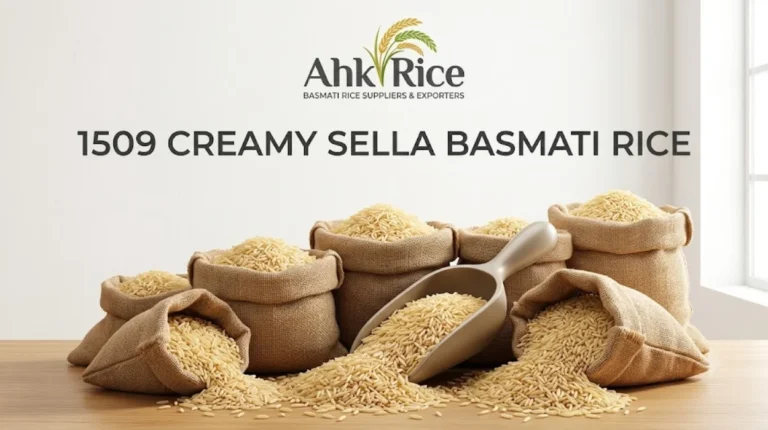
Parboiling creates creamy Sella Basmati rice by gelatinizing starch inside the grain before milling, locking nutrients into the kernel, and forming a firm, glossy structure that cooks into separate, elongated grains with a rich mouthfeel. Here is why: controlled soaking, steaming, and drying transform raw paddy into a stable, non-sticky rice grade with enhanced texture and color.
What is creamy Sella Basmati rice?
Creamy Sella Basmati rice is parboiled basmati paddy processed through 3 core stages—soaking, steaming, drying—to produce firm, non-sticky grains with elongation up to 2.5× after cooking and a golden or white translucent appearance.
Creamy Sella Basmati refers to a processed basmati category where paddy undergoes hydrothermal treatment before milling. This treatment changes the internal starch structure. The grain becomes harder, less brittle, and resistant to breakage during milling.
Basmati rice originates from the Punjab region of Pakistan and India. Farmers cultivate basmati varieties such as 1121, Super Kernel, and 1509 in irrigated fields. These varieties contain long, slender grains with natural aroma compounds like 2-acetyl-1-pyrroline.
Parboiling defines the Sella grade. The term “Sella” comes from the Italian word “scalded,” referring to heat-treated rice. This grade differs from raw basmati because the starch inside the grain undergoes partial gelatinization.
What defines the creamy texture?
Creamy texture in Sella Basmati results from starch restructuring. Amylose and amylopectin molecules rearrange during steaming. This creates a smooth surface and consistent hydration during cooking.
Rice grains absorb water evenly. This uniform absorption prevents stickiness. The cooked rice appears glossy and separate, with a soft yet firm bite.
With the definition of creamy Sella Basmati established, the next question is how the parboiling process creates these structural changes.
How does the parboiling process create creamy Sella Basmati?
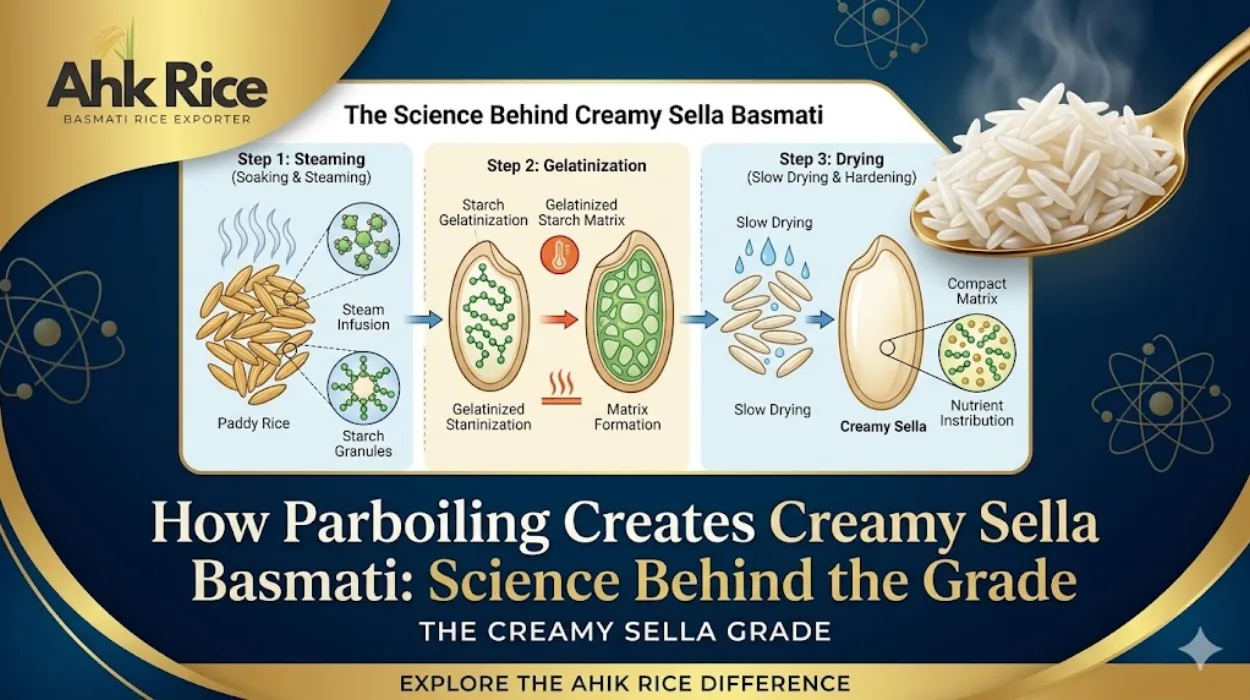
Parboiling creates creamy Sella Basmati through 3 sequential actions—hydrate the paddy to 30% moisture, steam at 100–110°C, and dry to 12–13% moisture, which gelatinizes starch and hardens the grain structure.
Parboiling process sella begins with raw paddy, not milled rice. The husk remains intact during treatment. This protects the kernel and allows controlled moisture penetration.
Step-by-step parboiling process
- Clean the paddy to remove dust, stones, and immature grains
- Soak the paddy in water for 8–12 hours until moisture reaches 30%
- Steam the soaked paddy at 100–110°C for 5–10 minutes
- Dry the steamed paddy under hot air to 12–13% moisture
- Rest the paddy for uniform moisture distribution
- Dehusk the dried paddy to remove husk
- Polish the rice to improve appearance
- Sort by length using graders
- Grade by color using optical sorters
Soaking initiates hydration. Water enters the grain through capillary channels. Steaming triggers starch gelatinization. Heat causes starch granules to swell and lose crystalline structure.
Drying stabilizes the grain. Moisture reduction hardens the kernel. This prevents breakage during milling and improves shelf life.
What changes inside the grain?
Starch transformation defines the sella processing science. Amylose molecules align into a dense structure. This structure reduces surface stickiness during cooking.
Nutrients migrate inward. Vitamins and minerals move from the bran layer into the endosperm. This improves nutritional retention compared to raw milled rice.
With the mechanism of parboiling explained, the next step is to identify the components that control this transformation.
What are the key components in sella processing science?
Sella processing science depends on 4 key components—moisture control, temperature control, pressure regulation, and drying efficiency—to ensure uniform gelatinization and grain integrity above 95% whole kernels.
Each component affects the final grain quality. Processing facilities use automated systems to control these variables.
Moisture control
Moisture determines how evenly the grain hydrates. Paddy must reach 30% moisture before steaming. Uneven soaking creates inconsistent texture in cooked rice.
Temperature control
Temperature drives gelatinization. Steam must maintain 100–110°C. Lower temperatures fail to gelatinize starch. Higher temperatures damage grain structure.
Pressure regulation
Pressure ensures steam penetrates the husk. Controlled pressure allows uniform heat distribution. Uneven pressure causes partial gelatinization.
Drying efficiency
Drying reduces moisture to 12–13%. This level ensures safe storage and milling stability. Over-drying cracks grains. Under-drying leads to spoilage.
Grain sorting and grading
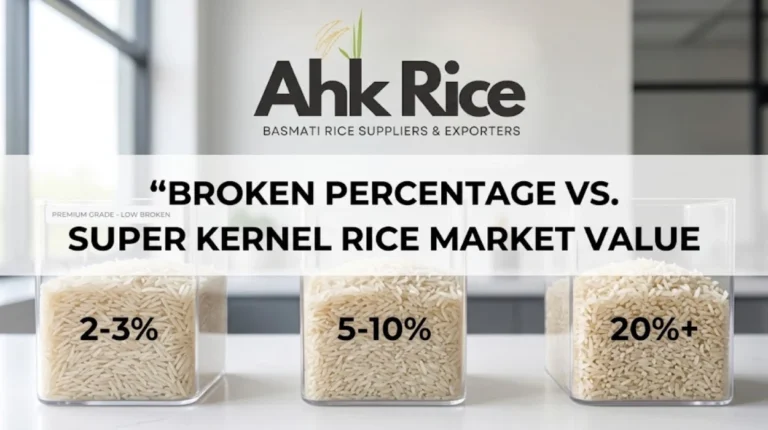
Sorting ensures uniformity. Optical sorters remove discolored grains. Length graders separate broken rice from whole kernels.
Examples include long grain separation for export markets, broken rice removal for industrial use, and color sorting for premium packaging.
With these components defined, the next question focuses on the measurable benefits created by this process.
What are the benefits of creamy Sella Basmati rice?
Creamy Sella Basmati delivers 5 measurable benefits—higher elongation up to 2.5×, lower breakage below 5%, longer shelf life up to 24 months, non-sticky texture, and improved nutrient retention compared to raw rice.
Each benefit results directly from the parboiling process.
Higher elongation
Parboiled grains expand lengthwise during cooking. This creates long, separate grains. Premium markets demand elongation above 2×.
Lower breakage
Hardened grains resist mechanical stress. Milling produces over 95% whole kernels. This increases export value.
Longer shelf life
Parboiling reduces microbial activity. Drying stabilizes moisture. Rice stores safely for 18–24 months in controlled conditions.
In a 40°C warehouse in the Gulf region, Sella maintains quality for 18 months. Raw basmati degrades within 12 months. Catering buyers prefer Sella for this reason.
Non-sticky texture
Gelatinized starch reduces surface adhesion. Cooked rice remains separate. This suits dishes like biryani, pilaf, and mandi.
Nutrient retention
Vitamins migrate into the grain during steaming. This preserves nutrients lost in raw milling.
With benefits established, the next question addresses where this rice fits in real-world applications and markets.
Where is creamy Sella Basmati used and which markets import it?
Creamy Sella Basmati is used in 3 major sectors—hospitality, retail, and bulk catering—and is imported by 15+ countries, including UAE, Saudi Arabia, Iraq, and African markets due to its durability and cooking performance.
Use cases depend on cooking style and storage conditions.
Hospitality sector
Hotels and restaurants use Sella for biryani and pulao. The grain remains separate after long cooking cycles. This ensures consistent presentation.
Bulk catering
Large-scale kitchens require rice that withstands reheating. Sella maintains structure after multiple heating cycles.
Examples include airline catering, wedding catering, and institutional kitchens.
Retail markets
Retail consumers prefer Sella for its ease of cooking. The rice does not stick or clump. This simplifies preparation.
Import markets
Middle Eastern countries import large volumes. High temperatures require rice with long shelf life.
African markets import Sella for its affordability and durability. Parboiled rice resists spoilage in humid climates.
Export data shows Pakistan exported over 5 million tons of rice in FY2024–25 (source: Pakistan Bureau of Statistics). Sella Basmati forms a significant share of premium exports.
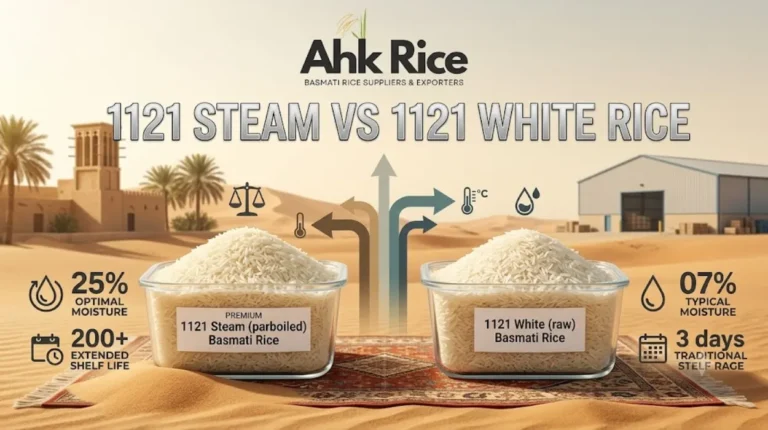
For a deeper comparison between Sella and steam-treated varieties in different markets, refer to this contextual guide on cooking behavior and demand fit.
With use cases and markets explained, the next question addresses common misconceptions that affect buyer decisions.
What are common problems and misconceptions about Sella Basmati?
Common misconceptions include 3 incorrect beliefs—Sella is over-processed, Sella lacks aroma, and Sella cooks hard—while actual data shows controlled processing preserves aroma, ensures softness, and improves consistency.
Misunderstanding the process leads to incorrect product selection.
Misconception 1: Sella is over-processed
Parboiling is controlled hydrothermal treatment. It does not damage the grain. It strengthens structure and improves quality.
Misconception 2: Sella lacks aroma
Aroma compounds remain present after parboiling. Controlled steaming preserves 2-acetyl-1-pyrroline. Improper drying causes aroma loss, not parboiling itself.
Misconception 3: Sella cooks hard
Correct cooking produces soft, separate grains. Use a water ratio of 1:2 and cook for 12–15 minutes. Overcooking causes hardness.
Misconception 4: All Sella is the same
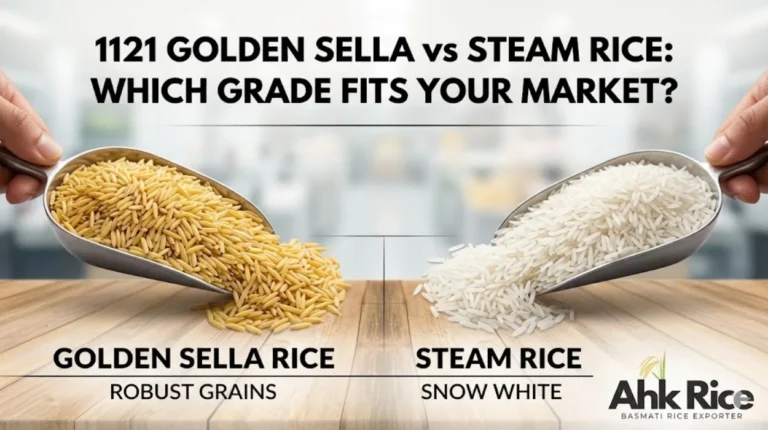
Sella grades vary by variety and processing method. Golden Sella has a yellow hue due to longer steaming. White Sella has a lighter color due to controlled drying.
Examples include 1121 Golden Sella, Super Kernel White Sella, and 1509 Sella grades.
Misconception 5: Sella is inferior to raw rice
Sella suits specific markets better. In hot climates, Sella outperforms raw rice due to stability and shelf life.
With misconceptions clarified, the final understanding connects processing science with real-world performance and market fit.
Frequently Asked Questions
What is the difference between Sella and raw Basmati rice?
Sella Basmati undergoes parboiling before milling, while raw Basmati is milled directly after harvesting. Parboiling hardens the grain, reduces breakage, and creates non-sticky cooked rice. Raw Basmati cooks softer but has a shorter shelf life and higher fragility during processing.
Why does Sella Basmati appear yellow or golden?
Golden color forms during extended steaming in the parboiling process. Heat and moisture cause natural pigments to develop inside the grain. White Sella uses controlled drying to reduce color intensity, while Golden Sella retains a deeper hue due to longer heat exposure.
How does parboiling improve rice shelf life?
Parboiling reduces internal moisture and microbial activity. Drying stabilizes the grain at 12–13% moisture, which prevents spoilage. This allows Sella Basmati to maintain quality for up to 24 months under proper storage conditions, even in warm climates.
What is the ideal cooking method for Sella Basmati rice?
Cook Sella Basmati using a 1:2 rice-to-water ratio. Boil water, add rice, and cook for 12–15 minutes. Drain excess water if needed. This method ensures long, separate grains with a soft yet firm texture suitable for dishes like biryani and pulao.
Which Basmati varieties are commonly used for Sella processing?
Common varieties include 1121 Basmati, Super Kernel Basmati, and 1509 Basmati. Each variety differs in grain length, aroma intensity, and cooking performance, but all respond well to parboiling.