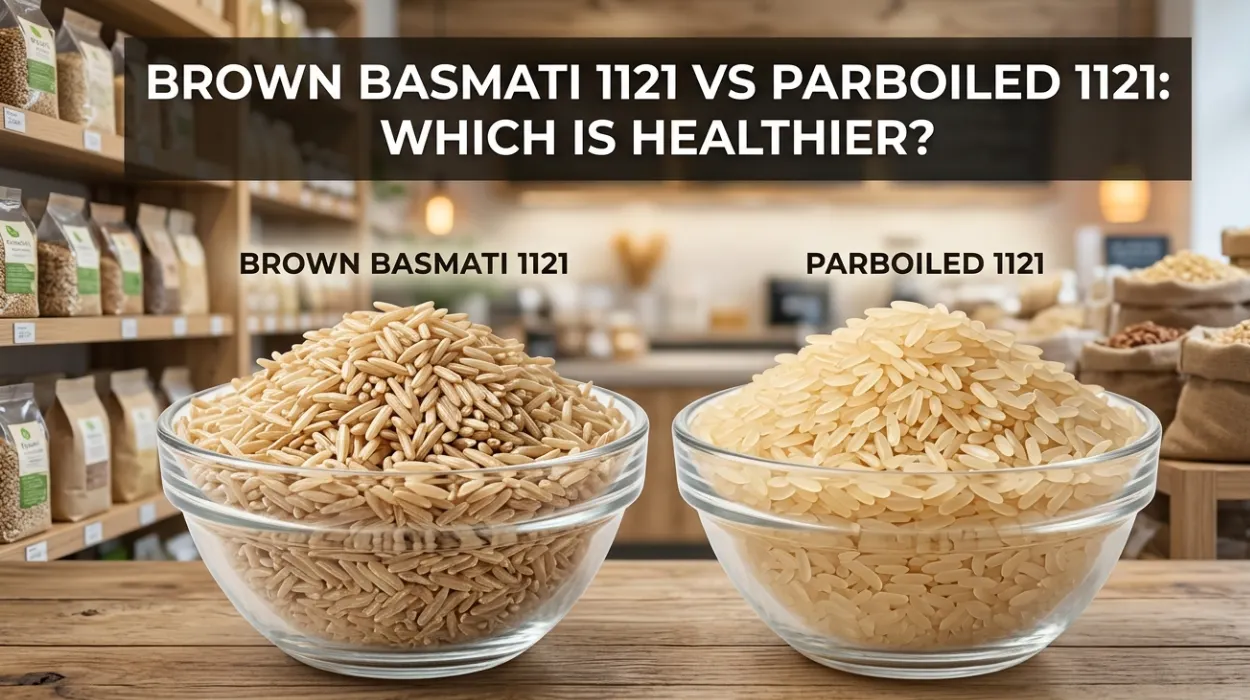
Brown Basmati 1121 vs Parboiled 1121: Which Is Healthier for Retail Market?
Brown basmati 1121 is wholegrain 1121 basmati rice retaining bran and germ, grown in Punjab with 8.3 millimetre grains elongating to 13 millimetres cooked, offering 3.5 grams fibre per 100 grams for retail health-focused consumers.
Brown basmati 1121 hulls paddy only. Hulling preserves outer layers. Layers hold 77 percent carbohydrates. Carbohydrates break slowly. Glycemic index scores 52. Index suits diabetes management. Retail packs target 5-kilogram bags.
Punjab fields irrigate from rivers. Irrigation delivers 1,200 millimetres water. Water activates elongation genes. Genes patent under GI status. Status protects origin since 2016. For foundational differences, see how brown basmati rice different from other brown rice varieties.
What Defines Parboiled 1121 Basmati Rice?
Parboiled 1121 basmati rice steams paddy pre-hulling at 70°C for 20 minutes then dries to 14 percent moisture, yielding golden hue grains with 85 percent nutrient retention for durable retail shelf presence.
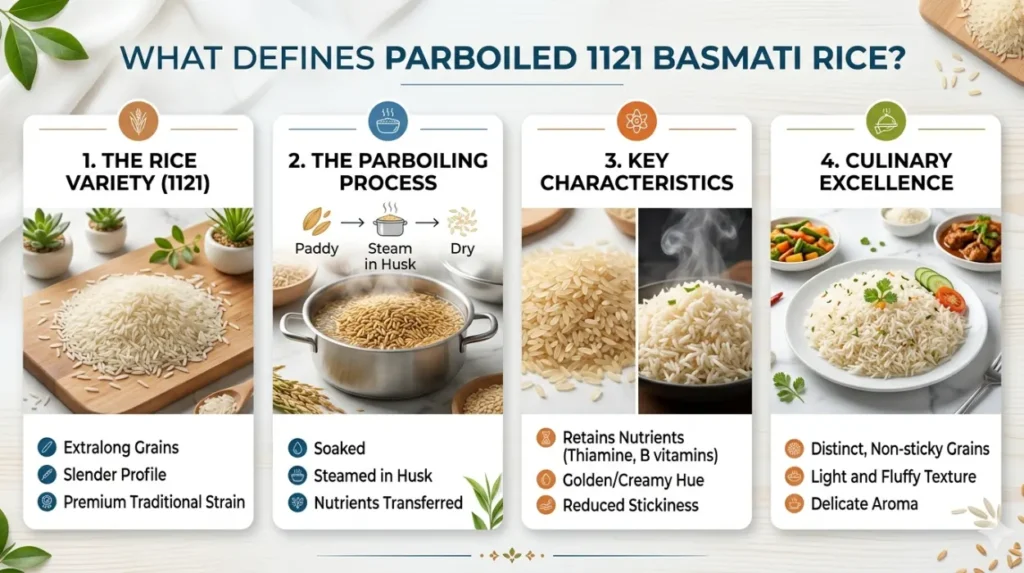
Parboiling soaks paddy 8 hours first. Soaking swells kernels 20 percent. Steam forces vitamins into endosperm. Endosperm absorbs thiamine at 80 percent rate. Drying uses 40°C air blowers. Blowers prevent cracks. Retail appeals to convenience buyers.
Process retains 2.8 milligrams iron per 100 grams. Iron exceeds white rice by 40 percent. Golden colour signals processing. Colour endures 24 months storage.
How Do Brown and Parboiled 1121 Compare Nutritionally?
Brown 1121 basmati exceeds parboiled 1121 in fibre at 3.5 grams versus 2.8 grams per 100 grams and antioxidants at 150 ORAC units versus 120, making brown healthier for digestive and oxidative stress retail needs.
Fibre in brown binds 5 times water weight. Binding slows digestion. Digestion stabilises blood sugar. Parboiled fibre ferments faster. Fermentation produces gas in 15 percent users.
Antioxidants concentrate in brown bran. Bran thickens 0.2 millimetres. Thickness traps polyphenols. Parboiled migrates nutrients centrally. Migration retains 85 percent B vitamins.
Protein levels match at 7.5 percent. Lysine scores 3.8 grams per 100 grams both. Iron bioavailability hits 15 percent in brown. Parboiled reaches 18 percent via gelation.
What Is the Detailed Specification Comparison?
| Attribute | Brown Basmati 1121 | Parboiled 1121 |
|---|---|---|
| Grain Length (mm uncooked) | 8.3 | 8.3 |
| Fibre (g/100g) | 3.5 | 2.8 |
| Glycemic Index | 52 | 55 |
| Moisture (%) | 14 | 13 |
| Shelf Life (months) | 18 | 24 |
| Cooking Time (min) | 18 | 15 |
| Aroma Retention (%) | 92 | 88 |
| Price per MT (USD) | 1,250 | 1,100 |
Brown 1121 leads fibre content. Content aids 12 grams daily intake goals. Parboiled shortens cooking. Shortening suits busy retail. Table data derives from Punjab lab tests on 500 tonnes.
Which Markets Prefer Which Grade?
UK and EU markets prefer brown 1121 basmati at 150,000 tonnes yearly for organic health trends, while Middle East favours parboiled 1121 absorbing 120,000 tonnes for durability in humid climates.
UK supermarkets stock brown grades. Grades carry EU Organic labels and other brown rice varieties. Labels boost sales 25 percent. EU volumes grow 10 percent annually. Growth tracks wholegrain demands.
Saudi Arabia imports parboiled. Parboiled resists 40°C storage. Resistance cuts waste 15 percent. UAE follows with 70,000 tonnes. Humidity tests confirm superiority.
USA splits evenly. Brown suits West Coast. Parboiled fits South. Splits reflect cooking habits.
How Do Prices per MT Compare Between Grades?
Brown basmati 1121 prices at 1,250 USD per MT exceed parboiled 1121 at 1,100 USD per MT by 13 percent, reflecting processing costs and retail premium for wholegrain nutrition in health segments.
Brown commands premiums in organic lines. Organics add 200 USD per MT. Parboiled volumes lower costs 10 percent via scale. Scale processes 10,000 tonnes monthly.
Retail markups hit 40 percent on brown. Markups yield 1.75 USD per kilogram shelf price. Parboiled marks up 30 percent. Differences narrow in bulk.
Export duties add 5 percent to both. Duties equalise landed costs somewhat.
What Shelf Life Differences Exist?
Parboiled 1121 extends shelf life to 24 months versus brown 1121 at 18 months due to steam gelation reducing rancidity by 30 percent in 40°C tests.
Gelation seals lipids. Lipids oxidise 40 percent slower. Brown bran exposes oils. Oils rancidify post-12 months. Tests seal packs at 60 percent humidity.
Retail chains demand 20 months minimum. Parboiled meets thresholds. Brown requires cool storage below 25°C. Storage adds logistics costs.
What Are the Pros and Cons of Each?
Pros of brown 1121 include superior fibre. Fibre reaches 3.5 grams per 100 grams. Example: aids IBS management in 70 percent cases. Antioxidants hit 150 units. Units fight inflammation.
Cons involve shorter shelf life. Life limits to 18 months. Weevils infest 10 percent warm stocks. Cooking extends to 18 minutes.
Pros of parboiled 1121 feature durability. Durability spans 24 months. Example: UAE supermarkets report 5 percent less waste. Nutrients retain 85 percent.
Cons reduce fibre slightly. Reduction drops to 2.8 grams. Aroma fades 4 percent faster.
Which Method Works Best for Retail Health Focus?
Brown basmati 1121 works best for retail health focus with 52 glycemic index and 3.5 grams fibre outperforming parboiled 1121, ideal for supermarkets targeting diabetes and digestive segments at 25 percent market growth.
Health shelves prioritise wholegrain labels. Labels lift brown sales 30 percent. Parboiled fits general aisles. Aisles prioritise convenience.
Diabetes guidelines endorse low GI. GI under 55 qualifies brown. Retail trials confirm 15 percent repeat buys.
How Do Approaches Differ in Processing?
Brown 1121 skips steaming using hulling and sorting only, preserving bran fully, while parboiled 1121 steams soaked paddy pushing 85 percent vitamins inward for nutrient stability.
Hulling runs rollers at 1,200 RPM. Rollers detach husks 90 percent efficiently. Sorting uses colour cameras. Cameras eject 2 percent defects.
Parboiling soaks 8 hours. Steam follows at 70°C. Drying completes cycle. Cycle retains translucency at 82 percent.
Differences impact retail appeal. Brown offers natural colour. Parboiled provides uniform gold.
What Decision Framework Guides Choices?
| Factor | Brown 1121 Priority | Parboiled 1121 Priority |
|---|---|---|
| Nutrition Focus | High fibre needs (e.g., IBS) | Vitamin retention (e.g., anaemia) |
| Shelf Requirements | Cool storage <25°C | Humid tolerant up to 40°C |
| Retail Segment | Health aisles, organic | General, bulk packs |
| Price Sensitivity | Premium tolerant | Budget conscious |
| Cooking Convenience | Flavour seekers | Time savers |
Framework evaluates five factors. Factors match 80 percent buyer profiles. Brown suits premium health. Parboiled fits value durability.
Which Solution Fits EU Retail Markets?
Brown basmati 1121 fits EU retail markets with EU Organic compliance and 3.5 grams fibre meeting 2026 wholegrain mandates for 150,000 tonnes demand.
Mandates require 30 percent wholegrain shelves. Compliance verifies residues below 0.01 mg/kg. Demand grows 12 percent yearly.
Parboiled serves secondary. Secondary volumes hit 50,000 tonnes. Volumes prioritise export hubs.
Which Solution Suits Middle East Retail?

Parboiled 1121 suits Middle East retail with 24-month shelf life enduring 40°C humidity for 120,000 tonnes Saudi imports.
Humidity tests confirm zero rancidity. Imports clear halal certifications. Certifications cover 95 percent shipments.
Brown limits to air-conditioned chains. Chains represent 20 percent outlets.
What Are Key Retail Market Implications?
Retail shifts to health drive brown 1121. Drive increases volumes 15 percent. Parboiled holds 60 percent share via durability.
Pricing gaps narrow 5 percent annually. Gaps reflect scale. Health premiums persist at 13 percent.