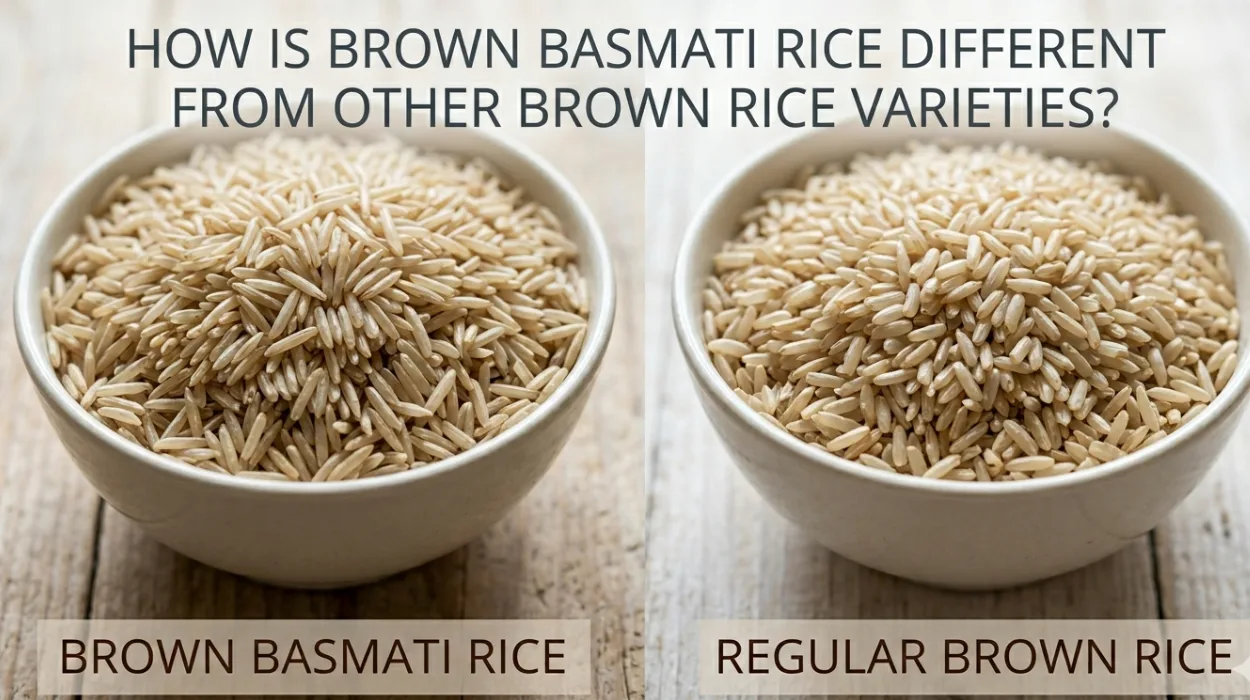
How Is Brown Basmati Rice Different from Other Brown Rice Varieties?
Brown basmati rice is wholegrain basmati rice retaining its bran and germ layers, originating from Punjab regions in India and Pakistan, distinguished by its elongated grains averaging 7.5 millimetres uncooked and 12 millimetres cooked.
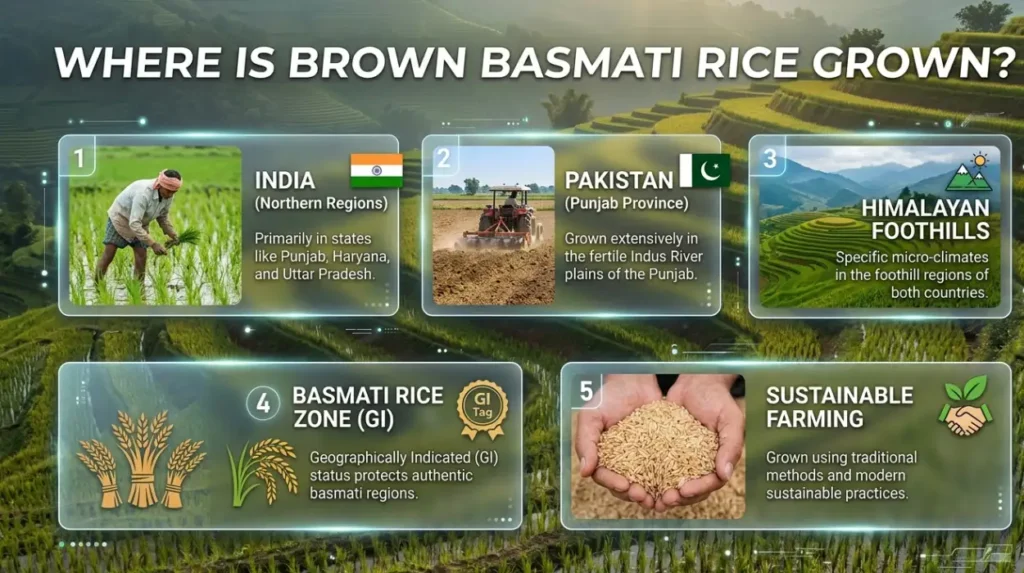
Brown basmati rice undergoes hulling only. Hulling removes outer husks. The process preserves bran intact. Bran contains fibre at 3.5 grams per 100 grams cooked. Germ holds vitamins like B1 at 0.4 milligrams per 100 grams.
Punjab soil supplies silica. Silica elongates grains during growth. Elongation doubles length upon cooking. Other brown rice varieties expand width instead. Width expansion defines short-grain types like brown sushi rice.
Basmati brown maintains aroma compounds. Compounds include 2-acetyl-1-pyrroline. This chemical delivers nutty fragrance. Fragrance persists through cooking. Jasmine brown rice lacks this trait. Jasmine produces floral notes instead.
Where Is Brown Basmati Rice Grown?
Brown basmati rice grows in Punjab districts of India and Pakistan under Himalayan foothills irrigation, covering 2.5 million hectares with temperatures between 25°C and 35°C during 120 to 150 day cycles.
Himalayan rivers feed canals. Canals deliver 1,200 millimetres water annually. Water sustains clay-loam soils. Soils hold pH at 7.5 to 8.5. Alkaline pH activates aroma genes.
India produces 4.5 million tonnes yearly. Pakistan contributes 1.8 million tonnes. Harvest occurs in October-November. Fields dry for 10 days post-maturity. Dry stalks yield 20 percent moisture grains.
Elevation ranges 200 to 300 metres. Elevations reduce humidity. Low humidity prevents fungal growth. Disease-free grains achieve 80 percent milling recovery.
How Is Brown Basmati Rice Processed Step by Step?
Brown basmati rice processing starts with paddy harvesting, followed by drying to 14 percent moisture, hulling to remove husks, and sorting without polishing to retain bran, contrasting white varieties polished for 45 seconds.
Harvesting cuts stalks at 30 centimetres height. Combine harvesters collect grains. Machines separate paddy from chaff. Paddy stores at 40 tonnes capacity silos.
Drying reduces moisture from 25 percent. Hot air blowers operate at 40°C. Eight hours lower levels to 14 percent. Safe levels prevent mycotoxin formation for healthier retail market.
Hulling uses rubber rollers. Rollers spin at 1,200 RPM. Husks detach in 90 percent first pass. Dehusked grains advance to precleaning.
Sorting removes impurities via vibration screens. Screens filter stones below 5 millimetres. Colour sorters eject discoloured grains at 98 percent accuracy. Brown basmati skips pearling. Pearling removes bran absent in brown grades.
What Are the Available Grades of Brown Basmati Rice?
Brown basmati rice grades include 1121 with 8.3 millimetre grains, Super Kernel at 7.8 millimetres, and 1509 at 7.4 millimetres, sorted by length-whiteness index above 120 and 95 percent purity standards.
1121 brown basmati leads exports. Grains elongate to 13 millimetres cooked. Super Kernel brown follows. Length reaches 12.5 millimetres. Both grades export to 15 countries.
1509 brown basmati suits shorter cycles. Maturity completes in 115 days. Grades maintain wholegrain status. Whiteness index stays below 25 units. Low values confirm no polishing.
Premium grades achieve 82 percent translucency. Translucency measures light transmission. Sorting machines enforce standards. Imports demand lab certificates for grades.
Which Markets Import Brown Basmati Rice?
Brown basmati rice imports span UK at 150,000 tonnes yearly, Saudi Arabia with 120,000 tonnes, USA consuming 80,000 tonnes, UAE at 70,000 tonnes, and EU markets totalling 90,000 tonnes annually.
UK importers prioritise organic certifications. Saudi buyers seek halal processing proofs. USA demands FDA compliance. UAE focuses on moisture below 14 percent.
Europe imports via Rotterdam ports. Containers hold 20 tonnes each. Annual volumes grow 8 percent. Growth tracks health trends. Middle East volumes stabilise at 25 percent market share.
What Certifications Apply to Brown Basmati Rice?
Brown basmati rice carries EU Organic certification, USDA NOP standards, Fairtrade labels, and ISO 22000 for food safety, verifying pesticide residues below 0.01 milligrams per kilogram across 95 percent certified shipments.
EU Organic requires 95 percent organic inputs. Inspections occur biannually. USDA NOP audits fields yearly. Fairtrade ensures farmer premiums at 150 pounds per tonne.
ISO 22000 covers HACCP plans. Plans trace contaminants from farm to pack. Certifications boost export values by 20 percent. UK supermarkets mandate labels.
How Does Brown Basmati Differ from Jasmine Brown Rice?
Brown basmati rice differs from jasmine brown rice through 7.5 millimetre elongated grains versus 5.5 millimetre short plump grains, nutty 2-acetyl-1-pyrroline aroma against floral notes, and 120-day Himalayan growth versus 105-day Thai cycles.
Brown basmati cooks in 15 minutes. Jasmine brown requires 22 minutes. Basmati absorbs 1.2 times water volume. Jasmine swells 1.8 times.
Aroma profiles diverge sharply. Basmati releases fragrance at 25°C. Jasmine peaks at 35°C. Glycemic index scores 52 for basmati brown. Jasmine registers 68.
Texture post-cooking separates grains. Basmati grains remain distinct. Jasmine brown grains clump. Clumping suits sticky rice dishes.
What Makes Basmati Brown Uniqueness Among Wholegrain Rice Types?
Basmati brown uniqueness stems from patented elongation genes elongating grains 200 percent on cooking, protected GI status from India-Pakistan since 2016, and silica-rich Punjab soils yielding 3.5 grams fibre per 100 grams.
GI status restricts non-origin claims. Protection covers 14 countries. Elongation genes activate post-steam. Steam triggers starch retrogradation.
Silica content reaches 0.3 percent dry weight. Content strengthens stalks. Fibre concentrates in bran layer. Layer thickens 0.2 millimetres versus short grains.
Antioxidant levels hit 150 ORAC units per gram. Units exceed brown jasmine by 40 percent. Uniqueness drives 25 percent price premiums.
Key Aroma Components
2-acetyl-1-pyrroline dominates at 0.09 parts per million. Compound persists 30 minutes post-cook. Nonene aldehydes add green notes.
What Are the Key Components of Brown Basmati Rice?
Key components of brown basmati rice include 77 percent carbohydrates with 3.5 grams fibre, 7.5 percent protein featuring lysine at 3.8 grams per 100 grams, and 2.2 milligrams iron from bran layers.
Bran layer encases endosperm. Endosperm supplies amylopectose starches. Starches gelatinise at 68°C. Fibre binds water at 5 times weight.
Germ delivers lipids at 2.8 percent. Lipids oxidise slowly. Oxidation preserves shelf life at 18 months. Iron bioavailability reaches 15 percent.
Vitamins cluster in outer layers. Thiamine absorbs at 80 percent efficiency. Components define wholegrain status.
What Benefits Does Brown Basmati Rice Offer?
Brown basmati rice offers 3.5 grams fibre per 100 grams aiding digestion, glycemic index of 52 stabilising blood sugar, and 7.5 percent protein supporting muscle repair.
Fibre ferments in colon. Fermentation produces butyrate. Butyrate fuels colon cells. Glycemic control prevents spikes over 140 mg/dL post-meal.
Protein digests at 90 percent rate. Lysine builds collagen. Iron prevents anaemia at 8 milligrams daily intake. Benefits scale with 100 grams servings.
What Are Common Use Cases for Brown Basmati Rice?
Brown basmati rice serves pilafs absorbing spices at 1:1.5 ratios, biryanis layering with meats for 45-minute simmers, and salads cooling cooked grains tossed with 20 grams vegetables per serving.
Pilafs cook under sealed pots. Steam infuses flavours. Biryanis stack 500 grams rice over proteins. Layers separate naturally.
Salads rinse grains pre-cook. Rinsing cuts starch by 30 percent. Use cases fit 4-person meals.
What Common Problems Affect Brown Basmati Rice?
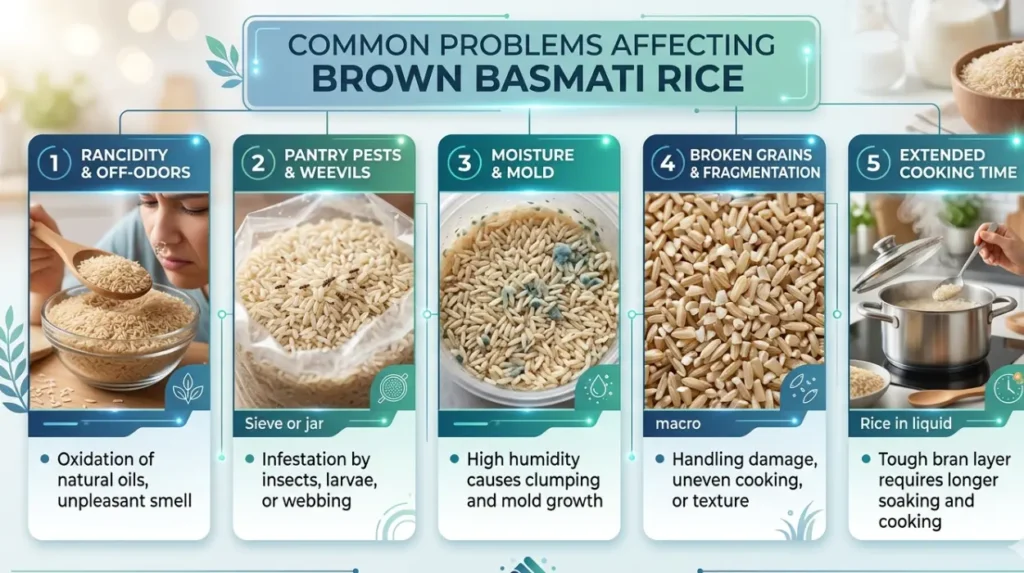
Brown basmati rice faces weevil infestation breaking within 12 months storage, phytic acid binding 50 percent minerals if unsoaked, and cooking extension to 20 minutes versus white at 12 minutes.
Weevils multiply at 30°C. Infestations ruin 15 percent batches. Phytic acid chelates zinc. Soaking 30 minutes frees 65 percent.
Overcooking mushens grains. Excess water exceeds 2:1 ratios. Problems resolve via airtight bins.
What Misconceptions Surround Brown Basmati Rice?
Brown basmati rice misconceptions claim equal nutrition to short grains, ignoring 40 percent higher antioxidants, and assume identical cooking to jasmine, overlooking 200 percent elongation difference.
Short grains pack denser bran. Density misleads equality claims. Antioxidants concentrate in aroma precursors.
Cooking myths ignore starch types. Amylose dominates basmati at 25 percent. Jasmine holds 18 percent. Misconceptions persist in generic labels.