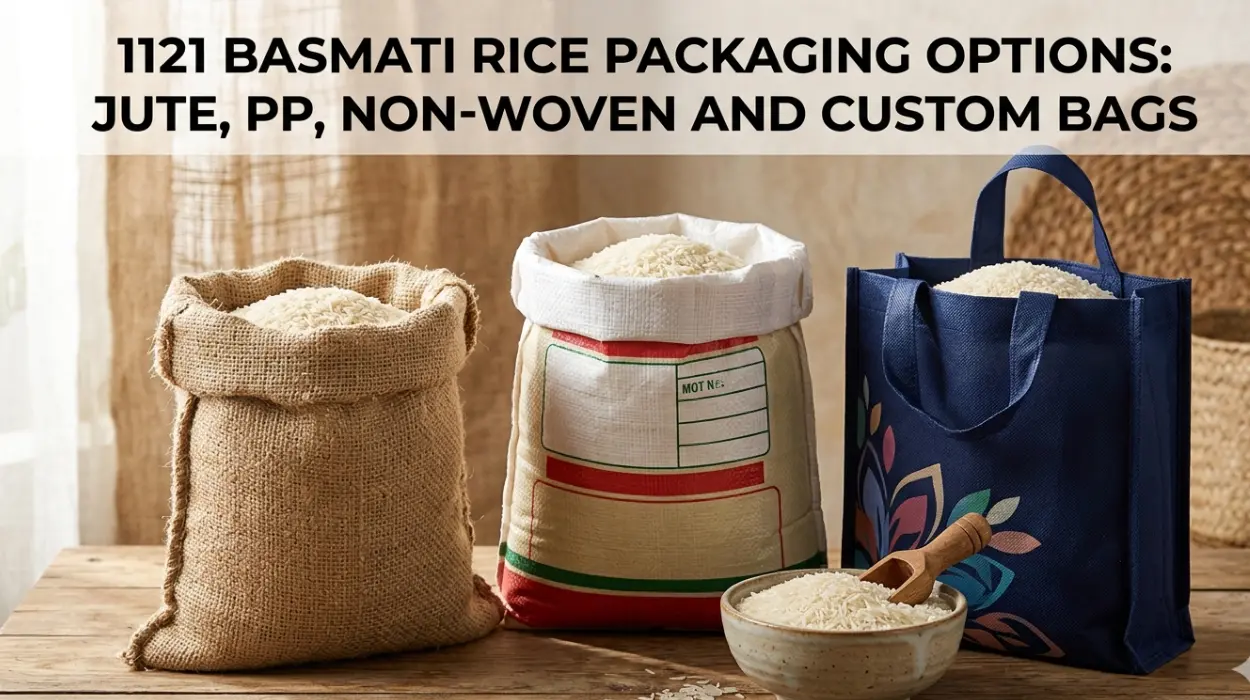
1121 Basmati Rice Packaging Options: Jute PP Non-Woven and Custom Bags
1121 basmati rice packaging options are the outer bag materials, bag constructions, and print formats used to protect 1121 rice during storage, transport, retail display, and export handling.
Packaging is not only a visual choice. It controls moisture exposure, product stability, stack strength, and shelf presentation. In rice export, the bag type also affects how buyers perceive grade, origin, and brand position. A 1121 rice bag can be designed for bulk trade, wholesale distribution, supermarket shelves, or private label retail. Each format changes how the rice behaves in the supply chain.
The main basmati rice packaging types are jute bags, PP woven bags, non-woven bags, and custom printed bags. Jute suits traditional bulk and export handling. PP woven suits strength and cost control. Non-woven suits premium shelf presentation. Custom bags suit brand-specific retail and private label use. The right choice depends on container movement, humidity exposure, destination market, and branding requirements.
AHK Rice supplies 1121, Super Kernel, and 1509 from Punjab with end-to-end processing and export handling, so packaging is part of the product specification rather than a separate afterthought. In rice export packaging, the bag is part of the commercial identity. The grain may be the same, but the market reads the bag as part of quality.
How does packaging work in rice export?
Rice export packaging works by combining a food-safe liner, a durable outer bag, accurate weight control, and printed information that supports storage, traceability, and market positioning.
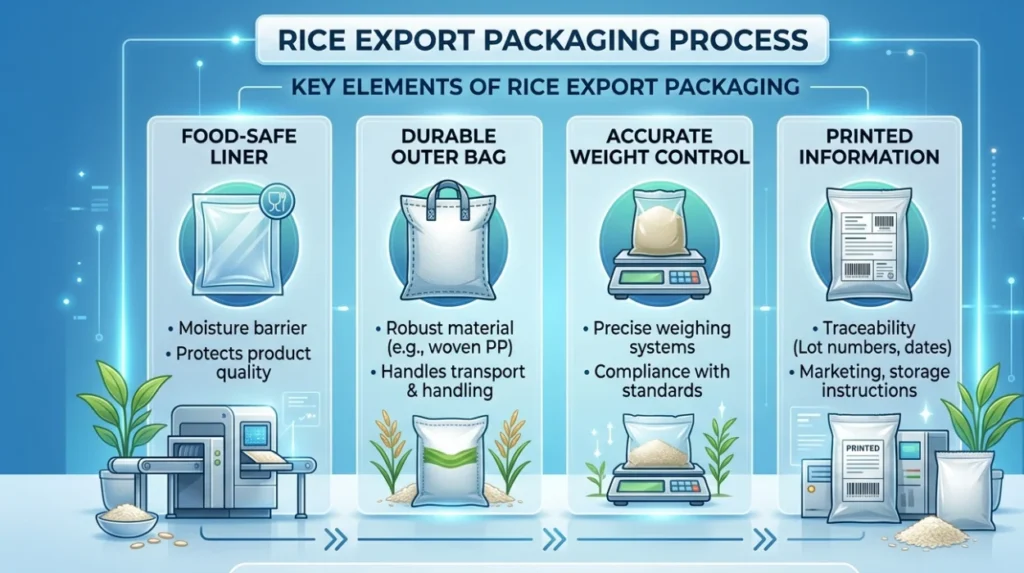
The process starts after milling, grading, and cleaning. The rice is weighed into a specific pack size, such as 1 kg, 5 kg, 10 kg, 25 kg, or 50 kg. A liner may be placed inside to reduce moisture migration and protect aroma. The outer bag then provides structural strength and visual identity. The bag is sealed, stacked, palletised, and loaded for shipment.
The packaging type must match the journey. A long sea route needs more moisture control. A domestic wholesale route needs fewer brand elements and more strength. A premium supermarket line needs better print quality and clearer pack presentation. A bulk export line needs durable stitching and load stability. These functions determine whether jute, PP, non-woven, or custom bags are used.
Packaging also affects compliance. Labels may need origin, net weight, variety name, and packing date. Export markets often require clear traceability. That means the rice export packaging has to carry both logistical and regulatory information. A poorly chosen bag can damage product condition or weaken market trust even when the rice itself is high quality.
What are the main components of 1121 rice bag options?
The main components of 1121 rice bag options are the bag material, lamination or lining, closure method, print style, weight capacity, and food-contact protection layer.
The bag material is the primary structural element. Jute is natural fibre. PP woven is synthetic and strong. Non-woven is softer and more presentation-focused. Custom bags can use one material or a layered structure. The lamination or liner protects against humidity, which matters in long export lanes. Closure may be stitched, heat-sealed, or folded depending on the format.
Print style matters because rice packaging communicates grade and brand. A bag may use plain one-colour printing, multi-colour branding, or high-resolution private label artwork. Weight capacity matters because 25 kg and 50 kg bags need very different reinforcement from 1 kg retail packs. Food-contact protection matters because the rice must remain clean and dry after milling.
In 1121 basmati rice packaging options, the outer bag is only one layer of the system. The liner, seal, stitching, and print quality all influence how the product looks and performs. A strong bag with poor sealing still creates risk. A visually attractive bag with weak fibre also creates risk. The final package must protect the grain and support the market format.
How do jute, PP, and non-woven bags differ?
Jute, PP, and non-woven bags differ in strength, moisture control, visual appeal, cost, and how they position 1121 rice in bulk or retail channels.
Jute bags are made from natural fibre. They are strong, breathable, and widely used in traditional rice export packaging. Their strength makes them suitable for heavier weights and long handling cycles. Their breathable nature helps reduce condensation, but that same breathability means they need careful use in humid routes. Jute bags often suit bulk and semi-premium export lines.
PP woven bags are made from woven polypropylene. They are stronger against tearing and usually lower in cost than more premium presentation formats. They are common in 25 kg and 50 kg pack sizes. PP is useful when load stability and stacking matter more than shelf appearance. It is a practical choice for wholesalers, traders, and large importers.
Non-woven bags sit closer to presentation packaging. They are smoother, cleaner looking, and often used for retail positioning. They do not replace heavy-duty export strength in every case, but they support premium shelf presentation and branded appearance. For 1121 basmati rice packaging options, non-woven makes more sense in smaller consumer packs than in pure bulk handling.
What are the benefits of each packaging type?
Each packaging type delivers a different balance of protection, cost, shelf appeal, and market suitability, so the best option depends on the intended buyer and route.
Jute bag benefits:
- Provides strong fibre-based protection for export handling.
- Supports traditional rice trade presentation.
- Works well for bulk weights such as 25 kg and 50 kg.
- Gives a recognisable export profile in South Asian and Gulf trade.
PP woven bag benefits:
- Delivers high tear resistance.
- Controls cost in bulk export and wholesale distribution.
- Stacks efficiently in warehouses and containers.
- Fits commodity and value-focused 1121 rice bag options.
Non-woven bag benefits:
- Improves shelf appearance.
- Supports premium retail and private label presentation.
- Feels cleaner and more consumer-facing.
- Works better in smaller pack sizes.
Custom bag benefits:
- Allows brand-specific artwork, language, and pack design.
- Improves differentiation on shelf.
- Supports private label and market-specific compliance.
- Helps the rice stand apart in competitive retail channels.
The key benefit of good packaging is control. The grain stays drier, the bag stays intact, and the brand message stays visible. In export packaging, those three outcomes matter as much as the rice grade itself. The buyer is not only buying rice. The buyer is buying a product presentation system that travels through the supply chain.
Which use cases fit each packaging option?
Different packaging options fit different use cases, with bulk trade favouring PP and jute, and retail or private label favouring non-woven and custom bags.
Jute bags suit traditional wholesale export where strength and familiar trade handling matter most. A 25 kg jute bag often works well for importers who re-bag at destination or sell into foodservice and cash-and-carry channels. PP woven bags suit the same general trade lane but with more emphasis on cost and stacking efficiency. They are common where large volume and low damage risk matter more than shelf display.
Non-woven bags suit premium retail packs, gift-style packs, and visually sensitive supermarket channels. They are also useful where a cleaner surface finish supports stronger consumer perception. Custom bags suit imported private label lines, where the buyer wants 1121 basmati to appear under a market-specific brand. A custom bag can support different languages, barcode formats, and origin references.
AHK Rice uses these packaging types across export formats for 1121, Super Kernel, and 1509. The relevant choice is driven by channel logic. Bulk trade needs strength. Retail needs appearance. Private label needs identity. Packaging should reflect that channel logic rather than forcing one format into every market.
What are the common problems or misconceptions?
The most common misconceptions are that all rice bags protect the grain equally, that visual design matters more than structure, and that cheap packaging always lowers total cost.
One common mistake is assuming that an attractive bag is automatically a better bag. Visual design matters, but it cannot replace structural strength or moisture control. A premium-looking bag that tears in transit damages both product and brand. Another mistake is assuming breathable packaging is always better. In humid lanes, breathability can increase moisture risk if the route is long and the container environment is unstable.
A third misconception is that the cheapest bag lowers overall cost. That is not always true. A weak bag can create spillage, damage, rework, and customer complaints. A slightly more expensive but better-suited bag can reduce those risks. In rice export packaging, the real cost includes the bag, the handling risk, and the market response.
Another issue is pack-size mismatch. A 50 kg export bag is not automatically appropriate for retail. A retail pack needs print quality, legal text space, and shelf appearance. The wrong 1121 rice bag options can create downstream selling problems even when the rice quality is strong.
How do certifications and compliance affect packaging?
Certifications and compliance affect packaging by setting the labelling, traceability, and food-safety requirements that each bag must carry for its destination market.
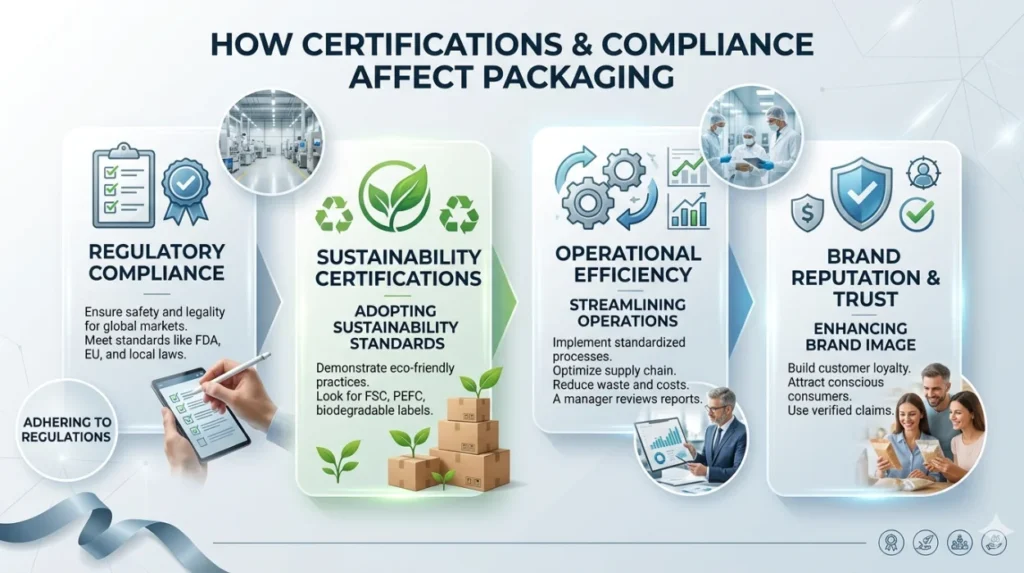
Some markets require clear origin labelling, net weight, batch identification, and packing date. Others require food-safety systems in the mill and clear traceability on the bag. The packaging must therefore support the documentation chain. If the bag design cannot carry the required information, the product becomes harder to move through import inspection or retail approval.
This matters more in export packaging than in local packaging because the buyer often uses the printed bag as a compliance object. The bag can act as proof of origin, product identity, and batch consistency. In a private label setting, the buyer may need multilingual text or market-specific declarations. In bulk trade, the buyer may prioritise bag durability and legibility.
The packaging format should always fit the certification context. A standard woven bag may work for bulk trade, but a consumer pack may need more print precision and more design control. A custom bag becomes useful where the market wants stronger brand presentation and compliance clarity at the same time.
What decision factors should buyers weigh?
Buyers should weigh channel type, pack size, destination climate, brand goal, and total handling risk before selecting a packaging format.
| Decision factor | Best fit | Why it matters |
|---|
| Decision factor | Best fit | Why it matters |
|---|---|---|
| Channel type | Bulk trade, retail, private label | Determines strength versus shelf appeal |
| Pack size | 1 kg, 5 kg, 10 kg, 25 kg, 50 kg | Changes structure and print needs |
| Destination climate | Humid, dry, mixed | Affects moisture protection requirements |
| Brand goal | Commodity, premium, private label | Sets presentation and differentiation needs |
| Handling risk | High, medium, low | Determines need for stronger materials |
A bulk importer in a humid market often leans towards PP or lined jute. A retail brand in a premium channel often leans towards non-woven or custom bags. A private label buyer often wants a custom format that carries its own identity while protecting the rice. The right answer is not universal. It depends on the route the product will travel and the market it must enter.