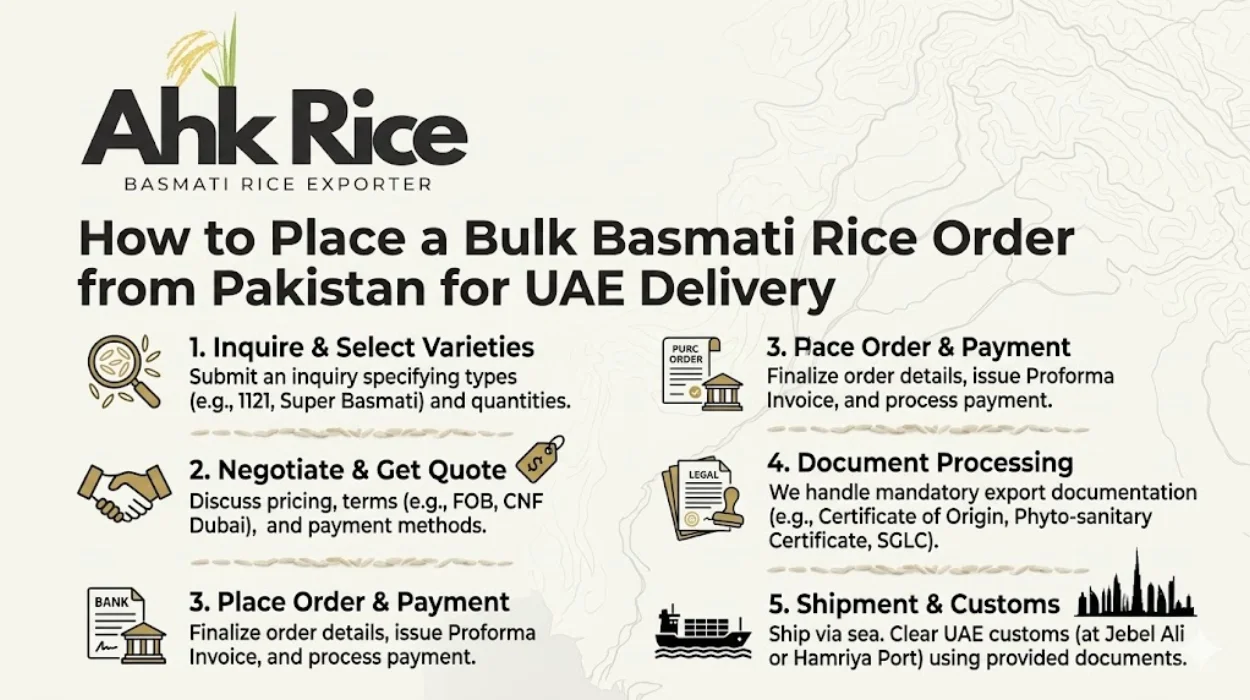
How to Place a Bulk Basmati Rice Order from Pakistan for UAE Delivery
A bulk basmati rice order from Pakistan to UAE is placed through exporter negotiation, CIF Dubai shipping contracts, and document-controlled logistics involving milling, grading, inspection, and container dispatch. Here is why: UAE buyers depend on structured export workflows from Pakistan to ensure consistent grain quality, customs clearance compliance, and predictable landed cost per metric ton.
This process becomes clearer when you understand grading, processing, and export documentation logic explained in this detailed guide on basmati grading and export basics. That foundation helps buyers evaluate rice quality before engaging in procurement decisions.
For final purchase execution and sampling flow, refer to AHK Rice UAE free sample Dubai container request, which supports container-level decision validation before contract confirmation.
What are the available solutions for placing a bulk basmati rice order from Pakistan to UAE?
Bulk basmati rice orders from Pakistan to UAE are executed through three primary solutions: direct exporter CIF contracts, UAE-based import trading companies, and broker-assisted sourcing. Each method changes pricing control, documentation handling, shipment visibility, and landed cost accuracy depending on buyer scale and operational capability.
Direct exporter CIF Dubai model
Direct exporter sourcing from Pakistan involves mill → grade → inspect → load → ship CIF Dubai under exporter responsibility. Buyers contract directly with suppliers like AHK Rice for full control over grade and packaging. Exporters manage fumigation, phytosanitary certification, and container sealing.
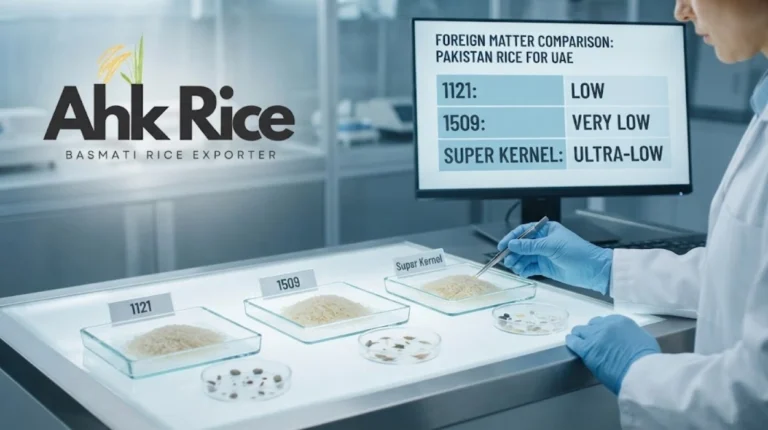
This model delivers consistent specification control for 1121, 1509, and Super Kernel varieties. It also reduces intermediaries and stabilizes price per MT.
UAE trading importer model
UAE importers purchase in bulk from Pakistan exporters and then redistribute locally. They handle warehousing, repacking, and retail distribution. This method simplifies procurement but increases markup layers.
Importers prioritize blended lots and mid-grade basmati for retail and HORECA channels.
Broker-assisted sourcing model
Brokers coordinate between Pakistani mills and UAE buyers. They do not own stock. They match price, negotiate contracts, and facilitate logistics.
This model suits first-time buyers but adds commission layers and reduces traceability of grading decisions.
With solution types defined, the next step is comparing how each structure performs across cost, control, and logistics efficiency.
How do different approaches compare in cost, control, and logistics efficiency?
Direct exporter CIF contracts deliver the lowest landed cost at $880–$1,050 per MT, while UAE importers offer fastest local availability but higher cost at $950–$1,200 per MT. Broker models sit between both but reduce quality control transparency and grading traceability.
7-attribute comparison table
| Attribute | Direct Exporter (Pakistan CIF) | UAE Importer | Broker Model |
|---|---|---|---|
| Price per MT | $880–$1,050 | $950–$1,200 | $900–$1,150 |
| Quality control | Mill-based grading control | Mixed batch control | Limited verification |
| Documentation handling | Exporter-managed full set | Importer-managed partial | Shared responsibility |
| Shipment visibility | Full container tracking | Post-arrival tracking | Partial tracking |
| Packaging customization | Fully customizable | Limited customization | Depends on supplier |
| Lead time | 18–28 days CIF Dubai | 3–7 days local stock | 20–30 days |
| Risk level | Low operational risk | Low logistics risk | Medium uncertainty |
Direct exporter models dominate in specification accuracy. UAE importer models dominate in speed. Broker models balance both but lack consistency in repeat orders.
Shelf life comparison (critical UAE factor)
| Rice Type | Storage Condition | Shelf Life | UAE Warehouse Performance |
|---|---|---|---|
| Golden Sella | Controlled humidity | 16–18 months | Stable in 40°C warehouses |
| Steam Rice | Moderate storage | 12–14 months | Moderate degradation risk |
| White Rice | Standard storage | 10–12 months | High quality drop risk |
Golden Sella maintains longer integrity because parboiling stabilizes starch structure. Steam rice retains aroma but loses firmness faster. White rice requires faster turnover in UAE climate conditions.
Price and shelf-life interpretation
Golden Sella costs slightly more per MT. It reduces spoilage losses in bulk storage. Steam rice costs less upfront. It increases turnover pressure for UAE distributors.
With comparison clarified, buyers must align method selection with business model requirements and operational capacity.
Which method works best for different UAE buyer cases?
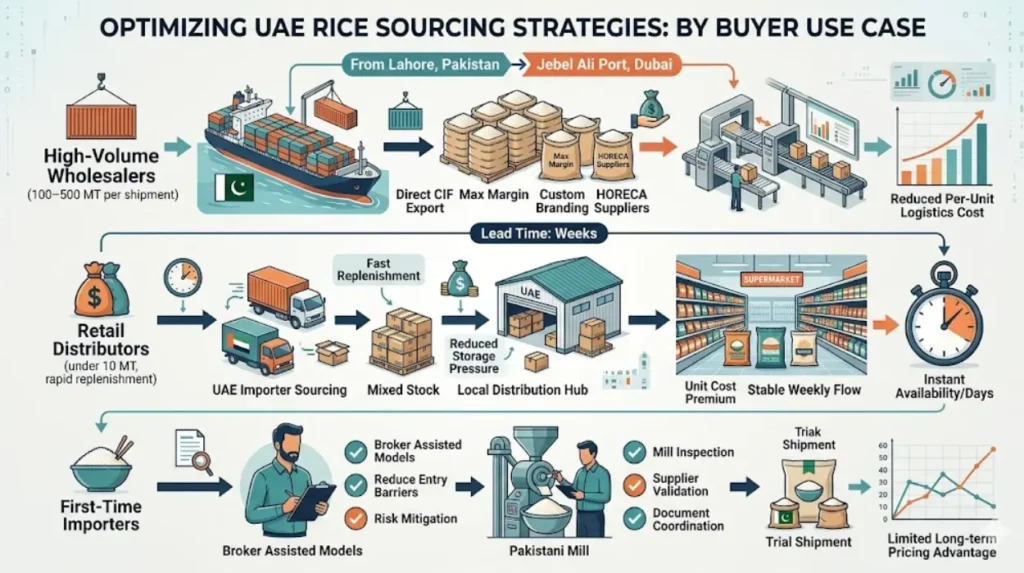
Direct CIF export works best for large UAE wholesalers ordering above 100 MT per shipment, while UAE importer sourcing works best for retail distributors needing fast replenishment under 10 MT. Broker models suit new buyers testing Pakistani basmati supply consistency.
High-volume wholesalers
Wholesalers importing 100–500 MT prefer direct CIF contracts. They control branding, packaging, and resale margins. They also reduce per-unit logistics cost.
This model suits HORECA suppliers serving hotels and catering companies in Dubai and Abu Dhabi.
Retail distributors
Retailers prioritize speed over cost optimization. UAE importers provide instant availability and mixed stock flexibility. This reduces storage pressure but increases unit cost.
Retail channels depend on stable weekly replenishment rather than shipment-level optimization.
First-time importers
New importers use broker-assisted sourcing to reduce risk exposure. Brokers help validate suppliers, inspect mills, and coordinate documentation.
This model reduces entry barriers but limits long-term pricing advantage.
With use cases defined, the next step is understanding the pros and cons of each structure with real operational examples.
What are the pros and cons of each sourcing method for UAE rice imports?
Direct exporter sourcing offers maximum cost efficiency and grade control, while UAE importers provide speed and convenience. Broker sourcing reduces entry complexity but increases dependency on third-party coordination and weakens quality traceability across shipments.
Direct exporter model pros
Cost efficiency reduces landed price per MT significantly. Grade control ensures consistent 1121, 1509, and Super Kernel quality. Packaging customization supports private label branding.
Direct exporter model cons
Longer lead time increases inventory planning requirements. Documentation coordination requires structured buyer participation.
UAE importer model pros
Fast availability supports urgent demand cycles. Local warehousing reduces import complexity.
UAE importer model cons
Higher per MT pricing reduces margin efficiency. Mixed batches reduce grain uniformity.
Broker model pros
Simplified supplier access reduces entry barriers. Negotiation support helps new buyers.
Broker model cons
Limited transparency in grading decisions reduces repeat order reliability. Commission layers increase cost unpredictability.
Each model behaves differently under price volatility and seasonal demand cycles, especially during Ramadan and GCC procurement peaks.
With pros and cons understood, the final step is selecting the correct method using structured decision factors.
What decision factors determine the right bulk basmati rice sourcing method for UAE delivery?
The correct sourcing method depends on order volume, storage capacity, budget flexibility, quality consistency requirements, and logistics capability, with CIF exporter models dominating for large-scale procurement and importer models dominating for rapid replenishment cycles.
Decision framework table
| Factor | Direct Exporter CIF | UAE Importer | Broker Model |
|---|---|---|---|
| Order size suitability | High volume (>100 MT) | Small volume (<10 MT) | Medium volume (10–100 MT) |
| Budget sensitivity | High efficiency | Lower sensitivity | Medium efficiency |
| Quality control need | Strong control | Moderate control | Weak control |
| Delivery urgency | Low urgency | High urgency | Medium urgency |
| Supply chain control | Full control | Limited control | Shared control |
Financial decision factor
Direct exporter contracts reduce cost per MT by up to 15–20% compared to UAE importers. This difference compounds significantly in annual procurement cycles.
Logistics decision factor
CIF Dubai contracts include shipping, insurance, and port clearance. This simplifies customs handling for UAE buyers operating at scale.
Quality decision factor
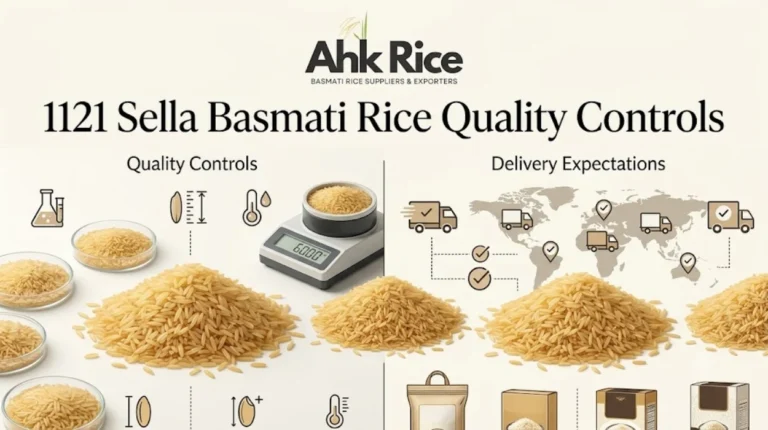
Exporter-controlled grading ensures uniform kernel length and moisture control. This is critical for catering and premium retail segmentation.
With decision factors established, buyers can now align procurement structure with operational strategy.
Conclusion: selecting the correct bulk basmati rice order structure for UAE delivery
A structured bulk basmati rice order from Pakistan to UAE depends on selecting the correct procurement model, aligning CIF logistics, and verifying grading consistency before shipment dispatch.
Direct exporter models provide the strongest long-term cost advantage. UAE importers provide operational speed. Brokers provide entry support for new buyers.
AHK Rice supports export-driven procurement through grading, inspection, and container-level dispatch for consistent UAE delivery performance.
FAQs
What is the process of bulk basmati rice order from Pakistan to UAE?
Bulk basmati rice orders follow a structured export chain starting from milling in Pakistan, followed by grading, inspection, fumigation, and certification. The exporter then loads containers and dispatches them under CIF Dubai terms. UAE buyers receive shipment after customs clearance and port handling. This ensures consistent quality and controlled logistics.
How long does rice CIF Dubai shipment take from Pakistan?
Rice CIF Dubai shipments from Pakistan typically take 18–28 days depending on port congestion, vessel schedule, and documentation clearance. The timeline includes container loading, sea transit, and UAE port discharge. Faster schedules are possible during peak shipping windows with pre-booked vessels and ready stock at the mill.
Which basmati rice grades are most exported to UAE?
The most exported grades to UAE are 1121 Basmati, 1509 Basmati, and Super Kernel Basmati. 1121 is preferred for premium aroma and long grain appearance. 1509 is chosen for cost efficiency and faster cooking. Super Kernel is used in mid-range retail and catering supply chains.
What documents are required for rice import in UAE?
Rice imports into UAE require Phytosanitary Certificate, Certificate of Origin, Commercial Invoice, Packing List, and Bill of Lading. These documents verify product safety, origin, and shipment legitimacy. Exporters in Pakistan prepare and submit these documents before container dispatch to ensure smooth customs clearance.
What is the difference between direct exporter and UAE importer sourcing?
Direct exporter sourcing from Pakistan offers lower cost and full grading control, while UAE importers provide faster availability but higher pricing. Exporters handle CIF shipping and documentation, whereas importers maintain local stock for immediate distribution. Choice depends on cost priority versus delivery speed requirement.