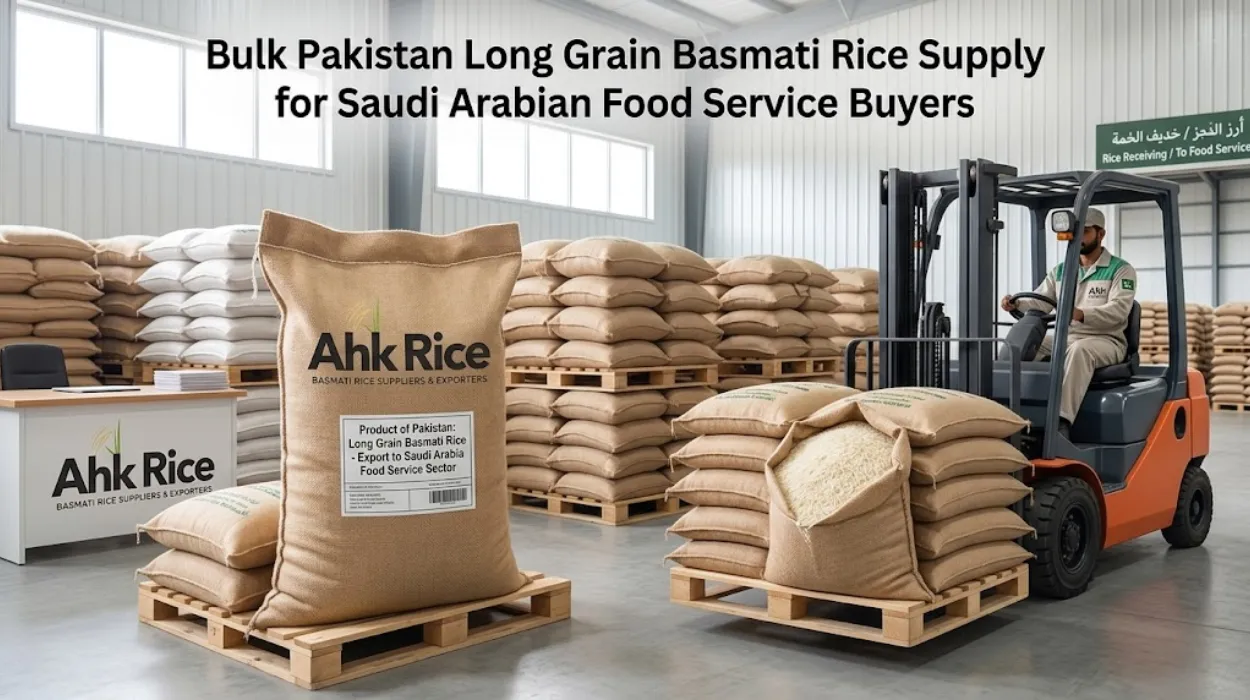
Bulk Pakistan Long Grain Basmati Rice Supply for Saudi Arabian Food Service Buyers
Bulk Pakistan long grain Basmati rice is the preferred procurement solution for Saudi Arabian food service buyers seeking consistent grain length, stable supply, and strong cooking performance. Here is why: Pakistan’s 1121 Basmati varieties deliver exceptional elongation, premium appearance, and reliable export availability, while AHK Rice provides quality-controlled processing, export documentation, and direct bulk supply tailored for Saudi catering, hospitality, and wholesale food service operations.
Saudi buyers evaluating rice procurement often begin by understanding why grain specifications directly affect food service performance. Buyers can learn more through our guide on why grain length influences commercial rice purchasing decisions in Saudi food service operations.
What Is the Best Solution for Saudi Arabian Food Service Buyers Seeking Bulk Pakistan Long Grain Basmati Rice?
1121 Basmati rice with grain lengths above 8.30 mm, consistent cooking elongation, export-grade processing, and direct manufacturer supply provides the strongest procurement solution for Saudi food service contracts.
Saudi food service companies require rice that performs consistently across thousands of daily meals. Grain appearance affects customer perception. Cooking yield affects profitability. Supply stability affects operational planning.
Pakistan 1121 Basmati rice satisfies these requirements because processors cultivate, harvest, mill, grade, and export rice specifically for premium international markets. Saudi Arabian distributors, caterers, restaurants, and institutional food providers continue increasing imports of Pakistani Basmati because of strong consumer acceptance and reliable quality standards (source: Pakistan Bureau of Statistics, FY2024-25).
AHK Rice supplies bulk long grain Basmati rice directly from Pakistan processing facilities. This model reduces intermediary costs and improves specification control.
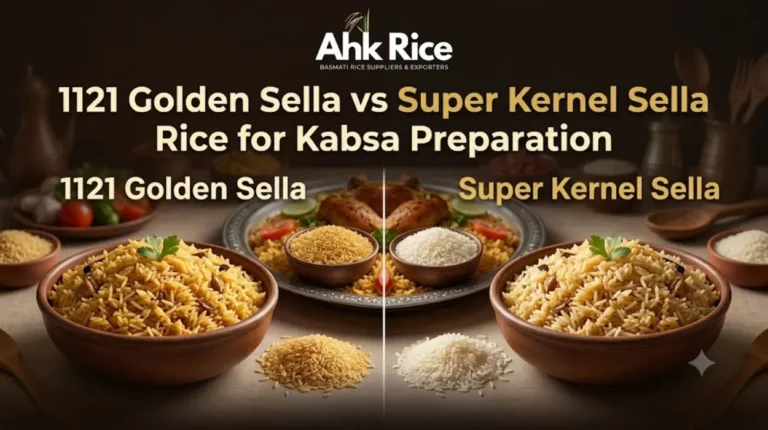
Saudi buyers comparing processing grades before finalizing procurement decisions should review our detailed analysis of how 1121 Golden Sella and Creamy Sella perform under commercial catering conditions, including grain retention, cooking stability, and contract suitability.
1121 Golden Sella Basmati Rice
1121 Golden Sella Basmati rice undergoes controlled parboiling before milling. This process improves grain strength and reduces breakage during transport and large-scale cooking.
Saudi catering operations prefer Golden Sella because the grain maintains shape after cooking. In large buffet environments, Golden Sella preserves appearance during extended serving periods.
1121 Creamy Sella Basmati Rice
1121 Creamy Sella Basmati rice follows a modified parboiling process that creates a lighter appearance while maintaining elongation characteristics.
Saudi hospitality businesses often select Creamy Sella for premium presentation. Buyers comparing retention performance can review our detailed comparison of grain stability across commercial catering contracts in Saudi Arabia.
Export Processing Steps at AHK Rice
When AHK Rice processes export-grade Basmati rice, the facility performs nine key steps:
- Clean the paddy.
- De-husk the grain.
- Dry the rice.
- Polish the kernels.
- Grade by size.
- Sort by length.
- Inspect for defects.
- Test quality parameters.
- Load export packaging.
These steps support consistency across repeated shipments.
Specification Table for Saudi Food Service Buyers
| Specification | 1121 Golden Sella | 1121 Creamy Sella |
|---|---|---|
| Raw Grain Length | 8.30–8.50 mm | 8.30–8.50 mm |
| Cooked Length | 17–22 mm | 17–22 mm |
| Moisture | 12–13% | 12–13% |
| Broken Grain | 2–5% | |
| Crop Origin | Pakistan Punjab | Pakistan Punjab |
| Shelf Life | 18–24 months | 18–24 months |
| Packaging | 5kg–50kg | 5kg–50kg |
AHK Rice verifies every shipment before dispatch to Saudi Arabian buyers.
With the procurement solution established, the next question concerns the commercial results buyers can expect after implementation.
What Results Can Saudi Arabian Food Service Buyers Expect?
Higher cooking yield, stronger plate presentation, reduced breakage, consistent supply, and improved customer satisfaction are the primary commercial outcomes.
Food service operators evaluate rice through operational performance rather than marketing claims. Cooking yield directly affects food cost calculations.
Pakistan 1121 Basmati rice expands significantly during cooking. This characteristic allows catering companies to serve more portions from the same purchased volume.
Improved Visual Presentation
Long grain appearance influences customer perception. Saudi consumers associate extra-long grains with premium quality.
1121 Golden Sella creates long, separate grains after cooking. Restaurant operators use this characteristic for Kabsa, Mandi, Bukhari rice, and banquet service.
1121 Creamy Sella delivers similar elongation with a lighter appearance. Premium hospitality venues often prefer this specification.
Reduced Operational Waste
Grain strength affects storage and preparation efficiency. Stronger kernels reduce losses during handling.
Golden Sella withstands transport better than many standard long grain alternatives. In long-distance shipping environments, Golden Sella maintains grain integrity more effectively. For Saudi warehouses receiving containerized imports, stronger grain structure reduces breakage risk during unloading and storage.
Creamy Sella also provides enhanced durability. For hotel kitchens managing daily high-volume cooking, Creamy Sella supports consistent batch preparation and presentation.
Reliable Contract Fulfillment
Food service contracts depend on uninterrupted supply.
AHK Rice maintains export-focused processing systems that support repeat procurement schedules. Buyers avoid sourcing inconsistencies that frequently occur through multiple intermediaries.
Pakistan exported substantial rice volumes to Gulf markets during 2025 and 2026, reinforcing the country’s position as a key supplier to the region (source: REAP export data, December 2025).
Quality Verification
AHK Rice tests every export lot before shipment.
Key verification parameters include:
- Grain length testing
- Moisture testing
- Purity verification
- Broken grain analysis
- Foreign matter inspection
- Packaging inspection
- Container loading verification
These controls support predictable product performance.
With operational outcomes understood, buyers should evaluate the factors that influence procurement costs.

What Factors Affect Pricing for Bulk Pakistan Long Grain Basmati Rice?
Rice grade, grain specification, packaging type, shipment volume, destination port, crop conditions, and freight rates determine final pricing.
Saudi buyers frequently focus only on per-ton pricing. Total landed cost provides a more accurate purchasing metric.
Rice Grade Selection
Premium grades command higher prices because they achieve superior grain length and cooking performance.
1121 Golden Sella generally trades at a premium over standard long grain varieties. Premium hospitality contracts often justify the higher procurement cost through improved customer perception.
1121 Creamy Sella pricing varies according to processing demand and seasonal availability.
Packaging Requirements
Packaging specifications influence total procurement costs.
Common export options include:
- 5 kg retail bags
- 10 kg retail bags
- 20 kg woven bags
- 25 kg woven bags
- 35 kg PP bags
- 40 kg PP bags
- 50 kg PP bags
Custom branding increases packaging expenses because new artwork, printing, and production setup are required.
AHK Rice offers both standard export packaging and private-label packaging solutions.
Shipment Volume
Larger orders improve freight efficiency.
Full container loads generally provide lower per-ton logistics costs than partial shipments. Saudi wholesalers commonly procure through 20-foot and 40-foot container programs.
Freight and Destination Port
Ocean freight changes throughout the year.
Saudi destinations commonly include:
- Jeddah Islamic Port
- King Abdulaziz Port Dammam
- King Abdullah Port
- Jizan Port
Freight fluctuations influence total landed costs even when rice pricing remains stable.
Typical Shipping Times from Pakistan to Saudi Arabia
| Destination | Estimated Transit Time |
|---|---|
| Jeddah | 10–15 days |
| Dammam | 12–18 days |
| King Abdullah Port | 10–16 days |
| Jizan | 14–20 days |
Transit schedules vary according to vessel routing and customs processing.
Sample Process and Costs
Saudi buyers frequently request samples before placing commercial orders.
AHK Rice follows a structured sample process:
- Submit specification requirements.
- Confirm target grade.
- Prepare sample package.
- Test quality parameters.
- Dispatch sample shipment.
- Review buyer feedback.
- Finalize commercial quotation.
Typical sample costs include:
| Item | Typical Cost Range |
|---|---|
| Product Sample | Free to nominal charge |
| Courier Charges | USD 40–120 |
| Laboratory Testing | Optional |
| Custom Packaging Sample | Project dependent |
Sample approval reduces procurement risk before container commitments.
With pricing considerations clarified, the final decision factor becomes implementation.
How Can Saudi Arabian Food Service Buyers Get Started?
Define specifications, approve samples, verify documentation, confirm shipment terms, and secure long-term supply planning.
Successful rice procurement begins with specification clarity.
Saudi buyers should define:
- Required rice grade
- Target grain length
- Packaging format
- Annual volume
- Delivery schedule
- Destination port
- Label requirements
Clear specifications accelerate quotation accuracy.
Export Documents Provided
AHK Rice supplies export documentation required for international trade.
Required export documents commonly include:
- Commercial Invoice
- Packing List
- Certificate of Origin
- Phytosanitary Certificate
- Fumigation Certificate
- Bill of Lading
- Quality Certificate
- Health Certificate where applicable
Accurate documentation supports smooth customs clearance.
Why Buyers Choose AHK Rice
AHK Rice focuses on commercial export requirements rather than spot-market trading.
Key advantages include:
- Long grain Basmati specialization
- Export-grade quality control
- Flexible packaging formats
- Direct factory sourcing
- Documentation support
- Container load capability
- Saudi market experience
AHK Rice also supports repeat procurement programs for distributors, food service operators, wholesalers, and hospitality groups requiring consistent monthly supply schedules.
Decision Framework for Saudi Buyers
Procurement teams should evaluate four factors before supplier selection:
- Verify grain specifications.
- Approve physical samples.
- Review export documentation.
- Confirm supply continuity.
This framework reduces sourcing risk and improves purchasing confidence.
Saudi Arabian food service buyers seeking dependable long grain Basmati rice supply, verified quality standards, structured sampling, and reliable export logistics can contact AHK Rice today and submit requirements through /request-a-quote/.
Frequently Asked Questions
How much Pakistan long grain Basmati rice fits into one export container for Saudi Arabia?
A standard 20-foot container typically loads around 24–26 metric tons of Basmati rice, depending on packaging specifications. A 40-foot container can accommodate higher volumes based on weight and shipping regulations. AHK Rice helps buyers determine the most efficient container configuration for their order size.
Which Basmati rice grade is most suitable for Saudi Arabian catering companies?
1121 Golden Sella is the most common choice for large catering operations because it offers excellent grain elongation, strong cooking performance, and durability during buffet service. Many hospitality businesses also choose 1121 Creamy Sella for its lighter appearance and premium presentation.
How long does it take to ship Basmati rice from Pakistan to Saudi Arabia?
Shipping times vary by destination port. Jeddah usually takes 10–15 days, while Dammam generally requires 12–18 days. Transit times may change due to vessel schedules, customs procedures, and seasonal logistics conditions.
Can Saudi buyers receive samples before placing a bulk order?
Yes. AHK Rice provides samples so buyers can evaluate grain length, cooking quality, aroma, and appearance before confirming a commercial shipment. Buyers typically cover courier charges, while sample product costs are often minimal or waived depending on the project.
What certifications and export documents are provided with bulk rice shipments?
Export shipments commonly include a Commercial Invoice, Packing List, Certificate of Origin, Phytosanitary Certificate, Fumigation Certificate, Bill of Lading, and Quality Certificate. Additional documentation can be arranged based on Saudi import requirements and buyer specifications.