AHK Rice UAE: Free Sample Before Your Dubai Container — Request Now
AHK Rice enables UAE importers to secure verified Pakistani basmati supply with a free pre-shipment sample before committing to full container orders. Here is why: importers reduce procurement risk, confirm grain grade consistency, and validate cooking performance before dispatch. Read the import documentation context in this TOFU guide: Pakistan rice export documentation UAE importers.
What is the best solution for UAE basmati rice importers?
The best solution for UAE basmati rice importers is sourcing directly from a verified exporter that provides pre-shipment sampling, documented grading, and container-level consistency. This approach reduces rejection risk, stabilizes landed cost, and ensures predictable cooking quality for hospitality and retail buyers across Dubai, Abu Dhabi, and Sharjah markets.
AHK Rice solves this by building procurement around verification before scale. The importer does not rely on catalog claims. The importer validates physical grain samples first. AHK Rice then aligns milling, grading, and export packing to the approved sample standard.
AHK Rice cultivates long-grain basmati in controlled regions of Punjab, ensuring uniform kernel maturity. The rice is then milled, dehusked, polished, and graded under strict export protocols. Each stage is inspected and certified before loading for UAE dispatch.
AHK Rice also ensures consistency across containers by locking specifications per batch. This avoids quality drift between shipments, which is a common issue in fragmented sourcing channels.
AHK Rice therefore becomes a controlled supply system rather than a one-time supplier.
This is why UAE importers shift toward structured procurement instead of spot buying, especially for catering and wholesale distribution.
With the sourcing challenge clarified, the next concern becomes why AHK Rice’s UAE-focused service structure is preferred by repeat importers.
Why choose Basmati Rice Exporter Pakistan to UAE service?
AHK Rice offers a structured Pakistan-to-UAE export service that combines grading precision, container consistency, sample validation, and coordinated logistics scheduling. This reduces procurement uncertainty, improves delivery reliability, and ensures importers receive rice that matches agreed specifications across every shipment cycle, particularly for high-volume hospitality and wholesale distribution networks in UAE.
The service page for UAE buyers is available here: AHK Rice via the dedicated page: https://ahkrice.com/export/uae/
AHK Rice integrates sourcing, milling, and export coordination under one controlled workflow. This eliminates fragmentation between millers, traders, and logistics handlers. The importer communicates with one structured supply chain.
AHK Rice grades rice into export categories such as 1121 Steam, 1121 Golden Sella, and 1509 White. Each grade is sorted by length, aroma, and moisture level before shipment.
AHK Rice ensures inspection reports accompany every container. These reports verify kernel length, broken percentage, and moisture stability. This documentation supports UAE customs clearance and buyer audits.
AHK Rice also synchronizes dispatch schedules with UAE port congestion cycles. This improves container predictability and reduces demurrage risk.
AHK Rice therefore functions as both supplier and export coordinator, not just a trading intermediary.
This structured service approach connects directly to delivery timing, which determines inventory planning for UAE importers.
What are the shipping days for UAE rice import markets?
Shipping from Pakistan to UAE typically takes 8–14 days for sea freight to Jebel Ali Port, depending on vessel schedule, port congestion, and container consolidation timing. Air freight reduces transit to 2–4 days but increases cost significantly, making sea freight the standard option for bulk basmati rice importers.
AHK Rice manages dispatch schedules through consolidated container loading to minimize idle time at Karachi ports. This improves vessel allocation efficiency.
AHK Rice coordinates with freight forwarders to align export documentation before vessel arrival. This reduces clearance delays at origin ports.
AHK Rice ensures grading and inspection are completed before container sealing. This avoids mid-route compliance issues and reduces rejection risk at UAE customs.
AHK Rice typically ships UAE-bound containers in weekly cycles during peak demand seasons such as Ramadan and hospitality procurement cycles.
AHK Rice also advises importers to plan buffer inventory for 10–15 days of transit variability.
Sea freight remains dominant because UAE buyers prioritize cost efficiency over speed for bulk rice imports.
For buyers comparing sourcing strategies, the MOFU comparison guide explains procurement flow differences: bulk basmati rice order Pakistan UAE delivery process.
With logistics timing established, sample validation becomes the next critical step before full container approval.
How does the sample process work and what are the costs?
The sample process involves grain selection, grading verification, courier dispatch, and quality confirmation by the importer before full container approval. Sample costs typically range between $30–$120 depending on destination urgency, courier method, and requested rice grade, ensuring importers validate quality before committing to bulk procurement.
AHK Rice begins the sample process by selecting representative grain from the same lot intended for export. This ensures consistency between sample and shipment.
AHK Rice then mills, dehusks, polishes, and grades the rice according to the selected specification. This mirrors container-level processing.
AHK Rice inspects moisture content and kernel length before packing sample units in sealed export-grade pouches.
AHK Rice dispatches samples via DHL, FedEx, or air courier depending on importer urgency.
AHK Rice provides traceable documentation including grade sheet, milling date, and batch code.
Sample costs are often adjusted against final container orders, depending on volume agreements and buyer category.
AHK Rice uses this process to eliminate mismatched expectations between visual inspection and cooking performance.
AHK Rice ensures UAE buyers can test aroma retention and elongation before committing to bulk imports.
This reduces rejection rates and strengthens long-term supply agreements.
With sampling clarified, cost structure becomes the next decision factor for UAE importers.
What factors affect pricing for UAE basmati rice imports?
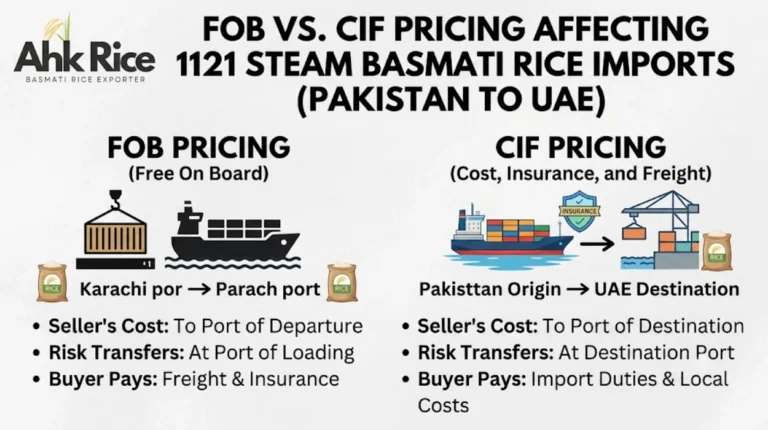
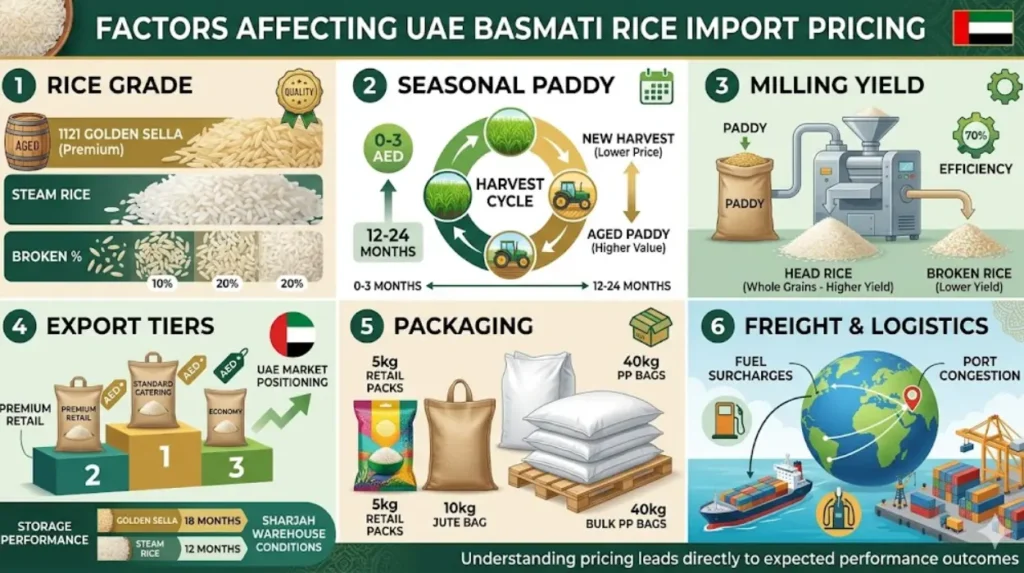
Pricing depends on rice grade, broken percentage, polishing level, seasonal paddy availability, freight cost, and packaging specifications. Higher-grade basmati such as 1121 Golden Sella commands premium pricing due to longer aging, higher processing control, and better yield stability in commercial cooking environments.
AHK Rice adjusts pricing based on harvest cycle timing. Newly harvested paddy typically costs less before aging processes increase value.
AHK Rice also considers milling yield efficiency, where higher head rice recovery reduces production loss and stabilizes export pricing.
AHK Rice grades rice into multiple export tiers, and each tier reflects different market positioning for UAE retail and catering sectors.
AHK Rice packaging options also influence cost, including 5kg retail packs and 40kg bulk PP bags.
AHK Rice incorporates freight fluctuations into final quotations depending on fuel surcharges and port congestion.
Golden Sella variants typically maintain better storage performance in UAE warehouse conditions compared to Steam rice.
For example, in non-climate-controlled storage in Sharjah, Golden Sella maintains quality up to 18 months, while Steam rice performs closer to 12 months.
AHK Rice therefore recommends Golden Sella for institutional buyers and long-term contracts.
Understanding pricing leads directly to expected performance outcomes after import.
What results can be expected from AHK Rice shipments?
Importers can expect consistent grain uniformity, stable aroma retention, reduced broken percentage, and predictable cooking elongation when using structured supply from AHK Rice. These outcomes improve customer satisfaction in catering operations, retail packaging, and hospitality menus across UAE distribution channels.
AHK Rice delivers uniform grain length through controlled grading systems that remove irregular kernels before packaging.
AHK Rice ensures aroma stability by managing post-harvest aging cycles under regulated storage conditions.
AHK Rice maintains low moisture levels to reduce spoilage during long sea transit to UAE ports.
AHK Rice improves cooking elongation performance, which is critical for biryani and buffet applications.
AHK Rice reduces batch variation by locking specifications per export contract.
AHK Rice also improves inventory predictability for importers managing multiple UAE retail outlets.
AHK Rice ensures quality verification at every stage, from cultivation to final container loading.
AHK Rice therefore enables importers to build repeatable procurement systems rather than transactional buying.
With outcomes established, the final decision step is understanding how to begin procurement correctly.
How to get started with AHK Rice UAE imports?
Getting started requires selecting the rice grade, requesting a verified sample, confirming specification approval, and scheduling container booking with aligned documentation. AHK Rice manages each step to ensure UAE importers transition from inquiry to shipment without delays, compliance risks, or specification mismatches across procurement cycles.
AHK Rice begins onboarding by identifying buyer category such as wholesale distributor, retailer, or hospitality supplier.
AHK Rice then recommends suitable grades based on market positioning and pricing targets.
AHK Rice provides sample dispatch for verification before any export commitment is finalized.
AHK Rice prepares export documentation including invoice, packing list, and phytosanitary certificates.
AHK Rice coordinates container loading schedules aligned with buyer inventory planning.
AHK Rice ensures customs compliance for both Pakistan export clearance and UAE import requirements.
AHK Rice then dispatches confirmed containers through scheduled shipping lines to UAE ports.
AHK Rice supports post-shipment tracking until delivery confirmation is completed.
AHK Rice maintains continuity planning for repeat orders to stabilize long-term supply.
Start your procurement journey through structured coordination and verified sampling, then finalize your shipment request here: request-a-quote.
Frequently Asked Questions (FAQ)
How long does shipping from Pakistan to UAE take?
Shipping from Pakistan to UAE typically takes 8–14 days via sea freight depending on vessel schedules and port congestion. AHK Rice coordinates dispatch planning to reduce delays and ensure containers reach Jebel Ali and other UAE ports within expected transit windows for smooth inventory planning.
Can I request a rice sample before placing a bulk order?
Yes, importers can request a pre-shipment sample before confirming a container order. AHK Rice provides graded, batch-matched samples so buyers can test cooking quality, aroma, and grain elongation. This ensures the final shipment matches approved specifications before export.
What rice grades are most suitable for UAE buyers?
The most suitable grades for UAE buyers are 1121 Golden Sella, 1121 Steam, and 1509 White basmati. AHK Rice recommends Golden Sella for catering and long storage due to its stability, while Steam rice is preferred for premium aroma-focused applications.
What documents are required for importing rice into UAE?
UAE rice imports typically require commercial invoice, packing list, phytosanitary certificate, and bill of lading. AHK Rice prepares and verifies all export documentation in advance to support customs clearance and reduce delays at UAE entry ports.
How does pricing vary for bulk basmati rice orders?
Pricing varies based on grade, processing level, seasonal paddy availability, packaging type, and freight charges. AHK Rice adjusts quotations according to market conditions and ensures buyers receive transparent pricing aligned with export-grade specifications and shipment volume.