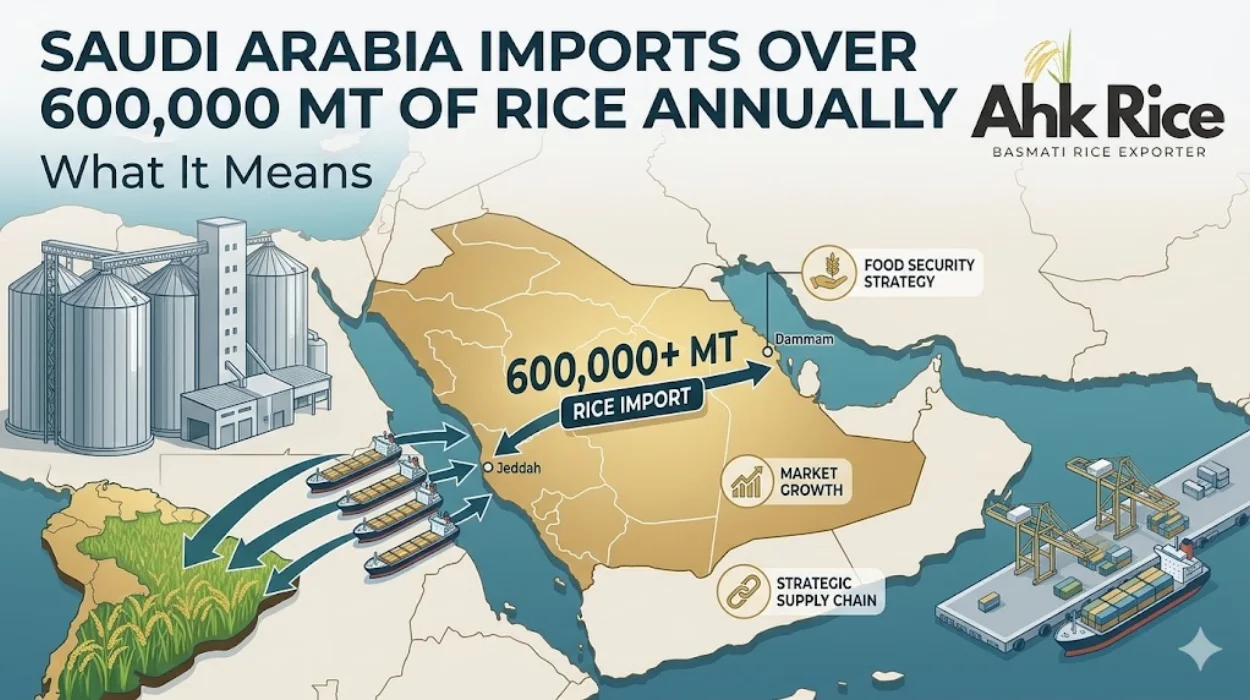
Saudi Arabia Imports Over 600,000 MT of Rice Annually: What It Means
Saudi Arabia imports more than 600,000 metric tons of rice every year because domestic rice cultivation remains limited by water scarcity, climate conditions, and food security priorities. Here is why: Saudi consumers eat rice daily, the hospitality sector consumes large volumes, and Gulf importers depend on stable supply chains from Pakistan and India (source: USDA Grain Reports 2025).
Saudi Arabia ranks among the largest rice importing countries in the Gulf region. The market depends heavily on Basmati rice because consumers prefer long grain aroma, elongation after cooking, and soft texture. Pakistani exporters, Indian millers, Saudi distributors, and food service buyers all operate within this high-volume supply network.
Saudi rice demand also affects freight pricing, processing specifications, export certifications, and packaging formats across South Asia. Pakistani rice exporters closely monitor Saudi buying patterns because Saudi Arabia consistently imports premium grades such as 1121 Basmati, Super Kernel Basmati, and 1509 Steam rice.
Understanding what this import volume means requires examining consumption patterns, import systems, processing standards, and regional demand shifts. With Saudi Arabia’s rice dependency established, the next question is what this import volume actually represents in economic and supply chain terms.
What Does Saudi Arabia Importing Over 600,000 MT of Rice Annually Mean?
Saudi Arabia imports more than 600,000 MT annually because rice functions as a daily staple food across households, restaurants, hotels, catering chains, and pilgrimage-related food distribution systems.
Saudi Arabia imports rice instead of cultivating it domestically because arid climate conditions limit water-intensive farming. Rice cultivation requires continuous irrigation. Saudi agriculture prioritizes crops with lower water consumption. This dependence creates one of the Gulf region’s largest food import markets.
Saudi rice import volume reflects both population demand and institutional consumption. Riyadh, Jeddah, Dammam, and Makkah consume large rice quantities through restaurants, labor camps, catering services, and hotel chains. Pilgrimage seasons also increase rice procurement because millions of visitors require centralized meal distribution.
Saudi Arabia imports several rice categories. These include:
- Basmati rice from Pakistan and India
- Non-Basmati long grain rice from Thailand
- Broken rice for industrial use
- Steam rice for catering
- Golden Sella rice for bulk kitchens
Saudi consumers strongly prefer aromatic long grain varieties. Pakistani Basmati remains important because the grain elongates significantly after cooking. Indian Basmati also holds strong market share because of broad retail distribution networks.
Saudi basmati 2026 projections indicate higher demand for premium aged rice grades because middle-income households increasingly prefer branded retail packaging over loose wholesale distribution (source: Gulf Food Trade Review 2025).
Saudi Arabia’s rice imports also influence global pricing. When Saudi buyers increase procurement volumes, freight rates, container demand, and milling schedules across Pakistan and India shift immediately.
With the meaning of Saudi Arabia’s rice import dependency established, the next question is how this import system actually works operationally.
How Does Saudi Arabia’s Rice Import System Work?
Saudi Arabia’s rice import system operates through international procurement contracts, port clearance systems, quality inspections, distributor networks, and retail or food service supply chains.
Rice exporters first cultivate and harvest paddy in producing countries such as Pakistan and India. Millers then process the grain according to Saudi buyer specifications. Importers in Saudi Arabia purchase rice through direct contracts, commodity traders, or regional distribution agreements.
The export process follows several structured stages.
How Do Exporters Prepare Rice for Saudi Buyers?
Exporters prepare rice through cleaning, grading, testing, certification, packaging, and container loading according to Gulf import standards.
Rice millers follow precise processing sequences because Saudi importers require uniform grain appearance and moisture consistency.
Processing stages include:
- Clean the harvested paddy
- De-husk the grain
- Polish the rice surface
- Grade by grain length
- Sort damaged kernels
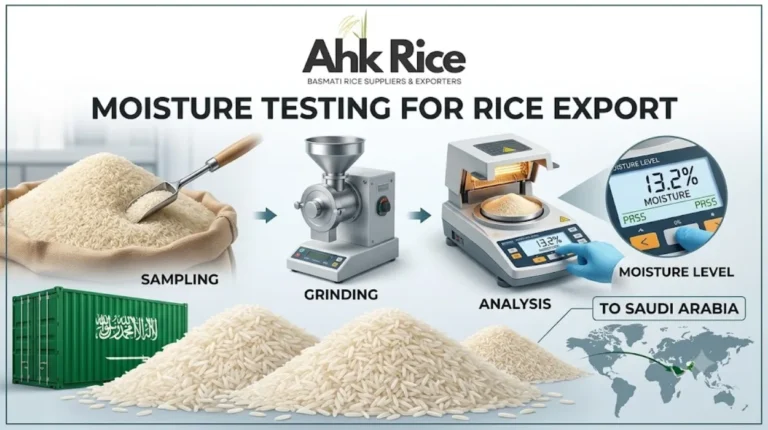
- Test moisture levels
- Inspect purity standards
- Pack according to buyer requirements
- Load containers for shipment
Saudi buyers commonly request moisture levels between 12% and 14% because excessive moisture damages shelf life during Gulf storage conditions.
Saudi importers also request different packaging formats depending on market segments. Retail distributors prefer 1 kg, 5 kg, and 10 kg branded bags. Catering buyers prefer 25 kg and 40 kg PP bags for restaurant operations.
How Does Rice Reach Saudi Arabia?
Rice shipments move through sea freight routes connecting Karachi Port and Port Qasim with Jeddah Islamic Port and Dammam Port.
Exporters dispatch containers after customs clearance and phytosanitary certification. Saudi authorities inspect shipments upon arrival. Importers then distribute rice through wholesalers, supermarket chains, and food service suppliers.
Saudi logistics systems prioritize rapid clearance because rice demand remains constant throughout the year. Delays increase warehouse costs and affect retail supply continuity.
The Saudi import process explains why exporters maintain strict processing standards. The next question is which rice varieties dominate Saudi demand.
Which Rice Varieties Dominate Saudi Arabia’s Import Market?
1121 Basmati, Super Kernel Basmati, and 1509 Basmati dominate Saudi imports because consumers prefer extra-long grain aroma and strong cooking elongation.
Saudi households associate Basmati rice with premium food quality. Long grain structure and fragrance directly influence purchasing decisions. Pakistani and Indian exporters both supply these varieties, but buyer preferences differ by region and price segment.
Why Does 1121 Basmati Lead Saudi Demand?
1121 Basmati leads Saudi demand because the grain reaches more than 8.3 mm in length and expands significantly after cooking.
1121 Basmati performs strongly in Kabsa, Mandi, and large-scale catering dishes. The rice absorbs spices effectively while maintaining separate grain structure.
Saudi restaurants prefer 1121 Golden Sella because parboiling strengthens the grain. Bulk kitchens benefit from reduced breakage during cooking. Steam rice also remains popular because it cooks faster and provides softer texture.
Golden Sella lasts longer than Steam rice. In Gulf warehouse environments reaching 40°C, Golden Sella maintains quality for up to 18 months. Steam rice performs best within 12 months storage periods. Saudi catering companies storing rice in non-climate-controlled facilities prefer Golden Sella specifications.
Why Does Super Kernel Basmati Remain Important?
Super Kernel Basmati remains important because Saudi consumers recognize it as a traditional aromatic rice variety from Punjab.
Super Kernel offers softer texture and stronger fragrance than many modern hybrid varieties. Retail buyers often purchase it for household cooking instead of commercial catering.
Punjab remains the core cultivation region for premium Pakistani Basmati. The region’s canal irrigation system and fertile soil support long grain development. Pakistani exporters mill, grade, and age the rice before export dispatch.
Why Is 1509 Basmati Growing Rapidly?
1509 Basmati grows rapidly because it offers shorter cultivation cycles and lower market pricing compared to 1121 varieties.
Saudi importers purchase 1509 Steam rice for mid-range retail and institutional food service programs. Buyers reduce procurement costs while maintaining long grain appearance.
Rice variety demand explains Saudi purchasing behavior. The next question is why Saudi Arabia depends so heavily on imported rice instead of domestic production.
Why Does Saudi Arabia Depend on Imported Rice?
Saudi Arabia depends on imported rice because rice cultivation requires extensive irrigation water and stable freshwater systems unavailable at commercial scale inside the Kingdom.
Rice farming consumes large water volumes during cultivation. Saudi Arabia’s desert climate creates agricultural limitations. Groundwater conservation policies also reduced water-intensive crop production over the last two decades.
Saudi Arabia instead focuses on strategic food imports. The country secures supply chains through international procurement agreements and diversified sourcing regions.
How Does Population Growth Affect KSA Rice Demand?
Population growth increases KSA rice demand because urban households, restaurants, and hospitality sectors consume rice daily.
Saudi Arabia’s urban population continues expanding. Riyadh and Jeddah alone support millions of residents. Migrant labor populations also contribute to rice consumption because South Asian and Middle Eastern cuisines rely heavily on rice-based meals.
Food service expansion also raises rice imports. Examples include:
- Hotel buffet operations
- Airline catering kitchens
- Industrial labor camps
- Fast casual restaurant chains
- Pilgrimage food programs
Hajj and Umrah seasons create additional rice demand spikes. Large-scale food preparation requires stable rice inventory before pilgrimage periods begin.
Why Does Saudi Arabia Prefer Basmati Over Other Rice Types?
Saudi Arabia prefers Basmati because long grain aroma and post-cooking elongation match Gulf cuisine requirements.
Saudi dishes such as Kabsa require separate grains after cooking. Thai rice and medium grain varieties produce different texture profiles. Basmati also absorbs spices and meat stock effectively.
Pakistani Basmati and Indian Basmati compete directly in Saudi retail markets.Price fluctuations, freight costs, crop yields, and currency exchange rates influence market share annually.
Saudi dependence on imported rice creates opportunities and challenges simultaneously. The next question is what misconceptions surround Saudi rice imports.
What Misconceptions Exist About Saudi Rice Imports?
The largest misconception is that Saudi Arabia imports only low-cost rice, while the actual market strongly favors premium Basmati specifications.
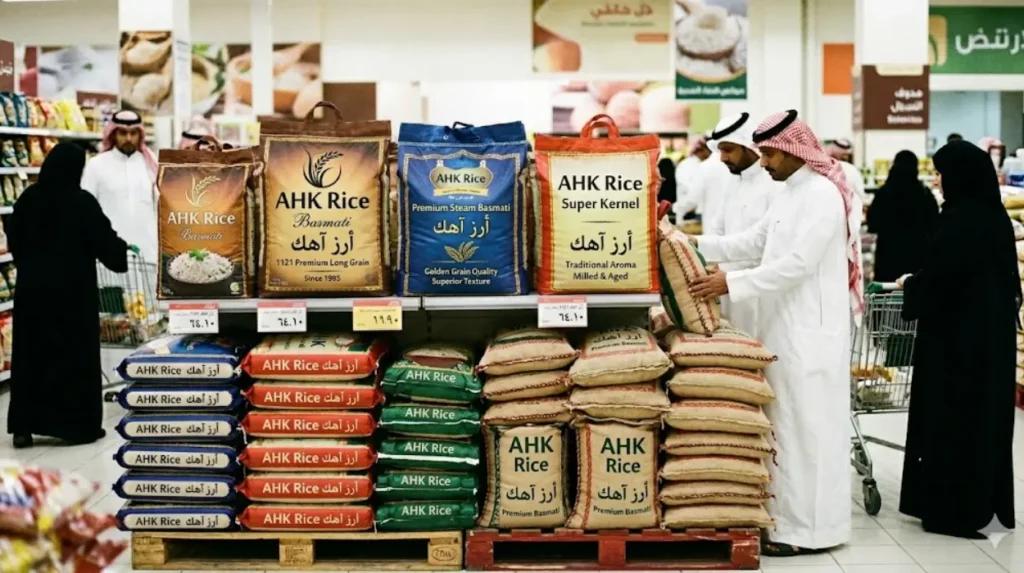
Saudi consumers pay premium prices for quality rice. Retail buyers prioritize aroma, grain length, aging, and cooking performance. Premium imported rice occupies large supermarket shelf space across the Kingdom.
Is Saudi Arabia Dependent on Only One Exporting Country?
Saudi Arabia sources rice from multiple countries because diversified procurement reduces supply chain risks.
Pakistan and India dominate Basmati supply. Thailand supplies non-Basmati long grain rice. Vietnam and the United States also contribute limited specialty volumes.
Import diversification protects Saudi buyers from crop failures and export restrictions. India’s temporary rice export controls during recent years increased Pakistani export opportunities across Gulf markets (source: FAO Rice Market Monitor 2025).
Does Higher Rice Volume Mean Lower Quality?
Large import volumes do not reduce quality because Saudi importers apply strict inspection and certification requirements.
Saudi importers inspect:
- Grain length consistency
- Broken percentage
- Moisture content
- Chalkiness levels
- Foreign matter presence
- Packaging integrity
Exporters also provide phytosanitary certificates and quality inspection reports before shipment dispatch.
Is All Basmati Rice Identical?
Basmati rice differs significantly by origin, processing method, grain length, and aging period.
Pakistani 1121 Steam differs from Indian 1121 Golden Sella in texture and cooking behavior. Aged rice differs from fresh crop rice in aroma intensity. Steam rice differs from parboiled rice in firmness and shelf stability.
These distinctions explain why Saudi buyers specify exact grades within procurement contracts.
With misconceptions clarified, the next question is how Saudi basmati demand affects future trade patterns.
What Does Saudi Basmati Demand Mean for 2026 Trade Trends?
Saudi basmati 2026 demand points toward higher imports of branded premium rice, stronger traceability requirements, and increased focus on consistent grain specifications.
Saudi consumers increasingly purchase packaged branded rice instead of loose commodity sacks. Retail chains prioritize visual presentation, batch consistency, and certification transparency.
Saudi importers also demand clearer product traceability. Exporters increasingly provide:
- Origin verification
- Milling batch records
- Quality inspection certificates
- Moisture analysis reports
- Food safety compliance documentation
Digital procurement systems also affect trade patterns. Importers compare prices, freight schedules, and crop forecasts more rapidly than previous years.
Saudi buyers continue prioritizing premium Basmati because consumer preference remains stable across generations. Population growth, hospitality expansion, and food service demand all support continued rice import growth.
Pakistan and India therefore remain strategically important suppliers to the Saudi market. Punjab cultivation regions continue driving Gulf rice supply because climatic conditions support long grain aromatic rice production.
Saudi Arabia importing more than 600,000 MT annually ultimately reflects one core reality: rice remains central to Gulf food security, daily consumption, and regional trade systems.
Frequently Asked Questions
Why does Saudi Arabia import so much rice every year?
Saudi Arabia imports large rice volumes because domestic rice farming remains limited by water shortages and desert climate conditions. Rice serves as a daily staple food across households, restaurants, hotels, labor camps, and pilgrimage catering systems throughout the Kingdom.
Which countries supply most rice to Saudi Arabia?
Pakistan and India supply most Basmati rice imports to Saudi Arabia. Thailand also exports non-Basmati rice to the Saudi market. Pakistani 1121 Basmati and Super Kernel Basmati remain highly popular because of aroma, grain length, and cooking performance.
What type of rice is most popular in Saudi Arabia?
Basmati rice remains the most popular rice category in Saudi Arabia. Consumers prefer long grain aromatic rice for traditional dishes such as Kabsa and Mandi. 1121 Golden Sella and Steam Basmati dominate catering and retail demand.
Why is Saudi basmati demand increasing in 2026?
Saudi basmati demand continues increasing because population growth, hospitality expansion, and branded retail sales all raise rice consumption. Saudi consumers also increasingly prefer premium packaged rice with verified quality certifications and consistent grain specifications.
How do exporters prepare rice for Saudi buyers?
Exporters prepare rice by cleaning, de-husking, polishing, grading, sorting, testing, and packaging the grain according to Saudi import standards. Buyers also require phytosanitary certificates, moisture testing reports, and quality inspection documents before shipment dispatch.