How Indonesian Wholesalers Buy Bulk Rice from Pakistan in 2026
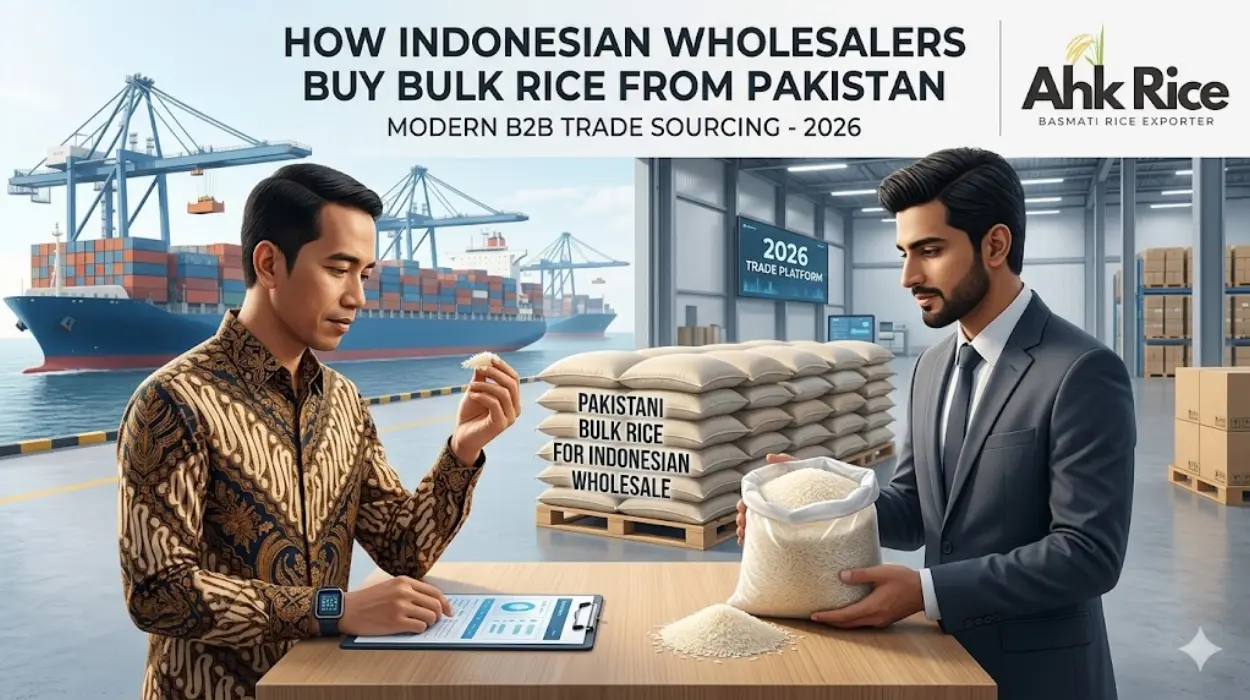
Indonesian wholesalers buy bulk rice from Pakistan through direct exporters because this method delivers better pricing, consistent specifications, and reliable shipment planning. Here is why: Pakistan remains one of the world’s largest rice exporters, while Indonesian importers increasingly seek stable supply chains, customizable packaging, and certified processing standards to meet growing retail and foodservice demand.
Indonesia’s rice market includes wholesalers, distributors, supermarket chains, food processors, and hospitality buyers. These buyers evaluate rice suppliers based on grain specifications, quality consistency, export documentation, shipment reliability, and landed cost per metric ton. Buyers exploring sourcing opportunities often begin by understanding broader trade dynamics through this analysis of Pakistan–Indonesia agricultural commerce and rice market development.
AHK Rice is a trusted Pakistani Basmati rice exporter based in Punjab, supplying 1121, Super Kernel, and 1509 varieties to more than 15 countries. The company manages cultivation partnerships, milling, grading, packaging, quality inspection, documentation, and export logistics through an integrated process.
What solutions are available for Indonesian wholesalers buying rice from Pakistan?
Direct exporter sourcing, trading company procurement, agent-based purchasing, contract supply agreements, and tender participation represent the primary sourcing solutions available to Indonesian rice wholesalers in 2026.
Rice sourcing solutions differ in pricing structure, supply control, communication efficiency, and risk management. Understanding each method helps wholesalers select the most suitable procurement strategy.
Direct Exporter Sourcing
Direct exporter sourcing involves purchasing rice directly from a Pakistani rice exporter such as AHK Rice. The exporter mills, grades, inspects, packs, and ships rice without intermediary involvement.
Direct sourcing provides greater visibility into product specifications. Buyers communicate directly with quality managers and export departments. This structure reduces additional commissions and simplifies claim resolution.
Trading Company Procurement
Trading companies purchase rice from multiple mills and resell it internationally. These companies provide access to various rice grades through a single contact point.
Trading companies simplify supplier management. However, pricing often includes additional margins because multiple parties participate in the transaction.
Agent-Based Purchasing
Procurement agents represent Indonesian buyers within Pakistan. Agents inspect factories, negotiate prices, verify documentation, and supervise shipments.
Agent-based sourcing benefits buyers entering the market for the first time. Agent commissions increase overall procurement costs.
Contract Supply Agreements
Contract agreements establish fixed purchasing volumes over several months. Buyers secure supply continuity and predictable shipment schedules.
Contract models help wholesalers serving supermarket chains or institutional buyers with stable demand forecasts.
Government and Tender Participation
Large import programs occasionally utilize formal tenders. Suppliers submit specifications, certifications, and pricing proposals.
Tender procurement suits large-volume buyers seeking competitive bids from multiple exporters.
The available sourcing methods establish procurement options. The next question compares these approaches using measurable business factors.
How do different rice sourcing approaches compare?
Direct exporter sourcing delivers the lowest procurement cost, contract supply offers the highest consistency, and agent-based purchasing provides the strongest local oversight for new importers.
Specification Comparison Table
| Attribute | Direct Exporter | Trading Company | Procurement Agent | Contract Supply | Tender Procurement |
|---|---|---|---|---|---|
| Price Competitiveness | Highest | Medium | Medium | High | High |
| Communication Speed | Direct | Medium | Medium | Direct | Formal |
| Quality Visibility | Highest | Moderate | High | High | Moderate |
| Supply Consistency | High | Medium | Medium | Highest | Medium |
| Documentation Control | High | Medium | High | High | Medium |
| Custom Packaging | Available | Limited | Depends | Available | Limited |
| Risk Management | High | Medium | High | Highest | Medium |
Price Per Metric Ton Comparison
Pricing varies according to rice variety, crop season, packaging requirements, and freight conditions.
| Sourcing Method | Additional Cost Range |
|---|---|
| Direct Exporter | 0–2% |
| Trading Company | 5–12% |
| Procurement Agent | 3–8% |
| Contract Supply | 1–4% |
| Tender Procurement | Variable |
A wholesaler importing 500 metric tons may save thousands of dollars annually through direct procurement because intermediary margins are removed from the supply chain.
Quality Control Comparison
Quality control begins before export. Pakistani exporters cultivate rice through contracted farming networks, harvest mature paddy, dry grain, mill rice, sort kernels, inspect batches, and certify final shipments.
AHK Rice follows a complete processing sequence:
- Cultivate contracted paddy fields
- Harvest mature grain
- Dry harvested paddy
- Clean foreign material
- Dehusk grain
- Polish rice
- Grade by size
- Sort by color
- Inspect final lots
Quality consistency becomes increasingly important as procurement volumes increase. The next question evaluates which sourcing method fits different buyer requirements.
Which method works best for different wholesale buying cases?
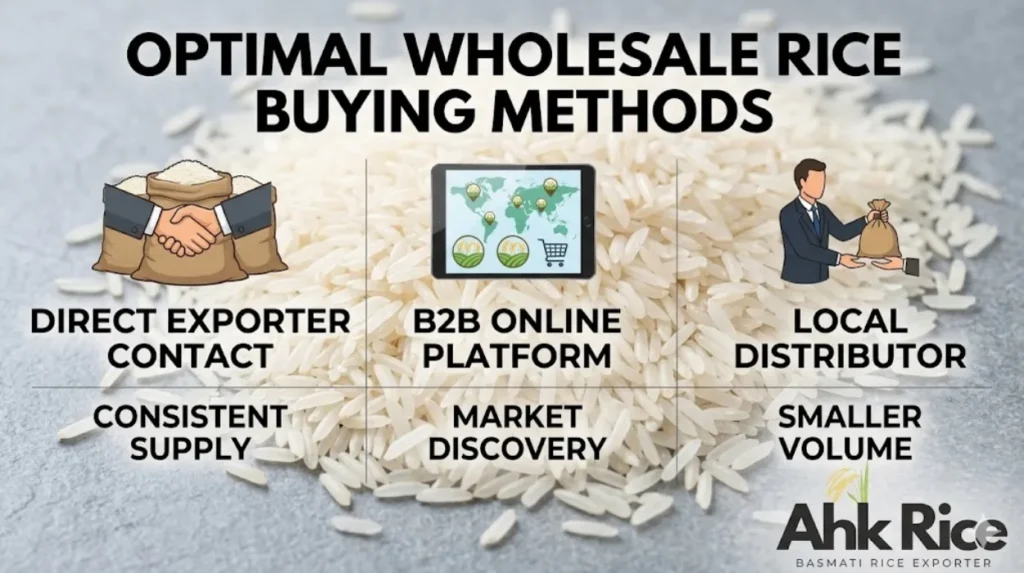
Direct exporter sourcing works best for established wholesalers, contract agreements suit recurring buyers, and procurement agents help first-time Indonesian importers manage supplier verification.
Retail Distribution Businesses
Retail distributors require consistent packaging, branding, and quality standards.
Contract supply agreements perform best because scheduled shipments support inventory planning throughout the year.
Foodservice and Hospitality Buyers
Hotels, restaurants, and catering companies prioritize grain appearance and cooking performance.
Direct exporter sourcing provides access to specific grades such as 1121 Steam Basmati or Super Kernel Basmati with customized specifications.
First-Time Importers
First-time importers often require local assistance.
Procurement agents provide factory audits, shipment supervision, and supplier validation.
Large Institutional Buyers
Institutional procurement prioritizes volume stability and documentation compliance.
Contract supply agreements reduce procurement uncertainty and improve forecasting accuracy.
Price-Focused Commodity Buyers
Commodity buyers focus primarily on landed cost.
Direct exporters typically provide the most competitive pricing structure because intermediary markups remain minimal.
Different buyer profiles require different procurement structures. Understanding product grades helps determine the correct specification after selecting a sourcing method.
Which rice grades do Indonesian buyers prefer from Pakistan?
1121 Basmati, Super Kernel Basmati, and 1509 Basmati dominate Indonesian wholesale demand because these grades offer strong cooking performance, premium appearance, and reliable export availability.
Regional Preference Comparison
Western Indonesia
Western Indonesian wholesalers focus on retail distribution and premium foodservice channels.
Preferred grades include:
- 1121 Steam Basmati
- 1121 Golden Sella Basmati
- Super Kernel Basmati
These grades provide long grain elongation and attractive presentation.
Eastern Indonesia
Eastern Indonesian markets emphasize value-oriented wholesale distribution.
Preferred grades include:
- 1509 Steam Basmati
- Super Kernel White Rice
- Broken Rice Grades
These specifications balance affordability and acceptable cooking quality.
Shelf Life Comparison
| Rice Grade | Shelf Life |
|---|---|
| 1121 Golden Sella | 18–24 Months |
| 1121 Steam | 12–18 Months |
| Super Kernel | 12–18 Months |
| 1509 Steam | 12–18 Months |
1121 Golden Sella maintains quality longer because parboiling strengthens grain structure before milling. In hot warehouse environments, Golden Sella performs better than standard steam rice. For wholesalers managing longer storage cycles, Golden Sella remains the preferred specification.
Rice grade selection influences procurement success. The next question evaluates the advantages and limitations of each sourcing strategy.
What are the pros and cons of different sourcing methods?
Direct sourcing offers maximum control, agents provide oversight, trading companies simplify procurement, and contracts improve supply stability.
Pros and Cons Table
| Method | Advantages | Limitations |
|---|---|---|
| Direct Exporter | Lower cost, direct communication, customization | Requires supplier evaluation |
| Trading Company | Single contact point | Higher pricing |
| Procurement Agent | Local expertise, inspection support | Additional fees |
| Contract Supply | Stable supply, predictable planning | Volume commitments |
| Tender Procurement | Competitive bidding | Longer procurement cycles |
Example: Direct Exporter Model
A wholesaler importing 1,000 metric tons annually receives direct mill specifications, packaging flexibility, and shipment scheduling support.
The buyer communicates directly with the exporter regarding moisture levels, grain length, broken percentage, and documentation requirements.
Example: Procurement Agent Model
A first-time importer may require factory verification.
An agent visits production facilities, inspects stock availability, reviews certifications, and supervises loading operations.
Understanding strengths and limitations supports better purchasing decisions. The final evaluation focuses on the key factors wholesalers should assess before selecting suppliers.
What decision factors should Indonesian wholesalers evaluate before choosing a supplier?
Quality consistency, certification, processing capability, shipment reliability, packaging flexibility, and export experience determine supplier suitability more than price alone.
Decision Framework Table
| Decision Factor | Importance | Evaluation Method |
|---|---|---|
| Product Quality | High | Laboratory reports |
| Export Experience | High | Shipment history |
| Certifications | High | Verify certificates |
| Packaging Options | Medium | Sample review |
| Logistics Capability | High | Shipping records |
Certifications to Verify
- ISO Certification
- HACCP Certification
- Phytosanitary Certificate
- Certificate of Origin
- Fumigation Certificate
- SGS Inspection Report
- Health Certificate
Export Documents Required
- Commercial Invoice
- Packing List
- Bill of Lading
- Certificate of Origin
- Phytosanitary Certificate
- Insurance Documents
Supplier Evaluation Checklist
- Verify milling capacity
- Verify export history
- Verify quality reports
- Verify packaging capabilities
- Verify logistics network
Pakistan exported significant rice volumes globally during recent seasons, strengthening its position among major rice suppliers (source: Pakistan Bureau of Statistics FY2024-25). Indonesian wholesalers increasingly evaluate suppliers using documented quality systems rather than price alone because consistent product performance reduces long-term procurement risk.
Supplier selection concludes the procurement process. Buyers seeking deeper trade analysis should review volume trends, import statistics, and market forecasts before finalizing sourcing strategies.
Frequently Asked Questions
How long does rice shipping from Pakistan to Indonesia take?
Rice shipments typically require 15–30 days depending on port selection, vessel schedules, customs clearance, and destination region.
What is the minimum order quantity for bulk rice imports?
Most exporters accept orders starting from one 20-foot container, although larger volumes receive better pricing.
Which Pakistani rice variety is most popular in Indonesia?
1121 Basmati Rice remains the most requested premium variety because of its grain length, aroma, and cooking expansion.
Which sourcing method offers the best pricing?
Direct exporter sourcing generally provides the lowest procurement cost because intermediary commissions are eliminated.
What certifications should Indonesian importers request?
Importers should request ISO, HACCP, Phytosanitary, Certificate of Origin, and SGS inspection reports before shipment approval.
How can wholesalers verify supplier quality?
Wholesalers should request laboratory reports, shipment references, production photos, certification copies, and physical samples before signing contracts.