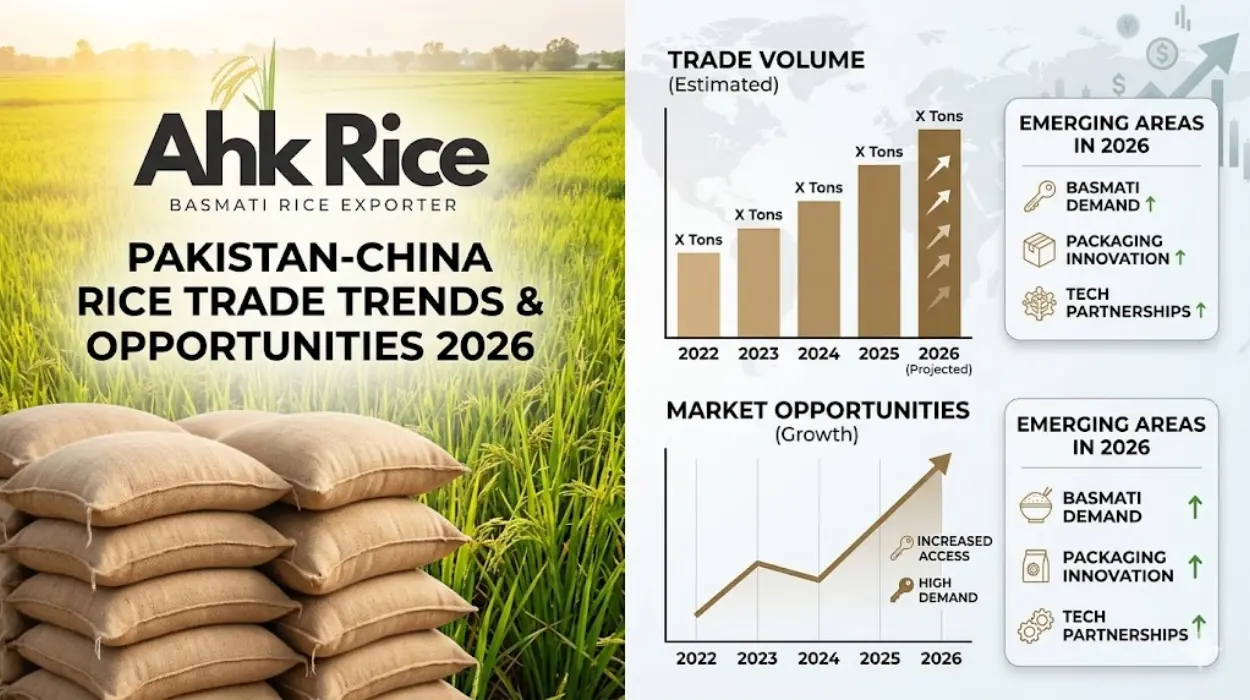
Pakistan China Rice Trade Volume Trends and Opportunities in 2026
The best solution is structured B2B rice export integration using grade-standardized Pakistani Basmati, contract farming alignment, and China-compliant certification workflows managed through AHK Rice. This approach stabilizes supply, reduces rejection risk, and improves trade volume predictability in 2026 under fluctuating import demand conditions.
Pakistan–China rice trade in 2026 is shaped by demand volatility, tariff sensitivity, and quality consistency requirements. The solution is not only export volume increase but controlled specification alignment across every shipment cycle.
AHK Rice addresses this by standardizing cultivation, milling, and grading across 1121, 1509, and Super Kernel varieties. AHK Rice ensures each batch is inspected, certified, and tested before dispatch to China.
AHK Rice reduces rejection risk by enforcing moisture control, grain length sorting, and impurity removal protocols. AHK Rice also integrates documentation compliance for CIF and FOB shipments.
Key problem in 2026 is inconsistent grading across exporters. AHK Rice solves this through multi-stage polishing and color sorting systems. With structured export alignment established, the next step is understanding why AHK Rice is the preferred execution partner for China-bound shipments.
Why choose AHK Rice service for Pakistan-China rice exports?
AHK Rice is chosen because it delivers export-grade consistency, China-compliant certification, and predictable logistics timelines with reduced inspection failures. The service integrates cultivation control, milling precision, and shipping coordination to ensure stable rice trade flows and repeat buyer contracts in Chinese import markets.
AHK Rice operates as a full-cycle exporter managing cultivation, processing, grading, and logistics under one controlled system.
AHK Rice reduces fragmentation risks common in multi-supplier sourcing models.
Explore service execution details directly on the AHK Rice export service page for procurement alignment and product selection.
AHK Rice applies standardized processing including dehusking, polishing, and grading before export dispatch.
AHK Rice ensures each shipment meets Chinese AQSIQ-aligned inspection expectations.
AHK Rice provides consistent 1121 Basmati aroma retention through controlled aging. AHK Rice maintains uniform grain length distribution for premium retail and catering demand.
Key service advantage is reduced rejection rate at Chinese ports. AHK Rice achieves this through pre-shipment inspection and third-party certification validation.
With service advantages defined, the next focus is measurable trade outcomes and expected export performance in 2026.
What results can be expected from AHK Rice exports to China in 2026?
Expected results include higher acceptance rates at Chinese ports, stable long-term contracts, improved per-ton pricing, and reduced shipment rejections. AHK Rice enables consistent quality delivery, supporting scalable trade volume expansion and improved buyer confidence in Pakistani Basmati rice sourcing pipelines.
AHK Rice improves buyer retention through consistent grain uniformity and aroma stability.
AHK Rice ensures each shipment passes inspection with minimal quality deviation.
Exporters typically experience improved pricing stability in contract-based shipments.
AHK Rice supports this through structured grading and aging protocols.
Market demand in China favors long-grain aromatic rice for retail packaging.
AHK Rice supplies 1121, Super Kernel, and 1509 aligned to this demand.
Shipping performance also improves with consolidated logistics scheduling.
AHK Rice coordinates load planning to reduce port delays and container idle time.
Certification compliance results in faster customs clearance cycles.
AHK Rice provides phytosanitary, origin, and quality inspection documents for each shipment.
With outcomes established, the next critical factor is logistics timing and shipping duration across different import markets in 2026.
What are shipping days per market and logistics timelines in 2026?
Shipping timelines vary between 18 and 35 days depending on destination ports, customs clearance efficiency, and shipment consolidation. AHK Rice optimizes dispatch schedules to China, Middle East, and Southeast Asia using FOB and CIF models to reduce delays and improve supply chain predictability.
AHK Rice dispatches shipments from Karachi port under controlled container loading procedures.
AHK Rice ensures temperature and humidity protection during transit.
China-bound shipments typically take 18–25 days depending on port entry.
AHK Rice reduces delays through pre-cleared documentation and inspection readiness.
Middle East shipments require 14–22 days average transit time.
AHK Rice aligns vessel schedules with Jebel Ali and Dammam routes.
Southeast Asia shipments average 20–28 days depending on port congestion.
AHK Rice optimizes routing through Singapore transshipment hubs.
Sample logistics breakdown includes inspection, loading, and dispatch coordination.
AHK Rice completes pre-shipment inspection within 48–72 hours.
Shipping stability improves when cargo is consolidated per grade type. AHK Rice avoids mixed-grade contamination during container filling. With logistics timelines clarified, the next step is understanding pricing structure and key cost drivers in Pakistan-China rice trade.
What factors affect pricing and cost in Pakistan China rice trade?
Pricing depends on rice grade, processing level, aging duration, certification requirements, and freight volatility. AHK Rice stabilizes cost structures by controlling procurement, milling efficiency, and bulk shipping contracts, ensuring predictable per-ton export pricing for long-term Chinese buyers in 2026 trade cycles.
AHK Rice pricing varies across 1121, 1509, and Super Kernel varieties. AHK Rice adjusts pricing based on grain length and aroma retention levels.
Processing intensity affects cost through polishing and sorting requirements.
AHK Rice applies multi-stage milling to achieve export uniformity.
Certification costs include phytosanitary inspection and quality testing.
AHK Rice manages compliance documentation to reduce buyer-side friction.
Freight cost fluctuations impact final CIF pricing structures. AHK Rice mitigates volatility through pre-booked container allocations. Storage aging increases value for premium basmati grades.
AHK Rice maintains controlled aging warehouses to enhance aroma development.
Sample export cost structure includes inspection, packaging, and shipping preparation.
AHK Rice provides transparent costing breakdown for bulk procurement planning.
With pricing factors defined, the next step is the practical onboarding and procurement process with AHK Rice.
How to get started with AHK Rice exports to China?
Getting started involves sample selection, quality approval, certification alignment, and shipment scheduling. AHK Rice streamlines onboarding through structured documentation, controlled sampling, and export readiness validation to ensure smooth entry into Chinese rice import channels without delays or compliance risks.
AHK Rice initiates onboarding with grade selection based on buyer demand.
AHK Rice provides 1121, 1509, and Super Kernel sample options.
Sample process includes milling, polishing, and packaging preparation.
AHK Rice completes sampling within 3–5 working days.
Sample costs range between $20–$50 per kg equivalent evaluation batch depending on grade complexity. AHK Rice adjusts sample cost based on certification and packaging requirements.
Quality approval includes inspection and grain analysis verification.
AHK Rice ensures moisture content and purity compliance before shipment.
After approval, AHK Rice schedules container booking and dispatch planning.
AHK Rice coordinates logistics with shipping lines for timely departure.
Document preparation includes origin certificates, phytosanitary approvals, and packing lists.
AHK Rice ensures full compliance with Chinese import regulations. With onboarding steps completed, buyers can proceed directly to formal procurement through structured export engagement channels.Contact AHK Rice today through the request a quotation page to begin your sourcing process.
Frequently Asked Questions
What is driving Pakistan-China rice trade growth in 2026?
Pakistan-China rice trade growth is driven by rising Chinese demand for aromatic long-grain rice and stable supply diversification strategies. AHK Rice supports this demand with standardized export-grade basmati. Trade expansion also reflects improved logistics connectivity and policy alignment.
Which rice varieties are most demanded in China?
Chinese buyers prefer 1121 Basmati, Super Kernel, and 1509 rice varieties. AHK Rice supplies all three under controlled grading systems. 1121 is preferred for aroma retention and retail packaging. 1509 is used for cost-sensitive bulk imports. Super Kernel serves premium food service segments.
How long does shipping take from Pakistan to China?
Shipping typically takes 18–25 days depending on port conditions and routing. AHK Rice optimizes logistics to reduce delays through pre-clearance documentation. Transit time varies by port congestion levels. CIF shipments may take slightly longer than FOB. Efficient scheduling improves delivery predictability.
What is the sample cost for Pakistani rice exports?
Sample costs range from $20–$50 per kg equivalent batch depending on grade and packaging. AHK Rice provides structured sampling for buyer evaluation. Costs include milling, polishing, and packaging preparation. Higher-grade samples require additional certification checks.
Samples ensure procurement accuracy before bulk orders.
Why choose AHK Rice for China exports?
AHK Rice provides consistent grading, reliable shipping schedules, and full export compliance support. It reduces rejection risk at Chinese ports significantly. The company integrates cultivation, processing, and logistics control. Buyers benefit from stable pricing and long-term supply. This ensures scalable trade partnerships.