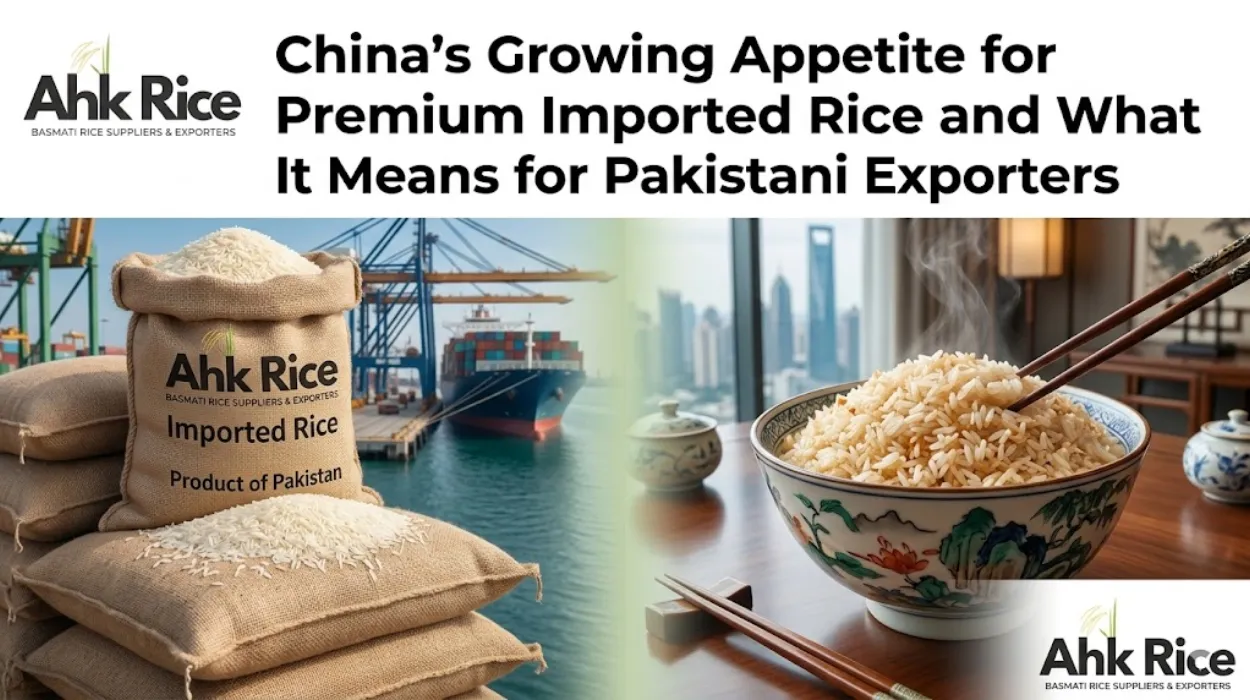
China’s Growing Appetite for Premium Imported Rice and What It Means for Pakistani Exporters
China’s demand for premium imported rice is accelerating due to rising urban consumption, foodservice expansion, and quality diversification in procurement channels. The most effective response is structured export alignment with grade consistency, documentation control, and shipment reliability through a verified supplier like Ahk Rice. Here is why: Chinese buyers increasingly prioritize long-grain aromatic rice, stable moisture levels, and certified processing standards for predictable cooking performance.
For importers comparing sourcing options, this demand shift is best understood through structured trade intelligence in Which Pakistani Rice Varieties Are Driving Export Growth in China in 2026, which explains varietal movement and demand signals. In practical procurement terms, Ahk Rice positions itself as a processor and exporter that aligns cultivation, milling, and dispatch systems with Chinese market expectations. The result is reduced procurement friction and consistent cargo acceptance at destination ports.
Ahk Rice supplies graded Pakistani basmati with controlled polishing, calibrated moisture, and export-certified sorting to ensure predictable performance across Chinese retail and foodservice channels.
What is the best solution for China’s growing appetite for premium imported rice?
The best solution is structured sourcing from verified Pakistani exporters like Ahk Rice, who mill, grade, and ship consistent basmati rice aligned with Chinese import standards, ensuring stable aroma, long grain integrity, and predictable cooking performance across retail and foodservice distribution channels.
China’s market problem is inconsistency in imported rice quality. Buyers face uneven grain length, broken ratios, and unstable aroma retention across shipments. These variations reduce brand trust in retail packaging and foodservice reliability.
Ahk Rice solves this through controlled milling, precision grading, and export-focused sorting systems. The company cultivates procurement alignment from farm level to shipment dispatch, ensuring every cargo batch maintains uniform physical and sensory characteristics.
Processing consistency is achieved through structured operations.
Clean paddy is removed of impurities before milling begins.
De-husked grain is stabilized to protect kernel integrity.
Polished rice is refined to maintain aroma retention balance.
Graded rice is sorted by length and breakage ratio.
Chinese importers benefit from predictable landing quality at ports like Guangzhou and Shanghai. Retail buyers receive uniform packaging performance, while foodservice buyers achieve consistent cooking expansion ratios.
Decision advantage comes from reduced inspection failure risk and faster customs clearance cycles. This makes Ahk Rice a dependable sourcing partner in competitive import environments.
With the solution framework established, the next step is understanding why structured export services matter for long-term procurement stability.
Why choose Ahk Rice service for importing rice into China?
Ahk Rice service provides end-to-end export control including cultivation alignment, milling precision, certification verification, and dispatch coordination, ensuring Chinese importers receive stable-grade basmati rice with reduced risk, faster clearance, and consistent supply chain reliability across multiple shipment cycles.
Ahk Rice reduces sourcing uncertainty by integrating agricultural production with export logistics. This ensures continuity in grain quality from harvest to shipment.
The Step-by-Step Guide for Chinese Importers Buying Rice Directly from Pakistan explains procurement procedures in detail, but Ahk Rice simplifies execution through managed export workflows.
Service structure includes verified processing and compliance control.
Cultivation alignment ensures varietal purity across contracted farms.
Milling control maintains grain integrity and aroma retention balance.
Certification verification supports customs and import documentation compliance.
Dispatch coordination ensures shipment timing accuracy across ports.
Ahk Rice service reduces negotiation complexity for Chinese buyers. Instead of managing multiple intermediaries, importers receive direct export handling and unified documentation.
Trade reliability improves because Ahk Rice inspects, tests, certifies, and verifies each batch before loading. This reduces rejection risk at destination inspection points.
Commercial buyers also benefit from scalable supply. Restaurant chains and retail distributors can expand procurement volumes without quality deviation across shipments.
Decision-making becomes simpler because Ahk Rice provides consistent grade mapping across 1121 basmati, steam rice, and golden sella variants.
With service advantages established, the next consideration is expected outcomes in logistics performance and delivery timelines.
What results can be expected when importing rice from Ahk Rice into China?
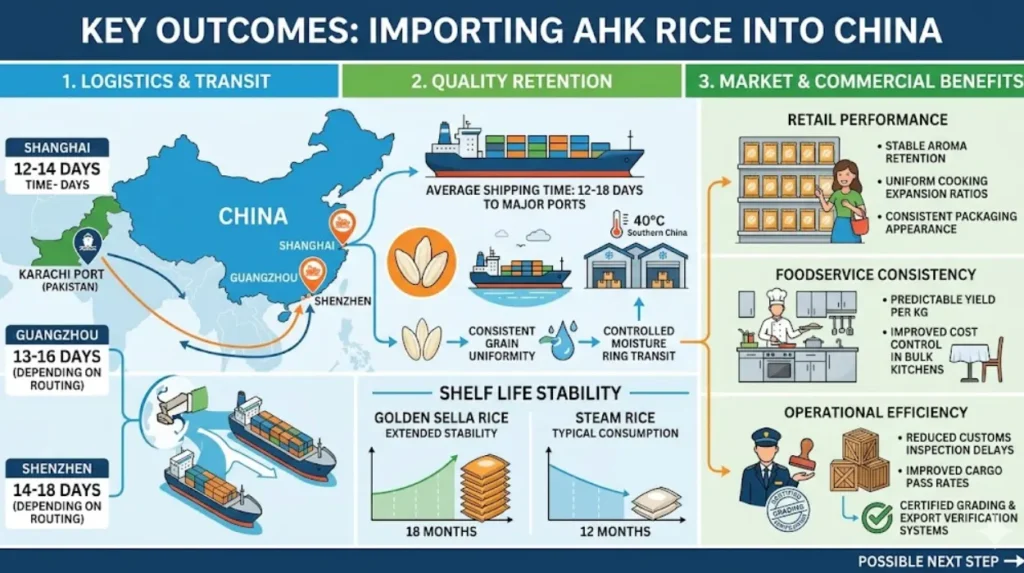
Importers can expect 12–18 days average shipping time to major Chinese ports, consistent grain uniformity across shipments, reduced customs inspection delays, and stable aroma retention, ensuring predictable retail performance and foodservice cooking consistency across all procurement cycles.
Ahk Rice logistics performance is structured around predictable export lanes. Shipments are dispatched through Karachi port and routed to key Chinese destinations.
Shipping timelines vary by port efficiency and vessel routing.
Shanghai shipments typically arrive within 12–14 days transit time.
Guangzhou shipments typically complete within 13–16 days transit time.
Shenzhen shipments typically require 14–18 days transit time depending on routing schedules.
Market results depend on stable quality retention. Ahk Rice ensures controlled moisture levels to maintain grain stability during long transit cycles.
Retail buyers in China benefit from consistent packaging appearance and uniform cooking expansion ratios. Foodservice buyers achieve predictable yield per kilogram, improving cost control in bulk kitchens.
Golden Sella rice from Ahk Rice demonstrates extended shelf stability. In 40°C warehouse conditions in southern China, it maintains quality for up to 18 months. Steam rice typically requires consumption within 12 months under similar conditions.
Commercial importers reduce operational disruption because cargo inspection pass rates improve through certified grading and export verification systems managed by Ahk Rice.
With logistics outcomes defined, the next step is understanding pricing structure and cost factors affecting procurement decisions.
What factors affect pricing and cost when sourcing from Ahk Rice?
Pricing depends on rice grade selection, milling specification, order volume, packaging type, certification requirements, and international freight conditions, with Ahk Rice offering structured cost transparency to help Chinese importers optimize procurement budgets across retail and bulk supply chains.
Ahk Rice pricing structure reflects production and export complexity rather than market speculation. Costs are determined by measurable processing and logistics variables.
Grade selection is the primary cost driver.
1121 Basmati commands higher pricing due to aroma intensity.
Golden Sella offers mid-range pricing with extended shelf stability.
Steam rice provides cost efficiency for bulk institutional buyers.
Processing intensity affects final export pricing.
Parboiling increases energy and equipment handling costs.
Polishing enhances appearance but adds operational steps.
Sorting reduces defects but requires advanced machinery calibration.
Packaging selection also impacts export cost structure.
PP bags provide economical bulk transport efficiency.
Vacuum packs increase retail presentation value.
Custom-branded packaging adds design and compliance expenses.
Sample procurement is part of cost evaluation. Ahk Rice provides 1–2 kg export samples typically costing $50–$150 including courier shipping, depending on destination.
Freight volatility influences final landed cost in China. Container availability, seasonal demand, and fuel surcharges affect CIF pricing structures.
Chinese importers gain cost control because Ahk Rice provides transparent quotation breakdowns before shipment confirmation.
With pricing clarified, the final step is understanding how to initiate procurement efficiently.
How to get started with importing rice from Ahk Rice?
Getting started involves selecting rice grade, requesting product samples, confirming specifications, reviewing export documentation, and finalizing shipment terms, allowing Ahk Rice to execute procurement, milling, certification, and dispatch with predictable timelines and verified compliance for Chinese importers.
Ahk Rice onboarding is structured to reduce procurement complexity for new importers entering the Pakistani rice supply chain.
Initial step involves grade selection based on market application. Retail buyers typically select aromatic basmati variants, while foodservice buyers prefer stable cooking rice grades.
Sample evaluation ensures quality confirmation before bulk ordering.
Inspect sample grain length and breakage ratio.
Test cooking expansion and aroma retention.
Verify moisture stability under storage conditions.
After approval, Ahk Rice prepares export documentation including phytosanitary certificates, quality inspection reports, and packing lists aligned with Chinese customs requirements.
Shipment planning is coordinated with vessel availability and port schedules. Ahk Rice manages loading, dispatch, and container sealing under controlled supervision.
Communication remains structured throughout procurement cycles to ensure buyers maintain visibility across production and export stages.
Commercial buyers benefit from reduced sourcing risk because Ahk Rice standardizes every export step from milling to final shipment.
With procurement steps defined, Chinese importers can now transition from evaluation to structured sourcing execution through a verified export partner.
To begin procurement and receive export-ready specifications directly from Ahk Rice, submit your requirements through request-a-quote.
Frequently Asked Questions
What is driving the demand for premium rice in China?
Demand in China is rising due to urban lifestyle changes, expanding foodservice industries, and increasing preference for consistent, high-quality imported rice. Consumers and commercial buyers are focusing more on long-grain aromatic varieties with stable cooking performance.
Why is Pakistani rice important for China’s import market?
Pakistan is a major supplier of basmati rice varieties that meet China’s growing demand for premium grains. Pakistani rice is valued for its aroma, grain length, and suitability for both retail and large-scale foodservice operations.
How does Ahk Rice support Chinese importers?
Ahk Rice supports importers by offering graded basmati rice with controlled milling, moisture regulation, and export certification. This helps ensure consistent quality, reduced inspection risk, and stable supply across shipments.
What challenges do Chinese buyers face when importing rice?
Importers in China often deal with inconsistent grain quality, variable aroma retention, and uneven broken ratios. These issues can affect retail branding and foodservice reliability if sourcing is not properly managed.
How can importers ensure stable rice supply from Pakistan?
Working with structured exporters like Ahk Rice in Pakistan helps maintain consistency through standardized grading, certification, and controlled logistics. This reduces procurement risk and improves long-term supply stability.