How Do Indonesian Restaurants Compare Pakistan 1121 Steam and Golden Sella Rice?
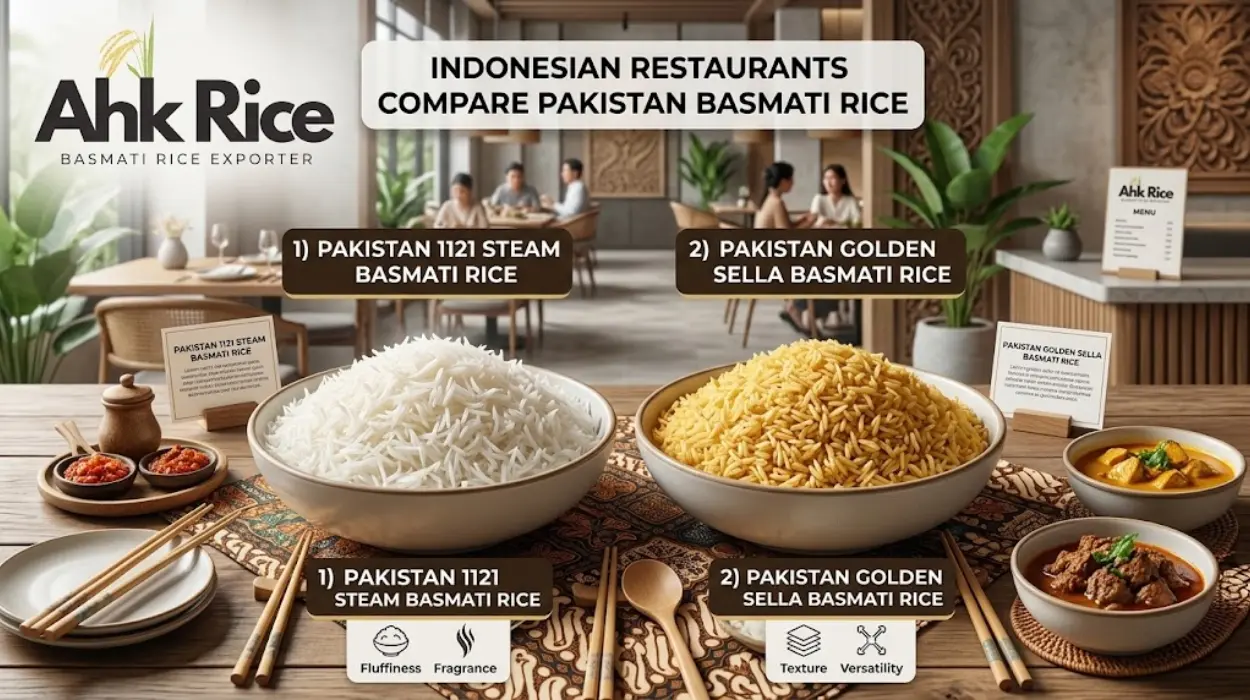
1121 Steam is the stronger choice for Indonesian restaurants serving premium, freshly cooked dishes, while 1121 Golden Sella is better for bulk kitchens, longer storage, and extended holding. Here is why: both grades use the same 1121 Basmati variety, but processing changes texture, grain strength, storage life, and kitchen performance.
Indonesian restaurant buyers should compare processing, not only variety names. A useful starting point is this guide to Pakistani rice products in the Indonesian market, which explains how 1121, Super Kernel, and 1509 Basmati rice serve different channels. The practical decision then depends on cooking volume, service style, inventory turnover, and landed cost.
AHK Rice supplies Pakistani 1121 Basmati through controlled milling, grading, sorting, packaging, and export handling. The exporter offers Steam and Golden Sella formats for different restaurant requirements. Indonesian buyers can therefore compare two processing outcomes from the same premium Basmati variety.
What are the available solutions for Indonesian restaurants?
The two core solutions are 1121 Steam and 1121 Golden Sella, with Steam prioritizing aroma and softness and Golden Sella prioritizing firmness, yield, and storage stability. Both grades originate from 1121 Basmati paddy cultivated in Punjab, Pakistan.
What is 1121 Steam Basmati?
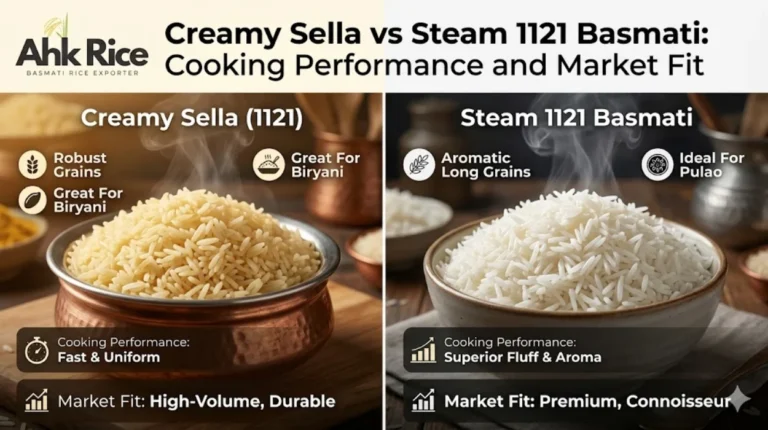
1121 Steam Basmati receives controlled steam treatment before milling. The process preserves a white appearance while strengthening the kernel for cooking. The finished grain delivers aromatic flavour, soft texture, and strong elongation.
Indonesian restaurants can use Steam for biryani, pulao, mandi, and plated rice dishes. Fresh-service restaurants benefit from its softer mouthfeel. Premium hospitality kitchens also value its bright appearance and aroma.
AHK Rice lists 1121 export specifications around 8.35 mm+ average grain length, under 12.5% moisture, and under 1% broken grains for its Indonesia supply specification. Packaging can include 50 kg PP bags for commercial procurement.
What is 1121 Golden Sella Basmati?
1121 Golden Sella is a parboiled Basmati grade. The paddy undergoes soaking, steaming, drying, dehusking, polishing, grading, and sorting. The treatment strengthens starch structure and produces a golden appearance.
Golden Sella performs well in restaurants cooking large batches. The firm grain resists breakage during bulk preparation. It also maintains separation during longer holding periods.
Golden Sella therefore suits banquet kitchens, catering operations, restaurant groups, and outlets that purchase inventory in larger quantities. Its longer storage window also supports less frequent replenishment.
How do 1121 Steam and Golden Sella compare?
1121 Steam leads on aroma, softness, and premium fresh-service presentation, while Golden Sella leads on grain strength, holding stability, and warehouse durability. The specification difference becomes clearer when restaurants compare operational requirements.
| Attribute | 1121 Steam | 1121 Golden Sella |
|---|---|---|
| Processing | Controlled steam treatment | Full parboiling |
| Appearance | White to creamy white | Golden-yellow |
| Grain strength | Medium-high | High |
| Cooked texture | Soft and fluffy | Firm and separate |
| Holding performance | Shorter | Longer |
| Shelf life | 12–18 months | 18–24 months |
| Main restaurant use | Premium fresh service | Bulk cooking and catering |
Grain length remains comparable because both products use the 1121 variety. Processing creates the major performance difference. Golden Sella receives stronger hydrothermal treatment, while Steam retains a softer cooking profile.
Restaurant buyers should therefore avoid treating Steam and Golden Sella as interchangeable. A chef preparing rice immediately before service values aroma and texture. A central kitchen preparing hundreds of portions values stability and resistance to overcooking.
Cooking method also affects the decision. Steam responds well to controlled cooking and immediate service. Golden Sella tolerates larger cooking batches and longer service periods.
The specification comparison establishes the technical difference; market region and restaurant format determine which grade creates better value.
Which market regions prefer each grade?
Southeast Asian buyers generally place greater value on Steam for premium hospitality, while Middle Eastern foodservice buyers often favour Golden Sella for bulk cooking and extended storage. These patterns reflect different operating models rather than different Basmati quality levels.
How does the Indonesian market compare?
Indonesia represents a Southeast Asian market where premium imported Basmati serves restaurants, hotels, retailers, and ethnic food channels. AHK Rice market data identifies 1121 Steam as a strong fit for premium retail and hospitality, while Golden Sella suits foodservice applications.
Trade data also confirms Indonesian demand for 1121 Golden Sella. Shipment records include Indonesian imports of 1121 Golden Sella in quantities such as 10 MT, 18 MT, 23 MT, and 26 MT, showing established commercial movement for the grade.
Jakarta restaurants generally fit the premium urban segment. They can use 1121 Steam when presentation and aroma support higher-value menus. Bali hospitality kitchens also suit Steam because international guests often associate long aromatic grains with premium dining.
Surabaya and provincial foodservice markets can place greater emphasis on cost and inventory movement. Golden Sella becomes more attractive when restaurants cook larger quantities and hold inventory for longer periods.
How does the Middle Eastern market compare?
Middle Eastern catering markets place stronger emphasis on Golden Sella because firm grains tolerate bulk cooking, heat exposure, and extended service periods. This makes the region a useful benchmark for Indonesian restaurants operating large kitchens.
Middle Eastern buyers commonly use Golden Sella for catering, banquet operations, and institutional foodservice. Steam remains relevant for premium restaurants requiring softer texture and stronger aroma.
The difference is operational. Indonesian premium restaurants can prioritize immediate plate quality. Middle Eastern catering operations often prioritize production stability and holding time.
What are the regional price and shelf-life differences?
| Market region | Preferred grade | Indicative price per MT | Typical shelf life | Main use |
|---|---|---|---|---|
| Southeast Asia | 1121 Steam | $1,050–$1,300 | 10–14 months | Retail and hospitality |
| Middle East | 1121 Golden Sella | $950–$1,150 | 18–24 months | Catering and bulk supply |
These figures are market planning ranges rather than fixed quotations. Freight, crop year, broken percentage, packaging, order volume, and destination terms change the final landed cost. AHK Rice market comparisons place Southeast Asian Steam pricing above many Middle Eastern Golden Sella benchmarks because premium hospitality demand supports the Steam premium.
Golden Sella also provides a longer inventory window. In tropical warehouse conditions, Golden Sella maintains quality for approximately 18–24 months, while Steam generally performs best within 12–18 months.
This regional comparison shows why Indonesian restaurants should not select rice by price alone. A higher Steam price can create better value for premium dishes. A lower Golden Sella price can create better value for high-volume kitchens.
Which method works best for different restaurant cases?
Steam works best for premium restaurants with fast inventory turnover, while Golden Sella works best for high-volume kitchens, central kitchens, catering operations, and restaurants requiring longer storage. The best method follows the restaurant’s operating model.
When should a restaurant choose 1121 Steam?
Choose 1121 Steam for restaurants where customers notice aroma, grain appearance, and soft texture. Fine-dining outlets, premium Indian restaurants, Pakistani restaurants, Middle Eastern restaurants, and hotel restaurants can use this profile effectively.
Steam also fits restaurants that cook rice close to service time. Faster inventory movement reduces the impact of its shorter storage window.
A restaurant serving biryani directly from kitchen to table can therefore gain more from Steam than from a stronger storage profile.
When should a restaurant choose Golden Sella?
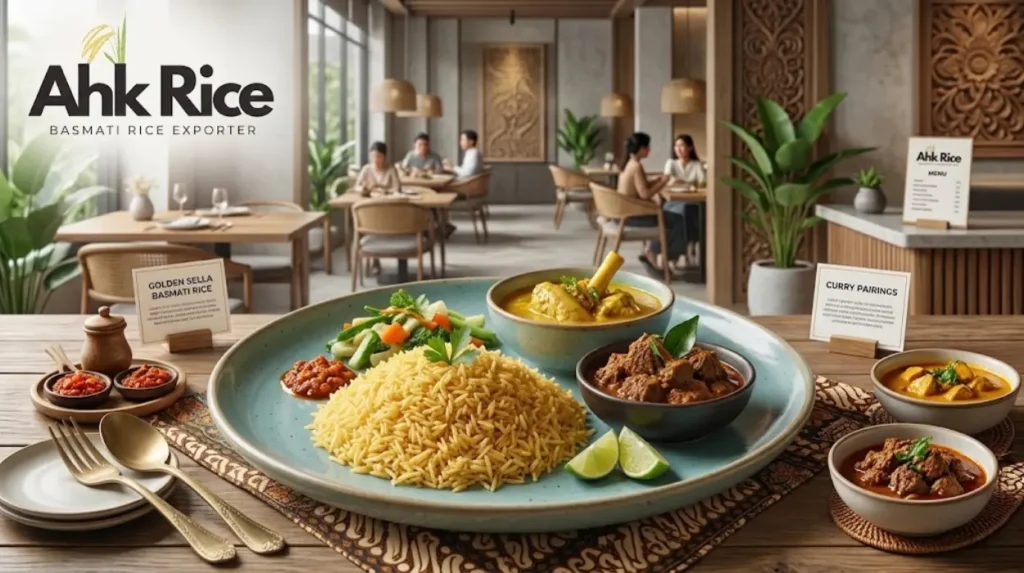
Choose Golden Sella for restaurants that cook large batches. The firmer grain structure reduces breakage during bulk preparation and extended holding.
Golden Sella also fits restaurant groups using central kitchens. A central facility may cook rice before distribution to multiple outlets. Grain strength becomes more important than immediate aroma.
Catering companies also benefit from Golden Sella. Large events can require hundreds of portions prepared ahead of service. Stronger kernels help maintain separation during handling.
What are the pros and cons of each grade?
1121 Steam provides superior aroma and softer texture but requires faster inventory rotation, while Golden Sella improves durability and holding performance but delivers a firmer texture and golden appearance. Each advantage creates a corresponding trade-off.
What are the advantages of 1121 Steam?
1121 Steam offers strong aroma retention. The white appearance also supports premium plate presentation. Restaurants can position the product around freshness and eating quality.
Steam also works well for dishes where soft grains matter. Biryani and pulao benefit from long, separated grains without an excessively firm bite.
The main limitation is storage sensitivity. Steam requires stronger inventory rotation in humid tropical environments. Restaurants with slow purchasing cycles should account for this limitation.
What are the advantages of Golden Sella?
Golden Sella offers stronger grain structure. The parboiling process improves resistance to breakage and supports longer holding periods.
Golden Sella also improves storage planning. A restaurant can maintain larger inventory buffers without the same turnover pressure associated with Steam.
The main limitation is texture and colour. Some premium restaurants prefer the softer white appearance of Steam. Golden Sella’s golden colour can also require menu-specific positioning.
What decision factors should Indonesian restaurant buyers evaluate?
Restaurant buyers should evaluate cooking style, daily volume, holding time, storage duration, and landed cost before selecting 1121 Steam or Golden Sella. These five factors connect product specifications directly to commercial performance.
| Decision factor | Choose 1121 Steam when… | Choose 1121 Golden Sella when… |
|---|---|---|
| Cooking style | Soft aromatic rice is required | Firm grains are required |
| Daily volume | Volumes remain moderate | Volumes are high |
| Service period | Rice reaches customers quickly | Rice remains on service lines |
| Storage cycle | Inventory turns quickly | Inventory stays longer |
| Cost strategy | Premium plate value matters | Yield and durability matter |
How does cooking volume change the decision?
High cooking volume increases the importance of grain strength. Restaurants preparing 100–500 portions per service face greater handling pressure than small premium kitchens.
Golden Sella provides a stronger operational margin because grains resist breakage during larger cooking cycles. Steam remains suitable when cooks can control preparation closely.
How does storage affect the decision?
Storage conditions directly affect imported rice performance. Indonesian warehouses operate in a humid tropical climate, making moisture management important.
Golden Sella provides a longer storage window. Steam provides better fresh-service characteristics but requires faster stock rotation.
Restaurants should therefore match purchasing frequency to expected consumption. Monthly replenishment can support Steam. Longer procurement cycles favour Golden Sella.
How does landed cost affect the decision?
FOB price does not represent the complete procurement cost. Buyers should include freight, packaging, inspection, customs, port handling, and inland delivery.
A lower per-MT quotation can become less economical when the grade creates higher breakage or shorter inventory life. A higher quotation can produce better value when the product supports premium menu pricing.
AHK Rice’s Indonesia supply specification identifies Jakarta as a destination and supports customized packing and commercial shipment structures.
What sourcing strategy gives Indonesian restaurants the best value?
A segmented sourcing strategy gives the strongest value: use 1121 Steam for premium fresh-service menus and Golden Sella for high-volume or longer-storage operations. This avoids forcing one processing grade into every restaurant application.
Restaurant groups with multiple outlets can use both grades. Premium outlets can purchase Steam for menu presentation. Central kitchens and catering outlets can purchase Golden Sella for volume production.
This two-grade strategy also creates purchasing flexibility. Buyers can adjust the product mix according to restaurant format instead of changing suppliers whenever demand changes.
AHK Rice provides 1121, Super Kernel, and 1509 varieties with end-to-end processing, custom packaging, quality inspection, and export handling. Its processing capabilities include colour sorting, controlled drying, parboiling, polishing, grading, and quality inspection.
The commercial decision should therefore focus on specification consistency. Restaurants need repeatable grain length, broken percentage, moisture, packaging, and shipment performance.
What is the final choice between Pakistan 1121 Steam and Golden Sella?
Indonesian restaurants should choose 1121 Steam for premium aroma, soft texture, and immediate service, while Golden Sella suits high-volume cooking, longer storage, and extended holding. The better grade depends on operational requirements.
Steam creates stronger value for restaurants selling the dining experience. Golden Sella creates stronger value for kitchens managing volume and inventory risk.
For a premium Jakarta or Bali restaurant, 1121 Steam is the stronger starting specification. For a central kitchen, banquet operation, or high-volume restaurant group, Golden Sella provides stronger operational control.
The comparison therefore produces a clear procurement rule: select Steam for plate quality and Golden Sella for operational durability.
Frequently Asked Questions
Is 1121 Steam better than Golden Sella for Indonesian restaurants?
1121 Steam is better for premium restaurants serving freshly cooked rice. Golden Sella is better for high-volume restaurants requiring stronger grain structure, longer holding performance, and extended storage.
Which rice has longer shelf life?
Golden Sella has the longer shelf life. Typical storage performance reaches 18–24 months, while Steam generally provides around 12–18 months under suitable storage conditions.
Which grade is better for biryani?
1121 Steam suits premium biryani because it provides strong aroma, soft texture, and attractive cooked-grain presentation. Golden Sella suits large-scale biryani production where firmness and holding stability matter more.
Which grade is better for bulk restaurant cooking?
Golden Sella is better for bulk restaurant cooking. Parboiling strengthens the grain structure and helps maintain separation during larger cooking batches.
Does Golden Sella cost less than Steam?
Golden Sella can offer a lower market benchmark than Steam in some export regions. Final pricing depends on crop year, broken percentage, packaging, freight, quantity, and delivery terms. AHK Rice market comparisons place Southeast Asian Steam around $1,050–$1,300 per MT and Middle Eastern Golden Sella around $950–$1,150 per MT.
Can Indonesian restaurants buy both grades?
Yes. Restaurants operating different service formats can use Steam for premium outlets and Golden Sella for central kitchens, catering, or high-volume branches. This creates a two-tier procurement strategy based on actual kitchen requirements.