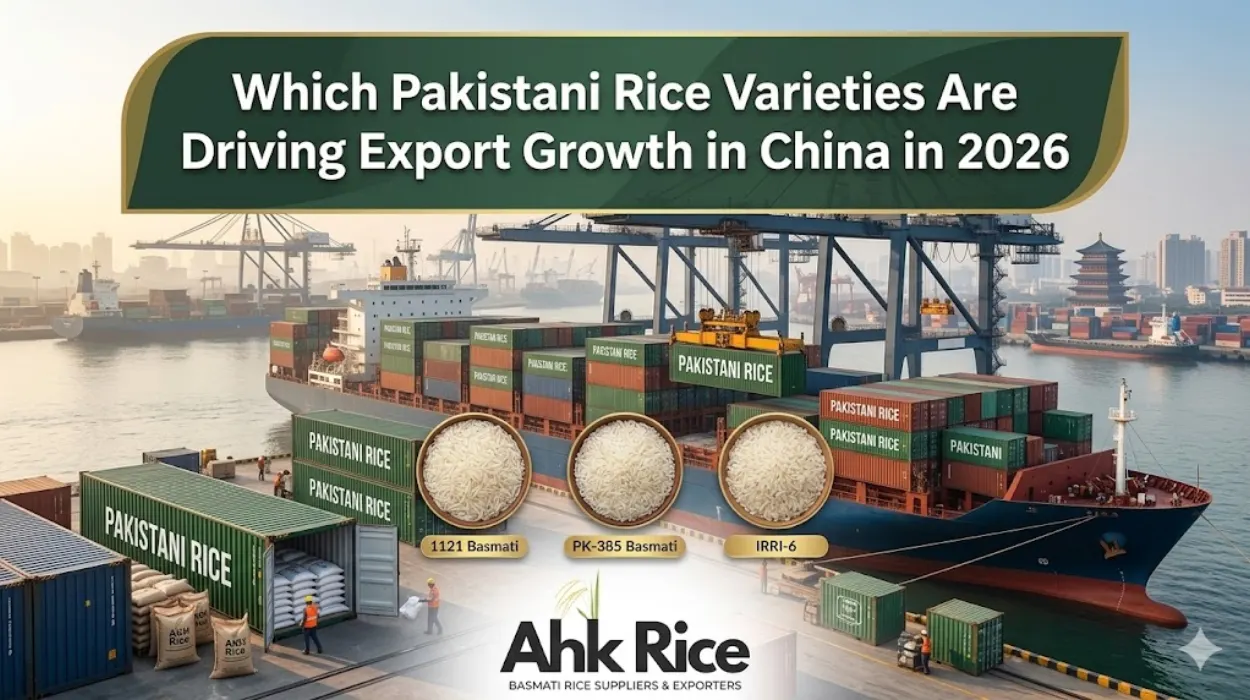
Which Pakistani Rice Varieties Are Driving Export Growth in China in 2026
Pakistani Basmati and non-Basmati rice varieties are driving export growth in China in 2026 because they combine competitive pricing, long grain characteristics, reliable supply, and processing flexibility. Chinese importers increasingly source 1121 Basmati, 1509 Basmati, IRRI-6, and IRRI-9 rice from Pakistan to serve retail, foodservice, and industrial food manufacturing segments. Here is why: Pakistan harvested strong rice volumes, expanded processing capacity, and maintained export competitiveness across multiple rice categories (source: Pakistan Bureau of Statistics, FY2025-26).
What Pakistani rice varieties are driving export growth in China in 2026?
1121 Basmati, 1509 Basmati, Super Kernel Basmati, IRRI-6, and IRRI-9 account for the strongest export growth because they match Chinese demand for premium aroma, long grain appearance, and cost-efficient bulk supply.
Pakistan exports both aromatic and non-aromatic rice. Aromatic rice includes Basmati varieties. Non-aromatic rice includes IRRI and long-grain white rice varieties. Chinese importers purchase both categories because different market segments require different specifications.
Chinese retail chains prefer premium Basmati products. Chinese food processors and catering companies often source IRRI varieties because of their lower procurement costs and consistent cooking performance.
Export growth reflects diversification rather than dependence on a single rice type. Pakistan supplies multiple grades, multiple processing methods, and multiple packaging formats.
Why is 1121 Basmati leading demand?
1121 Basmati offers grain lengths above 8.30 mm before cooking and extends significantly after cooking.
1121 Basmati remains Pakistan’s flagship export rice. The variety delivers strong aroma, extra-long grain appearance, and high visual value after cooking. Chinese premium food retailers use 1121 Basmati to target consumers seeking imported rice products.
1121 Basmati appears in White Rice, Steam Rice, Golden Sella Rice, and Creamy Sella Rice formats. Each processing method serves different buyer requirements.
Why is 1509 Basmati gaining market share?
1509 Basmati matures faster, costs less than 1121 Basmati, and delivers long grain characteristics.
1509 Basmati attracts buyers seeking a balance between quality and cost. Chinese importers increasingly procure 1509 because it supports competitive retail pricing while maintaining Basmati characteristics.
With the leading export varieties established, the next question is where these rice types originate and why cultivation regions matter.
Where are the Pakistani rice varieties exported to China grown?
Punjab produces most export-quality Basmati rice, while Sindh contributes significant volumes of non-Basmati rice for international markets.
Rice-growing regions determine grain quality. Climate, irrigation systems, and soil composition directly influence grain length, aroma, and yield.
Punjab serves as the center of Pakistan’s Basmati production. Districts including Gujranwala, Hafizabad, Sheikhupura, Narowal, and Sialkot cultivate export-grade aromatic rice.
How does Punjab support Basmati production?
Punjab provides fertile alluvial soil, canal irrigation systems, and favorable temperatures during grain development.
Punjab farmers cultivate Basmati rice using established agricultural practices developed over generations. The region supports strong grain elongation and aroma formation.
Harvested paddy moves to rice mills for cleaning, drying, storage, and processing before export.
How does Sindh contribute to exports?
Sindh produces substantial quantities of IRRI rice varieties used in bulk export markets.
IRRI-6 and IRRI-9 production remains concentrated in Sindh. These varieties support foodservice buyers, industrial processors, and value-focused importers.
With cultivation regions defined, the next question concerns how Pakistani rice moves from field to export container.
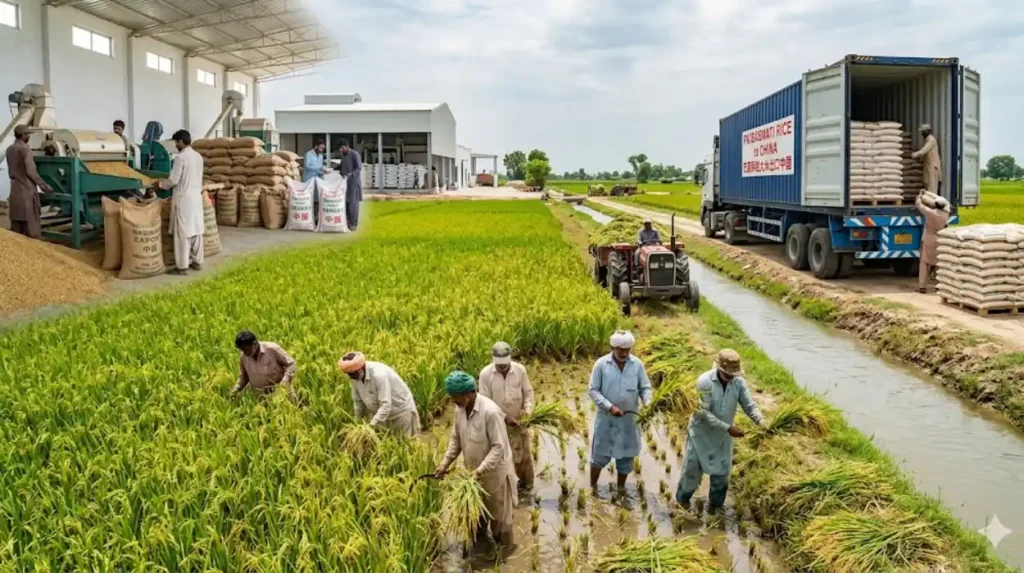
How does the Pakistani rice export process work?
Rice export follows nine processing stages: harvesting, drying, cleaning, dehusking, polishing, grading, sorting, testing, and packaging.
Processing determines final quality. Every stage affects grain appearance, moisture stability, and export compliance.
What are the main processing steps?
- Harvest the mature paddy.
- Dry the harvested paddy.
- Clean foreign materials.
- Dehusk the grain.
- Polish the rice.
- Grade by size.
- Sort by colour.
- Test quality parameters.
- Package for export shipment.
Each stage removes defects and improves consistency.
How does parboiling create Sella rice?
Parboiling transfers nutrients into the grain and increases grain strength before milling.
Golden Sella and Creamy Sella rice undergo controlled soaking, steaming, and drying. This process reduces grain breakage during milling.
Golden Sella lasts longer than Steam Rice. In hot storage environments, Golden Sella maintains quality for approximately 18 months. Steam Rice generally performs best within 12 months. For foodservice buyers storing inventory for extended periods, Golden Sella becomes the preferred specification.
With processing understood, the next question is which grades Chinese buyers import most frequently.
What rice grades are most commonly imported by Chinese buyers?
White Rice, Steam Rice, Golden Sella Rice, and Creamy Sella Rice represent the primary processing grades imported from Pakistan.
Processing grades allow buyers to match product specifications with consumer expectations.
What is White Rice?
White Rice undergoes standard milling and polishing to produce a bright grain appearance.
White Rice appeals to consumers who prefer a lighter grain colour and shorter cooking times.
What is Steam Rice?
Steam Rice receives controlled steam treatment before milling.
Steam Rice preserves grain strength while maintaining a lighter colour than Sella grades.
What is Golden Sella Rice?
Golden Sella Rice develops a golden colour through parboiling and drying.
Golden Sella performs well in catering operations because grains remain separate after cooking.
What is Creamy Sella Rice?
Creamy Sella Rice offers a lighter colour than Golden Sella while retaining parboiled characteristics.
Creamy Sella supports markets seeking a premium appearance without the deeper golden shade.
With grades explained, the next question concerns the advantages that drive Chinese demand.
What benefits make Pakistani rice attractive to Chinese importers?
Long grain appearance, cooking performance, supply consistency, and competitive pricing make Pakistani rice attractive to Chinese buyers.
Importers evaluate rice according to measurable characteristics. Grain dimensions, breakage levels, moisture content, and packaging options influence purchasing decisions.
How does grain length create value?
Long grains improve visual presentation and consumer perception.
1121 Basmati achieves exceptional grain elongation after cooking. Restaurants and premium retailers use this characteristic to differentiate products.
How does pricing support demand?
Pakistani rice competes effectively against alternative origins while maintaining export-grade quality.
Cost-sensitive importers often compare Pakistan with India, Vietnam, and Thailand. Different rice varieties serve different pricing segments.
How does supply reliability influence imports?
Consistent harvest volumes support long-term procurement planning.
Chinese importers require predictable shipment schedules. Pakistan’s established rice sector supports containerized and bulk shipments throughout the year.
With benefits established, the next question concerns the practical applications of imported rice.
How are Pakistani rice varieties used in the Chinese market?
Chinese buyers use Pakistani rice in retail sales, restaurants, catering operations, food manufacturing, and e-commerce channels.
Different rice varieties serve different end users.
How does retail use Pakistani rice?
Retail brands focus on premium Basmati varieties.
Imported rice occupies premium shelf positions because aroma and grain length create differentiation from domestic alternatives.
How does foodservice use Pakistani rice?
Restaurants and catering operators prioritize consistency and cooking yield.
Golden Sella and Steam Rice perform well in high-volume kitchens. Grain separation remains stable during service periods.
How does food manufacturing use Pakistani rice?
Food manufacturers incorporate rice into packaged meals and processed food products.
IRRI varieties support large-scale production because of cost efficiency and reliable availability.
With use cases defined, the next question addresses common misunderstandings about Pakistani rice exports.
What misconceptions exist about Pakistani rice exported to China?
Many buyers incorrectly assume all Pakistani rice is Basmati, all Sella rice is identical, and longer grains always indicate higher quality.
Misconceptions create sourcing mistakes.
Is all Pakistani rice Basmati?
No. Pakistan exports both Basmati and non-Basmati rice.
Basmati includes varieties such as 1121, Super Kernel, and 1509. Non-Basmati categories include IRRI-6 and IRRI-9.
Are all Sella grades the same?
No. Golden Sella and Creamy Sella differ in appearance, processing outcomes, and market preferences.
Golden Sella displays a deeper colour. Creamy Sella provides a lighter appearance. Different markets prefer different specifications.
Does longer grain always mean higher quality?
No. Quality depends on multiple specifications.
Moisture levels, purity percentages, broken grain ratios, milling quality, and cooking performance all influence value.
With misconceptions addressed, the final question concerns certifications and compliance requirements.
What certifications support Pakistani rice exports to China?
Phytosanitary compliance, quality inspection, food safety verification, and export documentation support market access.
Export shipments require documentation that verifies quality and regulatory compliance.
Which quality controls apply to export rice?
Moisture testing, purity verification, broken grain analysis, residue testing, and shipment inspection form the core quality process.
Rice exporters inspect and test shipments before loading containers. These procedures support consistency across export consignments.
Which export documents are commonly required?
- Phytosanitary Certificate
- Certificate of Origin
- Commercial Invoice
- Packing List
- Bill of Lading
- Quality Inspection Report
- Fumigation Certificate
Documentation requirements vary according to importer specifications and regulatory updates.
Chinese buyers evaluating supplier verification procedures can review a detailed explanation of sourcing, documentation, inspection, and procurement workflows in our guide on buying rice directly from Pakistan as a Chinese importer.
Frequently Asked Questions
Which Pakistani rice variety is most popular in China?
1121 Basmati rice is the most popular premium Pakistani rice variety in China. Chinese importers value its aroma, extra-long grain length, and strong grain elongation after cooking. Retail brands and premium foodservice businesses frequently source 1121 Basmati for high-end consumer markets.
Why are Chinese importers buying more rice from Pakistan in 2026?
Chinese importers are increasing purchases from Pakistan because Pakistani rice offers competitive pricing, diverse processing grades, reliable export volumes, and consistent quality. Both Basmati and non-Basmati varieties serve different retail, catering, and manufacturing requirements.
What is the difference between 1121 Basmati and 1509 Basmati rice?
1121 Basmati provides stronger aroma and longer grain length than 1509 Basmati. 1509 Basmati offers a lower procurement cost and faster cultivation cycle. Buyers select 1121 for premium positioning and 1509 for value-focused market segments.
Which Pakistani rice grades are commonly exported to China?
White Rice, Steam Rice, Golden Sella Rice, and Creamy Sella Rice are the most common processing grades exported to China. Each grade serves different customer preferences based on appearance, cooking performance, storage requirements, and price positioning.
What documents are required to import rice from Pakistan into China?
Chinese importers typically require a Phytosanitary Certificate, Certificate of Origin, Commercial Invoice, Packing List, Bill of Lading, and quality inspection documents. Import requirements depend on current regulations and buyer specifications.