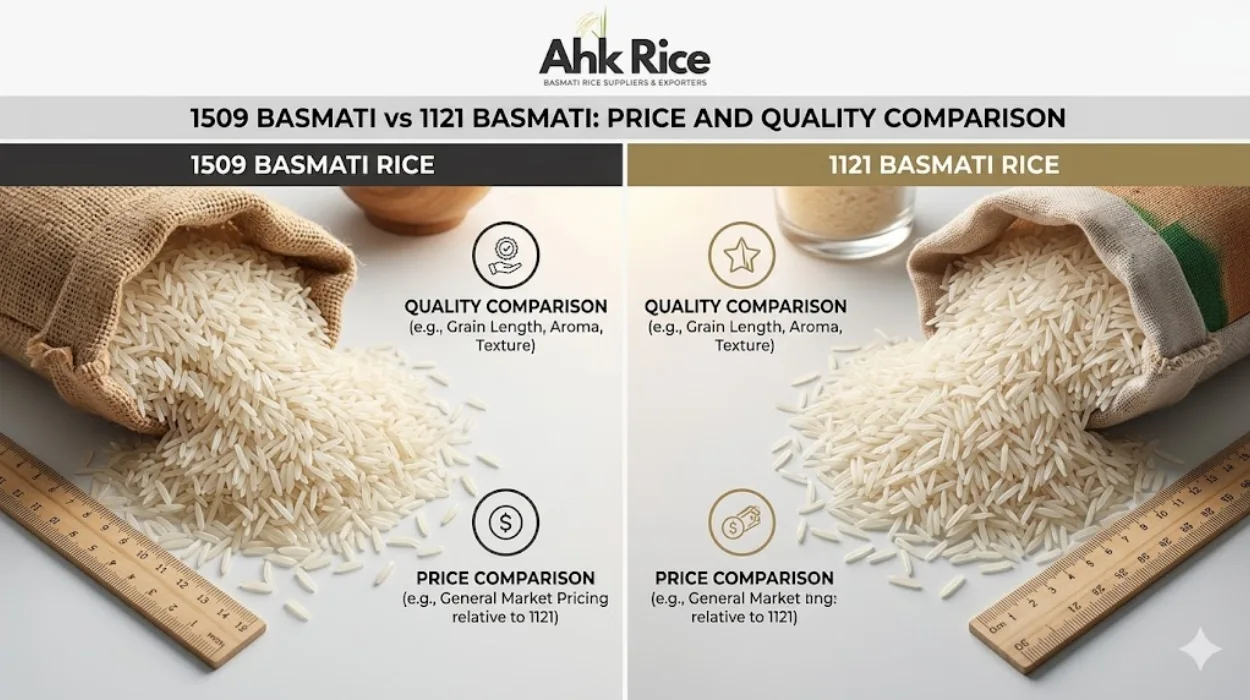
1509 Basmati vs 1121 Basmati: Price and Quality Comparison
1509 Basmati emerges as the cost-efficient, high-yield option for bulk export and foodservice buyers, while 1121 Basmati remains the premium benchmark for aroma-driven, long-grain presentation markets in 2026 global rice trade.
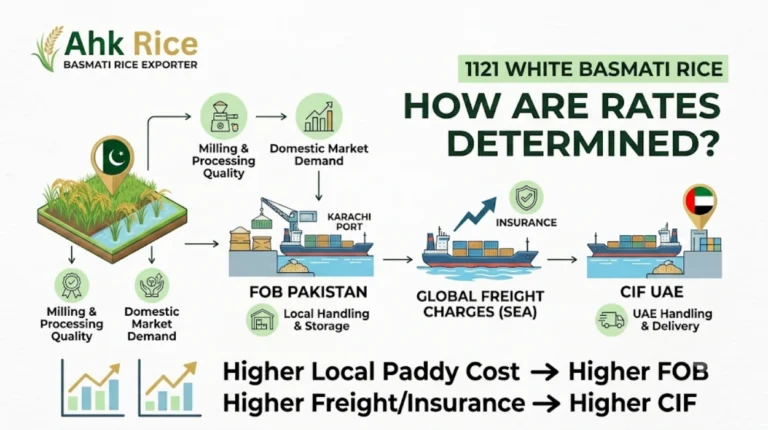
The comparison between these two varieties is no longer just agronomic. It is now a commercial strategy decision shaped by export pricing cycles, milling efficiency, and end-user expectations. In 2026, buyers evaluate both varieties not as substitutes but as segmented solutions across different market tiers. For deeper demand-side context, the foodservice-driven adoption trends of 1509 are explained in this ToFu guide on why 1509 Basmati rice is popular among foodservice buyers.
At the export sourcing level, suppliers like AHK Rice integrate both varieties into structured procurement programs, ensuring consistent supply across 15+ international destinations with tailored packaging, polishing levels, and grading protocols. For pricing benchmarks and export valuation, the updated reference point is the 2026 market breakdown in 1509 Basmati Rice Price Per Ton in 2026.
What are the available solutions?
Buyers in global rice trade typically choose between 1509 Basmati and 1121 Basmati depending on aroma strength, grain elongation, cooking yield, export price stability, and end use application across foodservice retail packaging institutional supply chains and regional culinary demand patterns.
The two dominant procurement solutions are structured around grain behavior and market segmentation.
1509 Basmati is engineered for high yield performance. It delivers better milling recovery and cost efficiency per metric ton. It is widely used in institutional supply chains where consistency matters more than fragrance intensity.
1121 Basmati is positioned as a premium aromatic grain. It delivers exceptional elongation after cooking, stronger fragrance retention, and visually superior plate presentation. It is preferred in branded retail packs and fine dining export channels.
Both solutions solve different problems in the rice value chain. One optimizes cost and scale. The other optimizes sensory quality and presentation.
How do different approaches compare?
Comparison between 1509 Basmati and 1121 Basmati shows differences in grain length aroma intensity yield per hectare milling recovery export demand price per metric ton cooking texture preferences across premium retail and bulk foodservice procurement strategies worldwide in 2026 markets.
Specification Comparison Table (2026 Export Standards)
| Attribute | 1509 Basmati | 1121 Basmati |
|---|---|---|
| Grain length (cooked) | Medium-long, 18–20 mm elongation | Extra-long, 21–23 mm elongation |
| Aroma intensity | Moderate | Strong and persistent |
| Milling recovery | High (68–70%) | Medium (64–66%) |
| Cooking expansion | High volume expansion | High elongation focus |
| Export demand | Bulk institutional | Premium retail |
| Price stability | More stable | More volatile |
| Yield per hectare | Higher agricultural yield | Lower yield but premium output |
Price Per Metric Ton Comparison (2026 Range)
| Market condition | 1509 Basmati (USD/MT) | 1121 Basmati (USD/MT) |
|---|---|---|
| Bulk export contracts | 850–1,050 | 1,200–1,550 |
| Retail packaging supply | 900–1,100 | 1,300–1,700 |
| Premium hospitality | 950–1,150 | 1,500–1,900 |
Shelf Life Comparison
| Factor | 1509 Basmati | 1121 Basmati |
|---|---|---|
| Ideal storage life | 18–24 months | 16–22 months |
| Aroma retention | Moderate | High but degrades faster |
| Moisture sensitivity | Lower | Higher |
| Long-distance shipping stability | Strong | Moderate |
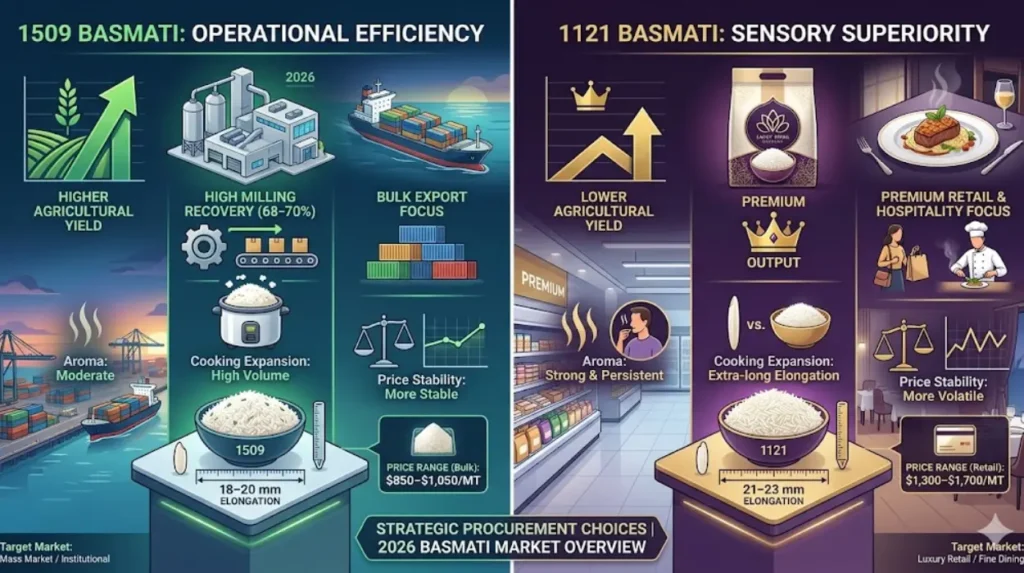
The comparison shows that 1509 prioritizes operational efficiency, while 1121 prioritizes sensory superiority.
Which method works best for different cases?
1509 Basmati performs best for high yield cost sensitive foodservice and bulk export contracts while 1121 Basmati dominates premium retail segments requiring stronger aroma longer grains and superior presentation in plated dishes across Middle Eastern European and North American markets 2026 demand.
Market Region Preference Analysis
| Region | Preferred Variety | Grade Preference | Price Sensitivity | Shelf Life Priority |
|---|---|---|---|---|
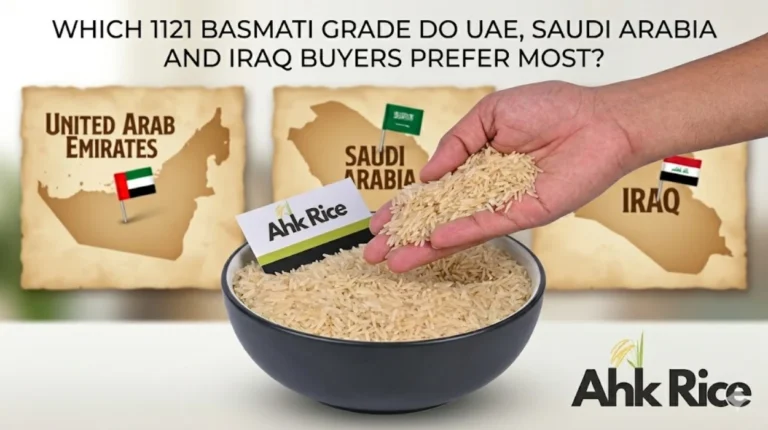
| Middle East | 1121 Basmati | Premium Grade A | Medium | High aroma retention priority |
| Europe | 1121 + 1509 blend | Retail + Institutional | High | Balanced shelf stability |
| North America | 1509 Basmati | Bulk/foodservice grade | High | Long storage cycles |
Middle Eastern buyers prioritize aroma and elongation for traditional dishes like mandi and kabsa.
European buyers balance cost efficiency with branded retail packaging requirements.
North American importers prioritize contract stability and large-scale institutional supply.
Pros and cons (with examples)
1509 Basmati offers higher yield lower cost and consistent cooking expansion making it ideal for volume buyers while 1121 Basmati provides superior aroma elongation and premium plate appeal but comes with higher procurement cost and slightly lower milling efficiency overall.
1509 Basmati Pros
- Higher milling recovery reduces export cost per ton
- Stable pricing supports long-term contracts
- Better performance in large-scale cooking systems
Example: Airline catering services prefer 1509 due to consistent texture after reheating.
1509 Basmati Cons
- Lower aroma intensity compared to premium variants
- Less visual elongation on plating
- Not preferred for luxury retail branding
1121 Basmati Pros
- Superior aroma retention during cooking
- Exceptional grain elongation (visual premium quality)
- Strong consumer preference in luxury markets
Example: High-end restaurants in Dubai and London prefer 1121 for plated presentation.
1121 Basmati Cons
- Higher procurement cost per MT
- Slightly lower milling recovery
- More sensitive to storage humidity
Decision factors
Key decision factors include target market segmentation export destination requirements budget per metric ton grain quality expectations shelf life needs processing capability packaging formats and long term supply stability across international rice procurement and trading environments in global markets 2026.
Decision Framework Table
| Factor | 1509 Advantage | 1121 Advantage | Buyer Impact |
|---|---|---|---|
| Cost efficiency | Strong | Weak | Determines bulk viability |
| Aroma strength | Medium | Strong | Influences premium demand |
| Grain elongation | Medium | High | Impacts plating aesthetics |
| Shelf stability | High | Medium | Affects export logistics |
| Market demand | Institutional | Retail premium | Defines buyer category |
Procurement Decision Matrix
| Buyer Type | Recommended Variety | Reason |
|---|---|---|
| Foodservice distributors | 1509 | Cost + volume efficiency |
| Retail brands | 1121 | Premium positioning |
| Government tenders | 1509 | Budget stability |
| Luxury restaurants | 1121 | Aroma and presentation |
| Export traders | Mixed portfolio | Risk diversification |
Strategic interpretation for 2026 rice trade
The 2026 basmati market is no longer purely quality-driven. It is segmentation-driven.
1509 Basmati has evolved into the backbone of bulk export economics. It stabilizes supply chains and reduces per-unit volatility in international contracts. It is the operational grain.
1121 Basmati remains the brand-building grain. It defines premium perception in supermarkets, hospitality chains, and gourmet imports. It is the reputational grain.
Exporters like AHK Rice structure their portfolios around this duality. This allows them to serve cost-sensitive institutional buyers and aroma-sensitive premium buyers without supply conflict.
Final synthesis
The correct choice is not universal. It is conditional. 1509 Basmati dominates when scale, stability, and cost efficiency define success. 1121 Basmati dominates when sensory quality, branding, and premium positioning define success. Modern procurement systems increasingly combine both to balance profitability and market reach.
Frequently Asked Questions
What is the main difference between 1509 and 1121 Basmati rice?
1509 Basmati focuses on higher yield, cost efficiency, and stable export performance, while 1121 Basmati is known for extra-long grain, stronger aroma, and premium visual presentation. The choice depends on whether buyers prioritize volume supply or premium quality positioning.
Which rice variety is cheaper in 2026 export markets?
1509 Basmati is consistently cheaper than 1121 Basmati in 2026 global trade. It benefits from higher milling recovery and agricultural yield, which reduces the final cost per metric ton, making it suitable for bulk institutional and foodservice contracts.
Which variety is better for restaurants and foodservice buyers?
1509 Basmati is preferred in foodservice operations due to its cost efficiency, consistent cooking results, and bulk handling advantages. It performs well in large-scale kitchens where uniformity and price control are more important than aroma intensity.
Does 1121 Basmati taste better than 1509?
1121 Basmati has a stronger aroma and longer grain elongation after cooking, which many consumers perceive as higher quality. However, taste preference depends on use case, as 1509 delivers a more neutral profile suitable for mixed dishes and large-scale cooking.
Which rice has a longer shelf life for export shipping?
1509 Basmati generally has a slightly longer shelf life and better stability in long-distance shipping due to lower moisture sensitivity. 1121 Basmati still stores well but requires more controlled humidity conditions to maintain aroma and grain integrity.