Why Do UK Buyers Request Moisture Specifications Before Importing Rice?
UK buyers request moisture specifications before importing rice because moisture content directly affects shelf life, food safety, grain quality, and shipping performance. Here is why: rice with excessive moisture develops mould, loses quality during transit, and creates financial losses through weight variation and storage issues.
Rice importers in the United Kingdom inspect moisture specifications before signing contracts because moisture determines how rice behaves during storage, transport, packaging, and retail distribution. Basmati rice travels thousands of kilometres from producing countries such as Pakistan and India to warehouses, distributors, supermarkets, and foodservice companies in the UK. Moisture becomes one of the most important measurable quality indicators throughout this journey.
What Are Moisture Specifications in Rice Imports?
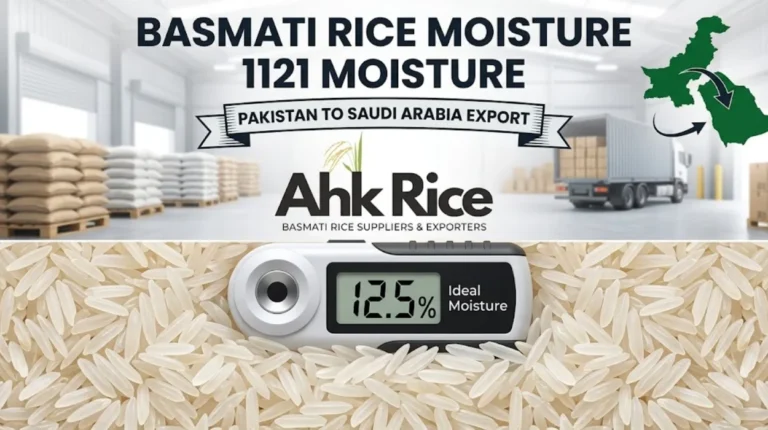
Moisture specifications define the exact water content within rice grains, usually between 12% and 14%, before export and international shipment.
Moisture content measures the percentage of water present inside a rice grain. Laboratories test rice samples using calibrated moisture meters before shipment. Import contracts often specify maximum moisture limits because rice quality depends heavily on stable moisture levels.
Rice exporters commonly supply moisture specifications such as:
| Rice Type | Standard Moisture Level |
|---|---|
| 1121 Basmati White Rice | 12%–13% |
| 1121 Steam Basmati | 12%–13% |
| 1121 Golden Sella | 13%–14% |
| Super Kernel Basmati | 12%–13% |
| 1509 Basmati Rice | 12%–13% |
UK importers compare these values before procurement. Higher moisture levels increase storage risks. Lower moisture levels improve stability during long-distance shipping.
With moisture specifications defined, the next question is how moisture affects rice during transport.
How Does Moisture Affect Rice During International Shipping?
Moisture levels above 14% increase spoilage risk, while levels between 12% and 13% improve storage stability and shipping performance.
Rice spends between 25 and 45 days in ocean containers travelling from Pakistan to the United Kingdom. During transit, containers experience temperature changes, humidity fluctuations, and condensation.
Excess moisture creates ideal conditions for microbial growth. Mould spores multiply rapidly when moisture exceeds accepted thresholds. Rice grains absorb surrounding humidity and become vulnerable to deterioration.
Container condensation presents another challenge. Water droplets form inside containers when external temperatures fluctuate significantly. Rice with elevated moisture levels absorbs this additional moisture, increasing quality risks.
Stable moisture levels protect grain structure. Long Basmati grains retain their appearance, aroma, and cooking characteristics throughout transportation.
UK buyers request moisture reports because shipping performance depends directly on moisture stability. Understanding shipping risks also requires understanding how rice is processed before export.
How Is Rice Processed to Achieve Export Moisture Standards?
Rice reaches export moisture standards through controlled drying, testing, grading, and inspection before shipment.
Rice processing begins immediately after harvest. Export-quality rice follows a structured sequence to achieve target moisture levels.
What Are the Main Processing Steps?
- Clean the harvested paddy.
- Dry the paddy to target moisture.
- Store the paddy under controlled conditions.
- De-husk the grain.
- Polish the rice.
- Grade by size and quality.
- Sort using colour sorters.
- Test moisture content.
- Load and dispatch export consignments.
Drying remains the most important moisture-control stage. Processing facilities reduce excess water gradually to avoid grain cracking.
Laboratories inspect samples from every production batch. Moisture meters verify compliance before packaging.
Exporters maintain records for traceability and quality verification. These reports become part of buyer documentation.
With processing established, the next question concerns the specific benefits moisture control delivers to importers.
Why Do UK Buyers Consider Moisture Control Important?
Moisture control protects quality, extends shelf life, reduces financial risk, and ensures regulatory compliance.
Rice importers operate within strict food safety requirements. Moisture specifications help them maintain consistent product quality throughout the supply chain.
What Benefits Does Proper Moisture Control Provide?
- Quality preservation
- Shelf life extension
- Weight stability
- Reduced spoilage
- Improved food safety
- Better cooking performance
- Regulatory compliance
Quality preservation remains the primary benefit. Long-grain Basmati maintains its appearance and cooking characteristics.
Shelf life improves significantly. Rice stored at 12%–13% moisture remains stable longer than rice stored above 14% moisture.
Weight stability protects commercial transactions. Excess moisture creates weight fluctuations during storage. Buyers pay for rice solids rather than excess water.
Food safety becomes easier to manage because controlled moisture limits microbial growth.
With benefits established, understanding the rice varieties imported into the UK provides additional context.
Which Pakistani Rice Varieties Do UK Buyers Commonly Import?
1121 Basmati, Super Kernel Basmati, and 1509 Basmati remain the most frequently imported Pakistani aromatic rice varieties.
Pakistan cultivates premium Basmati rice in Punjab’s fertile agricultural regions. Irrigation from the Indus River system supports production of export-quality grains.
What Is 1121 Basmati Rice?
1121 Basmati produces grain lengths exceeding 8 mm before cooking and up to twice that length after cooking.
1121 Basmati dominates many export markets because of its appearance, aroma, and elongation ratio. Buyers in the UK foodservice sector frequently source this variety.
What Is Super Kernel Basmati Rice?
Super Kernel Basmati offers traditional aroma, long grains, and strong consumer recognition in ethnic retail markets.
Super Kernel Basmati remains popular among South Asian communities throughout the United Kingdom.
What Is 1509 Basmati Rice?
1509 Basmati delivers long grains, competitive pricing, and efficient cooking performance.
1509 Basmati appeals to buyers seeking premium quality at a more accessible price point.
With varieties understood, certifications become the next important buyer consideration.
Which Certifications Support Moisture and Quality Verification?
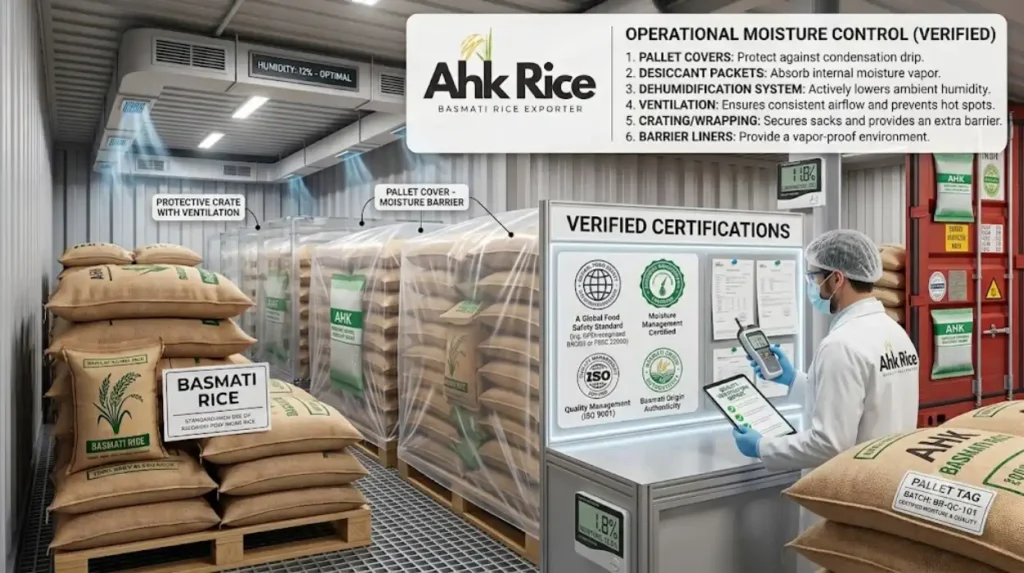
ISO, HACCP, phytosanitary certification, and laboratory testing verify rice quality and moisture compliance.
UK buyers require documentation proving that rice meets safety and quality requirements. Certification supports transparency throughout the supply chain.
What Certifications Are Commonly Required?
- ISO 22000 certification
- HACCP certification
- Phytosanitary certificate
- Certificate of origin
- Fumigation certificate
- Laboratory analysis reports
- Health certificate
Laboratory reports provide moisture verification. Independent testing confirms shipment compliance before export.
Phytosanitary certificates verify plant health status. Food safety certifications demonstrate systematic quality management.
Certification strengthens buyer confidence and reduces import risks.
With certifications covered, the next topic addresses common misconceptions surrounding rice moisture.
What Misconceptions Exist About Rice Moisture Specifications?
Higher moisture does not improve rice quality, and lower moisture does not automatically damage grain performance.
Many buyers assume higher moisture creates softer cooking results. This assumption ignores storage and shipping realities.
Does Higher Moisture Mean Better Rice?
No. Moisture above accepted limits increases spoilage risk and reduces storage stability.
Rice quality depends on variety, ageing, milling, grading, and aroma characteristics. Moisture supports preservation rather than quality creation.
Does Lower Moisture Reduce Rice Quality?
No. Properly controlled moisture protects grain integrity during shipping and storage.
Controlled drying preserves grain structure. Excessive drying causes breakage, but standard export moisture levels prevent this issue.
Is Moisture Important Only for Long Shipments?
No. Moisture affects warehousing, distribution, packaging, and retail storage after arrival.
UK distributors often store rice for months before final sale. Moisture stability remains important throughout the product lifecycle.
With misconceptions clarified, the final question concerns the broader role of moisture specifications in international trade.
Why Are Moisture Specifications Essential in Modern Rice Trade?
Moisture specifications create measurable quality standards that protect buyers, suppliers, and consumers throughout the supply chain.
Global rice trade depends on objective quality parameters. Moisture content provides a clear and measurable standard that buyers can verify before purchase.
Importers use moisture specifications to compare suppliers consistently. Exporters use moisture reports to demonstrate compliance. Inspectors use laboratory results to verify shipment quality.
UK buyers request moisture specifications because moisture affects every stage of rice handling. Cultivation, processing, storage, shipping, warehousing, distribution, and consumption all depend on controlled moisture levels.
Rice with stable moisture performs better during transportation, remains safer during storage, and delivers consistent quality to consumers. That reliability explains why moisture specifications appear in nearly every professional rice import contract.
Frequently Asked Questions
Why do UK importers check rice moisture levels?
UK importers check moisture levels because moisture directly affects shelf life, food safety, storage stability, and shipping performance.
What is the ideal moisture content for exported Basmati rice?
Most export-grade Basmati rice ships at 12%–13% moisture, while some parboiled grades ship at 13%–14% moisture.
How is rice moisture measured?
Laboratories use calibrated moisture meters and standardized testing procedures to determine moisture percentages accurately.
Can high moisture damage rice during shipping?
Yes. High moisture increases mould growth, condensation risks, grain deterioration, and storage losses.
Which Pakistani rice varieties are popular in the UK?
1121 Basmati, Super Kernel Basmati, and 1509 Basmati are among the most commonly imported Pakistani aromatic rice varieties.