Rice Export Trends Every International Buyer Should Know
The global agricultural trade system demands precise sourcing frameworks, predictable supply logistics, and verified product specifications. International rice procurement requires a granular understanding of variety metrics, milling protocols, regional cultivation advantages, and shifting cross-border regulatory frameworks. This foundational overview analyzes the core dynamics of the high-value rice export sector, focusing on operational logistics, standard botanical classifications, and systemic trade workflows.
What is premium Pakistani Basmati rice?
Premium Pakistani Basmati rice is a geographically protected long-grain aromatic cultivar grown exclusively in the fertile, alluvial soil tracks of the Punjab province. This specific crop requires distinct agro-climatic conditions, featuring mineral-rich glacial water irrigation, specific temperature cycles, and seasoned post-harvest maturing systems.
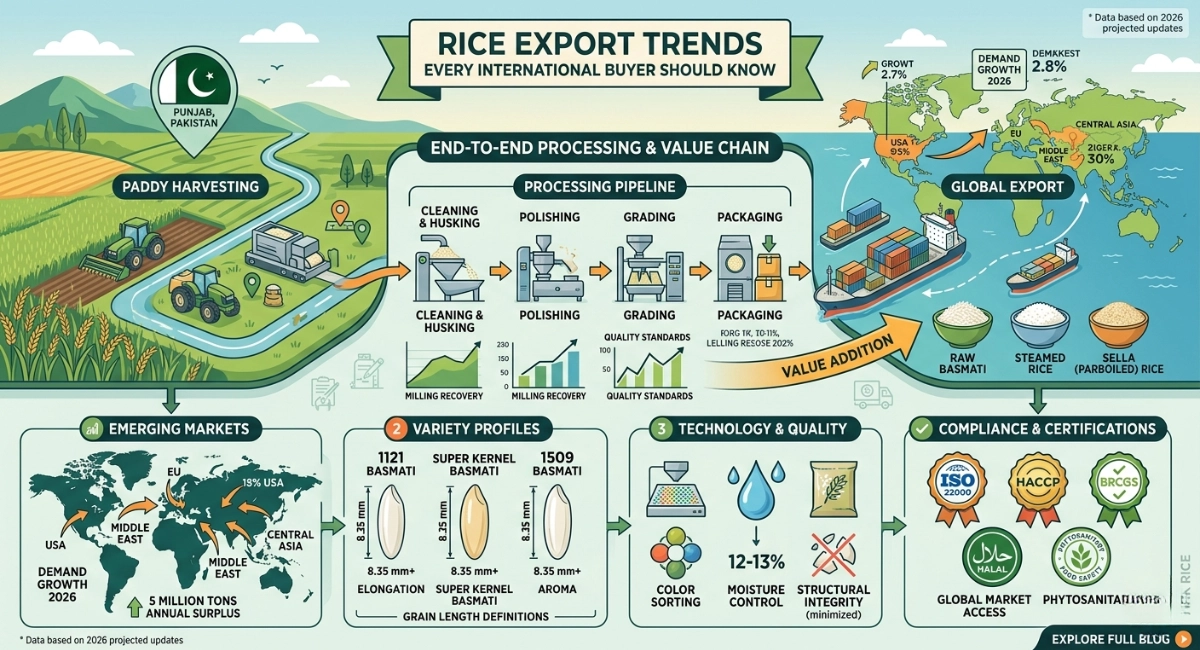
Botanical classification divides these premium commodities into strict registered varieties. The 1121 Basmati variety maintains a global reputation for extreme grain lengths, frequently measuring between 8.35 millimeters and 8.40 millimeters in its pre-cooked state. Super Kernel Basmati represents the traditional standard, recognized for intense natural aroma development and superior cooking elongation factors. The 1509 Basmati variety offers an early-maturing alternative with a grain length of 8.20 millimeters, delivering specific yield efficiencies to producers.
Geographic Indications laws protect the authenticity of these crops. The specific soil chemistry of the Indus River basin provides the precise nutrient balance required for the synthesis of 2-acetyl-1-pyrroline, which is the chemical compound responsible for the signature nutty aroma. International buyers evaluate these varieties based on clear biometric indicators, ensuring that physical kernel dimensions match the culinary expectations of target consumer markets.
How does the end-to-end processing pipeline work?
The end-to-end processing pipeline works through a automated structural sequence that converts raw paddy into stable, graded, and shelf-ready polished grains. This mechanical workflow utilizes specialized machinery to systematically execute cleaning, husking, color sorting, and customized packaging operations within a closed system.
1.Paddy Intake and Mechanical Cleaning:Stage 1.
Raw agricultural inputs pass through multi-stage vibratory sifters, magnetic separators, and de-stoners to isolate the raw paddy from external field debris. This process eliminates stones, weed seeds, straw particles, and metallic contaminants before the grain enters the milling machinery.
2.Pneumatic Husking and Shelling:Stage 2.
The cleaned paddy rolls through computerized rubber roll hullers where controlled shear pressure separates the tough outer protective husk from the inner nutrient layer. This stage yields brown rice, while pneumatic aspirators channel the removed husks out of the production floor for utilization as biomass fuel.
3.Polishing, Whitening, and Friction Adjustments:Stage 3.
Grains move sequentially into multi-stage abrasive whitening cones and friction polishers. The machine systematically strips away the bran layers and the germ tail, transforming the dull brown grain into a bright, white pearlescent kernel without fracturing the physical endosperm structure.
4.Water-Mist Silk Polishing:Stage 4.
The whitened grains pass through specialized mist-polishing cylinders where micro-quantities of purified water vapor are applied under specific pressure. This step removes remaining bran dust, giving the grain a smooth, glass-like finish that increases shelf stability by eliminating oil-rich surface residues.
5.Length Grading and Color Sorting:Stage 5.
Indented rotating cylinders isolate broken fragments from full-length premium grains based on exact dimensions. The uniform whole grains then drop through high-speed trichromatic optical sorters, where digital cameras detect and blast away discolored, chalky, or damaged kernels using targeted air pulses.
Processing Yield Standard: A standard industrial milling configuration yields approximately 68% total rice recovery from raw paddy inputs. Within this recovery, the primary premium output comprises 50% to 55% full-length whole head rice, with the remainder categorized as broken grains or secondary processing byproducts.
What are the key components of international rice grading?
The key components of international rice grading are measurable physical metrics, uniform moisture thresholds, and specific processing treatments that dictate final product categorization. Global buyers use these verified metrics to establish contract values, settle shipping specifications, and verify compliance with regional food safety import quotas.
Grain Length Definitions
Commercial grain classifications depend on precise pre-cooked length parameters measured in millimeters. Long-grain varieties require a minimum average kernel length of 6.61 millimeters. Premium iterations, such as the 1121 Steam variety, exceed this baseline by establishing an average length profile of 8.35 millimeters to 8.40 millimeters.
Processing Variations
Processing methods alter the final structural utility and storage behavior of the commodity. White rice undergoes standard milling to completely remove the hull, bran, and germ, prioritizing appearance and rapid cooking times. Sella rice, also known as parboiled rice, involves steam-vacuuming the raw paddy before husking, driving water-soluble nutrients from the bran layer directly into the starchy endosperm.
Steam processing utilizes precise hydrothermal treatments on aged brown rice grains, sealing internal micro-fissures and changing the starch structure into a gel state. This specific process creates highly resilient grains that resist breakage during industrial packaging operations. Brown rice retains its natural bran coating, offering higher fiber metrics at the expense of a shorter total shelf life due to fat oxidation risks.
Quality Variance Tolerances
Contracts specify strict allowable percentages for grain imperfections to manage cargo value variations. The broken grain threshold defines the maximum allowable percentage of fragments measuring less than 75% of the standard whole grain length. The chalky grain metric measures the percentage of kernels showing a milky, opaque appearance, which indicates incomplete starch structure development that reduces cooked texture quality.
| Grading Component | Premium Basmati Target | Standard Long Grain Limit | Evaluation Method |
| Average Grain Length | 8.35 mm – 8.40 mm | 6.61 mm – 7.00 mm | Digital Caliper Sizing |
| Moisture Content | 12.0% – 13.0% Max | 14.0% Max | Capacitance Moisture Meter |
| Broken Percentage | 1.0% – 2.0% Max | 5.0% – 10.0% Max | Indented Cylinder Separation |
| Chalky Kernels | 1.0% Max | 4.0% Max | Photoelectric Transmittance |
| Damaged / Discolored | 0.5% Max | 2.0% Max | Optical Color Sorting |
What are the commercial benefits of sourcing Pakistani rice?
The commercial benefits of sourcing Pakistani rice include strong supply-chain reliability driven by growing national production outputs, high pricing competitiveness compared to regional exporters, and superior kitchen performance indicators. These economic and agricultural strengths allow international distributors to secure predictable profit margins while maintaining high product quality standards.
Volume Stability Metrics
Sourcing from the Indus basin provides significant supply stability due to consistent crop production expansions. National output forecasts indicate a total harvest of 9.80 million tons for the 2026/2027 agricultural cycle, providing international trade channels with an estimated exportable surplus of 5.00 million tons. This structural availability insulates major bulk buyers from sudden crop export bans or volume restrictions.
Economic Competitive Edge
Importers gain measurable financial advantages through regional economic factors and dedicated national export incentives. The operational cost landscape in Punjab allows local mills to offer competitive Free On Board pricing models compared to other global suppliers. Furthermore, a 9% targeted government export subsidy helps stabilize export prices against international shipping rate fluctuations.
Product Utility Advantages
The high physical quality of the grain directly reduces processing waste during downstream cleaning and packaging stages. The structural strength of parboiled and steam-treated grains limits broken grain losses to less than 2% during cross-border transit. The high elongation ratio, which expands grains to twice their original size when cooked, ensures high consumer satisfaction scores in retail markets.
What are the primary use cases for different rice grades?
The primary use cases for different rice grades span high-end retail distribution lines, large-scale commercial catering sectors, and precision manufacturing frameworks. Matching specific variety attributes to precise end-user applications ensures optimum cooking performance and protects corporate procurement budgets.
High-End Consumer Retail Brands
Premium grocery chains and specialty boutique food brands select long-grain 1121 and Super Kernel varieties for packaging in consumer-ready pouches. These consumer profiles prioritize long grain lengths, polished visual presentation, and distinct aroma metrics. The retail sector uses clear plastic packaging or metallic zip-lock bags to showcase the lack of broken fragments or discoloration in the product.
Industrial Catering and Hospitality
Large-scale catering companies, hotel networks, and commercial kitchen systems choose sella or parboiled varieties for high-volume preparation environments. These industries require durable grains that do not rupture or release excess starch when held in warming trays for extended periods. Sella rice withstands heavy mechanical mixing and prolonged steam exposure without becoming sticky or losing its individual kernel structure.
Food Manufacturing and Processing
Industrial food processors use broken grain grades and coarse non-basmati varieties to manufacture infant foods, rice flour, puffed snacks, and brewing adjuncts. These applications do not require whole grain lengths, allowing manufacturers to leverage lower raw material costs. Processing facilities utilize the consistent starch structures of these grades to ensure uniform viscosity profiles during industrial extrusion processes.
What are the common misconceptions and structural problems in rice procurement?
The common misconceptions and structural problems in rice procurement involve misjudging moisture shelf-life limits, confusing generic long-grain varieties with authentic Basmati genetics, and ignoring maritime logistics complexities. Addressing these technical realities prevents unexpected cargo spoilage, regulatory border rejections, and financial losses.
The Moisture Misconception
A frequent error among procurement managers is assuming that higher moisture content improves final cooked yields. Excess moisture inside sealed shipping containers creates an environment ripe for mold cultivation, fungal growth, and sour odors during long sea journeys. Maintaining strict moisture levels between 12% and 13% prevents biochemical heat generation inside the bulk bags, protecting grain quality during transit through tropical shipping routes.
Variety Substitution Risks
Unverified supply chains frequently blend authentic premium Basmati grains with cheaper non-aromatic long-grain varieties to artificially lower prices. This practice degrades cooking quality, resulting in uneven water absorption and loss of uniform aroma profiles during preparation. Importers can prevent these grading issues by enforcing strict DNA testing requirements and utilizing verified trace-documentation protocols.
Container Sweat and Transit Logistics
Temperature variations during ocean transit cause water condensation, known as container sweat, along the metal ceilings of shipping holds. If cargo holds lack proper ventilation and container design, this moisture drops back onto the burlap or polypropylene bags, causing localized rotting. Using container liners, desiccants, and properly dried wooden pallets helps mitigate these cargo risks over long shipping distances.
Which international markets import this product and what certifications apply?
International markets importing this product include the Middle East, the European Union, the United States, and growing trade hubs across Central Asia and East Africa. Accessing these destination markets requires maintaining strict compliance with specific chemical residue limits, phytosanitary standards, and verified food safety manufacturing certifications.
Global Destination Markets
The Middle East region accounts for approximately 65% of all premium Basmati shipments, with the United Arab Emirates and Saudi Arabia leading total import volumes. Central Asian nations represent high-growth emerging destinations, with direct rail links and road routes driving shipments to Kazakhstan and Uzbekistan. Importers in the United States and the United Kingdom have also increased trade volumes, capturing market share helped by changing tariff policies on alternative regional suppliers.
Mandatory Export Documentation
Every container leaving Pakistani ports requires a specific suite of official legal documentation to clear destination customs systems. The Department of Plant Protection issues an official Phytosanitary Certificate verifying the cargo is free from agricultural pests. The Rice Exporters Association of Pakistan provides the official Certificate of Origin, while independent agencies issue mandatory fumigation certificates following standardized gas applications.
Food Safety Frameworks
European and North American regulatory authorities enforce strict maximum residue limits on chemical components, requiring precise crop management protocols during the cultivation phase. Processing mills must maintain international food safety certifications to enter premium retail markets. These critical operating frameworks ensure that all processing steps follow verified hygiene, safety, and trace-documentation standards.
- ISO 22000: Verifies the presence of an integrated food safety management system across the entire milling and packaging pipeline.
- HACCP: Identifies and controls potential biological, chemical, and physical hazards during grain processing stages.
- BRCGS / IFS: Validates operational standards within the processing environment to satisfy UK and European supermarket group procurement mandates.
- Halal / Kosher: Assures compliance with specific dietary requirements for specialized international consumer segments.