What Grain Length Is Best for Traditional Saudi Arabian Kabsa Rice? A Look at Pakistan Basmati Varieties
Traditional Saudi Arabian Kabsa tastes best with extra-long grain Pakistani Basmati rice measuring 8.0 mm to 9.0 mm before cooking and extending beyond 18 mm after cooking. Here is why: long grains remain separate, absorb meat stock evenly, retain shape during extended cooking, and create the authentic appearance expected in Saudi households and restaurants.
Saudi Arabian Kabsa is one of the largest rice-consuming food categories in the Gulf region. Rice serves as the foundation of the dish, while lamb, chicken, spices, and stock build flavor around it. Grain length directly affects texture, presentation, moisture absorption, and serving quality. Pakistan Basmati varieties dominate premium Kabsa applications because they provide the extra-long grain characteristics required for traditional preparation.
What Grain Length Is Considered Best for Traditional Saudi Arabian Kabsa?
The preferred Kabsa specification is 8.0–9.0 mm uncooked grain length and 16–22 mm cooked grain length.
Saudi Arabian consumers associate premium Kabsa with long, slender, separate grains. Short grains create a dense texture. Medium grains absorb stock quickly but lack the elongated appearance expected in traditional serving platters.
Pakistani Basmati varieties fit these requirements because their natural grain structure expands significantly during cooking. Length expansion improves visual appeal and helps the rice remain distinct when mixed with meat stock and spices.
The Saudi foodservice sector, including restaurants, catering companies, and banquet kitchens, commonly sources extra-long grain rice specifications because presentation affects customer perception. Large serving trays require rice that remains fluffy and visually consistent after holding periods.
The most preferred grain categories for Kabsa include:
| Rice Variety | Average Uncooked Length |
|---|---|
| 1121 Basmati | 8.3–8.5 mm |
| 1509 Basmati | 8.2–8.4 mm |
| Super Kernel Basmati | 7.2–7.6 mm |
| PK-386 Rice | 6.8–7.1 mm |
Saudi import demand continues to favor premium long-grain rice categories because foodservice operators seek maximum cooked volume and superior plate presentation (source: REAP export data, December 2025).
Grain length defines the final appearance of Kabsa, but understanding the rice varieties behind those specifications provides a clearer picture of market preferences.
Which Pakistani Basmati Varieties Meet Saudi Kabsa Requirements?
1121 Basmati, 1509 Basmati, and Super Kernel Basmati are the primary Pakistani varieties used for Saudi Kabsa preparation.
Readers comparing grain dimensions between premium Kabsa varieties can also review our detailed analysis of how 1121 Golden Sella and Super Kernel Sella differ in grain length and restaurant performance for Saudi kitchens.
Pakistan cultivates several Basmati varieties across Punjab’s rice-growing belt. Each variety offers distinct grain dimensions, cooking behavior, and market positioning.
1121 Basmati Rice
1121 Basmati produces 8.3–8.5 mm grain length before cooking. The grain extends beyond 20 mm after cooking under controlled conditions.
1121 Basmati dominates premium Gulf markets because it combines extra-long grain length with strong aroma and excellent elongation. Restaurants prefer this variety for high-end Kabsa presentations where visual quality influences purchasing decisions.
1509 Basmati Rice
1509 Basmati delivers 8.2–8.4 mm grain length with slightly faster cooking performance.
1509 Basmati gained popularity because it offers long grains and competitive pricing. Foodservice buyers often select this variety for large-scale catering operations that require consistent quality and cost control.
Super Kernel Basmati Rice
Super Kernel Basmati provides 7.2–7.6 mm grain length before cooking.
Super Kernel Basmati remains highly valued in Gulf markets because of its traditional aroma profile. The grain is shorter than 1121, but many consumers prefer its classic Basmati characteristics.
Each variety serves a specific segment of the Saudi market. Understanding how grain length develops during processing explains why these differences matter.
With the key varieties established, the next question is how processing influences grain length and cooking performance.
How Does Rice Processing Affect Grain Length for Kabsa?
Parboiling, drying, grading, and sorting determine grain integrity, elongation performance, and cooking stability.
Rice processing transforms harvested paddy into export-grade Basmati suitable for Kabsa preparation. Every processing stage influences final grain performance.
How Is Pakistani Basmati Processed?
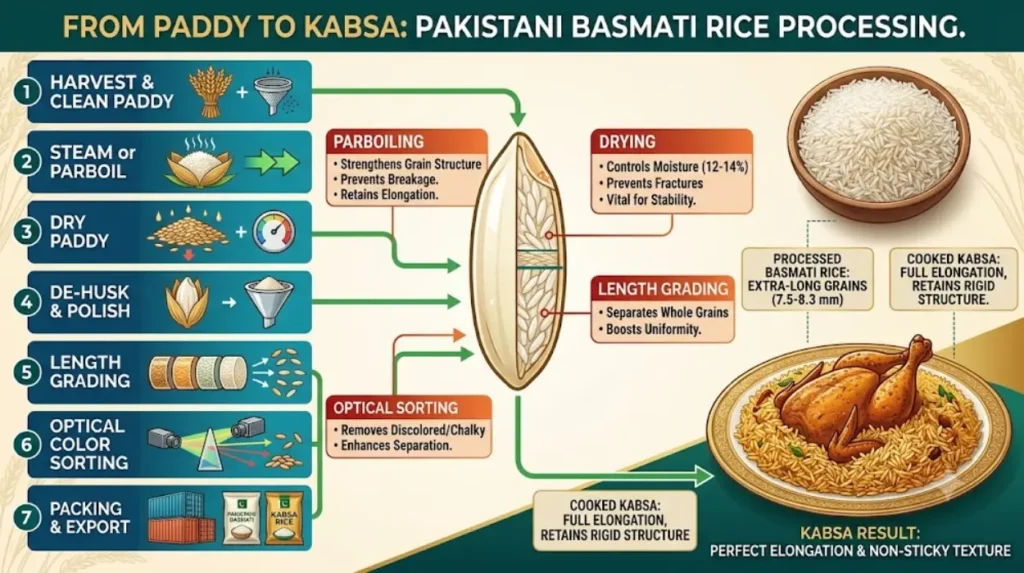
Processing facilities follow a structured workflow:
- Clean the harvested paddy.
- Remove foreign materials.
- Steam or parboil selected grades.
- Dry the grains to export moisture levels.
- De-husk the paddy.
- Polish the rice surface.
- Grade by grain length.
- Sort using optical color sorters.
- Pack according to export specifications.
Parboiling strengthens grain structure. Stronger grains break less during cooking and retain their elongated shape in Kabsa preparation.
Drying controls moisture content. Export-grade rice commonly maintains 12–14% moisture levels, supporting stability during shipping and storage.
Length grading separates grains according to size standards. Premium export categories contain higher percentages of uniform grains, creating a more consistent appearance after cooking.
Processing determines grain quality, but buyers also evaluate specific grades available within each variety.
What Grades of Pakistani Basmati Rice Are Available for Saudi Markets?
Steam, White, Golden Sella, and Creamy Sella grades represent the primary Basmati processing categories exported to Saudi Arabia.
Processing grades affect color, texture, shelf life, and cooking behavior.
White Basmati Rice
White Basmati undergoes milling and polishing without parboiling.
White rice offers a bright appearance and soft texture. Saudi households often prefer white rice for traditional home cooking applications.
Steam Basmati Rice
Steam rice receives controlled heat treatment before milling.
Steam processing strengthens grain structure while preserving natural color. Steam rice cooks consistently and maintains separation.
Golden Sella Basmati Rice
Golden Sella undergoes complete parboiling before milling.
Golden Sella develops a golden color and superior grain strength. Saudi catering companies frequently select this grade because it tolerates large-scale cooking operations.
Golden Sella lasts longer than Steam rice. In a 40°C warehouse environment common in Gulf logistics chains, Golden Sella maintains quality for approximately 18–24 months, while Steam grades generally perform best within 12–18 months.
Creamy Sella Basmati Rice
Creamy Sella follows a specialized parboiling process that produces a lighter color.
Creamy Sella combines grain strength with a premium appearance. Restaurants often choose this specification for upscale presentations.
Grade selection influences texture and presentation. Grain length remains important, but cooking performance determines practical results.
With processing grades understood, the next question is how grain length affects Kabsa preparation itself.
Why Does Grain Length Matter So Much in Kabsa Cooking?
Longer grains absorb stock efficiently, remain separate, and create the traditional Kabsa presentation expected across Saudi Arabia.
Kabsa preparation differs from simple boiled rice. Rice cooks with flavored broth containing meat juices, spices, onions, and tomatoes.
Long grains maintain separation during this cooking process. Separation creates the fluffy appearance associated with premium Kabsa.
Shorter grains absorb liquid quickly and become denser. Dense rice reduces visual volume and changes the expected texture profile.
Extra-long grains also improve serving presentation. Large communal platters showcase elongated grains more effectively than medium-grain alternatives.
Restaurant operators benefit from longer grains because cooked rice appears more abundant. Greater visual volume improves serving perception without altering portion size.
Grain length delivers clear cooking advantages, yet several misconceptions remain common among buyers.
What Common Misconceptions Exist About Grain Length and Kabsa Rice?
Longer grain does not automatically mean better quality, and aroma, aging, and grading remain equally important factors.
Many buyers assume grain length alone determines quality. Quality actually depends on multiple attributes.
Misconception 1: Longest Grain Always Wins
1121 Basmati offers the longest grain among major Pakistani varieties. Some consumers still prefer Super Kernel because of its traditional aroma profile.
Length improves presentation. Aroma influences eating experience.
Misconception 2: All Long-Grain Rice Performs the Same
Long-grain categories differ significantly in cooking behavior.
1121 Golden Sella retains structure differently than 1509 Steam Rice. Processing methods create distinct cooking characteristics.
Misconception 3: White Rice Is Always Better for Kabsa
Golden Sella grades often outperform White Rice in commercial kitchens.
Golden Sella withstands longer holding times. Large restaurants benefit from improved grain stability during service periods.
Misconception 4: Grain Length Cannot Be Controlled
Modern grading equipment sorts rice according to precise specifications.
Export facilities classify grains by size and remove broken kernels to meet buyer requirements.
Understanding these misconceptions helps buyers evaluate specifications more accurately. The next question focuses on the markets that actively import these varieties.
Which Markets Import Pakistani Basmati Rice for Kabsa Preparation?
Saudi Arabia, the United Arab Emirates, Kuwait, Qatar, Oman, and Bahrain represent the largest Gulf destinations for Pakistani Basmati rice.
Saudi Arabia remains one of the largest consumers of premium Basmati rice due to Kabsa’s cultural importance.
Restaurants, catering companies, hotels, and retail consumers purchase large quantities of long-grain Basmati each year. Pakistan remains a major supplier because Punjab’s climate supports cultivation of premium aromatic varieties (source: Pakistan Bureau of Statistics, FY2024–25).
United Arab Emirates buyers frequently select 1121 Golden Sella for catering operations. Kuwait importers often source both 1121 and Super Kernel grades. Qatar and Oman continue expanding imports of premium long-grain categories as hospitality sectors grow (source: REAP export data, December 2025).
Growing demand increases attention on quality assurance standards and certification requirements.
With export markets established, the final question concerns certifications that support international trade.
What Certifications Apply to Pakistani Basmati Rice Exports?
ISO certification, HACCP compliance, phytosanitary certification, fumigation certification, and food safety testing form the core export requirements.
International rice trade depends on verified quality standards.
Export shipments typically undergo:
- ISO quality management certification
- HACCP food safety compliance
- Phytosanitary certification
- Fumigation certification
- Certificate of origin
- Laboratory testing reports
- Halal compliance verification where required
Food safety testing evaluates moisture levels, purity, foreign matter, and grain specifications. Import authorities use these documents to verify compliance before market entry.
Certification protects buyers by establishing traceability and quality verification throughout the supply chain. Saudi importers increasingly require documented compliance because food safety regulations continue strengthening across Gulf markets.
Grain length remains the starting point of rice selection, but certification ensures that the chosen specification arrives consistently and safely.
Conclusion
1121 Basmati Rice provides the most suitable grain length for traditional Saudi Arabian Kabsa, with uncooked grains measuring 8.3–8.5 mm and cooked lengths exceeding 20 mm. Super Kernel Basmati remains a respected alternative because of its traditional aroma, while 1509 Basmati balances grain length and commercial efficiency. Grain grading, processing method, certification, and cooking performance all contribute to successful Kabsa preparation, but extra-long Pakistani Basmati continues to define the premium standard expected throughout Saudi Arabia.
Frequently Asked Questions
What grain length is ideal for traditional Saudi Arabian Kabsa?
Traditional Saudi Arabian Kabsa performs best with rice measuring 8.0–9.0 mm before cooking. Pakistani 1121 Basmati is the preferred choice because its grains elongate significantly during cooking and remain separate on the serving platter.
Why is 1121 Basmati rice popular for Kabsa in Saudi Arabia?
1121 Basmati rice is popular because it offers extra-long grains, strong elongation, and a light texture. The rice absorbs meat stock efficiently while maintaining grain separation, which is essential for authentic Kabsa presentation.
Is Super Kernel Basmati suitable for Kabsa preparation?
Yes, Super Kernel Basmati is suitable for Kabsa. The variety provides 7.2–7.6 mm grain length and a traditional Basmati aroma. Many Saudi consumers choose it for its flavor profile, although its grains are shorter than 1121 Basmati.
What is the difference between Golden Sella and White Basmati rice for Kabsa?
Golden Sella rice undergoes a parboiling process that strengthens the grain and improves cooking stability. White Basmati rice has a softer texture and a brighter appearance. Large catering operations often prefer Golden Sella because the grains remain intact for longer holding periods.
Which countries import Pakistani Basmati rice for Kabsa?
Saudi Arabia is the largest Kabsa-related market for Pakistani Basmati rice. Other major importers include the United Arab Emirates, Kuwait, Qatar, Oman, and Bahrain. These markets demand long-grain Basmati varieties for restaurants, catering businesses, and retail consumers.