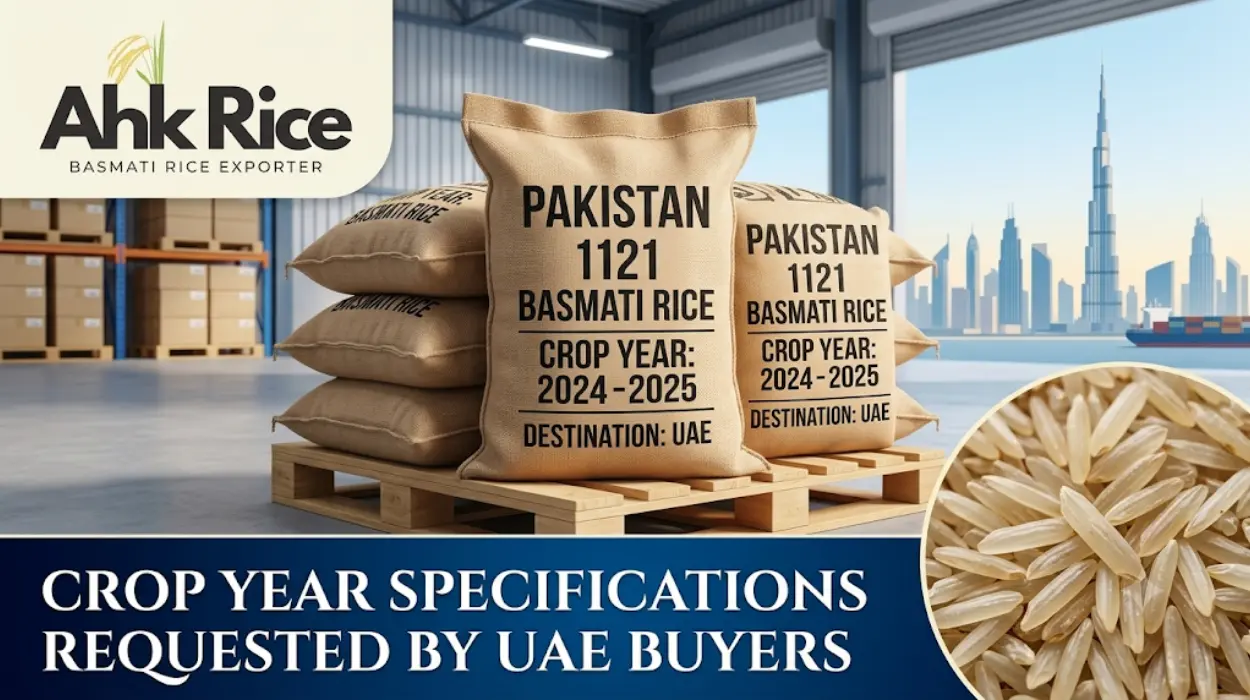
Crop Year Specifications Requested by UAE Buyers of Pakistan Basmati Rice
Pakistan crop-year specifications have become one of the most important purchasing requirements for UAE Basmati rice buyers. Here is why: crop year directly affects aroma, moisture, grain maturity, cooking performance, storage stability, and import value. Buyers who verify harvest year reduce quality disputes, improve inventory planning, and receive rice that matches their retail or food-service requirements.
UAE importers increasingly request verified crop-year information before confirming purchase contracts. Supermarkets, hotels, catering companies, wholesalers, and private-label distributors evaluate more than grain length or price. They compare harvest season, aging period, milling quality, moisture level, broken percentage, and packaging specifications before selecting an exporter. Pakistan remains one of the world’s leading Basmati suppliers because its Punjab region cultivates premium aromatic varieties such as 1121, Super Kernel, and 1509 under favorable climatic conditions (Source: REAP Export Data, December 2025).
Understanding crop-year specifications helps buyers compare suppliers objectively. Before evaluating verification methods, learn how harvest season influences Pakistan Basmati rice quality.
What crop-year specifications do UAE buyers usually request?
Buyers commonly request harvest year, aging period, moisture between 12–13%, broken percentage below 2–5%, grain length above 8.2 mm, purity above 95%, and complete export documentation because these specifications predict cooking consistency and commercial value.
Crop year identifies when paddy was harvested. Freshly harvested rice contains higher moisture and immature starch structure. Naturally aged rice develops stronger aroma, longer cooked grain, and improved texture. UAE buyers serving retail brands usually request aged crop stock because consumers expect consistent cooking performance.
Processing specifications follow crop verification. Exporters mill, dehusk, polish, grade, inspect, sort, and pack rice according to contract requirements. Every processing stage influences the final quality delivered to Dubai, Abu Dhabi, Sharjah, Ajman, and other GCC markets.
AHK Rice supplies verified Pakistan Basmati rice from Punjab and processes multiple varieties through controlled milling operations. The company exports 1121 Basmati, Super Kernel Basmati, and 1509 Basmati with customized specifications, packaging, and export documentation for buyers across more than fifteen countries.
Specification Comparison Requested by UAE Buyers
| Specification | Fresh Crop | Naturally Aged Crop |
|---|---|---|
| Harvest Age | 0–6 months | 12–24 months |
| Moisture | 13–14% | 12–13% |
| Aroma | Moderate | Strong |
| Grain Elongation | Good | Excellent |
| Cooking Stability | Moderate | High |
| Shelf Life | 12 months | 18–24 months |
| Premium Value | Lower | Higher |
Retail importers usually prioritize aged rice because consumers associate aroma with premium quality. Hotel suppliers also prefer mature crop stock because every batch cooks consistently across large commercial kitchens.
Wholesale traders often balance quality against price. Fresh crop provides lower procurement costs during new harvest season, while aged rice offers higher customer satisfaction and fewer complaints during long storage periods.
The specification comparison explains why crop year matters. The next step is comparing the available verification methods that exporters use.
What solutions are available for verifying Pakistan Basmati crop year?
The most reliable solutions combine government documentation, laboratory testing, warehouse traceability, production records, and exporter verification systems because multiple evidence sources reduce commercial risk and improve buyer confidence.
Different exporters verify crop year using different procedures. Basic suppliers provide only packing dates. Professional exporters provide harvest records, milling dates, warehouse inventory history, quality inspection reports, and shipment documentation.
Government Export Documents
Official export documents establish shipment authenticity. Commercial invoices, packing lists, phytosanitary certificates, certificates of origin, and fumigation certificates support international trade requirements. These documents confirm export compliance but do not always prove harvest season independently.
Laboratory Quality Testing
Independent laboratories inspect moisture, broken grains, foreign matter, damaged kernels, chalkiness, and grain dimensions. Laboratory reports demonstrate product quality before shipment. Moisture values around 12–13% indicate suitable storage conditions for export.
Warehouse Traceability
Professional inventory management tracks harvested paddy from procurement through storage, milling, grading, packaging, and container loading. Warehouse traceability allows exporters to identify the exact crop batch supplied to each customer.
Production Records
Mill production records document procurement dates, milling schedules, grading operations, quality inspections, and dispatch history. Buyers receive stronger confidence because each shipment links directly to production data.
Exporter Verification Systems
Established exporters combine every verification method into one documented process. AHK Rice verifies procurement, inspects raw paddy, grades rice by specification, records production batches, tests quality parameters, and prepares export documentation before dispatching containers.
| Verification Method | Accuracy | Cost | Buyer Confidence | Best Use |
|---|---|---|---|---|
| Packing Date Only | Low | Low | Low | Spot purchases |
| Laboratory Report | High | Medium | High | Quality verification |
| Warehouse Records | High | Low | High | Bulk contracts |
| Government Documents | High | Medium | High | Customs compliance |
| Complete Traceability System | Very High | Medium | Very High | Long-term import programs |
Retail chains typically request complete verification because consistent quality protects brand reputation. Catering companies often prioritize laboratory testing because cooking consistency directly affects food preparation. Private-label distributors usually require both verification systems before approving annual contracts.
Understanding verification methods makes supplier comparison easier. The next section compares fresh and aged crop strategies across UAE and other international markets while evaluating pricing, shelf life, and purchasing decisions.
How do different crop-year purchasing approaches compare?
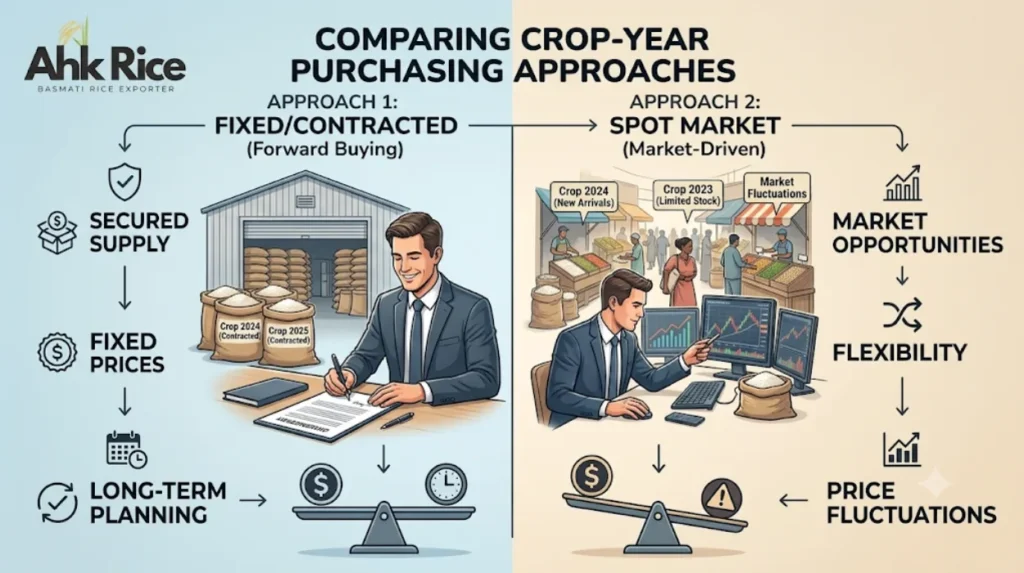
The best purchasing approach depends on sales channel, storage period, customer expectations, and procurement budget because fresh and aged Pakistan Basmati rice deliver different commercial advantages. UAE buyers generally select naturally aged rice for retail and hospitality markets, while price-sensitive wholesale traders sometimes purchase fresh crop immediately after harvest.
Crop year affects every commercial specification. Fresh rice offers lower procurement costs and larger seasonal availability. Naturally aged rice delivers stronger aroma, longer cooked grain, improved moisture stability, and better consumer acceptance. The correct choice depends on how the rice will be stored, marketed, and consumed.
Fresh Crop Pakistan Basmati Rice
Fresh crop rice refers to paddy harvested during the current production season. Exporters dry, mill, polish, grade, inspect, and package the rice after harvest before dispatching containers.
Fresh crop usually provides competitive pricing because inventory enters the market immediately after harvest. Buyers supplying institutional catering or price-sensitive wholesale markets often purchase fresh crop to reduce procurement costs.
Advantages include:
- Lower purchase price
- Higher seasonal availability
- Faster procurement after harvest
- Suitable for immediate distribution
Limitations include:
- Lighter aroma
- Higher natural moisture
- Less grain elongation
- Shorter storage life
Naturally Aged Pakistan Basmati Rice
Naturally aged rice remains under controlled warehouse conditions for 12–24 months before milling. During aging, moisture gradually stabilizes while starch structure matures naturally.
Aged rice cooks more consistently than fresh crop. Grain elongation improves significantly during cooking. Natural aroma also becomes stronger without artificial treatment.
Premium supermarkets across the UAE generally specify aged rice because customers expect fragrant, long-grain Basmati with reliable cooking performance.
Advantages include:
- Stronger natural aroma
- Better grain elongation
- Stable cooking quality
- Longer warehouse storage
- Higher consumer satisfaction
Limitations include:
- Higher procurement cost
- Limited inventory availability
- Longer production planning
Specification Comparison
| Attribute | Fresh Crop | Naturally Aged Crop |
|---|---|---|
| Procurement Price | Lower | Higher |
| Aroma Strength | Moderate | Excellent |
| Grain Elongation | Good | Very High |
| Moisture Stability | Good | Excellent |
| Cooking Performance | Consistent | Premium |
| Storage Stability | 12 Months | 18–24 Months |
| Retail Acceptance | High | Highest |
For example, Golden Sella aged rice maintains quality during long warehouse storage. Steam rice performs well for shorter inventory cycles. Retail brands usually prioritize aroma, while food-service buyers often prioritize cooking consistency.
The comparison between fresh and aged rice naturally leads to regional buying preferences.
Which crop-year specifications do UAE and European buyers prefer?
UAE buyers generally prefer 12–24 month aged 1121 and Super Kernel Basmati, while many European buyers prioritize certified traceability, food safety documentation, and stable quality over extended aging periods.
Buying preferences differ because each market serves different consumers.
UAE Market Preferences
UAE importers supply supermarkets, hotels, restaurants, catering companies, wholesalers, and private-label brands.
Most buyers request:
- 1121 Steam Basmati
- 1121 Golden Sella
- Super Kernel Basmati
- 12–24 months natural aging
- Moisture below 13%
- Broken below 2%
- Long grain above 8.30 mm
Consumers associate premium rice with aroma and grain elongation. As a result, verified crop year becomes part of supplier evaluation.
European Market Preferences
European importers focus heavily on compliance.
Typical requirements include:
- Traceability records
- Food safety testing
- Pesticide compliance
- Moisture certification
- Batch verification
- Sustainable sourcing
- Consistent grain grading
European distributors often accept younger crop rice when laboratory reports confirm stable quality.
Estimated Commercial Comparison
| Market | Preferred Grade | Average Premium Over Fresh Crop |
|---|---|---|
| UAE Retail | 1121 Aged Steam | US$80–150/MT |
| UAE Hotels | 1121 Golden Sella | US$90–170/MT |
| Europe Retail | Steam Basmati | US$40–90/MT |
| Africa Wholesale | Fresh Crop | Lowest Price |
| GCC Catering | Golden Sella | US$70–140/MT |
Prices vary according to harvest size, freight rates, exchange rates, milling quality, and international demand.
Regional preferences explain why exporters maintain multiple inventory categories throughout the year.
Which crop-year verification method works best for different buyers?
The most effective solution combines crop-year records, warehouse traceability, laboratory reports, and export documentation because multiple verification methods provide measurable evidence before shipment.
Different buyers require different verification levels.
| Buyer Type | Recommended Verification | Reason |
|---|---|---|
| Supermarkets | Complete traceability | Brand protection |
| Hotels | Laboratory testing | Cooking consistency |
| Catering Companies | Moisture verification | Large-volume cooking |
| Private Labels | Batch traceability | Product consistency |
| Wholesalers | Government documentation | Customs clearance |
AHK Rice follows an integrated verification process beginning with procurement and continuing through milling, grading, quality inspection, packaging, and export documentation. This approach enables buyers to compare crop-year specifications before shipment rather than after container arrival.
The decision process becomes easier after evaluating commercial benefits and limitations.
What decision factors should buyers evaluate before selecting crop-year specifications?
The most important decision factors are customer segment, storage duration, quality expectations, procurement budget, and supplier verification capability because these variables determine long-term purchasing success.
Every buyer balances quality against commercial objectives.
Decision Framework
| Decision Factor | Fresh Crop | Naturally Aged Crop |
|---|---|---|
| Lowest Procurement Cost | ✅ Best Choice | — |
| Premium Retail Sales | — | ✅ Best Choice |
| Long Warehouse Storage | — | ✅ Best Choice |
| Hotel & Restaurant Supply | Good | ✅ Excellent |
| Brand Reputation | Good | ✅ Highest |
Retail brands usually recover higher procurement costs through premium shelf positioning.
Hotels reduce cooking variation by selecting mature grain.
Wholesale distributors may maximize margins through seasonal fresh crop purchases.
The right specification depends on the buyer’s commercial strategy rather than a single quality parameter.
Crop-year verification has evolved from an optional specification into a commercial purchasing standard for UAE Basmati rice buyers. Verified harvest records improve transparency, reduce quality disputes, and help importers compare suppliers using measurable specifications instead of marketing claims.
Fresh crop remains suitable for buyers seeking competitive pricing and immediate availability. Naturally aged Pakistan Basmati rice provides stronger aroma, longer grain elongation, greater cooking consistency, and longer storage life. Retail supermarkets, hospitality companies, and premium private-label brands usually benefit most from aged inventory supported by laboratory reports and warehouse traceability.
AHK Rice supports international buyers with verified crop-year documentation, controlled processing, customized packaging, and complete export services for 1121, Super Kernel, and 1509 Basmati varieties.
For buyers comparing suppliers before placing bulk orders, continue with How to evaluate a Pakistan Basmati rice exporter that provides verified crop-year documentation for UAE importers.
Frequently Asked Questions
Does crop year affect Basmati rice quality?
Yes. Crop year influences moisture, aroma, grain maturity, cooking performance, storage stability, and commercial value. Naturally aged rice generally produces better cooking results than freshly harvested rice.
Which crop year do UAE buyers usually prefer?
Most UAE supermarkets, hotels, catering companies, and premium retailers prefer naturally aged Pakistan Basmati rice that has matured for 12–24 months under controlled storage conditions.
What documents verify crop year?
Buyers commonly request warehouse inventory records, production records, laboratory reports, packing lists, certificates of origin, phytosanitary certificates, and exporter batch traceability documents.
Which Pakistan Basmati variety is most popular in the UAE?
1121 Basmati Rice remains the preferred variety because of its extra-long grain, strong aroma, excellent elongation, and premium cooking performance.
Does aged rice cost more than fresh crop?
Yes. Naturally aged Basmati generally commands a premium of approximately US$80–170 per metric ton, depending on grade, processing type, market demand, and export season.