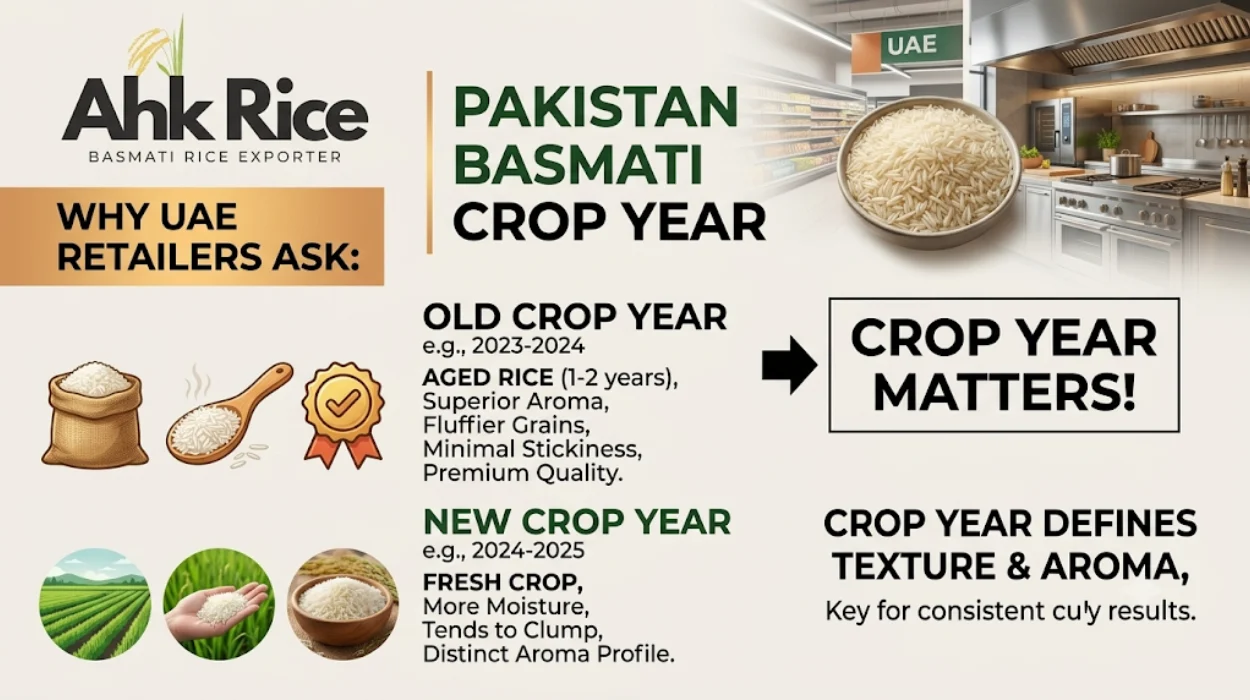
Why Do UAE Retailers and Hotels Ask About Crop Year in Pakistan Basmati Rice?
UAE retailers and hotels ask about the crop year because it directly determines aroma, cooking performance, grain stability, and shelf life. Here is why: freshly harvested Basmati contains higher moisture, while properly aged Basmati delivers longer grain elongation, lower stickiness, and consistent cooking results. Crop year has become one of the most important buying specifications for professional food businesses.
Pakistan Basmati rice serves supermarkets, hotels, restaurants, catering companies, wholesalers, and private-label food brands throughout the UAE. Buyers evaluate more than grain length or price before placing an order. They also verify the harvest season because rice changes naturally during storage. As the grain ages under controlled conditions, moisture declines, aroma compounds develop, and cooking consistency improves. These measurable changes influence customer satisfaction and commercial value.
Understanding crop year helps importers compare suppliers using objective quality indicators instead of marketing claims. The following guide explains what crop year means, how it influences Pakistan Basmati rice, how processors preserve quality, which grades buyers purchase, and why UAE food businesses include crop year in their purchasing specifications.
What Does Crop Year Mean in Pakistan Basmati Rice?
Crop year identifies the exact harvesting season of the rice. It tells buyers when the paddy was harvested, how long it has matured, and how the grain performs during cooking.
Crop year refers to the agricultural season in which farmers cultivate and harvest Basmati paddy. Pakistan harvests most Basmati rice between September and November in Punjab’s traditional rice-growing districts. The harvested paddy then enters storage before mills dehusk, polish, grade, and package the rice.
Crop year differs from packing date. A supplier can package rice in 2026 while selling rice harvested during the 2025 crop season. Professional buyers therefore request both dates to understand the product’s actual maturity.
Freshly harvested rice contains higher moisture. Natural aging gradually reduces internal moisture while stabilizing starch. This process improves cooking performance without altering the grain’s natural characteristics.
For example, a retailer selling premium family packs expects consistent cooking across thousands of households. A hotel serving daily buffets expects identical cooking performance every day. Crop year helps achieve that consistency.
With the definition of crop year established, the next question explains why UAE buyers place so much importance on this specification.
Why Do UAE Retailers and Hotels Check the Crop Year Before Buying?
Crop year predicts cooking quality, aroma intensity, grain elongation, moisture stability, and storage performance before the shipment leaves Pakistan.
UAE businesses purchase rice for different commercial purposes. Supermarkets focus on consumer satisfaction. Hotels require uniform cooking. Catering companies prioritize bulk consistency. Food manufacturers require stable raw materials for packaged products.
Each business depends on predictable cooking performance. Crop year provides one of the easiest indicators.
Older Basmati rice absorbs water more evenly during cooking. The grains separate better after cooking and maintain their structure during serving. Fresh rice generally requires more careful water control because internal moisture remains higher.
Hotels preparing hundreds of portions each day cannot adjust recipes for every shipment. Consistent crop year simplifies kitchen operations and reduces food waste.
Retailers also benefit because consumers expect every package to cook the same way. Consistency increases repeat purchases and reduces customer complaints.
Pakistan remains one of the world’s largest exporters of aromatic Basmati rice to Gulf markets, including the UAE (source: Pakistan Bureau of Statistics, FY2024–25).
This relationship between maturity and cooking leads naturally to the next question about how crop year changes the grain itself.
How Does Crop Year Influence Cooking Performance?
Properly aged Basmati delivers longer grain elongation, lower stickiness, stronger aroma, and better texture after cooking.
Basmati rice changes naturally during storage. Controlled aging reduces moisture while allowing the grain structure to stabilize. These changes improve cooking quality without chemical treatment.
Moisture Reduction
Fresh rice generally contains higher internal moisture. Storage gradually lowers moisture to commercial export levels, improving cooking consistency.
Lower moisture helps grains absorb water evenly during cooking. Uniform absorption produces separate cooked grains instead of clumps.
Aroma Development
Pakistan Basmati naturally contains aromatic compounds. Controlled storage strengthens these aromas over time, creating the fragrance expected in premium rice.
Restaurants serving biryani, mandi, kabsa, and pulao value mature aroma because customers immediately recognize premium-quality Basmati.
Grain Elongation
Properly matured rice expands more effectively during cooking. Premium 1121 Basmati often reaches nearly twice its uncooked length under correct cooking conditions.
Longer cooked grains improve presentation in restaurants, hotels, and banquet services.
Texture Stability
Aged rice produces firmer cooked grains. The rice remains separate after cooking and tolerates holding time better during buffet service.
Fresh rice softens faster during prolonged heating. Hotels therefore often prefer aged crop-year specifications for commercial kitchens.
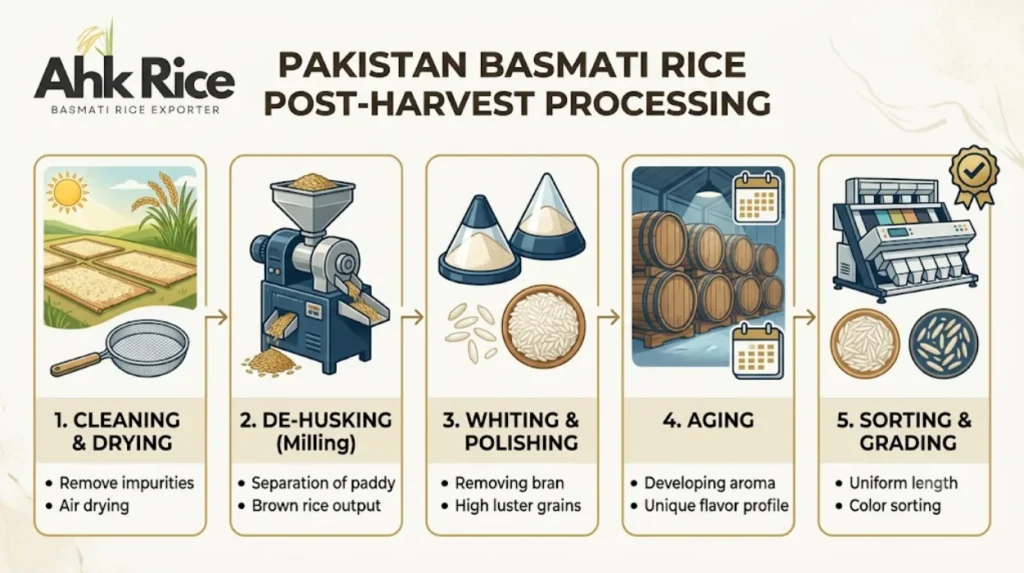
How Is Pakistan Basmati Rice Processed After Harvest?
Proper processing protects grain length, aroma, moisture balance, food safety, and export quality. Every processing stage prepares the rice for consistent performance in international markets.
Harvesting marks the beginning of the quality journey. Professional rice mills follow controlled processing steps to preserve the natural characteristics developed during cultivation and aging. Each stage has a specific purpose and contributes to the final cooking quality.
Processing Steps from Paddy to Export
- Clean the harvested paddy to remove dust, stones, straw, and foreign material.
- Dry the paddy until it reaches the required moisture level for safe storage.
- Store the paddy under controlled warehouse conditions for natural aging.
- Dehusk the grain by removing the outer husk without damaging the kernel.
- Mill the rice to remove bran layers according to the required finish.
- Polish the kernels for a clean and uniform appearance.
- Grade the rice according to grain length and broken percentage.
- Sort the rice using optical colour sorters to remove defective kernels.
- Inspect the finished product for moisture, purity, and food safety before packaging.
Each processing stage supports quality preservation. Skipping or shortening any step reduces consistency and increases quality variation between shipments.
Professional exporters also maintain traceability throughout production. Batch records connect each shipment with its crop year, processing date, and quality inspection results.
With the processing sequence complete, the next question examines the commercial grades available for international buyers.
What Grades of Pakistan Basmati Rice Are Available?
Pakistan exports White Rice, Steam Rice, Golden Sella Rice, Brown Rice, and Parboiled Rice across several premium Basmati varieties. Each grade serves different cooking applications and market requirements.
Pakistan produces multiple Basmati varieties, including 1121 Basmati, Super Kernel Basmati, and 1509 Basmati. Each variety is available in different processing grades to satisfy retail, food service, and industrial buyers.
White Basmati Rice
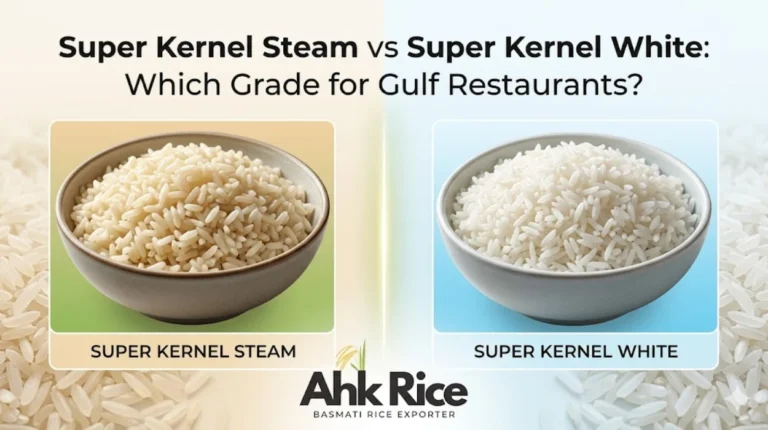
White Basmati undergoes milling and polishing after dehusking. The rice delivers a bright appearance, delicate aroma, and soft texture after cooking. Supermarkets and premium household brands frequently select this grade.
Steam Basmati Rice
Steam rice receives controlled steam treatment before final milling. The process improves grain strength while preserving its natural appearance. Restaurants and catering companies value this balance between presentation and durability.
Golden Sella Basmati Rice
Golden Sella passes through a parboiling process before milling. The kernels develop a golden colour and stronger cooking stability. Hotels serving buffet meals prefer this grade because the grains remain separate for longer periods.
Golden Sella also performs well in high-volume kitchens operating under continuous service conditions. In UAE warehouses with temperatures approaching 40°C, Golden Sella typically maintains quality for up to 18 months, while Steam Basmati performs best within 12 months under similar storage conditions (source: REAP export guidance, December 2025).
Brown Basmati Rice
Brown Basmati retains the bran layer after dehusking. The rice contains higher dietary fibre and requires longer cooking times. Health-focused retailers often include this grade in premium product ranges.
Different processing grades satisfy different commercial needs. The next section explains why crop year remains important regardless of the selected grade.
What Benefits Does Crop Year Provide for UAE Buyers?
Crop year improves quality planning, purchasing confidence, inventory management, customer satisfaction, and product consistency throughout the supply chain.
Crop year helps importers compare products using measurable information rather than promotional descriptions. Buyers understand how long the rice has matured before shipment.
Hotels benefit because mature rice cooks consistently across large batches. Uniform cooking simplifies recipe standardisation and reduces preparation time.
Retailers benefit because consumers receive the same cooking experience from every package. Consistent quality strengthens customer trust and repeat purchases.
Food distributors benefit because inventory planning becomes easier. Crop year information helps rotate stock according to storage age and expected shelf life.
Private-label brands benefit because clear crop-year documentation supports transparent product specifications. Retail chains increasingly request detailed technical data before approving suppliers.
These commercial advantages explain why professional buyers treat crop year as a purchasing specification instead of a marketing feature.
What Are the Main Uses of Pakistan Basmati Rice in the UAE?
Pakistan Basmati rice serves retail supermarkets, luxury hotels, restaurants, catering companies, food distributors, and private-label brands because each sector requires reliable cooking quality and premium grain appearance.
The UAE imports Pakistan Basmati rice for diverse commercial applications. Each business segment selects specific varieties and processing grades according to its operational requirements rather than price alone.
Retail Supermarkets
Retail chains package premium Basmati rice for household consumers. These buyers prioritize long grains, natural aroma, attractive packaging, and consistent cooking performance. Crop year information helps retailers deliver the same quality throughout the selling season.
Hotels and Resorts
Hotels prepare hundreds of meals every day. Premium Basmati rice supports buffet service, banquet dining, room service, and fine-dining restaurants. Properly aged rice produces uniform grain elongation and remains separate during extended serving periods.
Restaurants
Restaurants prepare dishes such as biryani, kabsa, mandi, pulao, and grilled rice platters. Chefs prefer rice with stable moisture because consistent absorption simplifies recipe control and reduces cooking errors.
Catering Companies
Large catering businesses cook thousands of portions for corporate events, schools, airlines, hospitals, and industrial facilities. Mature Basmati reduces variation between production batches and improves serving efficiency.
Private-Label Brands
Private-label companies purchase Pakistan Basmati rice for packaging under supermarket brands. These businesses require complete product specifications, including crop year, grain length, broken percentage, moisture content, and food safety documentation.
The wide range of commercial applications highlights why buyers also examine quality assurance before importing rice.
Which Certifications Apply to Pakistan Basmati Rice Exports?
International buyers expect food safety certification, quality inspection, phytosanitary compliance, and export documentation before approving shipments.
Exported Pakistan Basmati rice passes through multiple inspection and certification procedures before international shipment. These documents verify product safety, quality, and regulatory compliance.
Common certifications and export documents include:
- ISO 22000 Food Safety Management System
- HACCP Certification
- Phytosanitary Certificate
- Certificate of Origin
- Fumigation Certificate
- Health Certificate
- Quality Inspection Report
- Packing List
- Commercial Invoice
- Bill of Lading
Government authorities and independent inspection agencies verify different stages of the export process. These documents simplify customs clearance and help importers meet UAE food regulations.
Professional buyers review certifications together with crop year because both factors influence purchasing confidence. One confirms regulatory compliance, while the other predicts product performance.
Understanding certifications leads naturally to the final question about common misunderstandings surrounding crop year.
What Misconceptions Exist About Crop Year in Pakistan Basmati Rice?
Crop year does not indicate expired rice, inferior quality, or old inventory. It identifies the harvest season and helps buyers evaluate natural grain maturity.
Many buyers confuse crop year with packing date. These two terms describe different stages of the supply chain.
Packing date records when processors package the rice. Crop year records when farmers harvested the paddy. Rice harvested in one year can be safely processed and packaged during the following year after controlled aging.
Another misconception assumes newer rice always delivers better quality. Premium Basmati achieves its best cooking performance after appropriate storage because natural moisture reduction improves grain stability and aroma.
Some buyers also believe all Basmati ages equally. Different varieties, including 1121 Basmati, Super Kernel Basmati, and 1509 Basmati, develop unique cooking characteristics during storage. Professional buyers therefore evaluate crop year alongside variety, processing grade, moisture content, and inspection reports.
Crop year should never be considered in isolation. It forms one part of a complete quality specification that includes grain length, purity, broken percentage, processing method, and certification.
Crop year has become an essential quality indicator for Pakistan Basmati rice imported into the UAE. It helps retailers, hotels, restaurants, and food distributors predict aroma, cooking consistency, grain elongation, and shelf life before placing purchase orders. Unlike the packing date, the crop year reflects when the rice was harvested, allowing buyers to assess its natural maturity.
Professional processing also plays a critical role after harvest. Cleaning, drying, aging, dehusking, milling, polishing, grading, sorting, and inspection preserve the characteristics that distinguish premium Pakistan Basmati rice. Combined with internationally recognized certifications and complete export documentation, these processes support reliable product quality for global markets.
Understanding crop year enables buyers to make informed purchasing decisions based on measurable specifications rather than assumptions. Businesses that evaluate crop year together with variety, processing grade, moisture level, and certification can select Pakistan Basmati rice that consistently meets customer expectations across retail shelves, hotel kitchens, restaurants, and large-scale catering operations.
Frequently Asked Questions
Why is the crop year important for Pakistan Basmati rice?
The crop year shows when the rice was harvested. It helps buyers evaluate natural aging, moisture content, aroma development, cooking consistency, and expected shelf life before purchasing.
Does an older crop year mean lower-quality rice?
No. Properly stored Basmati rice improves through controlled natural aging. Mature rice develops stronger aroma, better grain elongation, and more consistent cooking performance than freshly harvested rice.
What is the difference between crop year and packing date?
Crop year refers to the harvest season of the paddy. Packing date indicates when the rice was packaged for sale. Rice harvested in one year can be packed during the following year after natural aging.
Which Pakistan Basmati varieties are commonly exported to the UAE?
The most popular varieties include 1121 Basmati Rice, Super Kernel Basmati Rice, and 1509 Basmati Rice. Each variety is available in White, Steam, Golden Sella, and Brown processing grades.
Which processing grade do UAE hotels usually prefer?
Many hotels prefer 1121 Golden Sella Basmati Rice because it offers excellent grain separation, strong cooking stability, long grain elongation, and better holding performance during buffet service.