How Crop Year Influences Cooking Performance of Pakistan Basmati Rice in UAE Markets
Pakistan Basmati rice harvested in the correct crop year delivers better cooking performance, longer grain elongation, stronger aroma, and more consistent texture for UAE buyers. Here is why: grain maturity, moisture stabilization, and post-harvest aging directly influence starch behavior during cooking. Buyers who verify crop year reduce quality complaints, improve customer satisfaction, and achieve more predictable commercial results.
The UAE imports large volumes of Pakistani Basmati rice for supermarkets, hotels, restaurants, catering companies, and private-label brands. Each buyer segment expects different cooking characteristics. Premium retail consumers demand aroma and long grain elongation. Hospitality businesses require batch consistency across hundreds of daily servings. Crop year affects both expectations.
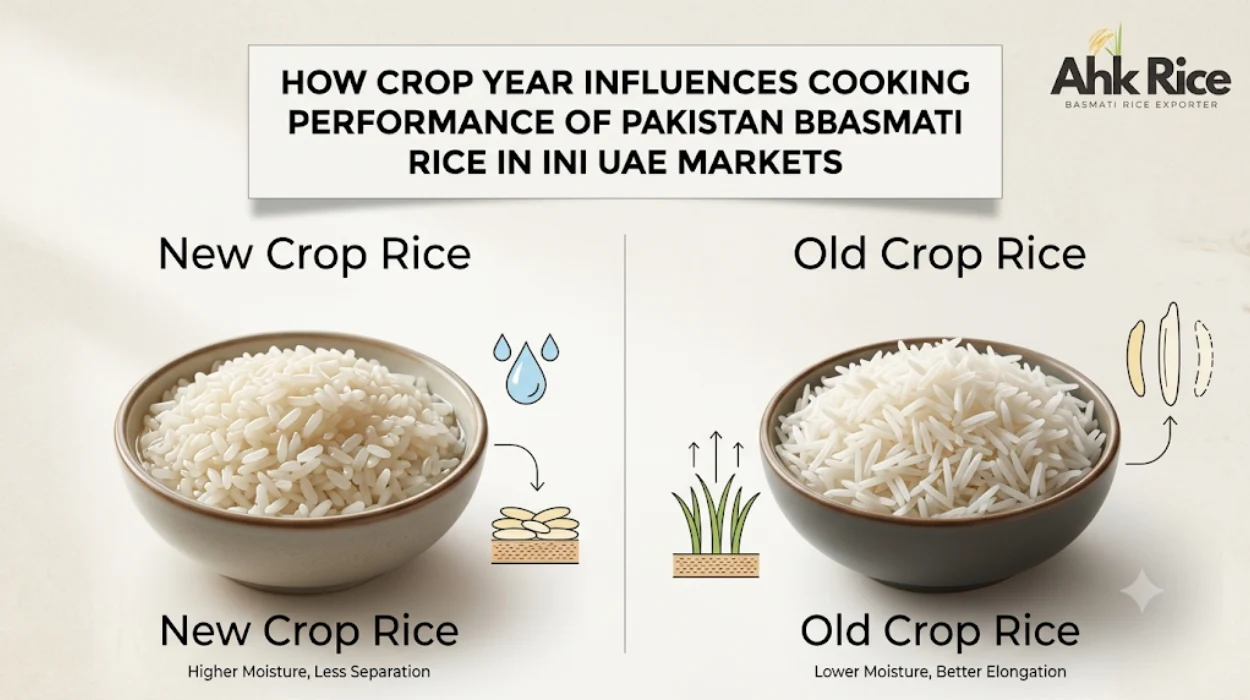
Pakistan harvests Basmati rice annually between September and November. Freshly harvested rice contains higher moisture and less stabilized starch. During natural aging, moisture gradually reduces while starch molecules mature. This process improves cooking performance, separates grains more effectively, and strengthens the traditional Basmati aroma. These quality improvements explain why experienced UAE importers verify crop year before procurement rather than purchasing solely on price.
AHK Rice processes and exports verified Pakistan Basmati rice from Punjab through complete milling, grading, quality inspection, packaging, documentation, and international shipping. Buyers seeking a complete understanding of crop year effects can first read our detailed guide explaining how aging changes Pakistan Basmati rice quality. That educational resource explains harvesting, processing, and natural aging before commercial purchasing decisions.
What are the available solutions for buyers selecting Pakistan Basmati rice?
The best solution depends on the buyer’s business model. Fresh crop rice offers lower pricing. Naturally aged rice provides superior cooking performance. Verified crop-year rice delivers predictable quality. Third-party tested shipments reduce commercial risk. Premium hospitality buyers achieve the highest consistency through aged, verified lots.
Selecting Pakistan Basmati rice begins with understanding available sourcing strategies rather than comparing prices alone. Every option balances cooking quality, inventory turnover, customer expectations, and procurement cost.
Fresh Crop Rice
Fresh crop rice comes directly after harvest and initial milling. Moisture levels remain comparatively higher, while starch continues stabilizing during storage. Fresh crop rice usually costs less because storage expenses remain minimal.
Retail brands targeting value-conscious consumers often select fresh crop rice. Restaurants focused primarily on low procurement costs may also choose this option. However, cooking performance varies more between production batches.
Naturally Aged Rice
Naturally aged rice remains stored under controlled warehouse conditions for approximately 12–24 months. Controlled aging reduces moisture while allowing starch structures to mature.
Cooking quality improves significantly through natural aging. Grain elongation becomes more uniform. Stickiness decreases. Aroma develops greater intensity. Professional chefs consistently prefer aged Basmati because recipes produce repeatable results.
Verified Crop-Year Rice
Verified crop-year rice combines quality verification with documented harvest records. Buyers receive confirmation of harvesting season before shipment.
Crop-year verification increases transparency throughout international procurement. Importers avoid mixing older and newer harvests that may cook differently. Retail brands also maintain consistent customer experience across multiple production batches.
Third-Party Tested Rice
Independent laboratories inspect rice before export. Testing commonly verifies:
- Moisture percentage
- Grain length
- Broken percentage
- Chalky grains
- Purity
- Foreign matter
- Packaging compliance
Laboratory verification supports food safety documentation while strengthening importer confidence.
Specification Comparison
| Attribute | Fresh Crop Rice | Naturally Aged Rice | Verified Crop-Year Rice |
|---|---|---|---|
| Harvest Age | 0–6 months | 12–24 months | Documented |
| Moisture Stability | Moderate | High | High |
| Aroma Development | Moderate | Excellent | High |
| Grain Elongation | Good | Excellent | Excellent |
| Cooking Consistency | Moderate | Very High | High |
| Commercial Risk | Higher | Low | Lowest |
| Typical UAE Buyers | Budget Retail | Hotels & Premium Retail | Importers & Private Labels |
Each solution addresses different commercial objectives. The next comparison examines how cooking performance changes across crop years and why regional buyers select different specifications.
How do different approaches compare?
Naturally aged and verified crop-year Pakistan Basmati rice consistently outperform fresh crop rice in cooking quality, aroma retention, grain elongation, and storage stability. UAE hospitality businesses usually prioritize consistency, while African wholesale markets often prioritize competitive pricing and faster inventory turnover.
Cooking performance depends on more than variety alone. Harvest timing, storage duration, milling quality, and moisture management work together to determine final results.
AHK Rice supplies several premium Pakistani varieties, including 1121 Basmati,Super Kernel Basmati, and 1509 Basmati. Each variety responds differently to aging because starch composition and grain structure vary. Properly aged 1121 Basmati produces exceptional elongation, making it the preferred choice for luxury restaurants and premium retail brands in the UAE.
Commercial buyers compare specifications before comparing prices. The table below summarizes the major differences.
| Specification | Fresh Crop | Naturally Aged |
|---|---|---|
| Grain Elongation | 1.8–2.0× | 2.2–2.5× |
| Aroma | Medium | Strong |
| Water Absorption | Moderate | Excellent |
| Cooking Uniformity | Moderate | High |
| Shelf Life | 12 months | 18–24 months |
| Average Export Price* | Lower | Higher |
| Best Application | Budget Retail | Premium Hospitality |
*Export prices vary by variety, grade, season, and market conditions.
UAE Market Preference
UAE supermarkets, hotels, restaurants, and catering companies typically prioritize 1121 Steam, 1121 Sella, and aged White Basmati because customers expect long grains, fluffy texture, and authentic aroma. Product consistency reduces complaints and protects premium brand positioning.
African Wholesale Market Preference
Many African distributors emphasize affordability, inventory turnover, and reliable availability. Fresh crop or semi-aged rice often satisfies these commercial requirements while maintaining acceptable cooking quality.
How do different approaches compare for UAE buyers?
Verified crop-year rice delivers the most reliable cooking performance, while naturally aged rice produces the best aroma and grain elongation. Fresh crop rice remains the most economical option. UAE retailers, hotels, and catering businesses select different grades according to customer expectations, storage capacity, and menu requirements rather than price alone.
Cooking performance depends on crop year, processing quality, storage conditions, and rice variety. Buyers who evaluate only export pricing often overlook factors that influence customer satisfaction after cooking. Long-term procurement decisions should compare performance, consistency, and commercial value together.
AHK Rice exports verified crop-year 1121 Basmati, Super Kernel Basmati, and 1509 Basmati through complete milling, grading, quality inspection, packaging, and export documentation. Buyers evaluating supplier capabilities can review the company’s Pakistan Basmati Rice Export Services (Insert Service Page Link Here using this contextual anchor.) before comparing grades.
Comparison of Fresh Crop vs Naturally Aged vs Verified Crop-Year Rice
| Attribute | Fresh Crop Rice | Naturally Aged Rice | Verified Crop-Year Rice |
|---|---|---|---|
| Moisture Content | Higher | Lower and Stable | Verified Within Specification |
| Grain Elongation | Good | Excellent | Excellent |
| Aroma Development | Moderate | Strongest | Strong |
| Cooking Consistency | Moderate | Excellent | Excellent |
| Batch Uniformity | Moderate | High | Highest |
| Commercial Risk | Higher | Low | Lowest |
| Best Buyer Type | Budget Retail | Hospitality | Importers & Private Labels |
Naturally aged rice consistently produces longer grains because moisture gradually stabilizes during controlled storage. Proper aging also reduces surface stickiness and improves grain separation. Premium restaurants benefit because identical recipes deliver predictable presentation every day.
Verified crop-year rice provides another commercial advantage. Documented harvesting dates prevent suppliers from mixing multiple harvest seasons within one shipment. Consistent lots simplify inventory management and reduce customer complaints across repeated purchases.
Fresh crop rice remains suitable for buyers seeking competitive pricing and rapid stock turnover. Value-oriented retail brands often prioritize affordability while accepting moderate variation in cooking characteristics.
UAE and Saudi Arabia Grade Preferences
Different Gulf markets purchase similar Pakistani Basmati varieties but prioritize different specifications.
| Market | Preferred Grade | Primary Buyer | Main Requirement |
|---|---|---|---|
| UAE | 1121 Steam, White, Golden Sella | Hotels, Retail, Catering | Aroma and grain elongation |
| Saudi Arabia | 1121 Golden Sella, Super Kernel | Wholesale and Catering | Shelf stability and bulk supply |
UAE supermarkets frequently promote premium aroma as a product differentiator. Restaurants focus on presentation because long, separate grains improve plated meals. Catering companies prioritize cooking consistency for large-scale production.
Saudi Arabian wholesalers often purchase Golden Sella because parboiling strengthens grain structure. Large institutional kitchens benefit from lower breakage during cooking and transportation.
Price Comparison Per Metric Ton
Export pricing changes throughout the season according to crop availability, global demand, freight costs, and currency movements. The comparison below illustrates typical commercial positioning rather than fixed quotations.
| Grade | Typical Price Position |
|---|---|
| Fresh Crop White Rice | Lowest |
| Fresh Crop Steam Rice | Moderate |
| Naturally Aged White Rice | High |
| Naturally Aged Steam Rice | Higher |
| Verified Crop-Year Premium Lots | Premium |
Naturally aged rice commands higher prices because storage increases warehouse, financing, inspection, and inventory costs. Hospitality buyers frequently recover these additional costs through higher menu quality and stronger customer satisfaction.
Shelf Life Comparison
Proper packaging and warehouse management directly influence storage performance after export.
| Product Type | Recommended Shelf Life |
|---|---|
| Fresh Crop Rice | Up to 12 months |
| Naturally Aged Rice | 18–24 months |
| Golden Sella Rice | Up to 24 months |
| Verified Crop-Year Rice | 18–24 months under proper storage |
Controlled warehouse conditions preserve aroma, moisture balance, and grain quality. Importers storing rice in UAE temperatures benefit from insulated warehouses because excessive heat accelerates moisture loss.
Pros and Cons of Each Procurement Method
| Procurement Method | Advantages | Limitations |
|---|---|---|
| Fresh Crop | Lower purchase cost, faster availability | Less aroma, variable cooking performance |
| Naturally Aged | Excellent elongation, superior aroma, stable cooking | Higher inventory cost |
| Verified Crop-Year | Full traceability, consistent batches, reduced procurement risk | Premium pricing |
A premium hotel in Dubai illustrates these differences clearly. Naturally aged 1121 Basmati produces uniform long grains across buffet service. Customer presentation improves while kitchen waste decreases.
A supermarket private-label brand benefits differently. Verified crop-year documentation simplifies quality assurance and strengthens consumer confidence through consistent product specifications.
A wholesale distributor supplying independent grocery stores may prefer fresh crop rice because competitive pricing supports high-volume sales despite moderate cooking variation.
Which crop-year strategy works best for different UAE business cases?
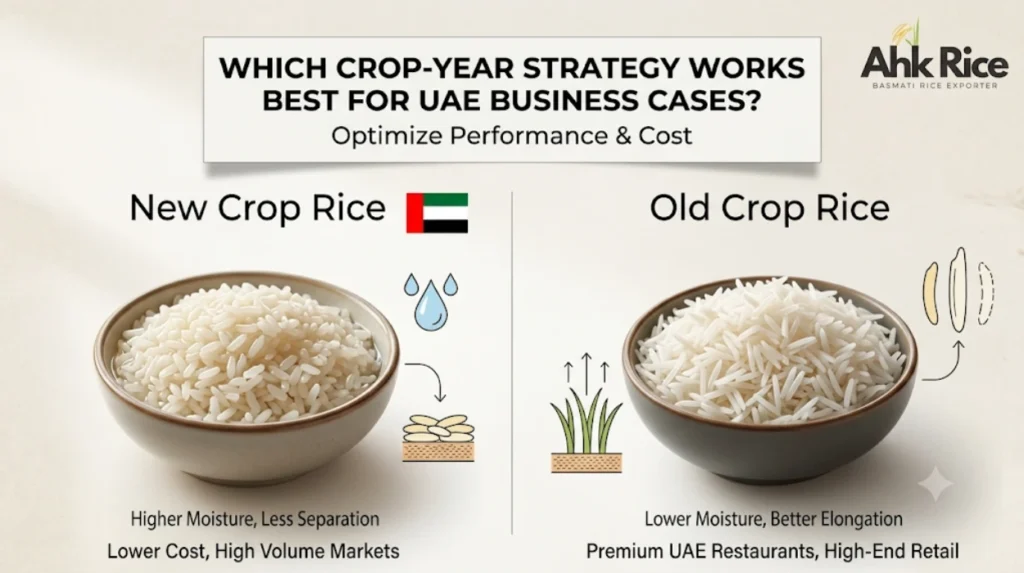
Naturally aged rice performs best for premium hospitality, verified crop-year rice suits retail and private labels, while fresh crop rice remains appropriate for budget wholesale distribution. The correct choice depends on customer expectations, storage capacity, procurement strategy, and desired cooking consistency rather than the lowest purchase price.
Every UAE buyer serves a different customer segment. Hotels focus on presentation and repeat dining experiences. Supermarkets require consistent quality across every production batch. Catering companies prioritize cooking efficiency for large volumes. Wholesale distributors emphasize competitive pricing and inventory turnover. Matching crop year to the business model creates better commercial outcomes.
Premium Hotels and Fine Dining Restaurants
Premium hospitality businesses benefit most from naturally aged 1121 Basmati rice. Controlled aging enhances aroma, improves grain elongation, and creates fluffy, separate grains after cooking.
Luxury restaurants prepare biryani, mandi, kabsa, and pulao where rice quality remains visible on every plate. Uniform grain expansion reduces plate variation and strengthens customer satisfaction. Premium establishments also experience fewer cooking adjustments because moisture levels remain stable between batches.
Supermarkets and Private Label Brands
Retail businesses achieve the greatest value through verified crop-year Basmati rice. Harvest documentation creates consistent specifications across multiple shipments throughout the year.
Private-label brands rely on customer trust. Consumers expect identical cooking performance every time they purchase the same package. Crop-year verification minimizes batch variation and simplifies quality assurance programs.
Catering Companies
Large catering operations require predictable cooking results because thousands of meals may be prepared daily. Verified crop-year rice reduces production risk by maintaining similar water absorption, cooking time, and grain expansion throughout repeated deliveries.
Large kitchens also benefit from reduced food waste because standardized batches require fewer recipe adjustments.
Wholesale Importers
Wholesale distributors frequently select fresh crop or semi-aged rice when serving price-sensitive markets. Faster inventory turnover offsets the modest reduction in aroma and cooking consistency.
This strategy supports distributors supplying independent grocery stores where affordability remains the primary purchasing factor.
Decision Framework for UAE Buyers
| Buyer Type | Recommended Crop Year | Preferred Grade | Main Priority | Best Choice |
|---|---|---|---|---|
| Five-Star Hotels | 12–24 Months Aged | 1121 Steam | Premium presentation | Naturally Aged |
| Restaurants | 12–18 Months Aged | Super Kernel | Consistent cooking | Naturally Aged |
| Supermarkets | Verified Harvest Year | White Basmati | Brand consistency | Verified Crop-Year |
| Catering Companies | Verified Harvest Year | 1121 Sella | Large-scale cooking | Verified Crop-Year |
| Wholesale Traders | Fresh or Semi-Aged | 1509 or White Rice | Competitive pricing | Fresh Crop |
Decision-making becomes easier when buyers compare long-term commercial value rather than the initial purchase price. Premium grades reduce customer complaints, strengthen repeat orders, and improve product reputation.
What decision factors should buyers evaluate before purchasing?
Harvest year, moisture level, grain length, milling quality, certification, packaging, and supplier traceability determine cooking performance more accurately than price alone. Buyers who evaluate these specifications before procurement reduce commercial risk and improve customer satisfaction across every shipment.
Professional importers assess technical specifications before negotiating prices. This process protects product quality after the shipment reaches the UAE.
Key Procurement Factors
- Verify the crop year through documented harvest records.
- Inspect moisture content to ensure stable cooking performance.
- Confirm grain length matches market specifications.
- Review broken percentage before shipment approval.
- Check quality certifications including laboratory testing and phytosanitary documentation.
- Evaluate packaging options for retail or bulk distribution.
- Assess supplier export capability including documentation and logistics support.
AHK Rice supports international buyers through end-to-end processing, including milling, grading, colour sorting, quality inspection, customized packaging, container loading, export documentation, and global shipping. This integrated process helps maintain specification consistency from harvest through final delivery.
Selecting the correct crop year is only one part of procurement. Consistent processing standards and documented quality controls ensure the rice performs as expected after arrival in the destination market.
Crop year directly influences the commercial performance of Pakistan Basmati rice in UAE markets. Fresh crop rice offers competitive pricing for wholesale distribution, while naturally aged rice delivers superior aroma, grain elongation, and cooking consistency for premium hospitality. Verified crop-year rice provides traceability, standardized quality, and dependable batch performance for supermarkets, catering businesses, and private-label brands.
Importers who evaluate harvest year together with moisture content, milling quality, grading standards, and supplier verification reduce procurement risk and build stronger long-term customer satisfaction. Rather than selecting rice solely by price, successful buyers compare technical specifications that determine performance in the kitchen and value in the marketplace.
Businesses ready to move from evaluation to supplier selection can continue with Source Pakistan Basmati Rice with Verified Crop Year for UAE Retail and Hospitality Businesses.
Frequently Asked Questions
Why does crop year affect Basmati rice cooking performance?
Crop year determines the rice’s maturity and moisture stability. Naturally aged rice develops stronger aroma, longer grain elongation, and more consistent cooking characteristics than freshly harvested rice.
Which crop year is best for UAE hotels?
Hotels generally prefer 12–24-month naturally aged 1121 Basmati rice because it provides excellent grain separation, aroma, and presentation for premium dishes.
Is verified crop-year rice better than fresh crop rice?
Yes. Verified crop-year rice offers documented traceability, more consistent cooking performance, and reduced quality variation between shipments.
Which Pakistani Basmati varieties are most popular in the UAE?
The most requested varieties include 1121 Basmati, Super Kernel Basmati, and 1509 Basmati, depending on the buyer’s market segment and application.
What should importers verify before purchasing Pakistan Basmati rice?
Importers should verify the harvest year, moisture content, grain length, broken percentage, certifications, packaging specifications, and supplier export experience before placing an order.