How Super Kernel Steam Rice FOB Pakistan Pricing Impacts UAE Import Costs?
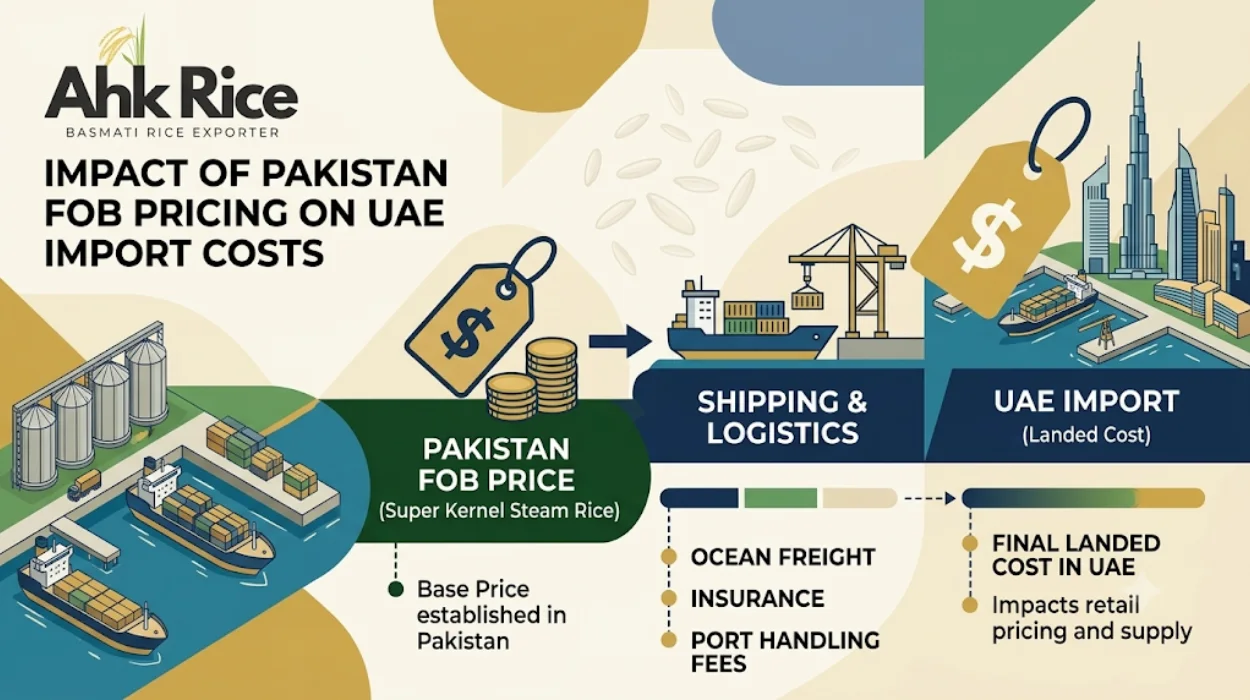
Super Kernel Steam Rice FOB Pakistan pricing directly affects the final landed cost in the UAE. Here is why: FOB pricing determines the exporter’s selling price before freight, insurance, customs clearance, warehousing, and distribution costs are added. Every increase of USD 10 per metric ton at origin raises procurement costs throughout the UAE supply chain.
Super Kernel Steam Rice remains one of Pakistan’s most exported Basmati varieties. UAE importers purchase large volumes for retail, catering, hospitality, and food service sectors. Understanding how FOB pricing influences import costs helps buyers estimate budgets accurately and compare supplier offers effectively.
What Is Super Kernel Steam Rice FOB Pakistan Pricing?
FOB pricing represents the rice cost at the Pakistani port before ocean freight, insurance, and destination charges are added.
FOB stands for Free on Board. The seller prepares the rice, completes export procedures, and loads the cargo onto the vessel at a Pakistani port.
Super Kernel Steam Rice is a long-grain aromatic Basmati variety cultivated mainly in Punjab, Pakistan. Farmers cultivate the crop during the Kharif season and harvest it between October and November.
Steam processing strengthens grain structure. The process improves cooking performance and reduces grain breakage during handling and transportation.
FOB quotations usually include rice value, milling costs, packaging, inland transportation, export documentation, and port handling charges.
UAE importers use FOB pricing as the starting point when calculating total procurement expenses.
With the FOB concept established, the next question is how pricing moves through the import chain.
How Does FOB Pricing Affect UAE Import Costs?
Every FOB increase directly raises freight-adjusted procurement costs and final distributor margins in the UAE.
UAE buyers begin calculations with the FOB value. They then add freight charges, insurance costs, customs expenses, local transportation, warehousing fees, and distribution margins.
A shipment priced at USD 1,100 per metric ton FOB creates a different landed cost than a shipment priced at USD 1,050 per metric ton FOB. The difference remains visible throughout the supply chain.
Food distributors monitor FOB movements because rice purchases often involve container loads of 24 to 27 metric tons.
A USD 20 increase per metric ton creates a USD 480 to USD 540 increase per container. Large importers handling hundreds of containers experience significant cost changes.
Currency exchange rates also influence import calculations. UAE buyers often evaluate FOB prices against AED purchasing budgets.
Understanding these cost movements becomes easier after examining the factors that shape FOB pricing.
What Factors Determine Super Kernel Steam Rice FOB Prices?
Crop yield, processing costs, export demand, exchange rates, logistics costs, and quality specifications determine FOB pricing.
Crop Production
Rice production influences market availability. Higher harvest volumes increase supply and stabilize export prices.
Pakistan remains one of the world’s leading Basmati exporters (source: REAP export data, December 2025).
Processing Costs
Steam rice requires multiple processing stages before export.
Processing steps include:
- Clean the paddy.
- Parboil the grain.
- Dry the grain.
- Store the grain.
- Dehusk the grain.
- Polish the grain.
- Grade the grain.
- Sort the grain.
- Pack the rice.
Each stage adds operational expenses.
Export Demand
Strong demand from Gulf countries supports pricing levels.
UAE, Saudi Arabia, Oman, Qatar, and Kuwait remain important destinations for Pakistani Basmati exports (source: Pakistan Bureau of Statistics, FY2024-25).
Logistics Expenses
Fuel prices, trucking rates, and port charges affect FOB calculations.
Exporters incorporate these expenses before issuing quotations.
With pricing factors explained, the next question concerns the product itself and its specifications.
What Are the Main Characteristics of Super Kernel Steam Rice?
Grain length of 7.0–7.5 mm before cooking and strong elongation after cooking define Super Kernel Steam Rice.
Super Kernel Steam Rice belongs to the traditional Basmati family. The variety offers aroma, elongation, and visual appeal.
The grain expands significantly during cooking. Many food service operators prefer the variety because cooked grains remain separate.
Key Specifications
| Specification | Typical Value |
|---|---|
| Grain Length | 7.0–7.5 mm |
| Moisture | 12–14% |
| Broken Grains | 1–5% |
| Purity | 95–100% |
| Crop Origin | Punjab, Pakistan |
| Shelf Life | 18–24 months |
| Processing Type | Steam Processed |
Steam processing produces a cream-colored grain. The appearance differs from Golden Sella and White Basmati grades.
Specification differences lead directly to grade differences, which influence FOB values.
What Grades of Super Kernel Steam Rice Are Available?
Export grades range from 100% purity specifications to economical grades containing higher broken percentages.
Super Kernel Steam 100% Sortex
This grade contains maximum purity and minimal defects.
Retail brands commonly select this specification for premium packaging.
Super Kernel Steam 5% Broken
This grade balances quality and cost efficiency.
Many wholesalers prefer this grade for commercial distribution.
Super Kernel Steam 10% Broken
This grade offers lower procurement costs.
Food service operators often select this grade for bulk consumption.
Super Kernel Steam 15% Broken
This grade targets price-sensitive markets.
Large-volume institutional buyers often purchase this specification.
Each grade creates a different FOB quotation because quality requirements influence processing intensity.
With grades defined, the next question concerns UAE demand.
Why Does the UAE Import Large Volumes of Super Kernel Steam Rice?
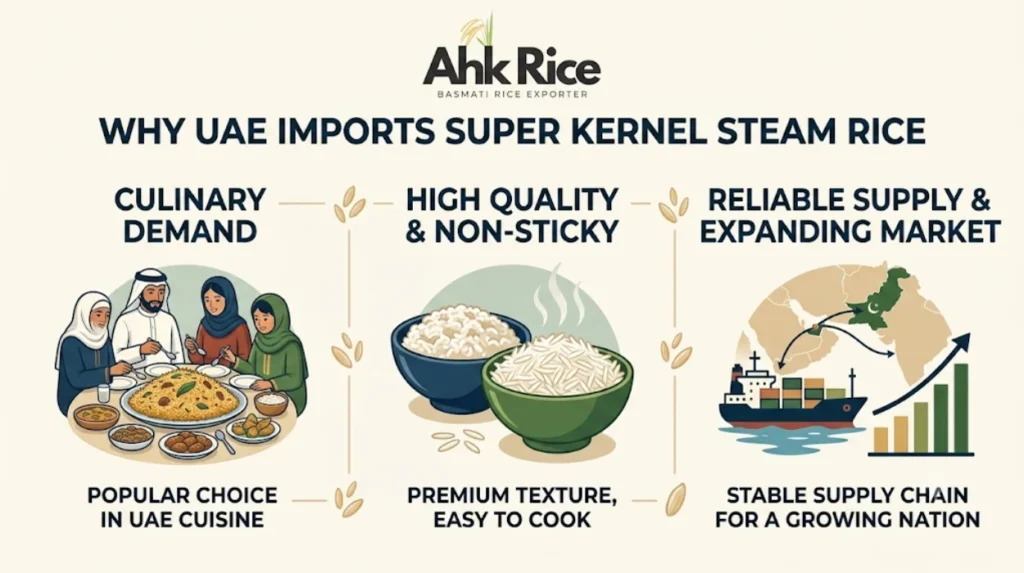
Population growth, tourism, food service expansion, and strong South Asian consumption drive UAE imports.
The UAE serves as a major rice consumption and re-export hub.
Dubai and other emirates distribute imported rice across retail and wholesale channels.
Hospitality businesses consume substantial rice volumes. Hotels, restaurants, catering companies, and institutional kitchens require consistent supplies.
South Asian communities contribute significantly to Basmati demand. Traditional dishes depend on aromatic long-grain rice.
Rice import demand remains strong because the UAE imports most food products rather than producing them domestically.
Market demand explains import volumes, but certifications also influence purchasing decisions.
What Certifications Apply to Super Kernel Steam Rice Exports?
Phytosanitary, quality, food safety, and origin certifications support international trade compliance.
Export shipments undergo inspection and verification before dispatch.
Common certifications include:
- Phytosanitary Certificate
- Certificate of Origin
- Fumigation Certificate
- Health Certificate
- ISO Certification
- HACCP Certification
- SGS Inspection Report
Quality teams inspect rice before loading containers.
Laboratories test moisture levels, purity percentages, grain dimensions, and contamination risks.
Certification documents help UAE importers satisfy regulatory requirements and customer specifications.
Certification standards connect directly to common misconceptions about FOB pricing.
What Are Common Misconceptions About FOB Pricing?
FOB pricing does not represent the final UAE cost and does not include destination expenses.
Many buyers compare FOB quotations without calculating total landed costs.
Freight charges vary by season. Insurance costs vary by shipment value. Destination handling charges differ among ports.
Another misconception involves quality comparisons.
A lower FOB price often reflects different specifications. Broken percentage, purity level, moisture content, and grain size all influence quotations.
A second misconception concerns freight inclusion.
FOB pricing excludes ocean transportation. CIF pricing includes freight and insurance.
Readers wanting a deeper understanding of destination-inclusive calculations should review a detailed guide explaining how freight and insurance influence UAE procurement pricing.
With misconceptions clarified, the final question concerns the practical benefits of understanding FOB pricing.
What Benefits Come From Understanding FOB Pricing?
Accurate budgeting, supplier comparison, procurement planning, and margin protection result from FOB pricing knowledge.
FOB analysis helps importers compare suppliers using consistent benchmarks.
Procurement teams identify whether price differences result from quality variations or market movements.
Budget planning becomes more reliable. Importers forecast inventory investments before placing purchase orders.
Margin management improves because distributors understand every cost component from origin to destination.
Supply chain visibility also improves. Buyers track how production costs, export demand, and logistics expenses influence final retail pricing.
Understanding FOB pricing creates stronger procurement decisions and more accurate landed cost calculations for UAE rice importers.
Frequently Asked Questions
What does FOB mean in rice exports?
FOB means Free on Board. The exporter loads the rice onto the vessel at the departure port, while the buyer pays freight and destination costs.
How is Super Kernel Steam Rice processed?
Processors clean, parboil, dry, dehusk, polish, grade, sort, and package the rice before export.
Why do FOB prices change during the year?
Harvest volumes, export demand, currency exchange rates, logistics costs, and quality specifications influence pricing.
Does FOB pricing include shipping to the UAE?
No. FOB pricing excludes ocean freight, insurance, customs clearance, and destination handling charges.
Which UAE sectors use Super Kernel Steam Rice?
Retail distributors, restaurants, hotels, catering companies, wholesalers, and institutional kitchens use the variety.
What certifications are commonly required?
Phytosanitary certificates, certificates of origin, fumigation certificates, health certificates, ISO certifications, and HACCP certifications are commonly required.