How Do Companies Develop Their Own Imported Rice Brand?
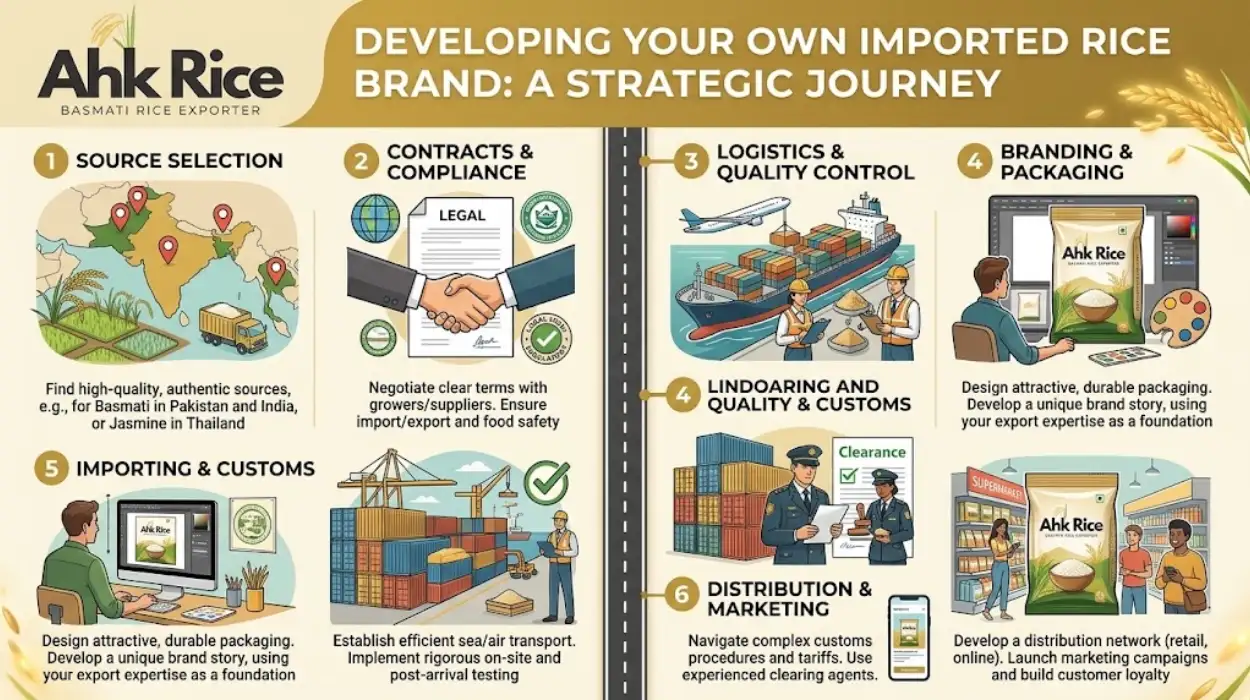
Companies develop their own imported rice brand by controlling the rice specification, sourcing model, packaging, compliance, and supply chain from origin to retail. Direct exporter private-label sourcing provides the strongest cost-to-quality balance for scalable brands. Here is why: origin processing reduces intermediaries while keeping grading, packaging, and export controls connected.
A private-label rice brand starts with product selection rather than logo design. Buyers define variety, processing grade, grain length, broken percentage, moisture, packaging, and target market. Understanding the wider Pakistani Basmati rice export process helps connect cultivation, milling, grading, testing, packing, and dispatch with the final branded product.
Private label means a company sells rice under its own brand while another company performs some or all manufacturing activities. The brand owner controls positioning, packaging, pricing, and distribution. The rice manufacturer controls processing, grading, testing, and packing according to the approved specification.
AHK Rice is a Pakistani Basmati rice exporter based in Punjab. It supplies 1121, Super Kernel, and 1509 varieties to 15+ countries. Its end-to-end processing model covers milling, grading, sorting, customized packaging, quality control, and export coordination. Buyers can review the AHK Rice rice export and processing service when comparing origin-manufacturing capabilities.
What are the available solutions for developing an imported rice brand?
Four main solutions exist: direct exporter private label, destination-market co-packing, trading-company white label, and hybrid origin-to-market production. Each model changes cost, minimum order quantity, quality control, packaging flexibility, compliance responsibility, and scalability.
Direct exporter private label
Direct exporter private label means the rice is processed and packed at origin under the buyer’s brand specification. The exporter can mill, dehusk, polish, grade, sort, test, and pack the rice before dispatch.
This model removes unnecessary handling between milling and export. It also keeps the product specification connected to the production lot. Direct sourcing works especially well for supermarkets, wholesalers, ethnic retailers, and foodservice distributors requiring repeat container volumes.
Destination-market co-packing
Destination-market co-packing imports bulk rice and repacks it into branded retail formats. The buyer gains strong control over local packaging operations and smaller production batches.
The disadvantage is additional handling. Warehousing, labor, packaging, and local compliance costs increase the cost per metric ton. The rice also passes through another operational stage before reaching the consumer.
Trading-company white label
Trading-company white label uses an intermediary that sources rice and supplies it under a retailer’s or distributor’s brand. This approach simplifies supplier management.
Specification control becomes weaker when the trader aggregates different origins or production lots. Traceability also requires closer verification because the brand owner may not directly control the mill.
Hybrid origin-to-market production
Hybrid production combines Pakistani origin processing with destination-market packaging. The exporter mills and grades the rice, while a destination facility completes selected packaging activities.
This model suits brands that require local packaging flexibility but still want origin-level control over rice quality. It also creates two operational control points rather than one.
With these four solutions established, the next question is which structure provides the strongest commercial balance.
How do different approaches compare?
Direct exporter private label offers the lowest reported cost range at £820–£950 per MT, compared with £980–£1,150 for UK co-packing and £900–£1,100 for trading white label. The comparison also shows differences in MOQ, lead time, quality consistency, compliance handling, and scalability.
Specification comparison
| Attribute | Direct Exporter Private Label | UK Co-Packing | Trading White Label | Hybrid Model |
|---|---|---|---|---|
| Cost per MT | £820–£950 | £980–£1,150 | £900–£1,100 | Mid-range |
| MOQ | 1–2 containers | Flexible batches | Medium | Medium |
| Lead time | 20–35 days | 10–20 days | 15–30 days | 20–35 days |
| Brand control | High | Very high | Medium | High |
| Quality consistency | High | Medium | Variable | High |
| Compliance handling | Export-managed | UK-managed | Shared | Shared |
| Scalability | High | Medium | Medium | High |
The published comparison shows exporter private label can reduce cost by approximately 10–25% against UK co-packing. The difference comes from fewer intermediaries and lower destination-side handling requirements.
Lead time creates a different trade-off. UK co-packing can offer faster small-batch packaging, while origin production requires milling schedules, packaging preparation, container planning, and export dispatch.
Brand control also differs. Co-packers provide strong control over retail presentation. Direct exporters provide strong control over both the rice specification and export packaging. This makes exporter production stronger for brands that want consistent product characteristics across repeated shipments.
Shelf life depends primarily on rice processing and storage conditions rather than the country where final packaging occurs. Published AHK Rice comparisons place 1121 Steam at around 10–12 months in controlled UK warehouse conditions. Golden Sella can reach 16–18 months under specified GCC storage conditions because parboiling strengthens grain stability.
The commercial comparison therefore requires both price and storage performance. A lower packaging cost has limited value when the selected processing grade does not match the destination warehouse or distribution cycle.
Which rice grades suit different market regions?
UK retail generally suits 1121 Steam and Super Kernel, while GCC markets favor 1121 Golden Sella and 1509 parboiled rice for storage resilience and foodservice use. The correct grade depends on retail positioning, cooking expectations, storage conditions, and purchasing volume.
UK retail and wholesale
UK retail buyers commonly evaluate 1121 Steam and Super Kernel for long grain appearance, aroma, and cooking performance. 1121 Steam fits premium retail positioning where appearance and aroma influence consumer choice.
Super Kernel provides another premium positioning route. Its long-grain characteristics and aromatic profile make it suitable for ethnic grocery, wholesale, and selected retail channels.
Private-label brands targeting British supermarkets also need consistent packaging and specification control. A branded 5 kg or 10 kg bag should contain rice that matches the approved sample across commercial production lots.
GCC retail and foodservice
GCC buyers commonly favor 1121 Golden Sella and 1509 parboiled rice where cooking durability and storage stability carry greater weight. Parboiling strengthens the grain structure before milling.
Golden Sella provides stronger bulk-handling characteristics than conventional Steam rice. Published AHK Rice comparisons place Golden Sella at approximately 18 months under UAE-style storage, while Steam typically reaches around 12 months under controlled humidity.
The market distinction changes brand strategy. A UK premium retail brand can emphasize aroma, appearance, and softness. A GCC foodservice brand can emphasize grain separation, cooking yield, durability, and storage stability.
With regional product fit established, the next step is matching each production model to the company’s business case.
Which method works best for different business cases?
Direct exporter manufacturing works best for established wholesalers and retailers seeking repeat container volumes, while co-packing suits smaller brands testing packaging and demand. Trading models fit mixed portfolios, while hybrid production suits brands requiring origin processing with destination packaging flexibility.
Supermarket brands
Supermarket brands need repeatable specifications. Direct exporter manufacturing provides stronger control over grain selection, processing, grading, sorting, and packaging across production runs.
A retailer launching 1121 Steam can establish one approved specification. The manufacturer then uses that specification as the reference for future production and inspection.
Ethnic retail brands
Ethnic retail brands compete heavily on aroma, grain length, cooking performance, and price. Super Kernel and 1121 Steam can support premium positioning without requiring a highly complex production structure.
A clear product specification also helps prevent substitution between varieties. This protects the brand identity across repeated imports.
Online direct-to-consumer brands
Online brands often prioritize packaging differentiation. Small pack sizes such as 1 kg, 5 kg, and 10 kg can become important elements of the brand strategy.
Destination co-packing can suit smaller experimental launches. The higher processing cost becomes more acceptable when the initial objective is market testing rather than maximum container efficiency.
Foodservice brands
Foodservice brands need dependable cooking performance and bulk stability. Golden Sella and 1509 parboiled rice can suit high-volume kitchens because stronger kernels reduce operational variability during bulk preparation.
A restaurant supplier should evaluate cooked yield alongside the purchase price. The cheapest rice per MT does not automatically create the lowest cost per prepared serving.
Wholesale import brands
Wholesale importers usually prioritize container economics. Direct exporter private label provides a stronger structure because production, grading, packing, documentation, and dispatch remain connected.
With business cases matched to supply models, the next question is what advantages and limitations each approach creates.
What are the pros and cons of each private-label strategy?
Exporter manufacturing delivers stronger cost efficiency and quality consistency, while co-packing provides greater packaging flexibility; trading simplifies sourcing but reduces specification control. Each model creates a different balance between cost, control, speed, and operational complexity.
Direct exporter private label
The main advantage is origin-level control. The exporter can process rice against a defined variety and grade before packing it under the buyer’s brand.
The main limitation is MOQ. Container-level procurement requires stronger inventory planning. Production schedules also need coordination with milling capacity, packaging preparation, inspection, and vessel bookings.
UK co-packing
The main advantage is packaging flexibility. Brands can test different bag sizes, designs, and retail formats without committing to large origin packaging runs.
The main limitation is cost. Warehousing, labor, repacking, and additional handling increase the total cost per MT. Quality control also requires checks after repacking.
Trading white label
The main advantage is sourcing simplicity. A trading company can coordinate multiple suppliers and product types through one commercial relationship.
The main limitation is traceability. Multiple origins or blended supply chains can make consistent grading more difficult. Brand owners must therefore verify each specification and production lot carefully.
Hybrid production
The main advantage is balance. Origin mills control rice quality while destination facilities provide local packaging flexibility.
The main limitation is coordination. Two facilities must maintain the same product specification. Packaging changes must not alter the approved commercial identity of the rice.
These trade-offs make supplier selection more important than simply comparing the first quotation.
What decision factors should companies evaluate before creating a rice brand?
Five factors determine whether an imported rice brand can scale: retail channel, MOQ, cost efficiency, quality consistency, and packaging or compliance requirements. These factors should be evaluated together because changing one can affect the others.
Decision framework
| Decision Factor | Exporter Private Label | UK Co-Packing | Trading Model |
|---|---|---|---|
| Retail channel fit | Supermarkets, wholesalers | D2C, boutique | Mixed |
| MOQ flexibility | Low–medium | High | Medium |
| Cost efficiency | Highest | Lowest | Medium |
| Quality consistency | High | Medium | Variable |
| Scalability | Strong | Moderate | Moderate |
Retail channel
Define the target channel before selecting the production method. Supermarkets require consistency and documentation. D2C brands require packaging flexibility. Foodservice brands prioritize cooking performance and supply continuity.
MOQ
Set the first commercial quantity according to expected sales. Direct exporter models become stronger as volume increases because production and container costs spread across larger shipments.
Cost structure
Compare landed cost rather than factory price alone. Freight, packaging, inspection, documentation, customs, port handling, and inland delivery all affect the final commercial cost.
Product specification
Define variety, processing, grain length, broken percentage, moisture, foreign matter, packaging, and inspection requirements before production. This specification becomes the reference for sample approval and commercial shipment.
Compliance
Importers should establish required food-safety documents, testing, certificates, labeling information, and shipment records before production. UK private-label rice programs commonly involve phytosanitary documentation, food-safety compliance, and residue testing.
With the decision framework complete, the final question is how a company turns these decisions into a repeatable brand system.
How does a company build its imported rice brand from specification to shelf?
A scalable rice brand starts with one approved grade, one written specification, one packaging system, and one controlled manufacturing route. The process then expands through sampling, testing, production, packaging, inspection, dispatch, and repeat-order planning.
Define the product
Choose the rice variety and processing grade first. A company can select 1121, Super Kernel, or 1509 according to market positioning.
Define the specification
Set grain length, broken percentage, moisture, purity, packaging, crop requirements, and inspection standards. Record every value in the purchase specification.
Approve the sample
Request a representative sample before commercial production. Evaluate raw appearance, aroma, grain length, cooking expansion, texture, and packaging suitability.
Approve the packaging
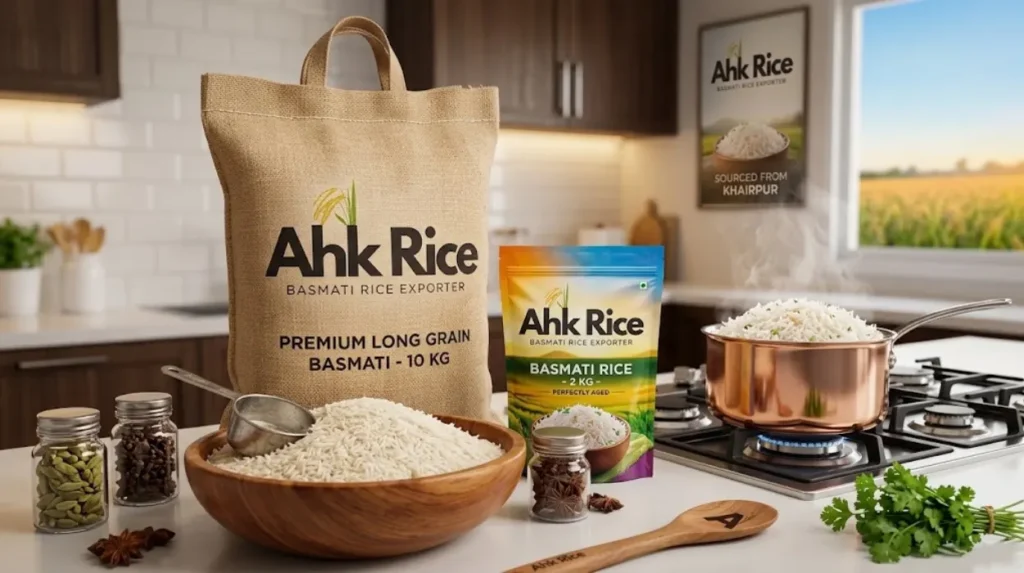
Finalize bag material, size, artwork, barcode, nutritional information, origin declaration, and required retail information. Packaging should match the destination market.
Test the production lot
Inspect the finished rice against the approved specification. Test relevant quality parameters before loading the container.
Dispatch the shipment
Complete commercial documentation, container loading, export clearance, vessel booking, and shipment dispatch. Maintain the same product identification across the documents.
Review repeat performance
Compare arrival quality with the original sample. Record customer feedback, warehouse performance, cooking results, and sales performance before expanding the SKU range.
This process turns private labeling from a packaging exercise into a controlled supply-chain system.
What is the best overall approach for a new imported rice brand?
Direct exporter private-label manufacturing provides the strongest overall model for companies seeking scalable supply, controlled quality, competitive MT economics, and consistent branded packaging. Co-packing remains valuable for small experiments, while hybrid and trading models serve specific operational needs.
The strongest brand strategy begins with product-market fit. UK retail brands can prioritize 1121 Steam or Super Kernel. GCC foodservice brands can prioritize Golden Sella or 1509 parboiled rice.
The next requirement is specification discipline. A brand becomes repeatable when every shipment matches the same approved variety, processing grade, quality limits, packaging format, and documentation requirements.
AHK Rice supports this origin-manufacturing structure through Pakistani Basmati sourcing, processing, grading, sorting, custom packaging, and export coordination. Its product portfolio includes 1121, Super Kernel, and 1509 varieties supplied across 15+ countries.
Private labeling therefore creates more than a branded bag. It creates a controlled commercial product. The companies that define the rice specification first can make stronger decisions about manufacturing, packaging, pricing, and market positioning.
Frequently Asked Questions
What is private-label rice?
Private-label rice is rice manufactured or supplied for sale under another company’s brand name. The brand owner controls branding, packaging, positioning, and distribution while the manufacturer processes and packs the rice according to agreed specifications.
Which rice varieties are suitable for private-label brands?
1121, Super Kernel, and 1509 are suitable Pakistani Basmati options. 1121 Steam fits premium UK retail, Super Kernel supports premium ethnic retail, and Golden Sella or 1509 parboiled grades suit markets requiring stronger cooking and storage performance.
How much does private-label rice cost per MT?
Published AHK Rice comparison figures place direct exporter private-label sourcing at approximately £820–£950 per MT. UK co-packing ranges from £980–£1,150 per MT, while trading white label ranges from £900–£1,100 per MT.
What is the minimum order quantity for private-label rice?
Direct exporter models commonly operate around one to two containers in the referenced UK comparison. Co-packing provides greater flexibility for smaller batches, making it more suitable for early-stage brands testing demand.
How long does private-label Basmati rice last?
Shelf life depends on variety, processing, moisture, packaging, and storage conditions. The referenced AHK Rice comparison places UK-controlled 1121 Steam storage at around 10–12 months and Golden Sella at up to 16–18 months under specified GCC conditions.
Can companies create custom rice packaging?
Yes. Private-label manufacturing can include customized bags, retail sizes, printed branding, barcodes, and market-specific packaging requirements. The packaging specification should be finalized before commercial production.
Is direct exporter manufacturing better than UK co-packing?
Direct exporter manufacturing provides stronger cost efficiency and origin-level quality control. UK co-packing provides greater flexibility for small batches and packaging experimentation. The better method depends on volume, channel, and brand development stage.
What should a company check before choosing a rice manufacturer?
Companies should check rice variety, processing capability, quality testing, traceability, packaging capacity, certifications, export documentation, MOQ, lead time, inspection procedures, and shipment coordination.
Can AHK Rice manufacture private-label Basmati rice?
AHK Rice supports structured processing, grading, custom packaging, and export workflows for Pakistani Basmati varieties including 1121, Super Kernel, and 1509. This structure supports private-label programs requiring controlled specifications and international dispatch.