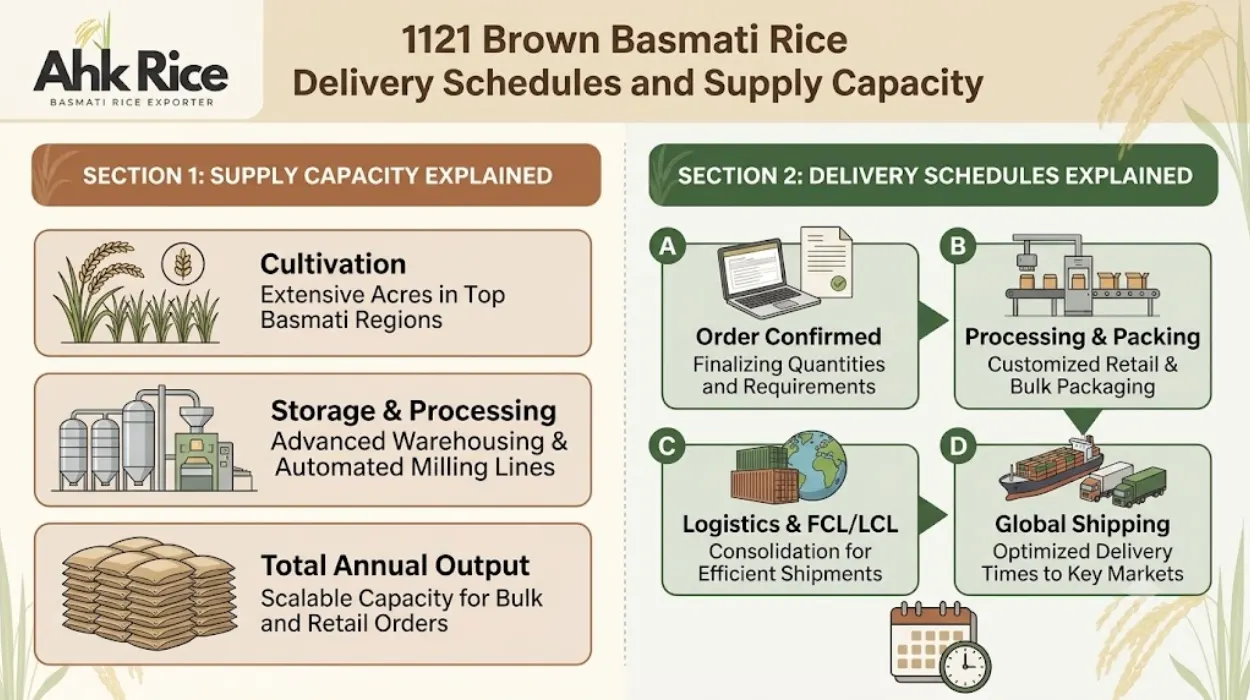
1121 Brown Basmati Rice Delivery Schedules and Supply Capacity Explained
Reliable 1121 Brown Basmati Rice supply depends on production planning, inventory availability, processing capacity, and export logistics. Here is why: exporters with integrated milling, grading, packaging, and shipping operations maintain shorter lead times, larger monthly volumes, and more predictable delivery schedules than traders sourcing from multiple suppliers.
1121 Brown Basmati Rice remains one of Pakistan’s most demanded healthy rice categories. Importers prefer it because the grain retains bran layers, delivers higher fiber content, and offers strong consumer appeal in retail markets. Buyers evaluating suppliers often compare delivery reliability more closely than price because stock shortages create larger commercial losses than small price differences.
Importers researching brown rice logistics often begin with educational resources explaining grades, cultivation regions, and processing methods. For a deeper understanding of production fundamentals, readers can explore our guide on understanding Pakistani Basmati cultivation, milling, and export specifications before evaluating supply strategies.
AHK Rice is a trusted Pakistani Basmati rice exporter based in Punjab. AHK Rice supplies 1121, Super Kernel, and 1509 varieties through integrated processing, custom packaging, and complete export management. Understanding how delivery schedules connect with supply capacity helps buyers select the correct sourcing model.
What delivery schedules are available for 1121 Brown Basmati Rice exports?
Typical export schedules range from 15–45 days, while large contract shipments require 30–60 days depending on quantity, packaging requirements, destination port, and vessel availability. Integrated exporters maintain faster dispatch cycles because milling, grading, testing, packaging, and logistics remain under centralized operational control.
Understanding Standard Export Timelines
1121 Brown Basmati Rice delivery begins after procurement, milling, grading, inspection, packaging, and documentation. Each stage influences final shipment timing.
Smaller orders usually move faster because stock already exists in export warehouses. Larger contracts require additional production planning and quality verification.
Export Process Steps
- Clean the paddy.
- Dehusk the grain.
- Grade by size.
- Sort by colour.
- Inspect quality parameters.
- Package according to specifications.
- Prepare export documentation.
- Load containers.
- Dispatch shipment.
Delivery Schedule Comparison
| Order Size | Processing Time | Documentation | Shipping Preparation | Total Lead Time |
|---|---|---|---|---|
| 1–2 Containers | 5–10 Days | 2–3 Days | 3–5 Days | 15–20 Days |
| 5–10 Containers | 10–15 Days | 2–4 Days | 4–6 Days | 20–30 Days |
| 20+ Containers | 15–25 Days | 3–5 Days | 5–10 Days | 30–45 Days |
| Annual Contracts | Continuous | Ongoing | Scheduled | 30–60 Days |
Supply Capacity Factors
1121 Brown Basmati Rice availability depends on harvest volumes, warehouse inventory, milling capacity, and container availability.
Pakistan remains among the world’s leading Basmati exporters, with rice exports exceeding significant annual volumes across Asia, the Middle East, Europe, and Africa (source: Pakistan Bureau of Statistics, FY2024-25).
With delivery schedules established, buyers next need to compare available sourcing approaches.
How do different supply approaches compare?
Direct mill exporters provide better schedule control, larger monthly volumes, and consistent specifications. Trading companies offer flexibility but depend on external suppliers. Hybrid sourcing models balance inventory access and procurement diversity for specific market requirements.
Specification Comparison Table
| Attribute | Direct Export Mill | Trading Company | Hybrid Supply Model |
|---|---|---|---|
| Monthly Capacity | 5,000–20,000 MT | 500–5,000 MT | 3,000–10,000 MT |
| Quality Consistency | High | Medium | High |
| Delivery Predictability | High | Medium | High |
| Packaging Control | Full | Limited | High |
| Documentation Accuracy | High | Medium | High |
| Price Stability | Better | Variable | Moderate |
| Contract Fulfillment | Strong | Supplier Dependent | Strong |
Direct Mill Exporters
Direct exporters control processing operations. They mill, grade, inspect, package, and dispatch rice through one management structure.
Direct control reduces communication delays. Direct control also improves consistency between shipments.
Trading Companies
Trading companies source rice from multiple mills. This approach expands supplier access.
Quality variations may occur because different mills process rice using different specifications.
Hybrid Supply Networks
Hybrid suppliers combine owned processing facilities with approved sourcing partners.
Hybrid models maintain flexibility during peak demand periods. They also support larger annual contracts.
Having compared sourcing methods, buyers must determine which option suits their market requirements.
Which supply method works best for different importing regions?

UAE buyers usually prioritize stable inventory and rapid replenishment, while European buyers prioritize certification compliance, traceability, and specification consistency. The best sourcing strategy depends on market regulations, customer expectations, and inventory planning cycles.
UAE Market Preferences
UAE importers focus on continuous availability. Retail chains and foodservice distributors require predictable deliveries throughout the year.
Preferred grades include:
- 1121 Brown Basmati Rice Premium
- 1121 Brown Basmati Rice Sortex
- 1121 Brown Basmati Rice Retail Packs
UAE buyers commonly import in:
- 1 kg packs
- 5 kg packs
- 10 kg packs
- 20 kg bags
European Market Preferences
European buyers emphasize certification and traceability.
Preferred requirements include:
- BRC compliance
- HACCP systems
- ISO certification
- Residue testing
- Traceability records
European importers frequently select premium grades with stricter sorting standards.
Price per MT Comparison
| Market Region | Typical Grade Preference | Price Position |
|---|---|---|
| UAE | Premium Sortex | Competitive Mid-Range |
| GCC Catering | Standard Premium | Value Focused |
| Europe | Premium Export Grade | Higher Specification Premium |
| North America | Retail Grade Premium | Premium Positioning |
European markets generally accept higher prices for stronger compliance requirements. UAE markets prioritize inventory continuity and supply responsiveness.
With regional requirements clarified, buyers should evaluate storage performance and shelf-life considerations.
What are the pros and cons of different supply strategies?
Large-volume contract sourcing delivers lower costs and stronger inventory security. Spot purchasing offers flexibility but increases supply risk. Stock-supported programs provide the best balance between availability, cost control, and delivery consistency.
Shelf Life Comparison
| Product Condition | Expected Shelf Life |
|---|---|
| Standard Brown Basmati | 9–12 Months |
| Vacuum Packed Brown Rice | 12–18 Months |
| Controlled Storage Inventory | 12–15 Months |
Brown rice contains natural bran oils. These oils create nutritional value but shorten shelf life compared to white rice.
Long-Term Contract Advantages
Benefits include:
- Stable pricing
- Reserved production capacity
- Priority scheduling
- Consistent specifications
- Better forecasting
Challenges include:
- Larger commitments
- Forecast planning requirements
- Inventory coordination
Spot Purchase Advantages
Benefits include:
- Flexible quantities
- Lower commitment
- Immediate purchasing opportunities
Challenges include:
- Supply uncertainty
- Variable pricing
- Inconsistent lead times
Stock-Supported Programs
Benefits include:
- Fast replenishment
- Better inventory security
- Consistent specifications
Challenges include:
- Storage costs
- Forecast coordination
Understanding advantages and disadvantages leads directly into buyer decision criteria.
Which decision factors should buyers evaluate before selecting a supplier?
Monthly demand, lead time tolerance, quality specifications, certification requirements, and inventory strategy determine the most effective supplier relationship. Buyers matching these factors correctly achieve better fulfillment performance and lower operational risk.
Decision Framework
| Decision Factor | Low Volume Importer | Distributor | Retail Chain | Foodservice Group | National Importer |
|---|---|---|---|---|---|
| Monthly Demand | <100 MT | 100–500 MT | 500–1,500 MT | 500–2,000 MT | 2,000+ MT |
| Inventory Strategy | Flexible | Planned | Structured | Scheduled | Contracted |
| Preferred Supply Model | Spot | Hybrid | Direct Mill | Direct Mill | Direct Mill |
| Delivery Priority | Medium | High | High | High | Critical |
| Quality Requirement | Standard | Premium | Premium | Premium | Premium |
Key Evaluation Checklist
Before selecting a supplier, verify:
- Processing capacity
- Warehouse capacity
- Export documentation capability
- Quality testing systems
- Packaging flexibility
- Port access
- Shipment history
Quality Verification Factors
Quality assurance depends on measurable specifications.
Important parameters include:
- Grain length
- Moisture percentage
- Broken percentage
- Foreign matter
- Purity level
- Colour consistency
- Packaging integrity
Importers evaluating long-term supply partnerships should review our detailed article on securing dependable 1121 Brown Basmati Rice shipments for UAE import programs to understand supplier selection criteria and contract planning considerations.
Frequently Asked Questions
How much 1121 Brown Basmati Rice can a large exporter supply monthly?
Large integrated exporters can supply 5,000–20,000 MT monthly depending on inventory levels, processing capacity, and export schedules.
How long does a typical export shipment take?
Most export shipments require 15–45 days from order confirmation to vessel departure. Large contracts may require additional planning.
Which market imports the most 1121 Brown Basmati Rice?
The Gulf region remains a major destination. UAE, Saudi Arabia, and other GCC countries import substantial volumes of Pakistani Basmati rice (source: REAP export data, December 2025).
Does brown rice have a shorter shelf life than white rice?
Yes. Brown rice contains natural bran oils. Typical shelf life ranges from 9–12 months, while proper packaging extends storage life.