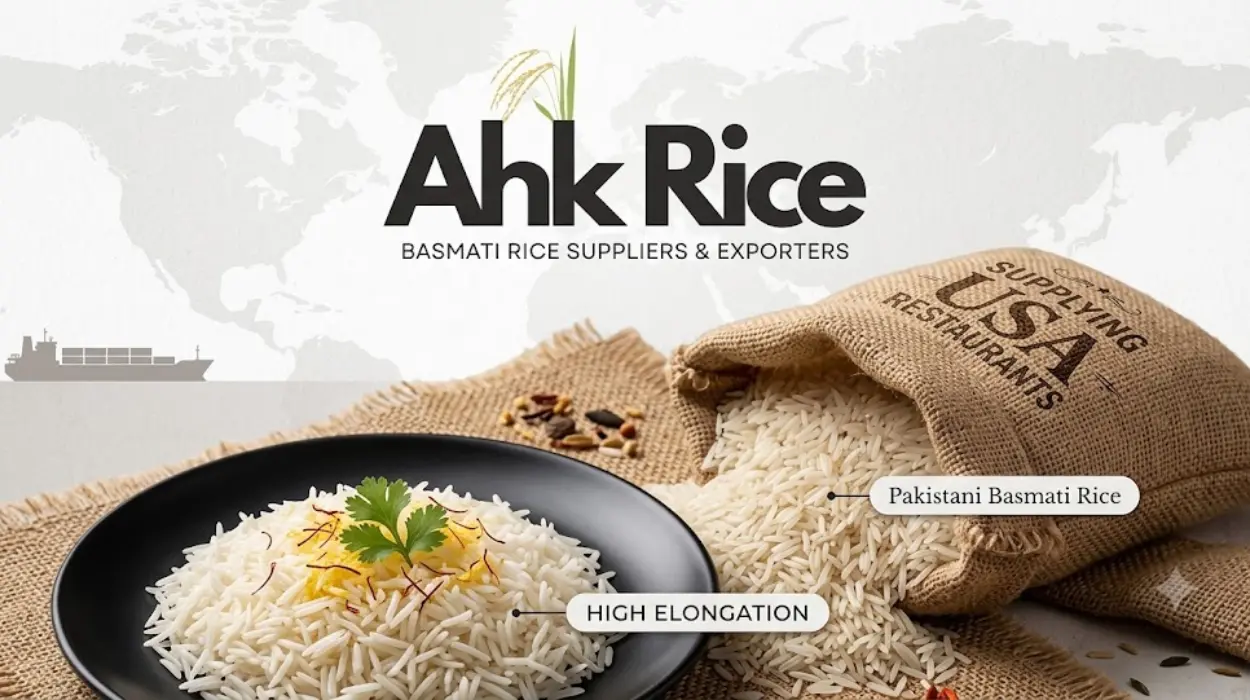
Supply USA Restaurants with High Elongation Pakistani Basmati Rice
Restaurant chains, catering companies, institutional kitchens, and foodservice distributors across the United States increasingly evaluate Basmati rice based on cooking elongation because it directly affects plate presentation, portion consistency, and customer satisfaction. If you have not already explored why elongation has become a purchasing priority, read our guide on:
Why cooking expansion matters for commercial foodservice buyers. Buyers comparing suppliers should also review:
How premium cooking yield is measured before import decisions.
For importers seeking dependable commercial supply, AHK Rice provides export-grade Pakistani Basmati rice through its USA export program. AHK Rice supplies premium 1121, Super Kernel, and 1509 Basmati varieties processed in Punjab under internationally recognized food safety standards. In 2026, AHK Rice continues serving wholesalers, restaurant distributors, private-label brands, and foodservice operators requiring consistent grain length, verified cooking performance, and reliable export logistics.
What is the best solution for supplying USA restaurants with high elongation Pakistani Basmati rice?
The most reliable solution is partnering with an experienced Pakistani exporter that consistently delivers verified elongation performance, standardized processing, laboratory-tested specifications, dependable documentation, transparent shipping schedules, and responsive commercial support from sample approval through final container delivery into the United States during 2026.
Many restaurant buyers discover that grain length before cooking does not guarantee excellent presentation after cooking. Premium commercial kitchens require rice that expands significantly while maintaining a slender appearance instead of becoming thick or sticky.
This makes cooking elongation one of the most important purchasing specifications for foodservice importers.
AHK Rice produces export-grade Basmati using carefully selected paddy sourced from Punjab’s major growing regions. Controlled milling, moisture management, grading, and sorting help preserve grain integrity before export.
Commercial buyers typically evaluate several technical specifications together:
| Specification | Preferred Export Standard |
|---|---|
| Variety purity | High verified purity |
| Average grain length | Export specification dependent |
| Cooking elongation | Strong and consistent |
| Moisture | Export compliant |
| Broken percentage | Customer specification |
| Foreign matter | Controlled and inspected |
| Packaging | Customized commercial options |
Instead of purchasing solely on price, experienced importers compare laboratory reports together with cooking performance.
That approach reduces operational risk for restaurants serving thousands of meals every week.
Why should restaurant importers choose the USA service from AHK Rice?
Choosing an exporter with established USA supply experience reduces uncertainty because documentation, production scheduling, packaging, quality inspections, and logistics are coordinated specifically for American commercial foodservice requirements while maintaining consistent product specifications throughout every shipment during the export process.
Importing rice into the United States involves more than buying a commodity.
Foodservice businesses require dependable communication, complete export documentation, consistent specifications, and predictable delivery schedules.
AHK Rice manages every production stage internally to improve quality consistency.
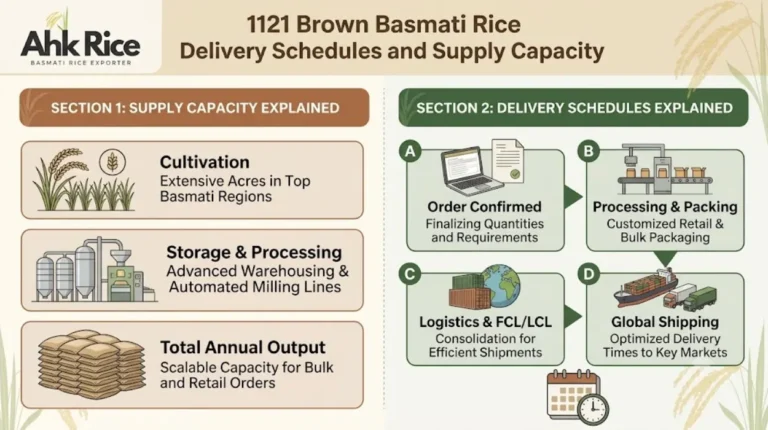
The export process generally includes:
- Contract confirmation
- Production scheduling
- Paddy selection
- Cleaning
- Milling
- Length grading
- Color sorting
- Metal detection
- Laboratory inspection
- Packaging
- Container loading
- Export documentation
- Shipment dispatch
Every stage contributes to maintaining grain quality until the container leaves Pakistan.
Because AHK Rice works with commercial buyers instead of only retail customers, packaging can be prepared according to distributor or private-label requirements.
Available packaging commonly includes:
- 1 kg
- 2 kg
- 5 kg
- 10 kg
- 20 kg
- 25 kg
- 40 kg
- 50 kg woven bags
- Private-label retail packaging
This flexibility allows restaurant suppliers to serve multiple customer segments using one production source.
What shipping times can USA buyers expect in 2026?
Shipping schedules depend on destination port, vessel availability, customs processing, and container booking, but experienced exporters provide realistic production timelines and transit estimates so distributors can maintain inventory without unnecessary stock shortages or excessive warehouse costs throughout the supply chain.
Production generally requires approximately 7–10 working days after advance payment and artwork approval for standard orders.
Container loading is completed after final inspection and document verification.
Average sea transit from Pakistan during 2026 commonly falls within these ranges:
| Destination Market | Typical Transit Time |
|---|---|
| US East Coast | 30–40 days |
| US Gulf Coast | 28–38 days |
| US West Coast | 22–30 days |
Actual arrival depends on shipping line schedules, weather conditions, customs clearance, and port congestion.
AHK Rice communicates estimated shipment schedules before dispatch so commercial buyers can plan restaurant inventory more accurately.
How does the sample approval process work before placing a commercial order?
Professional exporters encourage technical product evaluation before large purchases because laboratory reports, cooking tests, packaging review, and physical grain inspection reduce commercial risk and allow buyers to verify product suitability before committing to container quantities for long-term supply contracts.
Commercial buyers rarely place a container order without evaluating samples.
A standard commercial sampling process normally follows these steps.
Step 1 – Requirement Discussion
The buyer shares:
- Required variety
- Grain specification
- Packaging preference
- Quantity
- Target market
- Expected cooking performance
Step 2 – Sample Preparation
AHK Rice prepares representative samples matching the requested commercial grade.
Typical sample sizes include:
- 500 g
- 1 kg
- 2 kg
Step 3 – Courier Dispatch
Samples are shipped through international courier services.
Typical courier delivery:
- USA: approximately 3–7 business days
Step 4 – Buyer Evaluation
Importers usually assess:
- Aroma
- Grain length
- Cooking elongation
- Texture
- Yield
- Appearance
- Packaging
Step 5 – Commercial Discussion
After approval, pricing, Incoterms, payment conditions, and shipment schedule are finalized.
Typical sample costs in 2026
| Item | Typical Cost |
|---|---|
| Product sample | Often complimentary for qualified buyers |
| Courier charges | Approximately USD 40–90 depending on weight and destination |
| Customized packaging sample | Additional if requested |
Policies vary according to buyer profile and project size.
Many long-term commercial negotiations begin with sample approval before container production.
What results can USA restaurants expect from high elongation Pakistani Basmati rice?
Restaurants selecting premium export-grade Pakistani Basmati rice typically achieve more attractive presentation, improved portion consistency, better customer perception, efficient food cost management, and reliable menu quality because properly processed grains expand significantly while maintaining their characteristic long, slender appearance after cooking.
Cooking performance influences both operational efficiency and customer satisfaction.
High elongation rice offers several commercial advantages.
Restaurants benefit from:
- Improved visual presentation
- Better buffet appearance
- Greater serving consistency
- Premium dining experience
- Reduced customer complaints
- Stronger perceived quality
- Consistent batch performance
For catering operations serving several hundred guests daily, these improvements become measurable business advantages.
Restaurant chains also appreciate standardized cooking behaviour because kitchen staff across multiple locations can achieve similar results.
AHK Rice focuses on maintaining specification consistency from shipment to shipment so repeat customers receive predictable commercial performance.
What factors affect pricing for premium Pakistani Basmati rice?
Export pricing depends on several measurable commercial variables including variety, crop quality, packaging, certification requirements, freight conditions, order quantity, destination, exchange rates, and seasonal market demand rather than a single universal price applicable to every international buyer.
No exporter can responsibly publish one fixed global price.
Instead, quotations are prepared according to customer requirements.
Major pricing factors include:
| Factor | Influence on Price |
|---|---|
| Variety | Premium varieties cost more |
| Order volume | Larger quantities may improve pricing |
| Packaging | Custom printing increases cost |
| Destination | Freight varies by port |
| Certification | Additional documentation may increase cost |
| Crop season | Seasonal availability influences pricing |
| Shipping terms | FOB, CFR, or CIF affect quotations |
Restaurant distributors usually request quotations based on container quantities.
Common order sizes include:
- 20-foot container
- 40-foot container
- Multiple-container contracts
- Annual supply agreements
AHK Rice prepares quotations after reviewing buyer specifications to ensure pricing accurately reflects commercial requirements.
How can buyers verify supplier reliability before importing?
Reliable exporters demonstrate capability through documentation, inspection records, processing transparency, sample approval, responsive communication, and consistent shipment history instead of relying solely on promotional marketing claims or unusually low pricing that may introduce unnecessary commercial risks.
Professional buyers commonly request:
- Company profile
- Export experience
- Product specifications
- Laboratory reports
- Packaging photographs
- Production images
- Sample shipment
- Commercial references where appropriate
- Export documentation overview
These materials help procurement teams compare suppliers objectively.
AHK Rice supports this evaluation process by providing clear product information and transparent communication throughout the purchasing cycle.
How do you get started with AHK Rice?
The fastest path to successful importing begins with sharing your required variety, specifications, quantity, packaging, destination port, and expected delivery schedule so the exporter can prepare suitable samples, accurate pricing, and a realistic production and shipping plan for your business.

Beginning the procurement process is straightforward.
First, identify the Basmati variety that best suits your restaurant or distribution business.
Next, define technical specifications such as grain length, packaging size, and estimated annual demand.
Request representative samples for internal cooking tests and quality evaluation.
After approval, AHK Rice prepares a detailed commercial quotation covering production specifications, packaging, payment terms, and shipment timelines.
Once the order is confirmed, production is scheduled, quality inspections are completed, export documentation is prepared, and containers are loaded for dispatch according to the agreed schedule.
For restaurant groups, distributors, wholesalers, and private-label brands seeking dependable high-elongation Pakistani Basmati rice in 2026, working with AHK Rice provides a structured procurement process designed to reduce sourcing risk while maintaining consistent commercial quality. When you are ready to discuss your requirements, request a tailored quotation through /request-a-quote/.
Frequently Asked Questions
How does high elongation Basmati rice benefit USA restaurants?
High elongation Basmati rice produces longer, separate grains after cooking, improving plate presentation, portion consistency, and customer satisfaction in restaurants and catering operations.
What Pakistani Basmati rice varieties does AHK Rice supply to the USA?
AHK Rice supplies premium 1121 Basmati, Super Kernel Basmati, and 1509 Basmati rice in multiple processing grades and customized packaging for USA foodservice buyers.
How long does it take to ship Pakistani Basmati rice to the USA?
Production usually takes 7–10 working days after order confirmation. Sea freight generally takes 22–30 days to the US West Coast and 30–40 days to the US East Coast, depending on shipping schedules.
Can I request a sample before placing a bulk order?
Yes. AHK Rice provides representative product samples so buyers can evaluate grain quality, aroma, cooking elongation, texture, and overall performance before confirming a commercial shipment.
What factors influence the price of Pakistani Basmati rice?
Pricing depends on the rice variety, order quantity, packaging requirements, destination port, shipping terms, certification needs, and current market conditions.
What packaging options are available for USA importers?
AHK Rice offers 1 kg, 2 kg, 5 kg, 10 kg, 20 kg, 25 kg, 40 kg, and 50 kg packaging, along with custom private-label packaging for wholesalers and restaurant distributors.
Why should USA foodservice buyers choose AHK Rice?
AHK Rice provides consistent export-grade quality, verified cooking performance, customized packaging, export documentation, and dependable shipping support tailored to USA commercial buyers.
How do I start importing Pakistani Basmati rice from AHK Rice?
Contact AHK Rice with your required variety, quantity, packaging, and destination. After sample approval and quotation, production, inspection, documentation, and shipment are arranged for export.